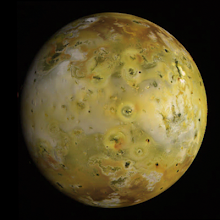
A transit of Io across the disk of Jupiter was visible in the early morning hours of April 8 from east Asia and Australia. Several observers there captured the transit and posted their images online. Christopher Go managed to capture (as usual) some great images of Io and its shadow crossing the disk of Jupiter (you can see Io below and to the left of the Great Red Spot). Additional images acquired yesterday morning by Go show Io on the far side of Jupiter (to the right of Jupiter in his images, remember south is up).
Nice to see Io is still around. Hadn't seen any new images in a week or so.
Link: Jupiter Image 2008/04/08(UT) [alpo-j.asahikawa-med.ac.jp]
Thursday, April 10, 2008


New Horizons Io Observations
 I have gone ahead and started up a page for Io observations acquired last year by the New Horizons spacecraft. This page includes images processed from the raw LORRI and MVIC images in the New Horizons PDS archive. The LORRI camera provides broadband, gray-scale images with different exposure times highlighting different aspects of Io, from its sunlit surface, to Jupiter-shine (the sub-Jovian hemisphere illuminated by Jupiter, rather than the Sun), to Io's volcanic plumes. The MVIC part of the RALPH instruments provides 4-filter color images. The instrument was designed for capturing color images in the Pluto system, so the sunlit areas in red and Near-IR filter images are overexposed, while blue and methane filter images are better exposed in high-phase observations.
Lots of cool stuff are available on this page. All LORRI images are in greyscale, 16-bit PNG files. Each image (that isn't terribly overexposed) has been rotated, sharpened, cropped, and magnified versions. Also look for MVIC color images (some combined with their LORRI counterparts), colorized LORRI images, annotated images, and preview images from Celestia to get an idea of the geometry of the observation.
The page is still under construction. Have about half the images on the page right now.
Link: New Horizons Io Observations [pirlwww.lpl.arizona.edu]
Wednesday, April 9, 2008
More from the OPAG Spring Meeting
A few additional notes on the OPAG Spring Meeting Presentations:
- Van Kane pointed out on UMSF.com that while the downselection between the Jupiter/Europa and Saturn/Titan mission will be later this year and instrument selection for the NASA component will occur in 2009 and 2010, ESA won't choose between the downselected Outer Planets Flagship mission, an X-Ray observatory, and a Gravitational Wave Observatory until 2011. Huh? Basically, when NASA and ESA decide between Titan and Europa in November, NASA will go ahead and get started on its component of the mission. According to Lebreton's presentation, ESA won't decide to commit to that mission until 2011, and it could even decide to do a different mission. Umm, yeah, something tells me that discrepancy won't last. For the Jupiter/Europa mission, this is less important since the two (or three) mission components would be launched separately. However, the two components of the Saturn/Titan mission would be launched together, with ESA's in situ probe piggy-backing on NASA's Titan orbiter. NASA, I doubt, would support such a mission architecture when ESA's involvement could still be pulled. This aspect of NASA and ESA's collaboration of this effort will need to be addressed before the JSDTs get too far in their study.
- Lebreton, in his presentation, states that the Jupiter Planetary Orbiter, ESA's contribution to the Europa/Jupiter System Mission, would launch no earlier than 2018. If combined with JAXA's possible Jupiter Magnetospheric Orbiter, this would push its launch date to no earlier than 2020. The Europa Orbiter would launch no later than 2017.
- In Ron Greeley's Europa/Jupiter mission presentation, the science goals for the Jupiter Magnetospheric Orbiter, appear to be pretty well defined. The presentation uses the name Jupiter Polar Orbiter for this probe.
Tuesday, April 8, 2008
Io Volcano Observer
 Leonard Dudzinski, the Program Executive for NASA's Radioisotope Power Systems Program, presented details on the availability of plutonium-based power sources for space missions, on new types of Radioisotope thermoelectric generator (RTG)'s, and on a program to test one of these new types of RTGs on the next Discovery-class mission.
Currently, the plutonium used to power some of the planned upcoming missions (like the Outer Planets Flagship Mission, the Mars Science Laboratory rover, and the next Discovery mission) is purchased from Russia. New production here in the US may start up in the middle of the next decade, but that won't be enough to supply the missions planned in the NASA roadmap. To improve this outlook, new technology and more efficient RTGs will be needed. Enter the Advanced Stirling Radioisotope Generator (ASRG). This RTG uses 75% less plutonium per unit but provides 115-130% more watts than the next-generation MMRTGs to be used on the upcoming Mars rover and Outer Planet Flagship missions. Plus the ASRG weighs less and costs less per unit.
While the ASRG will be a boon for missions that require power from radioisotopes, it is as yet not flight tested. This is why the next Outer Planets Flagship mission will use the less efficient MMRTGs. NASA has decided to make two ASRGs available for the next Discovery-class mission, to be launched in 2013-2014. All previous Discovery-class missions have used solar panels for power. The cost of the RTGs will not be counted against the Discovery mission cost cap. To study the feasibility of such a plan, NASA has commissioned nine mission concept studies to see if such mission can fit within the Discovery cost cap.
And the big news: one of these mission concept studies is the Io Volcano Observer. This study is being run by Dr. Alfred McEwen of the University of Arizona (my boss). Few details are publicly available at this point on this mission concept, but the idea would be for the mission to perform multiple flybys of Io. I had thought this was a study for a New Frontier-class mission. I didn't even think of this being a Discovery-class mission.
The concept study should be finished in late September. No word on when this will be available.
Link: Radioisotope Power for NASA's Space Science Missions [www.lpi.usra.edu]
Preliminary Report on Jupiter Joint SDT
Ron Greeley from Arizona State University presented a status report on the Jupiter/Europa Joint Science Definition Team (JSDT) at last week's Spring OPAG Meeting. As reported earlier, the Jupiter JDST will be a combination of ESA's LaPlace and NASA's Europa Explorer and Jupiter System Observer mission concepts. The mission would be composed of three separate mission components: Europa Orbiter (provided by NASA), Jupiter Planetary Orbiter (provided by ESA), and Jupiter Magnetospheric Orbiter (provided by Japan's national space agency, JAXA). Greeley's presentation and Jean Paul Lebreton's Cosmic Visions presentation provide details on how this joint mission concept study is progressing.
First, it appears that the Jupiter Planetary Orbiter will not flyby Io as originally thought. This mission component will use solar panels for power and thus will likely stay in the neighborhood of Ganymede and Callisto. Very few details were provided on the Jupiter Planetary Orbiter component though the presentation states that its science goals will be focused on the Jupiter System as a whole.
The Europa Orbiter (EO) has evolved a bit since the Europa Explorer concept study. The mission has taken on more of the Jupiter System science goals from the Jupiter System Observer concept. This includes early orbital tour strategies that include as many as four close Io flybys, though none and one near orbit insertion are also possibilities. Four Io flybys would add 0.3 Mrad to EO's total radiation dosage, but this is offset by EO's shorter primary mission at Europa (60 days versus 6 months for last year's Europa Explorer concept). The flybys would also add 10-20 kg of mass to the Attitude Control Subsystem, though the JSDT notes that this mass trade ''looks favorable'' since less fuel would be needed compared to using Ganymede to slow EO down near JOI.
This cut in primary mission length is intended to reduce the total cost of the mission down to NASA's cost cap of $2.1 billion (from $2.4-2.6 billion). Other cuts include the removal of several instruments from the core payload. These cuts include the narrow-angle camera, which was baselined with the resolution equivalent to the camera on Galileo. The two remaining camera systems, the medium-angle camera and the wide-angle camera, will have resolutions 10 and 100 times coarser, respectively. This cut will reduce the effectiveness of EO to do distant Io science, but this could be made up if the Jupiter Planetary Orbiter retains Jupiter System Observer's superior camera systems. The core payload also omits the Thermal Imager, which will reduce EO's effectiveness to map lower temperature thermal emission on Io. The Near-IR Spectrometer has been retained so that should be fine for higher temperature hotspots.
Another note from the Greeley (and Lebreton) presentations is that these mission components will likely be launched separately, and not necessarily in the same launch window. It is also possible that the Magnetospheric orbiter and Planetary Orbiter will be launched on the same vehicle. However, this would push JPO to 2020 or later, since the Magnetospheric Orbiter will not launch before 2020.
This mission concept is competing with the Titan/Saturn System Mission to be selected as the next flagship mission to the outer planets. Selection of the mission to be launched in the 2016-2017 timeframe will come later in the year.
Link: Preliminary Report of the Joint Jupiter SDT [www.lpi.usra.edu]
OPAG Spring Meeting Presentations
The presentations from NASA's Outer Planets Assessment Group (OPAG)'s Spring Meeting are now online. I am still sorting through them, but their are presentations on the Jupiter Joint Science Definition team's preliminary report, on the state of the Outer Planets Flagship mission program, on ESA's LaPlace and TANDEM mission concepts, on the state of radioisotope power, and on the New Frontiers program.
Will post a more complete summary in a couple of hours.
Link: March 2008 OPAG Meeting [www.lpi.usra.edu]
Monday, April 7, 2008
Zal and Shamshu mosaics from I27
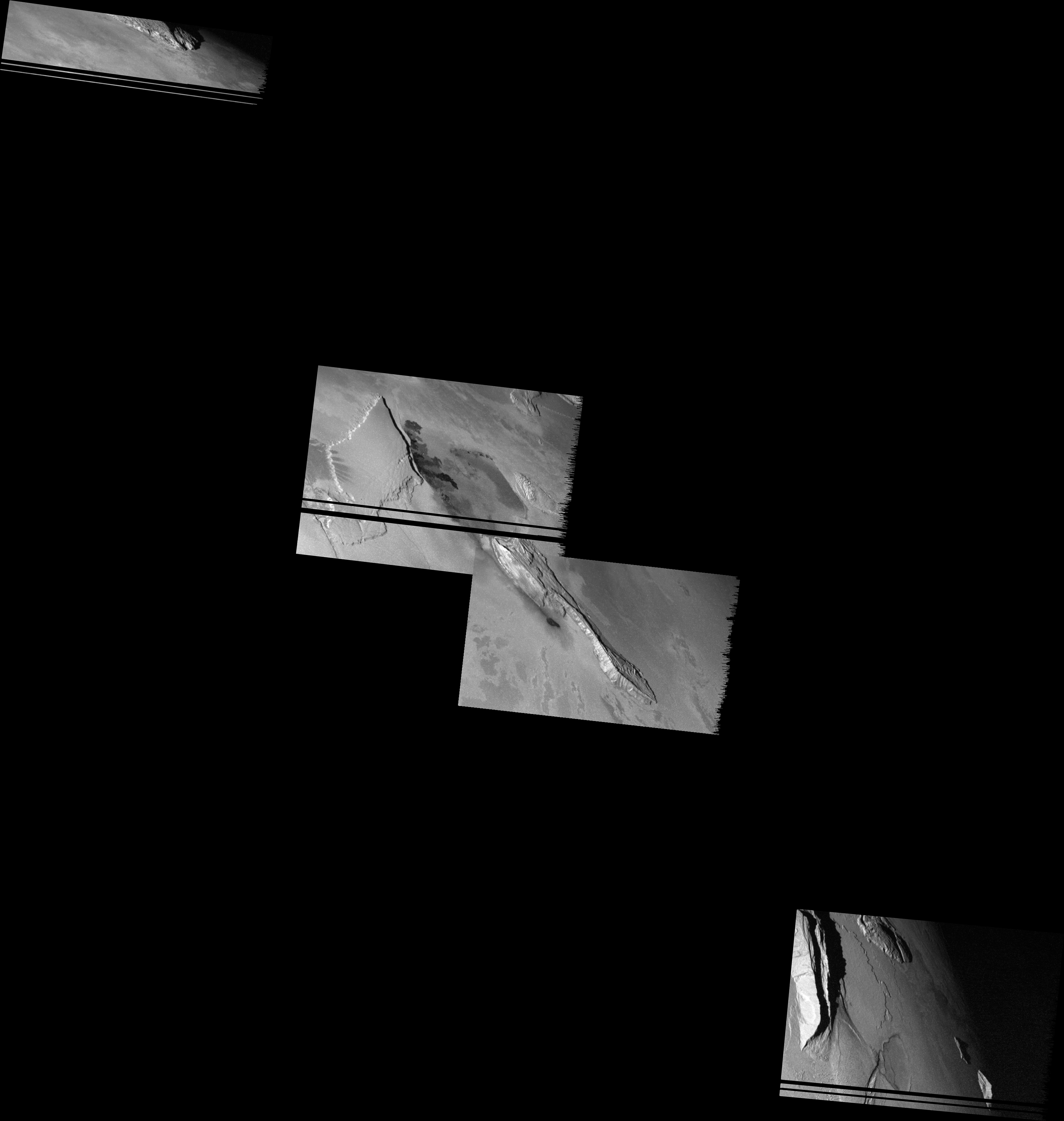
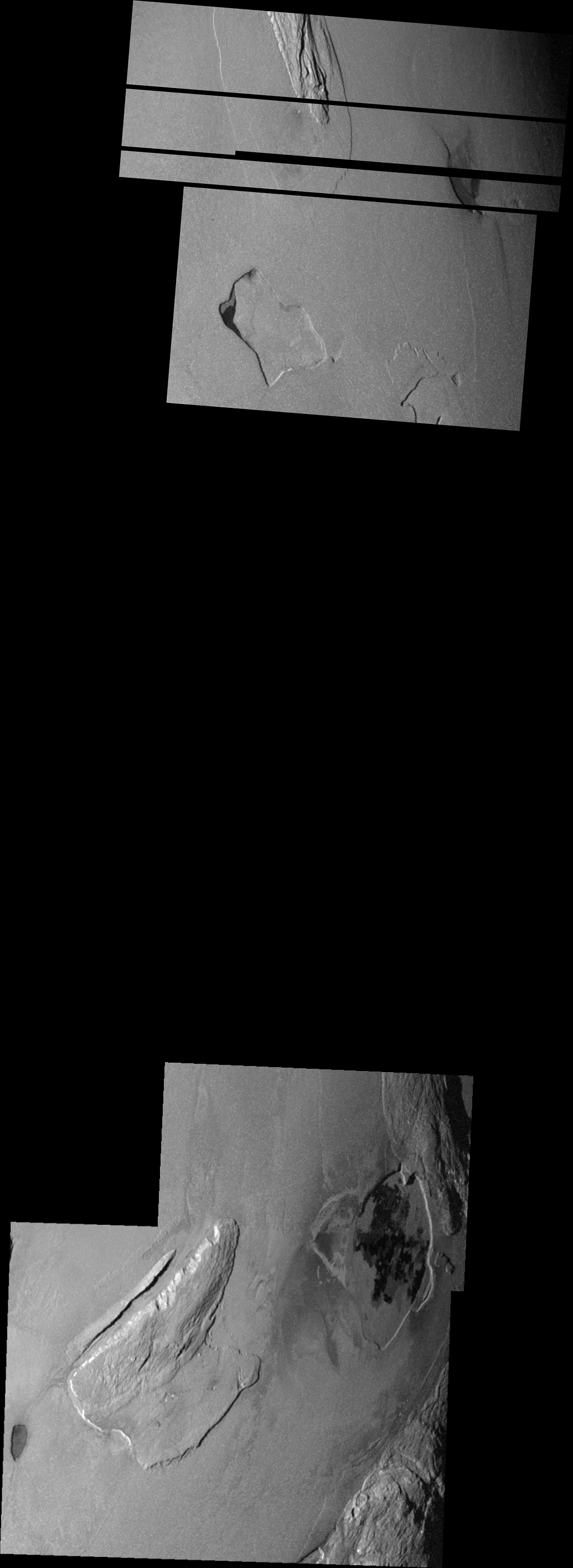
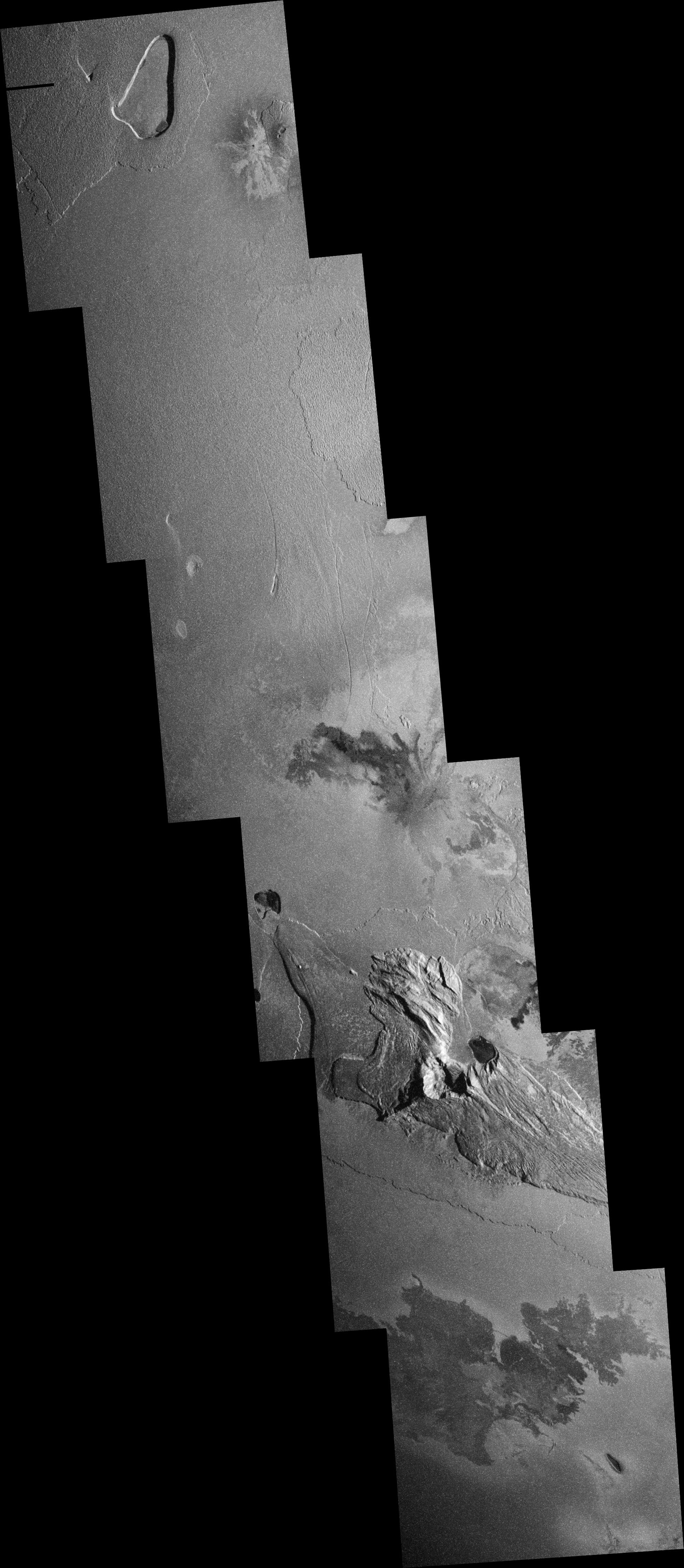
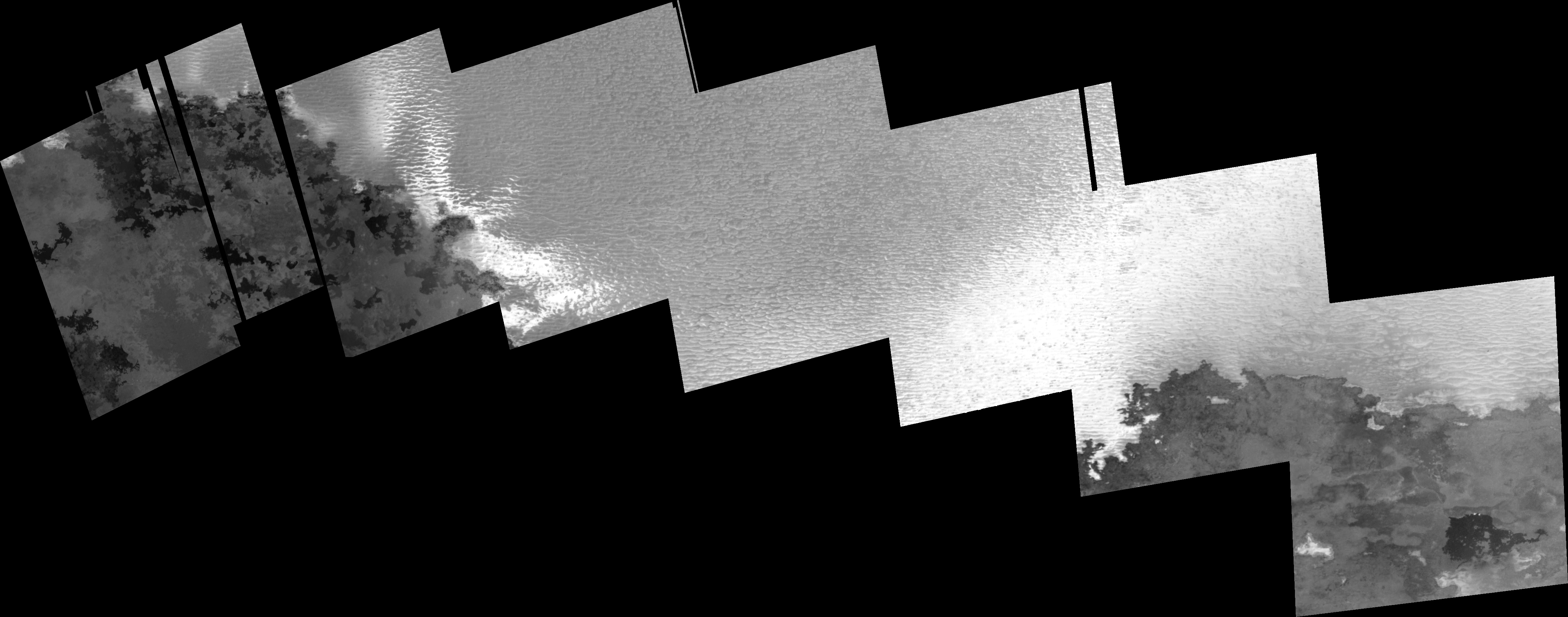
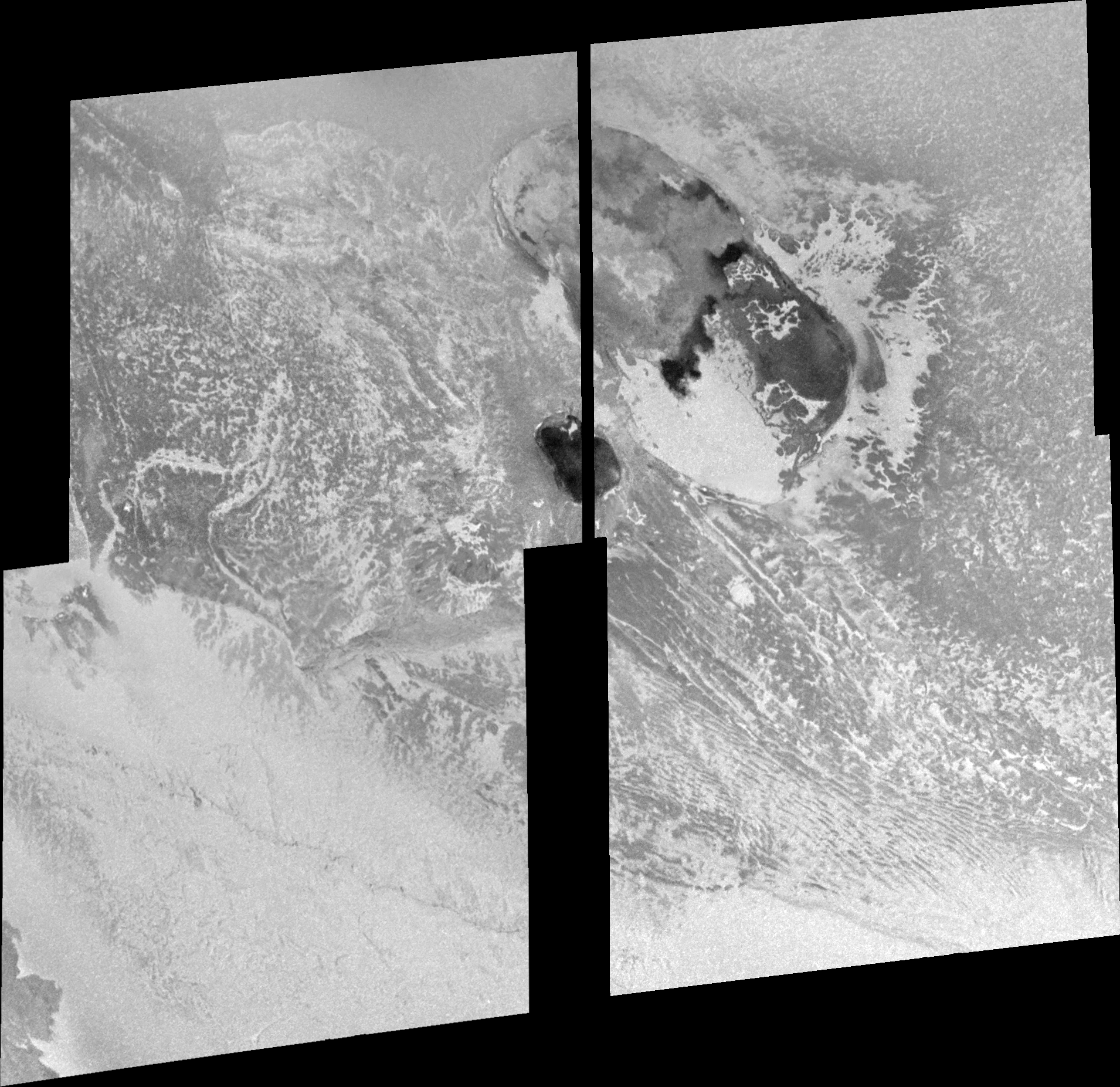
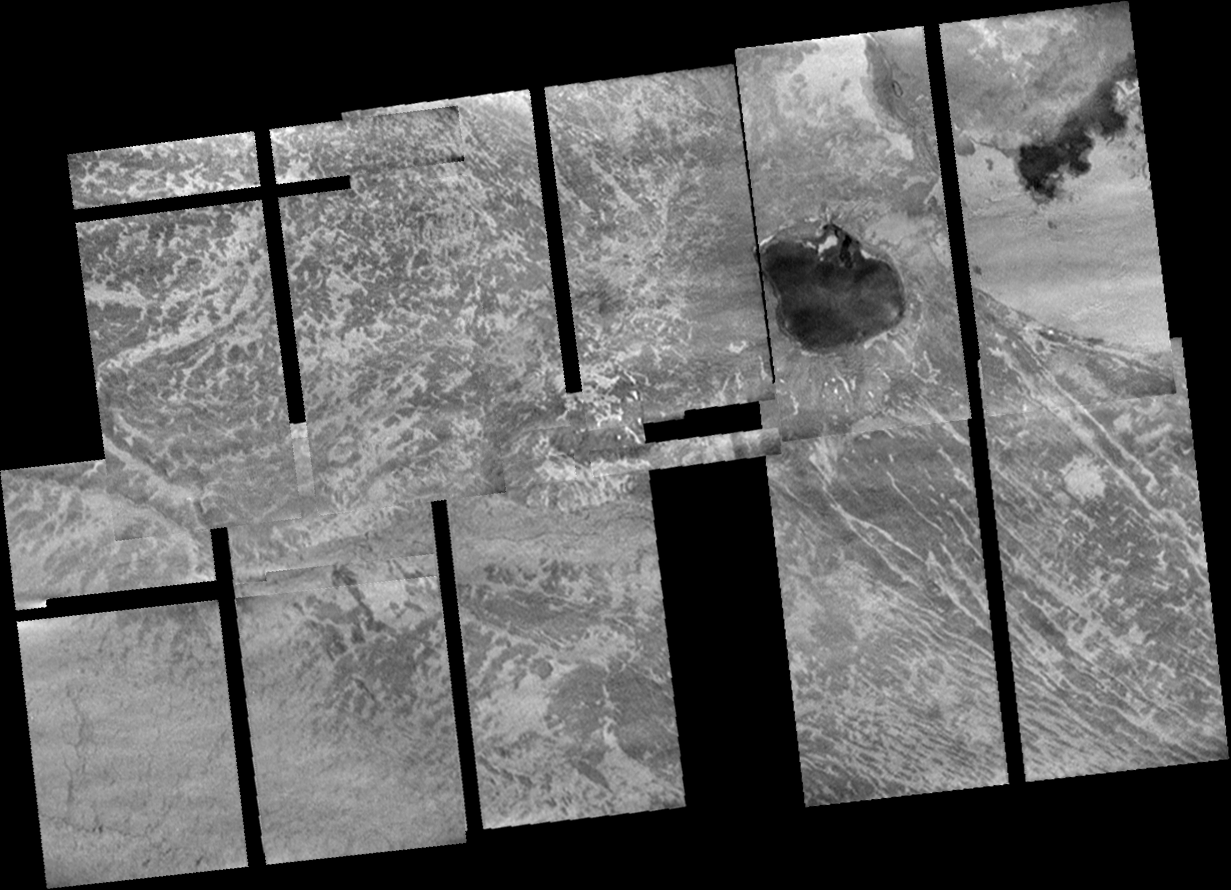
 Processed two more mosaics from I27. Both mosaics are regional-scale (~300-350 meters per pixel) views of the terminator at the time of the flyby. The first, 27ISZALTRM01, covers the Zal Patera-Mongibello Mons region of Io. The second, 27ISSHMSHU01, covers Shamshu Patera and the mountains surrounding it, as well as mountains and patera to the north of that active volcano. The significant gaps between frames results from some images not being downlinked from the spacecraft.
Hope you all enjoy! I will probably move on to work on a New Horizons Io image page before finishing up with the rest of the Galileo images, though I don't think I am missing too many observations except for the Tohil high-resolution mosaic from I32.
Link: Galileo I27 Images [pirlwww.lpl.arizona.edu]
Sunday, April 6, 2008
New Season of Battlestar Galactica
Just got done watching the first episode of the new season of Battlestar Galactica. Not bad, though I get the feeling I've seen this episode before, though I prefer Katie Sarkoff to Jodie Foster. Though I wouldn't describe the Moon as "yellow". Otherwise not a bad episode, a lot better than that New Caprica nonsense that started off Season 3.
Highlights from the last week
A much quieter week but here are the highlights:
- NASA's Outer Planet Assessment Group (OPAG) had their twice-annual meeting this week in Boulder, Colorado. Unfortunately, none of the presentations from that meeting are online yet, particularly the one on the NASA-ESA Jupiter/Europa Joint Science Definition Team. Hopefully, it will be in the upcoming week.
- I posted a few more mosaics from I24 and I27, including mosaics of the Amirani-Skythia-Gish Bar region, the Isum-Donar-Zamama region, and another of the Prometheus flow field.
- I played around some more with Celestia.
- Bush announced plans to send a manned mission to Io. Or was that a joke...
- I have a fever. The only prescription is more cowbell.
Amirani mosaic from I27
 Okay, I got one mosaic done tonight. I wasn't planning on posting this tonight but decided to stay up and watch the season premiere of Battlestar Galactica that I missed last night as well as the last couple of episodes from last season (hey, it has been a year since last season).
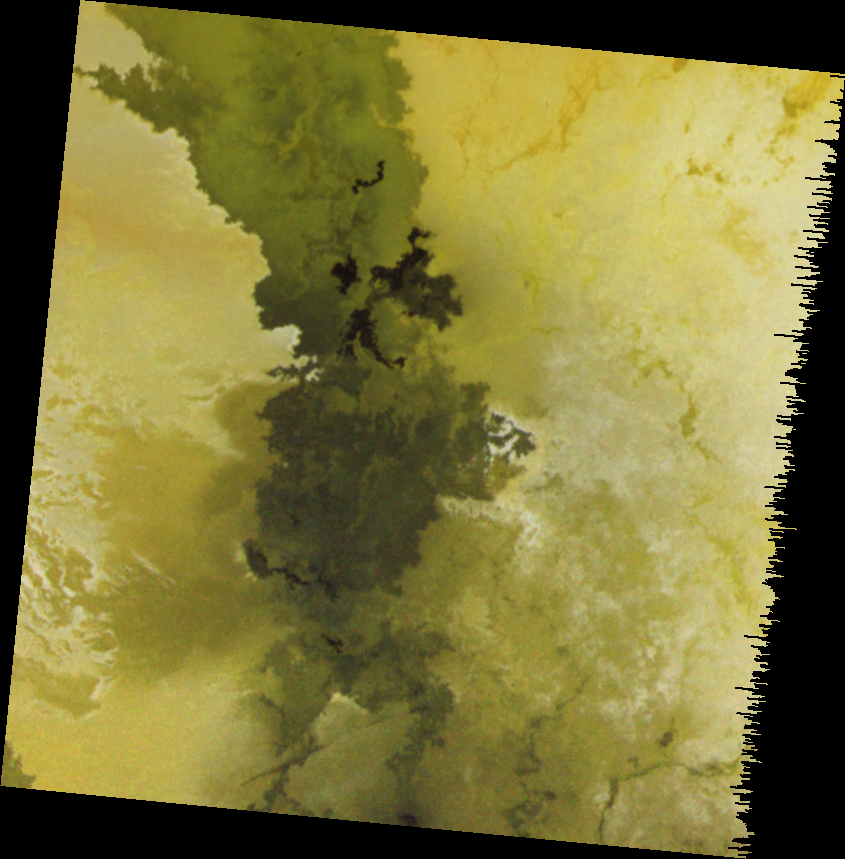
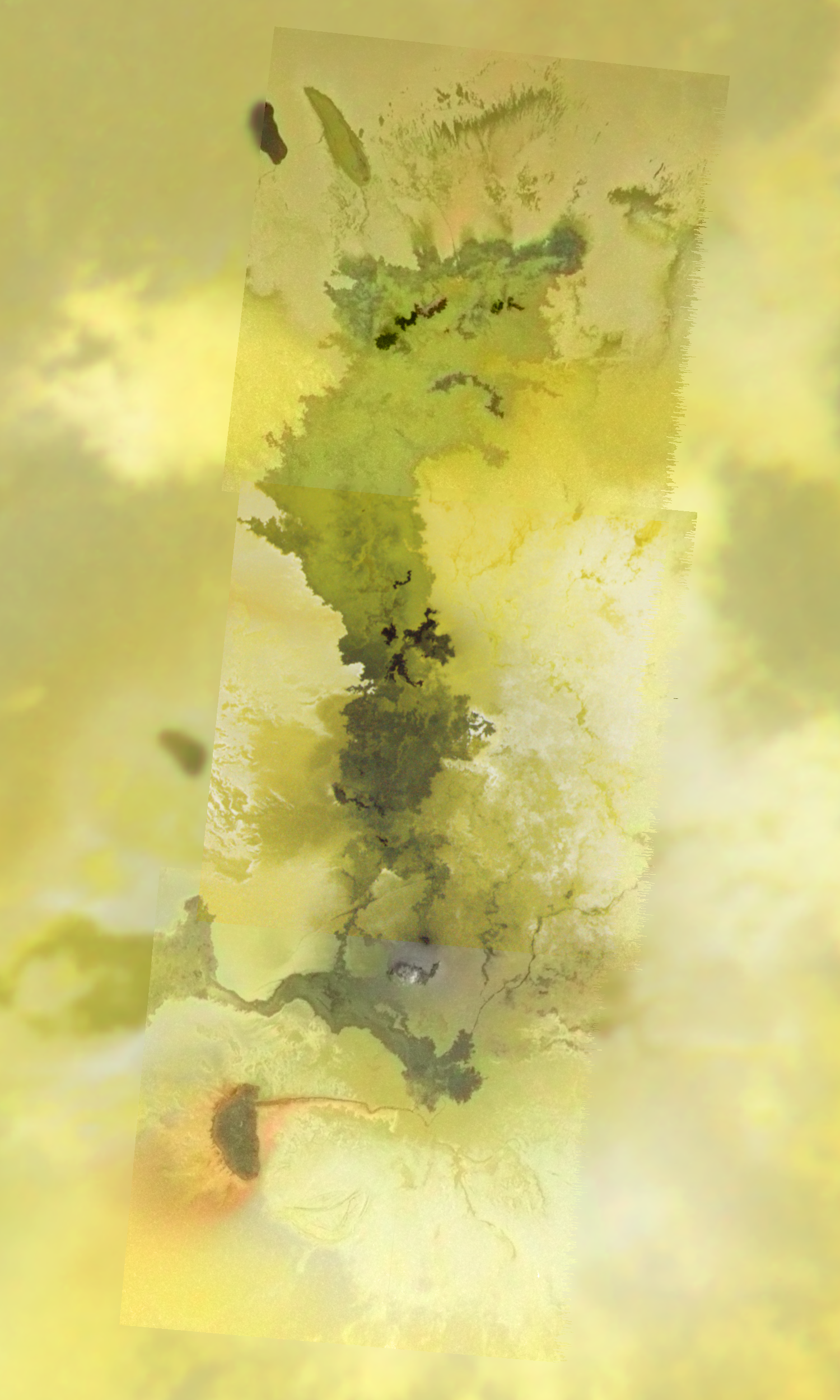
This mosaic is from Galileo's I27 flyby of Io that took place on February 22, 2000. This mosaic shows the Amirani lava flow at 207 meters (680 feet) per pixel. This mosaic was released at the time as PIA02567. I have created three separate versions of this mosaic. The first is a three-frame, green-filter mosaic covering the entire main flow field except the extension out west for the old Voyager-era Maui plume. The second is a single-frame, three-color (violet, green, and IR-756) composite over the center of the flow field. The third is a composite of the green-filter mosaic, the three-color composite, and low-resolution color data from C21 (shown at left).
The Amirani flow field is a composite basaltic flow field. Basically, the flow field is a build-up of smaller flow breakouts. You can see here the main flow field in green with recent (as of February 2000) flows in darker greens and black. The green color is the result of a chemical interaction between condensing sulfur and the cooling lava flows. As the flows cool, more sulfur and sulfur dioxide can condense on them, brightening the flow field as it cools and ages. The lava at Amirani starts out at a patera near lower left and is then funneled east via a narrow lava channel or lava tube. The plume at Amirani erupts from the dark spot near the boundary between the middle and bottom frames in the mosaic.
Link: Galileo I27 Images [pirlwww.lpl.arizona.edu]
Saturday, April 5, 2008
More Cowbell: Or Why I probably won't post any new images tonight
I usually post new reprocessed mosaics on Saturday night, but I may not get a chance tonight since Christopher Walken is hosting Saturday Night Live. This cast may not even be close to the best that SNL has had, but when Walken hosts the show, it is certain to be at least watchable.
I mean, he was in the best SNL skit ever:
Wednesday, April 2, 2008
Fun with Celestia and Tohil Mons
 <- Lookie what I made. This image uses Celestia to simulate the view from Galileo shortly after the I32 flyby in October 2002. The big thing is the use of an elevation map by Paul Schenk of Tohil Mons, near the terminator just below center. Compare this image to the view capture by Galileo, 32ISTERMIN01.
Very nice if I do say so myself. Now I just need topo maps of all the other mountains on Io ;)
Reprocessed Mosaics from I27
 Now that I am done with mosaicking images from I24, it is time to move on to I27. What about I25 and E26, you may ask? Well, for right now, I have all those images processed into nice mosaics. The only thing I can see doing is maybe some noise filtering and updating the color in the Culann mosaic.
For I27, I had previously uploaded mosaics of Amirani, Prometheus, the Chaac-Camaxtli region (as well as a version combined with C21 color), Tvashtar, and a cliff east of Isum Patera.
The two mosaics I worked on this time around include a high resolution view of Prometheus and environs and Tohil Mons. 27ISPROMTH01 is an eight-frame mosaic covering parts of the Prometheus flow field and the ridges just to the north of the field. Bright sulfur dioxide frost is clear visible superimposed on the ridges, blasted out from active flow fronts as the volatile is superheated after being covered in lava. The ridges are a fairly ubiquitous feature on Io's equatorial bright snowfields and are thought to be created as a response by the weak, SO2-rich surface layer to the local tidal stresses (see Bart et al. 2004). Toward the lower right of the mosaic, you can see two spots of incandescent lava. 27ISTOHIL_01 is a high-sun view of the mountain Tohil Mons (check out this I32 mosaic for a low-sun view of the same area). This observation is similar to one acquired in I24. The two mosaics allowed scientists to develop Digital Elevation Models of the mountain. The dark volcano near the center of 27ISTOHIL_01 is called Radagast Patera and the one to the northeast of that is Tohil Patera.
Last Couple of Mosaics from I24
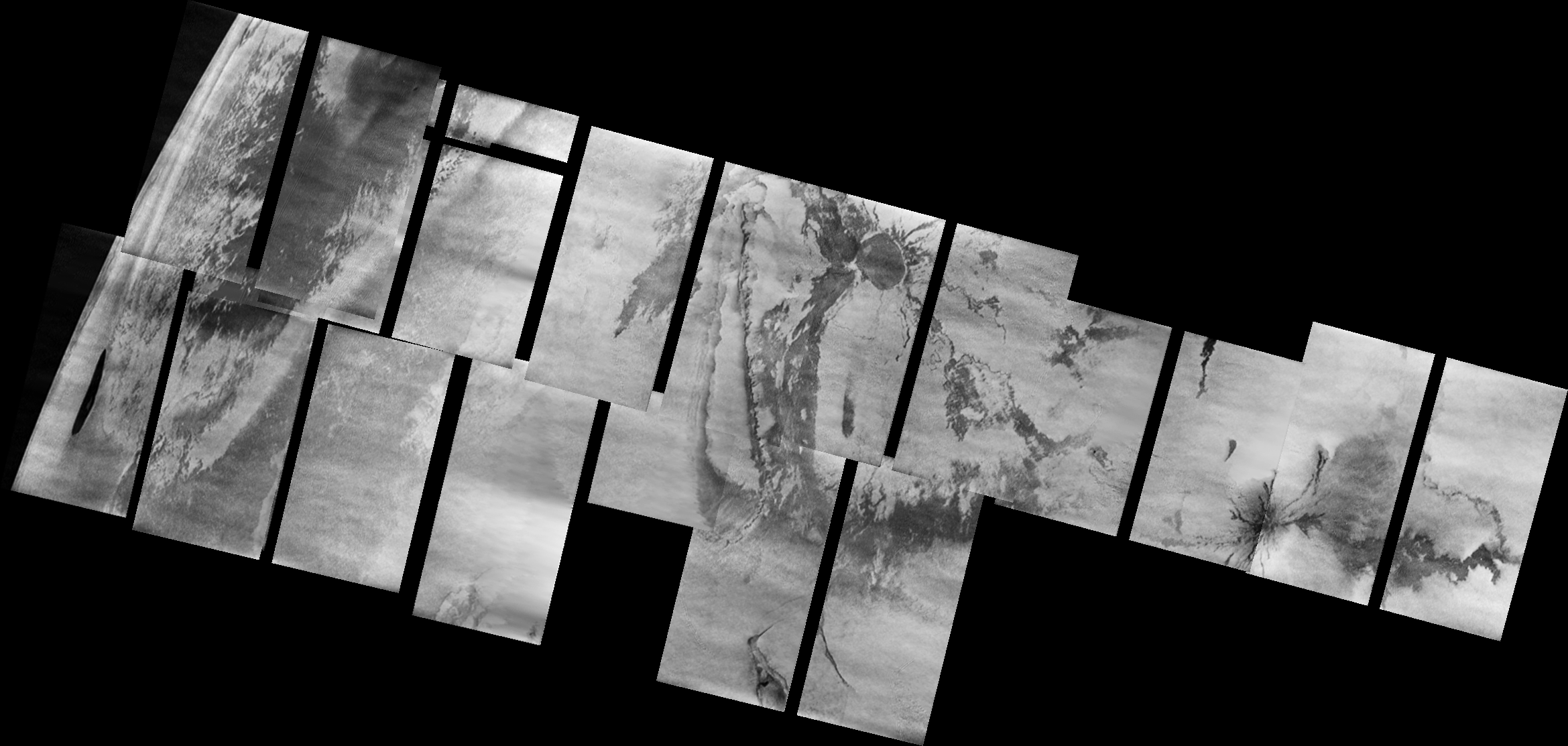
 Finally finished up reprocessing the last couple of observations from I24: a three-color global observation of Io's trailing hemisphere and a 10-frame mosaic covering the Isum-Donar-Zamama region of Io's northern trailing hemisphere.
The 24ISGLOCOL01 observation (left) was taken nearly 14 hours after Galileo's encounter with the satellite and involved numerous color filters. This observation was intended as part of a campaign to examine the changes in the dark pyroclastic deposit surrounding Pillan (just below center), then more than two years after the initial eruption, as well as to look a compositional variations on Io's surface, particularly looking for the presence of an absorption band at 0.9 microns that would reveal the presence of orthopyroxene, a common iron- and silica-rich mineral found in basaltic lavas. Note the teardrop-shaped mountain near the terminator at upper right.
The second observation is 24ISZAMAMA02, a mosaic intended to look at the Isum-Donar-Zamama-Volund region on Io. Unfortunately, many of the frames were scrambled in a manner that could not be recovered. Only 10 images out of 18 acquired are usable for this mosaic. So no Volund (and almost no Isum). But hey, Donar and Zamama shows up really well. Donar is a volcano near the center of the mosaic where lava appears to have over flowed its patera and flowed south then east. Just to the west of Donar is a teardrop-shaped dark outline. Yep, that's the outline around the mountain mentioned in the previous image. You don't see topography here, just albedo features, so obviously dark material has accumulated along the base and slope of the mountain. Zamama is the lava flow at the eastern end of the mosaic. The lava vent is at the western end of the flow (where you see the radiating lava flows), and the Zamama plume emanated from the center of the large lava flow. The earlier ZAMAMA01 observation revealed higher resolution details of this lava flow.
Don't forget to click on the names of the observations here . These will take you to higher resolution versions of these mosaics. Don't forget to check out the rest of the I24 observations here, as well as the other images I have reprocessed here.
Hope you enjoyed the April Fool's Joke from yesterday. Obviously, I was just joking about who Hillary Clinton went with on her trip to Io in 1997. She really went with her daughter Chelsea, country singer Billy Ray Cyrus, and comedian Arsenio Hall (not Vanilla Ice and Bozo the Clown).
Tuesday, April 1, 2008
Bush to Announce Plans for Manned Mission to Io
First off, I just want to say that it does pay to have friends in high places. In my case, it is Jessica Cairns, an assistant for the State Department White House liaison.
Anyways, she gave me the heads up and permission to post here that Bush plans to announce a shift in the destination of the goal of the VSE from Mars to Io! The announcement is expected to come during a speech at NASA Headquarters next week after Bush returns from the NATO summit in Romania and his meeting with Russian President Vladimir Putin. During the speech, Bush will outline plans for a series of unmanned probes to be launched toward Io over the next decade. The lunar missions will be refocused as test missions for the Io missions to come later. Particularly, rad-hard technologies and work in 1/6 gravity will be the focus.
Why the shift from Mars? After decades of unmanned Mars exploration, little evidence for life there has been found. The administration felt that if we had to send people to someplace lifeless, we might as well send people somewhere where "stuff blows up."
Already I see on the CNN website that the two remaining Democratic presidential candidates are attacking the plan. Barack Obama says that the country can ill afford to send manned missions to someplace where Illinois businessman Tony Rezko can't develop real estate. He also wanted to make it clear that he was the first to come out against this plan. Hillary Clinton related a story of her trip to Io in 1997, with her daughter Chelsea, rapper Vanilla Ice, and Bozo the Clown, where she nearly died of radiation sickness.
Anyways, details are pretty hard to come by at this point since the official announcement won't come until next week but I will certainly try to find out as much as I can and get back to you all.
Subscribe to:
Posts (Atom)


 Posts