Showing posts with label Exploration. Show all posts

Friday, February 20, 2015

2015 Io Volcano Observer Proposal


The deadline for NASA's Discovery proposals was this week. 28 proposals were submitted with targets ranging from Phobos and Deimos, to Venus, to asteroids like metallic 16 Psyche, and even Enceladus.  Of course, the one that Ionians will be pulling for is the Io Volcano Observer (IVO), proposed by a team led by the University of Arizona's Alfred McEwen and managed by John Hopkins' Applied Physics Lab, which is making its second go around after also being submitted for the 2010 Discovery Announcement of Opportunity (AO).  The Martian lander, InSight, was ultimately chosen after that AO over a great set of proposed missions, which included a boat that would've sailed around Titan's great Kraken Mare.

IVO, if selected this time around, would launch in late May 2021 with an arrival at Jupiter in February 2026 after a 510 km altitude flyby of Io.  IVO would remain in an elliptical, inclined orbit around Jupiter, flying by Io eight more times during the nominal mission between August 2026 and late December 2027.  An extended mission with nearly year-long orbits is possible, providing high-resolution, imaging coverage of Io's leading hemisphere in daylight as well as collaboration with the JUICE spacecraft.  Unlike the 2010 proposal, this year's would make use of advanced, roll-out solar panels to power the probe and its five instruments, instead of the Advanced Sterling Radioisotope Generators that are unavailable to proposal teams this time around.  These instruments include: two cameras, one narrow-angle and the other wide-angle (NAC and WAC); a Thermal Mapper (TMAP); Dual Fluxgate Magnetometers (DMAG); and a suite of particle instruments (PEPI), which includes an ion and neutral mass spectrometer (INMS) and a Plasma Ion Analyzer (PIA). There is also the potential for an add-on, student collaboration instrument, a wide-angle, near-infrared camera named HOTMAP.  While the WAC, PEPI, and HOTMAP will be bolted to the spacecraft, the NAC and TMAP will be on a ± 90° pivot, allowing for off-nadir pointing of those instruments without turning the entire spacecraft.

The mission's main goals include mapping Io's active volcanism on a more global scale than Galileo and Voyager were able to obtain, measuring Io's induced magnetic field at different points in its orbit around Jupiter to provide a better estimate for the thickness, distribution, and melt percentage of its magma ocean, mapping Io's topography including its numerous mountains, and measuring the composition of the volcanic gases that are released from Io's interior.  During two of its flybys (I0 and I2), IVO will acquire gravity science using 2-Way Doppler tracking, which combined with the gravity data acquired during a few of Galileo's encounters with Io, will constrain our knowledge of mantle rigidity.  The mission will also act as a technology demonstration for Deep Space Optical Communications, which could substantial increase the data return of future missions.

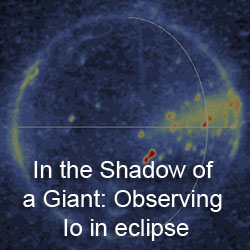
On each orbit, IVO will spend a week acquiring images of Io, allowing it to map Io so changes at its many volcanoes can be observed and to monitor hot spots and auroral emissions during four different eclipses.  IVO would also use this time to help look for Europa's elusive plumes in support of Europa Clipper, which should arrive at Jupiter shortly after IVO.  During the 24 hours around closest approach, while IVO approaches and departs from Io over its polar regions, IVO will acquire several NAC mosaics of Io along with TMAP images to map heat flow and monitor volcanism.  The NAC will also be used to acquire movies of active plumes like Pele and Marduk.  Finally, right at closest approach, the spacecraft will acquire WAC, NAC, TMAP, and maybe HOTMAP imaging swaths along with INMS mass spectra and DMAG/PIA measurements as IVO sweeps north across Io.  At least 20 Gb of data (100x the Io data returned by Galileo) would be acquired during each encounter and will be played back during the apojove part of each orbit (distant monitoring observations will also be acquired to help watch for new major eruptions).

More information about this exciting mission can be found in an abstract submitted to next month's Lunar and Planetary Sciences Conference.  A fact sheet with even more details about Io Volcano Observer is also available.  NASA expects to select three (or so) finalists for Phase A studies in September with a final selection from those sometime next year.

Link: The Io Volcano Observer (IVO) for Discovery 2015 [www.hou.usra.edu]
Link: Io Volcano Observer Public Fact Sheet [pirlwww.lpl.arizona.edu]

Saturday, February 20, 2010

Exploration of Io article at Wikipedia

I just got finished writing up a major new article on Io over at Wikipedia covering the exploration of Io.  This article covers the discovery of Io by Galileo, the observations of Io from Earth leading up to the space age, and the spacecraft that have performed science at Io, covering the Pioneer, Voyager, and Galileo missions quite extensively, and touching a bit on the future of Io exploration.

I don't want to post the entire article here on the blog because of its length, but here is the lead section:
The Exploration of Io, one of Jupiter's four largest moons, began with its discovery in 1610 and continues today with Earth-based observations and visits by spacecraft to the Jupiter system. The Italian astronomer Galileo Galilei was the first to record an observation of Io on January 8, 1610, though Simon Marius may have also observed Io at around the same time. For the next two and a half centuries, Io remained an unresolved, 5th-magnitude point of light in astronomers' telescopes. During the 17th century, Io and the other Galilean satellites served a variety of purposes, such as helping mariners determine their longitude, validating Kepler's Third Law of planetary motion, and determining the time required for light to travel between Jupiter and Earth. Based on ephemerides produced by astronomer Giovanni Cassini and others, Pierre-Simon Laplace created a mathematical theory to explain the resonant orbits of Io, Europa, and Ganymede. This resonance was later found to have a profound effect on the geologies of the three moons. Improved telescope technology in the late 19th and 20th centuries allowed astronomers to resolve (that is, see) large-scale surface features on Io. New technologies also allowed astronomers to estimate Io's diameter, mass, and surface composition, as well as discover the moon's effect on Jupiter's magnetic field.

The advent of unmanned spaceflight in the 1950s and 1960s provided an opportunity to observe Io up-close. The flybys of the two Pioneer probes, Pioneer 10 and 11, in 1973 and 1974 provided the first accurate measurement of Io's mass and size. Measurements from the Pioneers also allowed for the discovery of an intense belt of radiation near Io as well as an Ionian ionosphere. In 1979, the two Voyager spacecraft flew through the Jupiter system. Voyager 1, during its encounter in March 1979, observed active volcanism on Io for the first time and mapped its surface, particularly the side that faces Jupiter, in great detail. The Voyagers also observed the Io plasma torus and Io's sulfur dioxide atmosphere for the first time. In order to study the Jovian study in better detail and over a longer period of time, NASA launched the Galileo spacecraft in 1989, which entered orbit in December 1995 following the first close flyby of Io by an unmanned spacecraft. Galileo orbited Jupiter until crashing into the giant planet in September 2003. In between, Galileo flew by Io six more times between late 1999 and early 2002, providing high-resolution images and spectra of Io surface, confirming the presence of high-temperature silicate volcanism on Io. Distant observations by Galileo during parts of the missions allowed planetary scientists to study surface changes on Io's surface as a result of the moon's active volcanism.

Following Galileo and a distant encounter by the Pluto-bound New Horizons spacecraft in 2007, NASA and the European Space Agency (ESA) generated plans to return to the Jupiter system and Io. In 2009, NASA approved a plan to send an orbiter to Jupiter's moon Europa called the Jupiter Europa Orbiter as part of a joint program with ESA called the Europa/Jupiter System Mission. The ESA component of the project, the Jupiter Ganymede Orbiter, is on their short list of large-scale missions to be launched in the next decade with final approval coming in 2011. While these missions will perform Io science as ancillary to their primary mission targets, the proposed NASA Discovery mission, the Io Volcano Observer, would explore Io as part of its primary mission, though this project still needs to go through a competition process to be approved. In the meantime, Io continues to be observed by Earth-based astronomers, utilizing new technologies such as adaptive optics and improved telescopes such as Keck, the European Southern Observatory, and the Hubble Space Telescope.
Again, the rest of the article can be read over at Wikipedia.  Among the things you might learn include Io's role in the drawing of the Mason-Dixon Line, post-Pioneer models of Io's surface composition, and the sampling of the Thor plume by Galileo.

Link: Exploration of Io [en.wikipedia.org]

Monday, February 1, 2010

Carnival of Space #139 and the FY2011 NASA budget

The 139th edition of the Carnival of Space, a weekly series highlighting the best in the astronomy and space blogosphere, is now online at Mama Joules, a kid-friendly astronomy blog.  You know the drill.  Some great posts on orbital terminology, the premature reports of Spirit's demise, and early reports of the President's NASA budget for FY2011.  Gotta love the white board drawings illustrating the concepts of "gravity" and "flyby".

Speaking of the President's NASA budget for FY2011 (10/2010-10/2011), it was released today and a number of my fellow bloggers have commented about it including Van Kane and Phil Plait.  For information from the horse's mouth, check out this presentation from the NASA website, the NASA FY2011 factsheet from the Office of Management and Budget website, and the more detailed budget breakdown on the OMB site (though its breakdown is less helpful, IMHO).  For me this budget is a mix of good and bad.  Let me be clear there is a lot of good in this budget, though of course that assumes you trust the out-year budget estimates...  I like the precursor mission concept.  This could put some of the Mars, Moon, and near-Earth asteroid exploration from the Science Mission Directorate to the Exploration one, increasing the amount of money available for other targets.  The budget increases for space technology and extends the lifetime and capabilities of the International Space Station, which I support.  While the space station wasn't very popular when it was started, now that it is near complete, the ISS represents an important asset in space and we should use it for as long as we possibly can.  The ISS should be in use until we are basically holding the thing together with duct tape, a la the Mir space station.  The earlier plan to abandon the station in 2016 would have turned the ISS into an even larger waste of money.

Finally, the planetary science budget, which controls how much money all of your favorite missions in progress (Cassini, New Horizons, MER, MRO) and in construction (EJSM) get, increases by $140 million in FY2011 compared to this year's budget.  Looking at the out-year projections, the budget could increase by a $164 million between FY2011 and FY2015, but again, out-year projections are generally just guesstimates of future budgets, and should be taken with a GIANT grain of salt.  However, the NASA presentation does make it clear that they intend to use this money to restart Plutonium-238 production, essential for outer-planet missions, as well as continue operations for existing spacecraft like Cassini and funding for the Europa/Jupiter System Mission (EJSM).

Now, for the bad...  The budget cancels the Constellation program which include new heavy-lift rockets like Ares and crew vehicles like Orion to replace the shuttle.  This program was intended to support future manned missions to the Moon and Mars with a focus on long-term habitability as opposed to the Apollo-like short trips.  This program will be replaced by a combination of funding for commercial ferries to the space station and technology development to get the technologies in place to go to the Moon.  The good news is that this would shorten the time NASA would need to rely on Russia to get to the International Space Station following the Space Shuttle retirement from 5 years to 2-3 years with some cost savings.  However, I am concerned that it will be more difficult to maintain the out-year budget increases for science if federalized manned spaceflight is cut, as NASA could lose some its protection from powerful senators from Texas and Florida.  Then again, Constellation, with its payoff not coming for another five years, has always been a budgetary target, and it really comes as no surprise that Obama would cut it.  After all, George W. Bush proposed it, and since he was evil, Constellation must be a bad idea... Wait, that makes no sense...

In conclusion, I like the budget increases we are seeing for the planetary science budget, particularly the restart of the plutonium-238 production (though that was also proposed last year by the President, but got shot down by Congress).  However, I believe that the cancellation of Constellation and the move from a federal manned spaceflight program to a privatized one will make the projected out-year budget increases more politically vulnerable.

Link: Carnival of Space #137 [mamajoules.blogspot.com]
Link: NASA Fiscal Year 2011 Budget Estimates [www.nasa.gov]

Monday, October 12, 2009

Carnival of Space #124 @ we are all in the gutter

The blog we are all in the gutter has this week's edition of the Carnival of Space, the 124th edition.  The Carnival of Space provides a summary of the week that was in the space and astronomy blogosphere.  So it is definitely worth checking out to get yourself up to speed, particularly if you've been in Puerto Rico in a resort with poor quality internet much of last week ;-)

Elsewhere, Bad Astronomy has a great link to a new National Geographic map that provides a visualization of the first 50 years of interplanetary space exploration

Link: Carnival of Space #124 [weareallinthegutter.wordpress.com]

Saturday, September 19, 2009

Final Version of the Io Decadal Survey White Paper Posted

The final draft of the Io Decadal Survey White Paper has been posted online.  The white paper consists of two sections: the first summarizes the state of Io science, the justification for NASA sending additional missions, and the outstanding questions that should be addressed by future exploration of the satellite; the second discusses an exploration strategy for addressing these remaining questions.  The other submitted white papers can be found on the National Academies website; Van Kane has a good summary on his blog of these other papers.  I previously posted a note about the recommendations for future missions to Io based on an earlier draft of the white paper.

Let's take a look at the two Io white papers.  The first, Justification and Science Objectives, takes a look at the reasons why other planetary scientists should be interested in exploring Io, the outstanding questions left by the exploration of Io by Galileo and New Horizons, and the science objectives that a future Io mission or series of Io missions should attempt to accomplish.  In addition to the fact that Io is just plain awesome and everyone knows it ("Finally, as one of the most spectacular places in the Solar System, Io has unique public
appeal, and Io exploration offers many opportunities to attract and engage public interest in
planetary science."), the authors point out that studying Io provides opportunities to understand processes that are important to examine in general, including: satellite-magnetosphere interactions; the mechanics of tidal heating, an important process for Io as well as Europa, Ganymede, and Enceladus, as well as for extra-solar planetary systems; volcanism, particularly that found on the Moon and Archean Eon Earth; and the dynamics of thin atmospheres, particularly those which are strongly driven by surface temperature and vapor pressure. The authors also identified eight science objectives that an Io exploration campaign would attempt to accomplish (the sub-headings are my own notes):
  1. Determine the magnitude, spatial distribution, temporal variability, and dissipation
    mechanisms of Io’s tidal heating. (We would like to add “and implications for the coupled
    orbital-thermal evolution of Io and Europa.”)
    1. The latter goal can be helped by the examination of Europa to be performed by EJSM.
  2. Determine Io’s interior structure, e.g., whether it has a magma ocean.
  3. Determine whether Io has a magnetic field.
    1. This fits into the previous objective.  As explained later in Part 1, understanding the state of the core, its Fe/S ratio, and its size would help us understand the result obtained by Galileo that suggests that Io does not have a magnetic field.  Resolving the conundrum of why Io can be so active and not have one might help us better understand how planetary magnetosphere are created.
  4. Understand the eruption mechanisms for Io’s lavas and plumes and their implications for
    volcanic processes on Earth, especially early in Earth’s history when its heat flow was
    similar to Io’s, and elsewhere in the solar system.
    1. Two good places to provide comparative studies would be the Moon and Mercury.  While these two worlds are dead as a doornail now (deader actually), earlier in their histories, they experienced volcanic eruptions similar to those we see on Io now, particularly flood basalt eruptions and pyroclastic flows.
  5. Investigate the processes that form Io’s mountains and the implications for tectonics under
    high-heat-flow conditions that may have existed early in the history of other planets.
    1. In addition to the high-resolution observations to be obtained by Io-centric missions discussed in Part 2 of the white paper, additional information could be gained for this goal from the Ice-Penetrating Radar (IPR) on board the Jupiter Europa Orbiter during its two of its close flybys.
  6. Understand Io’s surface chemistry, including volatiles and silicates, and derive magma
    compositions (and ranges thereof), crustal and mantle compositions and implications for the
    extent of differentiation, and contributions to the atmosphere, magnetosphere, and torus.
  7. Understand the composition, structure, and thermal structure of Io’s atmosphere and
    ionosphere, the dominant mechanisms of mass loss, and the connection to Io’s volcanism.
  8. Investigate the neutral and plasma densities and energy flows in the Io plasma torus, plus their
    variations over time, and characterize the ionic radiation belts in the vicinity of Io and their
    influence on the surface.
The second part of the Io white paper, Recommendation for Missions, was more extensively discussed in my last post on this subject.  To answer Ted's comment for that post, where he suggested that IVO, a proposed Discovery-class Io mission, would be the most likely to fly, keep in mind that what is discussed in Part 2 is an exploration program, akin to what is currently going on for Mars.  For Io, this program would start with either a New Frontiers- or Discovery-class mission that would orbit Jupiter and flyby Io on several occasions.  Such a mission could be flown in the 2013-2023 decade covered by this survey.  Following this "Io Observer" mission, the next decade, 2023-2033, could see a follow-on mission that would orbit Io, providing detailed global maps using UV, visible, and near-infrared imagers and a laser altimeter, as well as measuring Io's gravity and possible magnetic fields, and deploy one or more in situ components, such as penetrators, landers, or rovers.  One important task for these in situ missions would be to measure seismic activity using seismometers.  Enough activity should be detected over a period as short as a day to provide a more detailed model of Io's interior structure.  Finally, the authors support telescopic observations of Io from Earth or from space-based platforms, including a UV telescope that would replace the capabilities that will be lost once Hubble is de-orbited and additional ground-based telescopes with adaptive optics capabilities, which would help ease scheduling pressures at telescopes such as Keck II.  These observations would allow for monitoring time-variable phenomenon at Io such as satellite-magnetosphere interactions, Io's atmosphere, and its volcanic activity.

Additional white papers can be found at the National Academies website as well as summaries at Van Kane's blog.  These white papers will be used as input into the upcoming Decadal Survey report, which will outline the direction planetary science should go within NASA over the next decade.  How much will be possible is up in the air as the planetary budget is projected to remain pretty flat over the next decade.  For Io, since the recommendations call for a fairly modest program over the next decade (one mission in either the New Frontiers or Discovery programs) with the major mission to be started in the decade following, it isn't impossible that such a program could fly.  What remains to be seen is how much NASA and the community will take to heart the first suggestion made by the authors of the Io white paper:
We recommend that NASA pursue a balanced solar system exploration program between life-focused and physical-science focused missions.
Link: Future Io Exploration for 2013-2022 and Beyond, Part 1: Justification and Science Objectives and Future Io Exploration for 2013-2022 and Beyond, Part 2: Recommendations for Missions [www8.nationalacademies.org]

Friday, August 28, 2009

Io Decadal Survey White Paper

The Planetary Science Decadal Survey is now well underway as the community discusses how NASA should spend its money in the discipline over the decade from 2013 to 2023. For the outer planets, the previous decadal survey made a Pluto flyby mission and a Jupiter atmospheric orbiter two of its main priorities. These mandates later morphed into the New Horizons and Juno missions. At this point in the process this go around, various groups in the community are producing white papers, documents that provide details as to what should be the priorities over the next decade for their subject, be it technology, planetary astronomy, Titan, Europa, or Io, for example. NASA's Outer Planets Assessment Group (OPAG) website has several drafts for some of these white papers, including the latest draft of the Io white paper. Additional submitted white papers can be found on the decadal survey website (check out some of the ones at the bottom of that page for a laugh).

The Io white paper being authored by Dave Williams from ASU with many others, including myself, in the Io community providing input. The paper is split up into two parts: Part 1 discusses why exploring Io should be important to the rest of the community and what kinds of science goals are needed for a future mission to the satellite; Part 2 explores the types of missions that should be sent to Io in the next decade and beyond.

While the first part of the white paper roughly follows the document from the previous decadal survey, explaining why exploration of Io is important, the second parts provides updates for recommendations to the NASA Space Science Division for future Io exploration:
  1. A balanced program between life-focused and general exploration missions
  2. A more modest (compared to EJSM) 'Io Observer' Discover- or New Frontiers-class mission
  3. The support of the IVO mission, currently being studied for the next Discovery AO
  4. New Frontiers-class mission concepts for the next New Frontiers AO that allows radioisotope power sources
  5. An Io orbiter in the 2023-2033 timeframe to follow-up on the discoveries of a Jupiter-orbiting 'Io Observer'
  6. Io in-situ missions in the same timeframe, including penetrators, landers, and rovers that would help constrain the size and physical state of Io's core and better understand Io's surface and lower atmospheric chemistry
  7. A space-based ultraviolet telescope to replace Hubble with diffraction-limited capability in the next decade
  8. Long-lived Jupiter missions that would provide opportunities to observe Io over long-time frames (Juno and EJSM may provide these types of observations over the next two decades)
  9. Expanding the time available for planetary astronomy on 10-meter class telescopes with Adaptive Optics capability. Such time availability would allow for long-term studies of Io's volcanic activity even without a spacecraft in the Jupiter system
  10. Including support for ground-based observation programs with Jupiter system missions to follow-up on discoveries of volcanic eruptions
These recommendations highlight the need to study Io's time-variable phenomena and to close the gaps in temporal coverage of Io's volcanic activity, whether it be using Jupiter-system missions (dedicated to Io or not) or Earth-based telescopes.

Link: Planetary Science Decadal Survey White Papers [www8.nationalacademies.org]

Monday, July 20, 2009

Apollo's Legacy 40 Years Later

40 years ago today, two astronauts from a small, liquid water-rich planet called Earth made their first steps into the new frontier, landing on that planet's only natural satellite. These first steps were seen by people around the world, and people from around the world looked on with pride, regardless of nationality, creed, or race.

Today, humanity still explores space, but it has been 37 years since we last traveled beyond low-Earth orbit and gone to another world. We have ceded the role of explorer to our robots. This is not to say that this entirely bad. People from around the world still marvel in awe at the images returned from the Mars rovers, still going strong well past their warranty with the only thing keeping them back is the occasional tall dune or patch of soft soil, the Cassini spacecraft, orbiting Saturn and returning incredible photos and data about that world and its many moons, or the Lunar Reconnaissance Orbiter, which returned incredible photos of the hardware the Apollo astronauts left behind on the Moon just last week. While it has been a great privilege to get a chance to work on the data that these robot explorers send back, I still feel that humanity has retreated in its quest for space.

There has always been a conflict, budget-wise, between manned and unmanned exploration of space, competing for money in the narrow budgets of the various national or European space agencies and flame wars on web forums dedicated to space exploration. The topic is often so toxic that it is even banned from one of the forums I moderate, Unmannedspaceflight.com. I feel that one can't necessarily live without the other. Without a healthy manned spaceflight program, the pressure to fund a healthy unnamed one will be lower for the powers that be. We are already seeing budgets that are getting tighter for the space science division at NASA, creating potential funding problem for projects like the Europa/Jupiter System Mission. Manned spaceflight gives unmanned missions an additional purpose, to scout and map places in the solar system that we may send people to in the next few generations, or to explore places that humans will probably never visit in person (like Venus). They can provide additional infrastructure for manned mission, such as acting as communication relays. In the end, I feel that without a healthy manned spaceflight program, we can kiss the current unmanned program goodbye, ceding such a program to the Europeans or the Chinese. While we may still fund an unmanned program, it would look much more like the European one. Such a program would only allow for limited funding for outer solar system missions.

We should go back to the Moon. We should go to Mars with people. Given how much and how often Mars Sample Return has been delayed, we might as well go with a manned mission at this rate. Most critically, we must NOT treat landing on these worlds as the goal. That was the #1 mistake of the Apollo program. By treating the landing as the goal, everything else, like science, additional landings, (semi-)permanent settlement, seemed pointless and a waste of money. Why continue to send people if the goal was just to land there, take pictures, and go home. The Moon is not Disneyland. It isn't Mount Rushmore. The Moon and the Solar System in general is more like the Old West. Neil Armstrong and Buzz Aldrin were more akin to 20th Century versions of Lewis and Clark. They didn't cross a finish line; they opened up a frontier. But because landing was seen as THE goal, the way to beat the Russians, we lost that frontier. If we want it back, we need to start trotting out phrases like "Manifest Destiny" and stop think that we are going to spend a bunch of money to send people to the solar system equivalent of taking pictures with Mickey. It worked in the mid-19th Century for the United States, maybe it will work again for the world.

Kim Stanley Robinson, author of "Red Mars," "Blue Mars," and "Green Mars," has a great editorial in yesterday's Washington Post about how one good reason for permanent settlement on Mars and beyond is to reduce the environmental strain of the human population on the resources of Earth, and he has a good point. He also states that space exploration could be helpful driver for discovering solutions to climate change. Personally, I am pretty sure that Earth's environmental state will be the driving force behind colonization, though not as Robinson envisions, colonizing only "if Earth is healthy." As environmental regulations for extracting energy and other resources on Earth become more draconian, doing so on lifeless worlds like our Moon, Mars, the various rocks of the asteroid belt, and Io would become more profitable and/or necessary.

Finishing this post, I thought I would ask a question for all of you readers out there, given that it has been 40 years since humans first landed on our moon, when do you think humans will first land on Io? See I have to bring this post back on topic ;-) I am definitely interested in hear all of your responses. Just post a comment to this post!

Thursday, March 19, 2009

Mission Madness

Okay, I've been telling myself that I wouldn't post about this, then I found the trash talking thread, and finally I got my blood up. The NASA EDGE podcast team have been hosting a spaceflight version of March Madness called Mission Madness. Similar to the college basketball March Madness, you can fill out a bracket consisting initially of 64 human and robotic missions with 32 match-ups. You can select which mission you think is better in those 32, first-round matchups. Every few days, the next round begins with match-ups being filled by the winners of previous round, until you reach the final four missions in early April. The voting has begun for the first round of matchups, so don't forget to vote.

There has been quite a bit of ranting about missions that were excluded from the bracket in the thread I linked to above. The only two missions I would have liked to see included but weren't would be Galileo and STS-61 (the first Hubble servicing mission). There is also a relative lack of Earth science missions. This could have been resolved, IMHO, by replacing the unflown missions like Ares-1, ORION, and JWST with some of these "missing missions".

Not to influence you too much, but my final four is Apollo 11, Vikings I & II, MER, and Voyager 1 & 2, with Apollo 11 beating Voyager 1 & 2 in the championship.

So far in the first round of voting, the votes are following the bracket I filled out with a few exceptions I want to make known (so you can vote for my picks, thus making me look like a genius). First off, SPB (a balloon mission) is currently leading over the Mars Rovers? WTF?!? I call shenanigans! A few closer matchups that aren't going my way at the moment: LCROSS is leading over MRO, NB-52 is leading over L.P. 1, Bell X-1 is leading over THEMIS, and SR-71 is leading over Friendship 7.

For the record, my college basketball final four is Kansas, Memphis, Pittsburgh, and Gonzaga, with Memphis beating Pittsburgh in the championship game. Of course, as I write this, my winner, Memphis, is currently losing in their first round game to Cal State-Northridge... I used to be good at picking these. I was in the top 20 in the Facebook bracket tournament going into last year's championship game, but I ended up picking the loser of that game. And to people in North Carolina, I'm sorry I picked Gonzaga over you guys. I actually met and talked with Roy Williams, UNC's coach, back when he was the head coach at KU. He was a frequent visitor to my high school when he was recruiting one of the players on my school's team.

Friday, February 20, 2009

Outstanding Science Questions at Io

Eric posted a few comments yesterday which provided a great suggestion for a blog post. What are the outstanding science questions that remain following Galileo and New Horizons? Can these questions be answered by the Jupiter Europa Orbiter (and Io Volcano Observer)? While better understanding Io's potential habitability by native lifeforms is certainly not one of them, there are at least five I can list here.

Before I do that, I want to point out Van Kane's post on his blog giving some of his closing thoughts on the Flagship mission selection. He pointed to my last post on how the selection of Europa as the target for that mission might effect the Io Volcano Observer and noted that the instruments could be more finally tuned to better answer questions at Io. That idea has crossed my mind. If the cost of IVO can't be brought in line with the Discovery mission cost cap, one potential alternative is to submit beefed up versions of some of IVO's instruments, particularly RCam and the Thermal Mapper, for the JEO Instrument Announcement of Opportunity. RCam's radiation-hard color push-broom camera could be just as effective at observing small-scale features on Europa as it could for determine eruption temperatures on Io. Additional bandpasses on Thermal Mapper compared to the Thermal Imager in JEO's model payload could also be useful for Jupiter on JEO. However, you do still lose the spatial coverage that would be provided by IVO, which would help it be more robust against variability in Io's volcanic activity. For example, what if Amirani was inactive in the mid-2020s?

So with that out of the way, here are five of the top (in my mind) outstanding science questions at Io:
  1. What is the composition of Io's lava's?
  2. What is the typical eruption temperature for Io's volcanoes? These first two questions are quite related. Following Galileo, there was consensus that Io's primary lavas were composed of basalt, a silicate lava rich in iron and magnesium and common on the terrestrial bodies in the solar system. However, the exact composition was very poorly constrained by the available data (dark at visible wavelengths, an absorption at 1 micron consistent with iron, and estimated lava temperatures in mafic to ultramafic range). The eruption temperature could be related to the amount of partial melting in Io's mantle. And of course temperature is related to the composition of Io's lavas. Generally the higher the magnesium level, the more mafic it is, the greater the liquidus temperature (and thus the eruption temperature). Understanding the effect of superheating during the ascent of the magma is also important. These questions can be answered through the measurement of Io's thermal emission in the 0.7-1 micron range (like from a near-infrared spectrometer or RCam on IVO) and by looking for absorption and emission features in the near-infrared that are consistent with materials in Io's lava, such as the Christiansen Feature.
  3. Is tidal heating on Io steady-state or time-variable? One of the potential implications of measurements of Io's heat flow is that Io may be pumping out more heat from its interior than it currently receives from tidal heating as a result of its orbital resonances with Europa and Ganymede. This would indicate that Io is cooling down from a period of much greater tidal heating in its past. A potential way to test this is by high-resolution tracking of the position of Io and Europa over time. One of the mission goals for JEO is to provide this kind of tracking to better constrain the orbital evolutions of Io and Europa. IVO's polar orbits would allow for better thermal emission mapping of Io's polar regions, which are thought to be much warmer than they should be given the lower solar angles.
  4. How are Io's two major structural landforms, paterae and mountains, formed? Various models following Voyager and again after Galileo have been produced to explain how paterae and mountains form on Io. Sub-surface radar sounding and high-resolution, low sun imaging could go a long way toward looking at the tectonic mechanisms behind how these intriguing features are formed. JEO would provide the sub-surface sounding, while IVO (and JEO to an extent, but longitude coverage would be limited) could provide imaging of a variety of mountains and paterae.
  5. Does Io have an internal magnetic field? This question may have been answered as a no by Galileo, but closer encounters at different latitudes with a magnetometer-equipped spacecraft would help put this issue to bed. Understanding Io's magnetic environment would help with our understanding of Io's deep interior.
Obviously, there are certainly more than just these five. These five also reveal my geology bias as there are certainly a lot of remaining questions regarding Io's interaction with Jupiter's magnetosphere and about Io's atmosphere.

Sunday, May 25, 2008

Good Luck to Phoenix

Just wanted to wish the Phoenix mission good luck and I hope their landing on the Martian northern plains goes off without a hitch.

Update: Phoenix landed! WOOT!

Friday, April 11, 2008

New Drug Prevents Radiation Damage

nprev over at UMSF.com has pointed out a new story on the website MedHeadlines.com on the discovery of an anti-radiation drug. The drug, code-named CBLB502, prevents damage (apoptosis or cellular suicide as the article calls it) from lethal doses of radiation to bone marrow and gastrointestinal cells. This is accomplished by mimicking cancer cells by activating a chemical pathway called NFKB. Rhesus monkeys and mice given this drug an hour before radiation exposure showed no ill-effects.

Such a drug will have numerous applications. The drug will certainly be given to cancer patients receiving radiation treatment. It also has civil defense applications. Exploration of the solar system would also be helped by this drug since the ill-effects from radiation exposure in space would be reduced, perhaps making the exploration of Io more tenable.

Link: New Drug Prevents Radiation Damage [medheadlines.com]