Showing posts with label I24. Show all posts

Thursday, December 31, 2009

Reprocessed images from Ted Stryk and jekbradbury

With only a few hours left in 2009 (here in Tucson anyway, I know its already 2010 for you folks in the Eastern Hemisphere), I thought I would do a quick round-up from news and interesting links from the last few weeks that I haven't had a chance to get to.  Enjoy!

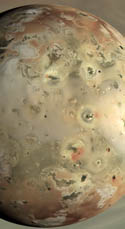
On the reprocessed images front, Ted Stryk has taken a look at some global views of Io taken by Galileo, including some optical navigation frames from March 31, 1997 during a mutual event between Io and two of Jupiter's small inner moons, Metis and Adrastea, and GLOCOL01 from October 16, 2001.  Ted combined three frames from 1997 to show not only the windows (used to further compress the data sent back from Galileo) around Adrastea and Io (well the limb of Io anyway), but a plume on Io's limb.  The location of the plume, as Ted points out, suggests that it was associated with Pele, but the size of the plume and its brightness at this phase angle makes me think otherwise...  maybe the plume is Pillan instead, but this data was taken at least a month before the eruption began.  I'll have to check into that.  The other image Ted processed was the GLOCOL01 global color observation from orbit I32, taken shortly after a flyby of Io.  I previously presented my version of this image.  Ted was able to pull out the plume from the Thor eruption that summer and fall.  I am amazed he was able to pull that out of the violet filter data.  My own stretching of that same data, shown at left (the plume is on the bright limb on the lower left hand portion of the image), BARELY shows that plume at all, suggesting that Ted had to noise filter that image to an extreme degree... great job, Ted!

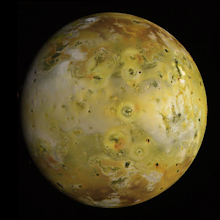
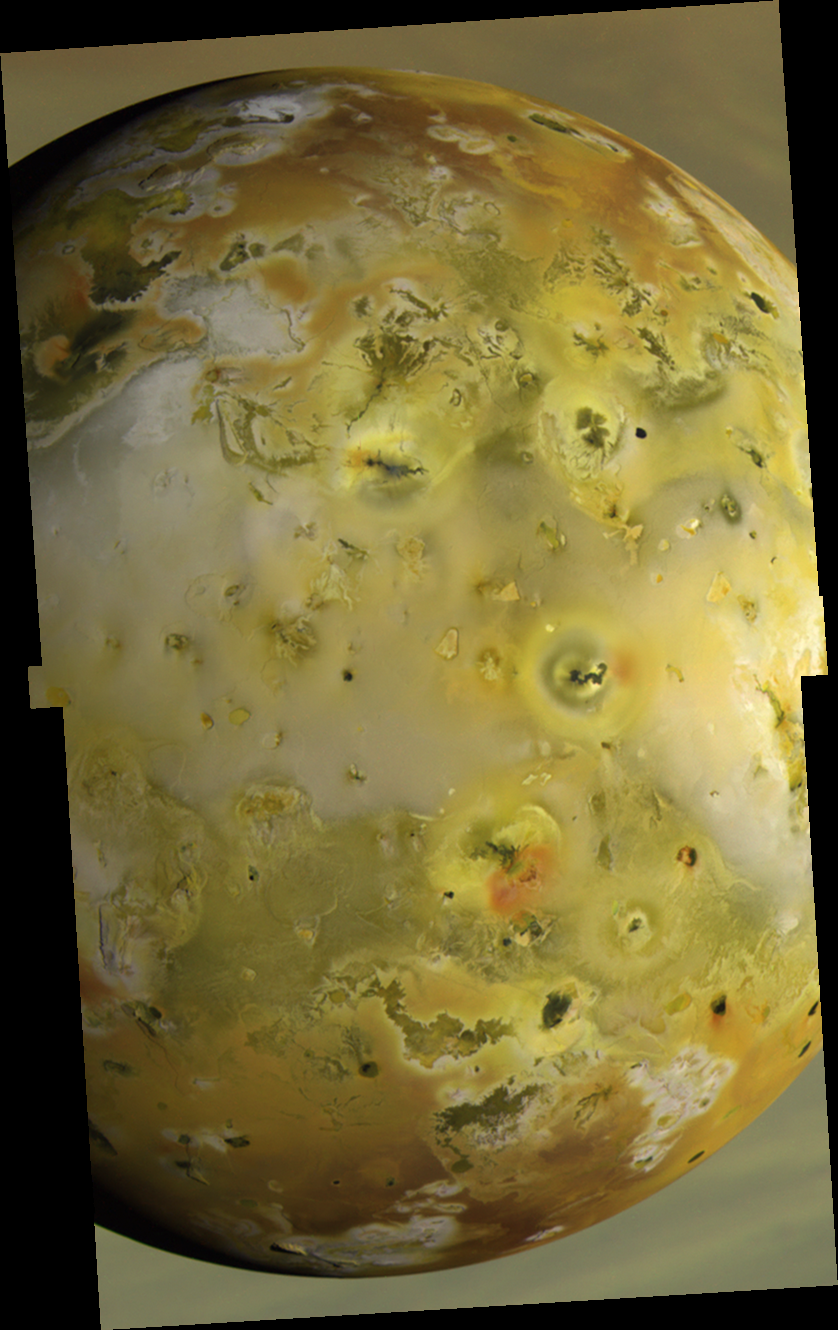
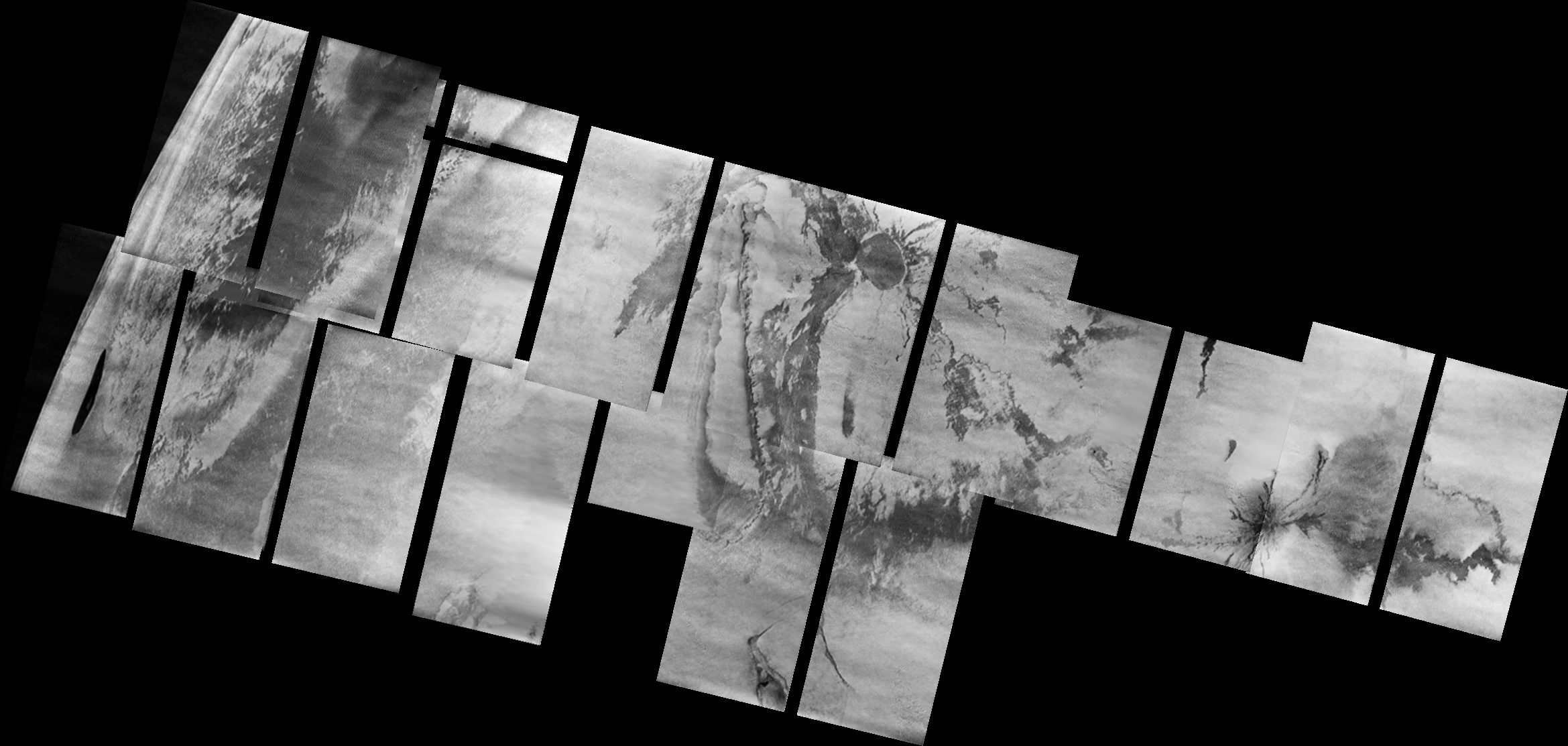
As jekbradbury commented here last week, he was able to bring out some details from some garbled I24 images that had yet to be reconstructed.  These images are marred by dark, vertical bands resulting from a corruptions of the camera's image summation algorithm.  Details on the image he processed can be found at the unmannedspaceflight.com forum.  The resulting image shows the current (as of 1999) main flow of Volund on the right side of the image and older, greenish flows to right of that dark flow.  For comparison, see the image at right taken from a color mosaic acquired in March 1998.  I think he is correct in his assessment that it isn't very useful for scientific uses since the data is so garbled, the effective resolution isn't any better than data acquired earlier in the Galileo mission, like the image at right.  However, it is nice to see this "lost" data set finally get some attention paid to it.  Perhaps the full ZAMAMA02 mosaic can be put together, even if some frames are of lower quality.

We are coming up on the 400th Anniversary of Galileo Galilei's discovery of the Galilean satellites.  If you know of any event commemorating this occasion, feel free to send them along to me and I will post them here on the blog.  I don't know of one here in town, I might have a small party at my home next weekend, but that is about it at this point.

Sunday, October 18, 2009

Galileo's I24 Flyby of Io - A Look Back: Results

Today, we finish up our look back at Galileo's I24 flyby of Io that occurred 10 years ago last Sunday. I had hoped to get this done a few days ago but present day encounters of Titan and Tethys had taken priority.  While last week's Cassini encounters felt almost routine, though you can never presume that just because you've seen an area many times before that you won't learn something new, the flyby we've been looking back at here in this blog was definitely not so.  In our last installment, we saw how Galileo's engineers and scientists had to overcome the spacecraft going into safing hours before the flyby was to occur, scrambled images, and a stuck spectrometer grating to pull off a fairly successful flyby.

In this final installment, we take a look at some of the data that was returned by Galileo and what it taught us about Io.  To put this data in a kind of video timeline, I created a Youtube video using Celestia and put together in Adobe Premiere Pro that I posted last week.  Check it out if you haven't done so already.

SSI


Despite the degradation of the majority of images acquired by Galileo during orbit I24, many of these images were still usable following a reconstruction effort at JPL using an alorithm in National Instrument's LabVIEW software.  For example, cooled lava flows, pits, and channels are visible in this 13-frame mosaic covering portions of the Pillan lava flow.  The eruption that formed much of the terrain visible here occurred two years earlier in a massive event that produced not only a 3100 sq. km lava flow, but also a huge pyroclastic eruption.  Lava from the eruption would then cascade over the edge of Pillan Patera (to the southwest of the area seen in the mosaic) to cover the floor of that depression with dark basaltic lava.  The rough texture, pits, and channels seen across portions of the flow field suggest potentially turbulent flow of Pillan's lavas, as well as a strong interaction been the emplaced lavas and the SO2 frost that coated the ground prior to the lava flowing over the surface.

Observations at other flow fields, such as the mosaic covering Prometheus shown above, revealed a different story.  Rather than a rough textured surface, SSI images revealed a patchwork of bright, sulfur dioxide frost, fresh dark flows, and older flows.  The irregular margins of this flow field and the similar Zamama and Amirani fields suggested much thinner flow lobes (~1 meter versus 8-10 meters) than what was seen at the more rapidly emplaced Pillan flows.  These flow fields, Amirani, Prometheus, and Zamama, are interpreted to compound flood basalt flow fields.  Rather than being formed in one giant eruption, lava at these volcanoes is emplaced in the form of "small" breakouts on top of previously erupted lava.  When lava from a breakout interacts with sulfur dioxide frost on top of the older lava, the sulfur is heated up and blasts its way through the meter-thick flow lobe, helping to form part of the plumes at these volcanoes.


Several of SSI's observations were dedicated to the other major landform type on Io, its many tall mountains.  This includes the high resolution mosaic of Ot Mons, an older mountain in the middle of Colchis Regio.  This mosaic and other lower resolution observations of Io's mountains closer to the terminator to the east revealed that nearly all of these structures are at some stage of degradation.  This is despite the fact that these mountains are all less than one million years old due to Io's high resurfacing rate.  The mosaic of Ot Mons revealed a structure covered in 100-meter tall, rounded hills with a mix of bright and dark material, with the dark material located mainly in topographic lows.  The lower resolution mosaics of mountains such as Skythia Mons, Gish Bar Mons, and Monan Mons, revealed evidence for large landslides and significant faulting across the top of these mountains.  In addition to evidence for various stages of degradation, evidence for layering was observed at several mountains, including one west of Donar Fluctus (seen near the center of the ZAMAMA02 mosaic).

These SSI observations provided further evidence that Io's mountains generally consisted of tilted crustal blocks.  The observed layering would then be old lava flows, pryoclastic material, and sulfur and sulfur dioxide ices that form layers in Io's upper crust.  The observed degradation shows that these mountains begin to fall apart soon after they form as a result of sulfur dioxide sapping from those ice layers within the mountains and Io-quakes that must be fairly common.

NIMS

While NIMS, Galileo's Near-Infrared Spectrometer, was in ride-along mode for most of its observations and it lost much of its spectral resolution due to the stuck grating, it was able to make a number of exciting observations.  One of its first observations of the flyby covered portions of Loki Patera (shown at right) while the volcano was on Io's nightside.  This observation revealed warm material within fissures in the bright island on the patera floor as well as within the darker, lava lake surface to the east.  This data revealed dark material with color temperatures ranging from 305 K on the patera floor to 350 K in the island cracks.  The NIMS team determined that assuming a starting temperature of 1475 K, the temperatures correspond to surface ages of about 127 days and 39 days, respectively, suggesting that the patera floor dates back to a prior Loki eruption, while the lava in the island cracks may date from the early stages of a Loki eruption at that started in September 1999.  The uniformity of the surface temperature of the caldera floor along with PPR data taken a few minutes earlier has been used as evidence that the dark patera floor of Loki consists of one large lava lake that overturns episodically.

As Galileo passed Io, it was able to turn its cameras toward Io's dayside.  This allowed NIMS to examine the distribution of sulfur dioxide frost across Io's anti-Jupiter hemisphere as well as search for hotspots and examine the fine scale thermal features at several Ionian volcanoes, including Prometheus and Amirani.  For example, the image at right shows the region surrounding the volcano Prometheus.  In this data from the REGION01 observation, two hotspots are seen at Prometheus, one associated with the vent in the east and the current breakout region to the west.  Based on this and higher resolution observation, as well as co-analysis with SSI data, it has been suggested that lava at Prometheus erupts along a fissure that bounds the eastern end of the flow field.  This lava then travels west via covered lava tubes until they reach a local topographic low where the lavas then erupt again onto the surface in the form of dark breakouts.  Higher resolution data also revealed a third hotspot between the two, from an area of activity in the center of the lava flow.  The dark ring around Prometheus in the 4.2 micron data, in the middle of an SO2 absorption band, results from plume fallout, not only of the present day plume, but also from the previous eastern location of the plume, as seen by Voyager in 1979.  NIMS also used its first opportunity to image Io at high resolution to search for small and faint hotspots and observations like the one above and below revealed several of these thermal features, including the first hotspots observed at volcanoes like Tien Mu Patera and Steropes Patera.


I know I haven't covered results from Photopolarimeter-Radiometer (PPR), Galileo's mid-infrared mapper, but it is getting rather late and I want to get this post out the door.  PPR further provided coorelations between thermal emission and dark materials.  During I24, PPR observed Loki near the start of a new overturning event at the lava lake there, as evidenced by increased thermal emission near the southwestern end of the patera, where these events typically start before moving around the patera in a counter-clockwise motion.  PPR also observed older flows at Zamama and Pillan, providing estimates for the age of these flows.

I hope you have all enjoyed this look back at Galileo's I24 flyby, which occurred 10 years ago on October 11, 1999.  Galileo would go on to encounter Io five more time as it wound down its mission at Jupiter, helping to revolutionize our knowledge of this exciting satellite.

Tuesday, October 13, 2009

Animation of Galileo's I24 Flyby of Io

Over the last few days we've been looking back at the Galileo's October 11, 1999 flyby of Io that occurred ten years ago this past Sunday.  We've looked at the planning that went into the science observations as well as some of the issues encountered during flyby.  Today, I wanted to present a video I created using Celestia and edited in Adobe Premiere Pro.  This combines a simulation of the flyby with some of the actual data that was returned during each observation.  And by ALL MEANS, full-screen this video!

The music used in this video is by _Ghost from ccMixter.com.  The two samples used, Ice and Chilli and Low (Ghostrust Reflection), are available under the Creative Commons NonCommercial Sampling Plus 1.0 license.


I had hoped to have this animation done yesterday, but what are you going to do? I hope you all enjoy!

Link: Galileo's I24 Flyby of Io [www.youtube.com]

Sunday, October 11, 2009

Galileo's I24 Flyby of Io - A Look Back: The Encounter

Ten years ago today, the Galileo spacecraft, itself nearing the ten-year anniversary of its launch, flew within 611 kilometers (379 miles) of Jupiter's volcanic moon Io.  This was Galileo's first opportunity to observe the satellite with its remote-sensing instruments, which had been turned off during Galileo's first Io flyby in December 1995 to protect the on-board tape recorder.  On Thursday we took a look at the planning that went into this encounter, as well as briefly covering the observations that led up to this encounter in 1999 and about Galileo's previous encounter in 1995.

Encounter Day

On October 11, 1999 at 04:33:03 UTC, Galileo encountered Io for the second time.  Unlike the previous encounter, all of Io's remote-sensing and fields-and-particles instruments were active, acquiring high-resolution and high-data rate observations of the volcanic moon.  This data included high-resolution imaging of several of Io's active volcanoes including Pele, Pillan, Zamama, Amirani, and Prometheus.

The encounter did not come off completely without a hitch.  18 hours prior to closest approach, the spacecraft entered safe mode.  This safing event was the result of high-radation causing an error in the Command and Data System B-string memory.  The CDS was basically the central computer for the spacecraft.  According to the PDS Galileo Host Overview document:
The hardware error causing the safing was a memory read error in the CDS B string High Level Module - the 'executive controller' for the CDS B string. Because the error was detected by the CDS bus controller (and not the microprocessor), this is likely to be an error in memory used for data buffers.
The safing event and the memory error that caused it led to the loss of magnetometer and other fields and particles instrument observations of the inner Io Plasma Torus and Photopolarimeter-Radiometer observations of Jupiter and Io's nightside.

Although Galileo was forced to use its low-gain antenna instead of its high-gain one because it failed to unfold, it was still enough to maintain a two-way communications link with Earth while it would carry out its science observations. This differs from Cassini, which must turn its antenna away from a direct-to-Earth link during most observations due to the lack of a scan platform. Thanks to Galileo's two-way link, Galileo's controllers on Earth were able to generate a preliminary diagnosis for error that caused the safe mode, send commands to the spacecraft to bring it out of the safe mode, and restart Galileo's science observations. The sequence began shortly before a PPR nightside observation (similar to this one from I25 and I27).  From that point, Galileo was able to complete the rest of its science observations for the flyby.

Safing events such as the one that occurred prior to I24 were an expected event as the result of the high-radiation environment close to Io's orbit.  The charged particles within the Io Plasma Torus can cause random memory errors such as the one seen prior to I24, which result in the spacecraft detecting an anomaly and putting itself in safe mode, essentially protecting itself from further harm.  Additional safing events would occur on future encounter, causing problems that resulting in the loss of close-approach science during the I25 encounter in November 1999 and the I33 flyby in January 2001.

Scrambled Images

Because Galileo had to use its low-gain antenna, the spacecraft played its data from each encounter very slowly, starting shortly after the perijove passage for that orbit right up until the beginning of the next perijove.  When the SSI team took a look at the more than 150 images that were returned, they discovered an anomaly with the summation mode images.  In this mode, also known as AI8, the images were shrunk by a factor of 2 in order to improve the signal-to-noise ratio, which was expected to be poor due to the intense radiation environment, and to allow for more images to be saved on the tape recorder and returned to Earth.  The imaging strategy for most of the I24 observations developed by the Io group on the SSI team was to acquire mosaics of images using the AI8 mode with an additional IM4 or IM8 image at the end of the mosaic (both are full-frame instrument modes.

While the full-frame images turned out better than expected due to less radiation-induced noise than expected, the AI8 images appeared scrambled, with at least two types of anomalies observed. You can seen example of one of these anomalies in the above image.  In this case, the images appear like double exposures with the left side of the image on top of the right side.  The lines alternate with a 13-pixel offset between each line.  From "Galileo SSI I24 AI8 Anomaly Description and Image Recovery Algorithm," a document on the NASA PDS site describing the AI8 issue and how it was fixed, here is how the summation mode on the Galileo SSI camera was supposed to work and how it failed in these cases:
  1. The image is first acquired by exposing the 800x800 active pixel area to incoming light from the target, increasing charge to each pixel from incoming photons or charged particles from the Jovian magnetosphere
  2. After the exposure, the image will then begin to be readout.  This process begins by shifting the "image" in the active pixel area of the CCD up by two lines into the serial shift register, basically a row of 825 image elements outside the active pixel area.  By shifting the image up by two lines, those two lines are added together.
  3. This row of summed pixels is then double-shifted to the left (two-pixels at a time), until 24 of the 25 pixels are filled.  During this step, the baseline stabilization circuitry is turned on to measure the dark level of those pixels.  The row of pixels would then continue to be double-shifted to the left to be read by the 8-bit analog-to-digital converter (ADC) and the summed pixels to be stored in memory.  The reconstruction group found that the pixels single-shifted left instead of double-shifted.  This led to many of the issues seen in these anomalous AI8 images, including the left half-right half double exposure as the right half were added onto the left half of the incoming summed line pair.
  4. This process would then be repeated for the next line.  Because the register had only shifted left 400 times, the right half of the top two lines was still there in the register, the left half of the next two lines were added to them.  The register would be shifted to the left, again mistakenly in single, rather than, double shifts.  Because the ADC is turned off at the start of the read out process (remember that normally there are no pixels with actual data in the first 25 pixels of the register), these 25 pixels are not stored to memory, resulting in the vertical gap seen in the middle of the reconstructed images.  At the end of this line, the serial shift register would then be shifted to the left, with the ADC off, 7 times.  This results in the alternating bright/dark lines along the right side of the scrambled image (and the alternating pairs along the left side of the vertical gap and the right side of the image in the reconstructed images).
  5. Steps 2-4 are repeated 199 more times for the rest of the image.
Using this slight offset and knowledge with how the summed images are supposed to be produced, scientists at JPL were able to reconstruct these images using software developed in National Instrument's LabVIEW program. Details on the reconstruction effort can be found at the PDS.  An example of a reconstructed image can be seen above.  Another anomaly resulted in dark vertical bars are visible in the image as a result of the successful summation half the time.  These images haven't been successfully recovered.

With many of the AI8 images recovered, these can still be used for scientific analysis, though much of the photometric information is lost in the reconstruction process.  Care must also be taken to look out for remaining artifacts, such ghosting of very bright and dark features appearing in the opposite half of the image.

Stuck Grating

One of the goals for the I24 encounter for the Near-Infrared Mapping Spectrometer (NIMS) was to measure Io's surface composition by looking for absorption features in the near-infrared (1-5 microns) at high-spatial and high-spectral resolution.  NIMS was an imaging spectrometer which used 17 detectors along with a diffraction grating in order for it to build up spectra images with up to 408 wavelengths for each pixel.  With so many wavelengths in this spectral range, high-resolution spectra can be generated, where small absorption bands from different surface components can be observed.

The hope was that with the NIMS data from different volcanoes across Io's anti-Jupiter hemisphere, scientists could not only measure the temperature of lava flows on the surface, but also directly measure their composition.  Unfortunately, between C22 and I24, the diffraction grating became stuck in a single position, reducing the spectra from 408 measurements down to 17.  In addition, three of those detectors became much less useful because the grating became stuck in an unusual position.  This position placed the wavelength these detectors would sense outside their blocking filters, rendering them effectively out-of-commission.  Two other detectors stopped functioning prior to this encounter, further reducing the number of wavelengths for NIMS spectra from I24 onward to 12 between 1 and 5 microns.  This anomaly reduced NIMS's effectiveness for detecting minor constituents because it could no longer resolve small absorption features.  However, the spectral resolution was still good enough for measuring color temperatures from Io's volcanoes and for measuring sulfur dioxide frost abundance by ratioing one measurement inside an SO2 absorption band with one outside that band.  The use of one grating position also allowed the NIMS team to acquire high signal-to-noise data since they oversampled their spectra (basically acquiring the same 12-wavelength spectra multiple times).

These problems aside, I24 was still largely successful with numerous images and spectra acquired.  On Tuesday and Thursday, we will take a look at some of the data Galileo acquired at Io during the I24 flyby.

Thursday, October 8, 2009

Galileo's I24 Flyby of Io - A Look Back: Planning

With NASA looking toward tomorrow morning's LCROSS impact of the Moon, we will begin our look back at Galileo's October 11, 1999 encounter with Io, which occurred 10 years ago Saturday night/Sunday morning.  While this flyby didn't involve the kind of exciting impact that the LCROSS event will, this flyby provided scientists their first opportunity to image Io up close.  Today we will look back at the planning that went into that flyby along with some of the data that influenced image targeting choices.  Over the next few days, we will take a look at the images and other data acquired and the problems encountered during that flyby.

Galileo's Mission Extended

The October 1999 flyby was not Galileo's first encounter with Io.  Shortly before entering orbit around Jupiter on December 7, 1995, Galileo flew within 897 kilometers (557 miles).  As originally planned, this encounter was to be the spacecraft's only flyby of Io as the intense radiation of the Io plasma torus was considered a major hazard for Galileo.  You can watch a video of a simulation of this encounter that I uploaded to Youtube back in March.  Unfortunately, in October 1995, a problem occurred in Galileo's tape recorder, which was to be used to store data recorded by the spacecraft's various instruments (and the Galileo Probe during its descent into Jupiter during the JOI event).  The tape recorder became stuck after saving a color image of the Galileo probe entry site.  While a workaround for this issue had been found by avoiding the area of the recorder with the Jupiter images, the additional decision to only use the recorder at low-speeds during the Io flyby, orbit insertion, and the Galileo probe atmospheric entry precluded the use of remote-sensing instruments during the Io encounter.  The loss of Io imaging during I0 left researchers with a desire to return to Io, but Galileo wouldn't come much closer to Jupiter than Europa's orbit during the rest of the primary mission, which ended in December 1997.

While Galileo certainly wasn't without its problems, at the end of the primary mission, the spacecraft was deemed healthy enough for a two year-extended mission to be funded.  The extended mission, also known as the Galileo Europa Mission, would focus on Europa to follow-up on the amazing discoveries from the primary mission.  After eight flybys of Europa between December 1997 and February 1999, Galileo would then flyby Callisto four times in mid-1999 to lower the spacecraft's orbital perijove down to the orbit of Io.  These Callisto encounters would help setup two encounters with Io in October and November 1999 (assuming the spacecraft was alive after the first flyby).

The Summer of '99

Galileo used Callisto encounters between May and September 1999 as gravity assists to sling shot to spacecraft into orbits that brought it closer to Jupiter, into the Io Plasma Torus and within the orbit of Io.  Such gravity assist maneuvers also allowed to spacecraft to approach closer to Io, not only during the two encounters in late 1999, but also during a non-targeted flyby on July 2, 1999.  This encounter, at a distance of 127,000 kilometers (79,000 miles), provided an opportunity to image Io's anti-Jovian hemisphere at 1.3 kilometers (0.8 miles) per pixel.  The resulting mosaic is shown at left.  This hemisphere covers much of the same territory that would be seen by Galileo in sunlight during I24 and I25, allowing researchers to better plan remote-sensing observations during the Io flybys.

During the next two orbits (C21 and C22), Galileo also observed Io from a greater distance, searching for surface changes and active volcanic plumes.  Again, like the global mosaic, these distant observations were designed to help Galileo scientists improve their science plan for the two flybys by potentially taking advantage of any major eruptions that might have been going on that summer.  In the C21, a large, red ring was observed around the volcano Grian on Io's sub-Jupiter hemisphere, the result of an outburst eruption that started on June 22, 1999.  The faint plume deposit had faded by the next perijove passage in mid-August.  A similar new plume deposit was also found at Masubi. Unfortunately, like Grian, Masubi would be in the hemisphere opposite of what would be observed by Galileo up-close.  The plume search imaging revealed volcanic plumes at Prometheus, Amirani, Masubi, and Grian.

Planning for an Encounter

With the data from the prior extended mission orbits in hand, planning for the I24 encounter could begin in earnest. An ambitious imaging plan developed with sixteen mosaic observations consisting of 191 images total.  In order to play all these images back in the month and a half between I24 and I25, nearly all of the images were acquired in summation mode (AI8), which shrank the images to 400x400 pixels in size, as opposed to 800x800 pixels for full-frame Galileo SSI images (IM4/IM8).  The use of this mode would allow scientists to sacrifice spatial resolution for additional imaging and expanded coverage.

Based on data acquired during Galileo's primary and extended missions, several primary science targets were to be examined during this encounter:
  1. Active volcanic centers.  This included high-resolution imaging of the Prometheus, Zamama, and regional-scale imaging across the Amirani, Marduk, and Isum flow fields.  Galileo's highest resolution imaging were to cover the Pillan flow field, emplaced during a major outburst eruption in 1997.  Finally, Galileo SSI would image the Pele lava lake at high resolution while Pele was still on Io's nightside.
  2. Mountains.  This included high-resolution imaging across Ot Mons in central Colchis Regio and regional imaging of Tohil Mons, Dorian Montes, Monan Mons, Hi'iaka Montes, and Gish Bar Mons.
  3. Paterae.  Like imaging of Io's mountains, observations of Ionian paterae (essentially volcanic depressions) were focused along the terminator.  This primarily consisted of regional scale imaging near the Amirani flow field and included Monan Patera and Gish Bar Patera.
  4. Context imaging.  Unlike Cassini, Galileo had no wide-angle camera.  In order to provide context for its higher resolution imaging (such as over Pillan and Ot Mons), Galileo would image several of these areas again at lower resolution to better understand how the geologic structures observed up-close fit in to their surroundings and to provide a bridge in resolution between the high resolution imaging and the global views acquired earlier in the mission.
  5. Stereo imaging.  Several of the observations planned for the I24 flyby were designed to act as one part of a stereo observation that would be combined with a companion mosaic to be acquired during another encounter.  This included a global mosaic at 1.45 kilometers (0.9 miles) per pixel covering the anti-Jupiter hemisphere (to be combined with the global mosaic from C21) and a six-frame mosaic covering Tohil Mons (to be combined with a similar mosaic during the February 2000 I27 flyby).
In addition to the imaging, the other instruments onboard Galileo planned for a very busy encounter.  the Near-Infrared Mapping Spectrometer (NIMS) team planned to look at several of Io's active volcanic centers, like Prometheus and Amirani, in sunlight in order to not only derive lava temperatures, but to also determine their composition by acquiring spectra across the volcanic flow fields.  NIMS also would image several volcanoes on Io's nightside, including Loki and Pele, focusing primarily on the distribution of hot material at these volcanoes.  Finally, NIMS would ride along with SSI observations as well as acquire global observations in order to determine the distribution of small volcanic centers on Io's anti-Jupiter hemisphere.  The Photopolarimeter-Radiometer team planned their mid-infrared observations along similar lines, mapping thermal emission over the night-side, sub-Jupiter hemisphere and the day-side, anti-Jupiter hemisphere.

With planning completed and the sequences uploaded to Galileo, scientists could only wait and see if their observations were successful.  In the next part of our series looking back at the I24 flyby, to be posted Sunday, we will take a look at the encounter itself and the issues that cropped up during the flyby.  Later next week, we will then take a look at the data that came back following the flyby.