Showing posts with label Eruptions. Show all posts

Tuesday, June 16, 2009

1979 Outburst Eruption of Surt: 30 Years Ago

On June 11, 1979, astronomer William M. Sinton observed Io and the other Galilean satellites using an infrared photometer at the University of Hawaii's 2.2-meter telescope at the summit of Mauna Kea. These observations were made as part of a three-day campaign to confirm Io's excessive brightness at 5 microns observed by Witteborn et al. 1979 by making observations of Io and the other Galileans using the photometer's M filter. Sinton published the results of these observations in the Astrophysics Journal the next year. While Sinton's June 10 observations didn't reveal excessive emission from Io at 5 microns, his observations the next day revealed a nearly 4x increase in the near-infrared flux of Io compared to the previous day, an increase he attributed in another paper from 1980 to a vapor explosion on Io's sub-jovian hemisphere that unroofed a liquid sulfur lake with a surface temperature of 600 K. Currently, such an observation would be reinterpreted as the either the sudden breakup of the crust of a silicate lava lake or the high-flow rate effusive eruption. Based on cooling models created by Ashley Davies et al. in 2005, the 600 K reported by Sinton 1980 would represent lava that erupted onto the surface (or was unroofed by a lava lake overturn event) an average of six hours prior to the observation (though with a single wavelength, we probably can't even say that much as this is a brightness temperature). Keep in mind that the eruption was still likely ongoing, but with a small area of very hot and fresh lava near the vent (or flow front) and larger areas of cooler lava.

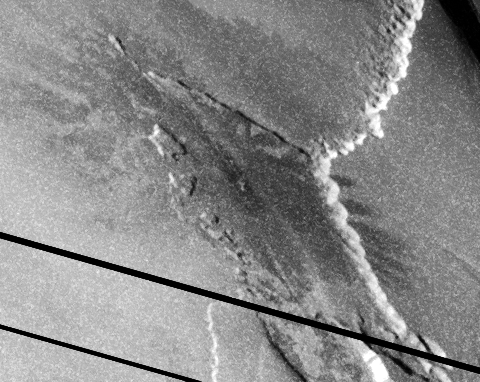
As this eruption occurred between the two Voyager encounters in 1979, the location of the eruption could be surmised by looking for surface changes in the hemisphere. Looking at the region observed by Sinton on June 11, 1979, one surface change stands out, at the volcano Surt on Io's northern sub-Jupiter hemisphere. These changes, shown at left in the left-hand pair of images, included a darkening of the western half of the 75-kilometer wide Surt volcanic pit (shown above in an image taken by Voyager 1) and a faint, Pele-class plume deposit circling the volcano (marked by the purple arrows in the image at left). This suggests that the eruption at Surt in June 1979 involved a substantial outpouring of lava (or the violent overturning of an otherwise quiescent lava lake) and a Pele-type plume, the larger of the two primary plume types on Io. The fact that the plume deposit appears so faint compared to more prominent red rings seen at other Pele-type plumes like Pele, Tvashtar, and Dazhbog suggests either a low amount of sulfur and sulfur dioxide was exolved from the erupting magma or the eruption had a very short duration (a few days), or a combination of both. The rapid decay of Surt's 5-micron emission, as observed by Sinton, definitely suggests that the eruption was short-lived. Either way, very little sulfur and sulfur dioxide was deposited as a result of the 1979 Surt eruption compared to other eruptions with Pele-type plumes. Similar changes were observed at Surt following a bright eruption in February 2001 (the most powerful eruption in terms of power output ever observed), suggesting short duration and/or low volatile content eruptions are typical for Surt.

The Surt eruption in 1979 was the first Ionian volcanic eruption to be observed from Earth following the phenomenon's discovery in March 1979 by Voyager 1. It showed that the occasionally near-infrared brightenings first reported shortly before the Voyager 1 encounter are the result of massive volcanic eruptions on Io and provided astronomers on Earth the encouragment to monitor Io for similar eruptions while scientists waited for the next spacecraft to arrive at Jupiter. Such observations during the 1980s provided the data needed for a paradigm shift from the idea of Ionian volcanism being primarily sulfurous in composition to primarily silicate.

Thursday, March 19, 2009

Hunga Tonga-Hunga Ha’apai eruption in Tonga

While Hunga Tonga-Hunga Ha’apai would be a great name for a volcano on Io, I am actually referring to the undersea volcano in the South Pacific island nation of Tonga. This seamount erupted yesterday producing a large steam and pyroclastic cloud reaching at least 15,000 feet into the air. The BBC has a video captured on a boat a few miles from the eruption site. The video clearly makes out the brighter steam and darker pyroclastic clouds. The large size of the eruption column is leading to disruption of Air New Zealand flights.

You can follow news about this eruption over at the Volcanism Blog, a great site to learn more about volcanic activity on Earth.

The closest analog to this eruption on Io would be an explosive eruption west of Zal Patera during the summer of 1997. Almost no lava was deposited during the eruption (within the limits of resolution and the annoying noise hits of our best images of the area), but there is evidence for an SO2 dust plume (analogous with the bright steam cloud seen at this Tongan eruption) and pyroclastics that produced a dark deposit that radiates out from the central vent (analogous to the dark cloud seen in the video linked above). Akin to sulfur dioxide plumes on Io, the steam cloud is produced as heat from the eruption boils off the water above the source vent. On Io, this "boiling off" normally occurs when lava flows over SO2 frost on the surface. The pyroclastic eruption at "At'am" would act remarkably like the pyroclastic flow here (though it would look less like a cloud, I would presume). There would be an initial ballistic phase as the largest clasts get sorted out. After a few kilometers, the pyroclastic column, consisting mostly of ash with low volatile contents, would collapse and move rapidly laterally along the surface. As can be seen at "At'am", the rapid speed of the pyroclastic surge allows it to climb up shallow slopes even on the 2 kilometer tall plateau, North Zal Montes.

Pyroclastic flows on Io were modeled by Smythe et al. back in 2001.

Wednesday, October 29, 2008

The Curious Case of Reiden Patera

Meet Reiden Patera. On the surface, it is an ordinary volcanic pit on Io. But in reality, it is anything but ordinary. Every few years, this particular volcano becomes just another part... of the Twilight Zone.

Okay, I am not Rod Sterling. However, today I thought I would write a little post on this curious volcano. Actually, it is quite ordinary. Our best resolution images are at only 1.5 km/pixel. It has never been the site of an outburst. However this volcano in the shadow of Pillan has gone through an interesting cycle of activity since the feature was first observed by Voyager 1 in 1979.

Reiden Patera is a 73-km wide volcanic depression located on Io's trailing hemisphere a couple hundred kilometers to the southwest of Pillan Patera. Reiden's proximity to Pillan causes occasional confusion between the two features when trying to identify the source of thermal emission in eclipse and near-infrared images of this region of Io. Reiden generally has a dark green floor with dark spots scattered around the margin of the patera. Surrounding the patera, there is normally a bright annulus, which is then surrounded by a dark annulus. The closest analog seen at high resolution by Galileo would be Camaxtli Patera, a similar-sized volcano on Io's anti-Jupiter hemisphere. Like Reiden, Camaxtli has a floor with a patchwork of bright deposits and dark lava flows, and has concentric bright and dark halos surrounding the depression. Reiden, like Camaxtli, has a roughly polygonal outline, with several straight margins, suggestive of structural control, by pre-existing tectonic faults, of the patera margin. A possible landslide deposit can be seen along Reiden's northern margin.

As you can see in the above montage, the appearance of Reiden changed during the course of the Galileo mission. During the first few orbits, several dark spots were seen along the margin, some appearing over time. This suggested on-going volcanic activity centered on the patera margin, and this is substantiated in the thermal data acquired by NIMS and SSI. The camera onboard Galileo, SSI, detected a hotspot at Reiden during the mission's first orbit in late June 1996 (G1). NIMS, the near-infrared spectrometer on Galileo, may have detected a hotspot at Reiden during the second and third orbits (early-September and early-November 1996, respectively), though Lopes et al. 1997 attributes the observed thermal emission to Pillan instead. Changes observed in images acquired in February 1997 (E6) suggests that Reiden was active until shortly after the November 1996, but SSI did show that Reiden had decreased in activity by E6 (in fact, Reiden was not visible in SSI eclipse observations like it was in G1). The lack of changes in images acquired in April 1997 (G7) provides further evidence that the eruption at Reiden had ended. By the next orbit, the outburst eruption at nearby Pillan had begun.

Over the next few years, Reiden remained an inactive volcano, and the dark lava flows seen along its margins began to turn from black to dark green. In images acquired in September 1997 (C10), even the dark halo surrounding Reiden was gone, but the inner, bright halo remained. How much topography and the nearby Pillan eruption played in this change isn't clear, but it appears that Reiden's bright halo maybe located on a low, topographic rise that surrounds Reiden as it was not covered by Pillan's pyroclastic deposits and the topographic rise acted as an impedment to the pyroclastic flow. This provides further evidence that Io's dark silicate deposits, associated with some volcanoes like Pillan, Tvashtar, Pele, and Babbar, are deposited in a process akin to terrestrial basal surges compared to the umbrella-like gas plumes Io is so famous for. As Pillan's dark deposit faded in 1998 and 1999, the dark halo seen when Reiden was active remained absent.

Reiden reactivated by late 2000 as it was seen as a hotspot by Cassini ISS during that spacecraft's distant flyby on December 30, 2000. Galileo during this time observed a darkening at Reiden, further suggesting that activity had resumed. In addition, Galileo observed fresh reddish deposits to the east and northwest of Reiden, perhaps from this new eruption. During a flyby in October 2001 (I32), Reiden was seen at higher resolution. This observation revealed fresh dark material (compared to comparable data acquired in October 1999) along most of its margin, except to the north (where there is a landslide). Reiden may have reactivated as early as October 1999 (I24), when two dark spots were observed along the margin of the patera, near its southwestern margin and along the southern part of the landslide deposit.

Reiden was also seen as active by New Horizons in LORRI imager data and was seen as a dark feature with a bright halo. During the Voyager flybys, it appeared similar to its appearance during the first few orbits of the Galileo mission, though with a dark spot along its northeastern margin, suggesting that Reiden was active during the Voyager mission.

Reiden, though named after the Japanese god of thunder (or was it the Mortal Kombat character...), has long been in the shadow of more famous volcanoes like Pillan and Pele, volcanoes that occasional affect the appearance of Reiden and its surrounding terrain. However, the history of activity at Reiden is an interesting one, where several distinct eruption cycles have been observed by multiple spacecraft. All of Reiden's activity has been confined to small effusive eruptions along the depression's margins. This would suggest that perhaps Reiden is a large lava lake, but there is no evidence of a massive crustal recycling event like those seen at Loki, a more classic example of a lava lake on Io. It is possible that magma uses the faults that bound the depression as conduits to reach the surface, explaining why flows are confined to the margins of the patera. However, a passive lava lake would explain the small eruption along the southern margin of the landslide deposit seen during C3 and I24, as the margin of the landslide would likely not be structurally controlled. It is also possible that this northern bright area is not a landslide, but a cool "island", similar to those seen at Loki and Tupan, two volcanoes thought to be lava lakes.

Hope you all enjoyed this look at Reiden Patera. I hope to post similar articles about other "forgotten" volcanoes here in the future.

Sunday, September 21, 2008

Eruption at Piton de la Fournaise

A fresh eruption at Reunion Island's Piton de la Fournaise volcano today produced a new basaltic lava and a large lava pond and an increase in SO2 concentration within its eight kilometer-wide caldera. Thomas Staudacher, from the volcano observatory on Reunion captured the view at left of the caldera showing this fresh flow. While this eruption seems pretty minor, Piton de la Fournaise (or Le Volcan to the local residents) has recently seen an uptick in activity. According to the AFP, an eruption in April 2007 resulted in the partial collapse of the volcano's caldera and included vigorous fire fountaining that reached upwards of 200 meters into the air.

Link: Le volcan du Piton de la Fournaise sur l'île de la Réunion [fournaise.info]

Friday, April 11, 2008

Renewed Explosive Volcanism at Kilauea

A second explosive eruption took place at Halema`uma`u crater atop the Kilauea volcano on Wednesday morning. The eruption, along with winds out of the south, lowered air quality across the more populated areas of the Big Island, including Hilo. This was due to the high amounts of sulfur dioxide within the new vent's gas plume. Sulfur dioxide, a common volcanic gas on Io and Earth, can causes irritation to a person's respiratory system.

Webcam images of the new vent along the wall of Halema`uma`u crater reveal a large, white plume and glowing red lava being spat out of the vent. The new explosion has expanded this vent by 5-10 meters. Debris from the explosion, smaller than the one that took place last month, could be found on the rim of the crater, 70 meters above the vent.

Air quality in Hilo is expected to improve as returning trade winds will blow the sulfur-rich plume to the southwest, away from major population centers.

Link: Halema`uma`u vent explodes a second time [hvo.wr.usgs.gov]

Tuesday, March 18, 2008

Solfataras at Kilauea

The Honolulu Star-Bulletin reported today on a brand new gas vent at the Halema`uma`u crater at the Kilauea volcano on the island of Hawaii. This gas vent, also known as a solfatara or fumerole, has emitted a large amount of sulfur dioxide, sulfur trioxide, and water vapor over the last few days to the point where health warnings and closures have been issued for the area around Kilauea. Also in the last few days, dull red glowing material has been visible near these vents. The temperature of this material is only 772 K, which might be indicative of molten sulfur.

Solfataras might be a good terrestrial analog for Io's Prometheus-type plumes. These plumes are thought to be formed when silicate lava interacts with sulfur dioxide frost on the surface.

Link: Glowing sulfur stumps brains at volcano site [starbulletin.com]