Friday, October 9, 2009

Model Projects More Oxygen in Europa Ocean than Previously Expected

The Galilean satellites session at this year's DPS meeting was held today in Fajardo, Puerto Rico.  I am not at the meeting, but you can check out my thoughts on the Io-related abstracts for this meeting that I posted a few weeks ago.  While I haven't heard word on what was presented at the Io talks, there is a new press release today covering one of the Europa talks, "Vertical Transport through Europa’s Crust: Implications for Oxidant Delivery and Habitability," by Richard Greenberg.

At this talk, Greenberg presented results on the production of oxygen through radiolysis and photolysis of water.  During these processes, some water molecules on Europa surface are broken down into their oxygen and hydrogen components by high-energy particles in Jupiter's magnetosphere and photons from the Sun.  Greenberg combined this research with estimates of Europa's resurfacing rate to determine how much oxygen is delivered to the satellite's sub-surface ocean.  He found that given this resurfacing rate, the concentration of oxygen in Europa's ocean would exceed those of the Earth, making possible not only microbial like, but the kinds of multi-cellular aquatic like we are more familiar with.  Greenberg also notes that an initial, 2-billion year delay in this process would prevent the premature oxidation of organic compounds that would have prevented the development of life.

So for those who dream of eating Europa calamari, you just got a big boost today.  Now we just need to find organic compounds at Europa... otherwise, all you have is a quite oxygenated, but sterile, ocean.

Link: Press Release - Vertical Transport through Europa’s Crust: Implications for Oxidant Delivery and Habitability [dps.aas.org]

Thursday, October 8, 2009

Galileo's I24 Flyby of Io - A Look Back: Planning

With NASA looking toward tomorrow morning's LCROSS impact of the Moon, we will begin our look back at Galileo's October 11, 1999 encounter with Io, which occurred 10 years ago Saturday night/Sunday morning.  While this flyby didn't involve the kind of exciting impact that the LCROSS event will, this flyby provided scientists their first opportunity to image Io up close.  Today we will look back at the planning that went into that flyby along with some of the data that influenced image targeting choices.  Over the next few days, we will take a look at the images and other data acquired and the problems encountered during that flyby.

Galileo's Mission Extended

The October 1999 flyby was not Galileo's first encounter with Io.  Shortly before entering orbit around Jupiter on December 7, 1995, Galileo flew within 897 kilometers (557 miles).  As originally planned, this encounter was to be the spacecraft's only flyby of Io as the intense radiation of the Io plasma torus was considered a major hazard for Galileo.  You can watch a video of a simulation of this encounter that I uploaded to Youtube back in March.  Unfortunately, in October 1995, a problem occurred in Galileo's tape recorder, which was to be used to store data recorded by the spacecraft's various instruments (and the Galileo Probe during its descent into Jupiter during the JOI event).  The tape recorder became stuck after saving a color image of the Galileo probe entry site.  While a workaround for this issue had been found by avoiding the area of the recorder with the Jupiter images, the additional decision to only use the recorder at low-speeds during the Io flyby, orbit insertion, and the Galileo probe atmospheric entry precluded the use of remote-sensing instruments during the Io encounter.  The loss of Io imaging during I0 left researchers with a desire to return to Io, but Galileo wouldn't come much closer to Jupiter than Europa's orbit during the rest of the primary mission, which ended in December 1997.

While Galileo certainly wasn't without its problems, at the end of the primary mission, the spacecraft was deemed healthy enough for a two year-extended mission to be funded.  The extended mission, also known as the Galileo Europa Mission, would focus on Europa to follow-up on the amazing discoveries from the primary mission.  After eight flybys of Europa between December 1997 and February 1999, Galileo would then flyby Callisto four times in mid-1999 to lower the spacecraft's orbital perijove down to the orbit of Io.  These Callisto encounters would help setup two encounters with Io in October and November 1999 (assuming the spacecraft was alive after the first flyby).

The Summer of '99

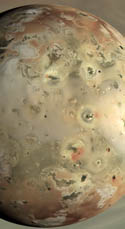
Galileo used Callisto encounters between May and September 1999 as gravity assists to sling shot to spacecraft into orbits that brought it closer to Jupiter, into the Io Plasma Torus and within the orbit of Io.  Such gravity assist maneuvers also allowed to spacecraft to approach closer to Io, not only during the two encounters in late 1999, but also during a non-targeted flyby on July 2, 1999.  This encounter, at a distance of 127,000 kilometers (79,000 miles), provided an opportunity to image Io's anti-Jovian hemisphere at 1.3 kilometers (0.8 miles) per pixel.  The resulting mosaic is shown at left.  This hemisphere covers much of the same territory that would be seen by Galileo in sunlight during I24 and I25, allowing researchers to better plan remote-sensing observations during the Io flybys.

During the next two orbits (C21 and C22), Galileo also observed Io from a greater distance, searching for surface changes and active volcanic plumes.  Again, like the global mosaic, these distant observations were designed to help Galileo scientists improve their science plan for the two flybys by potentially taking advantage of any major eruptions that might have been going on that summer.  In the C21, a large, red ring was observed around the volcano Grian on Io's sub-Jupiter hemisphere, the result of an outburst eruption that started on June 22, 1999.  The faint plume deposit had faded by the next perijove passage in mid-August.  A similar new plume deposit was also found at Masubi. Unfortunately, like Grian, Masubi would be in the hemisphere opposite of what would be observed by Galileo up-close.  The plume search imaging revealed volcanic plumes at Prometheus, Amirani, Masubi, and Grian.

Planning for an Encounter

With the data from the prior extended mission orbits in hand, planning for the I24 encounter could begin in earnest. An ambitious imaging plan developed with sixteen mosaic observations consisting of 191 images total.  In order to play all these images back in the month and a half between I24 and I25, nearly all of the images were acquired in summation mode (AI8), which shrank the images to 400x400 pixels in size, as opposed to 800x800 pixels for full-frame Galileo SSI images (IM4/IM8).  The use of this mode would allow scientists to sacrifice spatial resolution for additional imaging and expanded coverage.

Based on data acquired during Galileo's primary and extended missions, several primary science targets were to be examined during this encounter:
  1. Active volcanic centers.  This included high-resolution imaging of the Prometheus, Zamama, and regional-scale imaging across the Amirani, Marduk, and Isum flow fields.  Galileo's highest resolution imaging were to cover the Pillan flow field, emplaced during a major outburst eruption in 1997.  Finally, Galileo SSI would image the Pele lava lake at high resolution while Pele was still on Io's nightside.
  2. Mountains.  This included high-resolution imaging across Ot Mons in central Colchis Regio and regional imaging of Tohil Mons, Dorian Montes, Monan Mons, Hi'iaka Montes, and Gish Bar Mons.
  3. Paterae.  Like imaging of Io's mountains, observations of Ionian paterae (essentially volcanic depressions) were focused along the terminator.  This primarily consisted of regional scale imaging near the Amirani flow field and included Monan Patera and Gish Bar Patera.
  4. Context imaging.  Unlike Cassini, Galileo had no wide-angle camera.  In order to provide context for its higher resolution imaging (such as over Pillan and Ot Mons), Galileo would image several of these areas again at lower resolution to better understand how the geologic structures observed up-close fit in to their surroundings and to provide a bridge in resolution between the high resolution imaging and the global views acquired earlier in the mission.
  5. Stereo imaging.  Several of the observations planned for the I24 flyby were designed to act as one part of a stereo observation that would be combined with a companion mosaic to be acquired during another encounter.  This included a global mosaic at 1.45 kilometers (0.9 miles) per pixel covering the anti-Jupiter hemisphere (to be combined with the global mosaic from C21) and a six-frame mosaic covering Tohil Mons (to be combined with a similar mosaic during the February 2000 I27 flyby).
In addition to the imaging, the other instruments onboard Galileo planned for a very busy encounter.  the Near-Infrared Mapping Spectrometer (NIMS) team planned to look at several of Io's active volcanic centers, like Prometheus and Amirani, in sunlight in order to not only derive lava temperatures, but to also determine their composition by acquiring spectra across the volcanic flow fields.  NIMS also would image several volcanoes on Io's nightside, including Loki and Pele, focusing primarily on the distribution of hot material at these volcanoes.  Finally, NIMS would ride along with SSI observations as well as acquire global observations in order to determine the distribution of small volcanic centers on Io's anti-Jupiter hemisphere.  The Photopolarimeter-Radiometer team planned their mid-infrared observations along similar lines, mapping thermal emission over the night-side, sub-Jupiter hemisphere and the day-side, anti-Jupiter hemisphere.

With planning completed and the sequences uploaded to Galileo, scientists could only wait and see if their observations were successful.  In the next part of our series looking back at the I24 flyby, to be posted Sunday, we will take a look at the encounter itself and the issues that cropped up during the flyby.  Later next week, we will then take a look at the data that came back following the flyby.

Tuesday, October 6, 2009

More Mercury Mosaics from MESSENGER's 2nd Flyby

Tonight, I finished up a few more mosaics from MESSENGER's second flyby of Mercury that took place one year ago today.  I am glad to see so many liked the global mosaic posted yesterday.  We had almost as many visitors yesterday and today (so far) as we had all of last month :-O  Anyways, these new mosaics include a four-frame color mosaic shown at left, a five-frame, high-resolution color mosaic, and a 29-frame, monochrome very high-resolution mosaic.

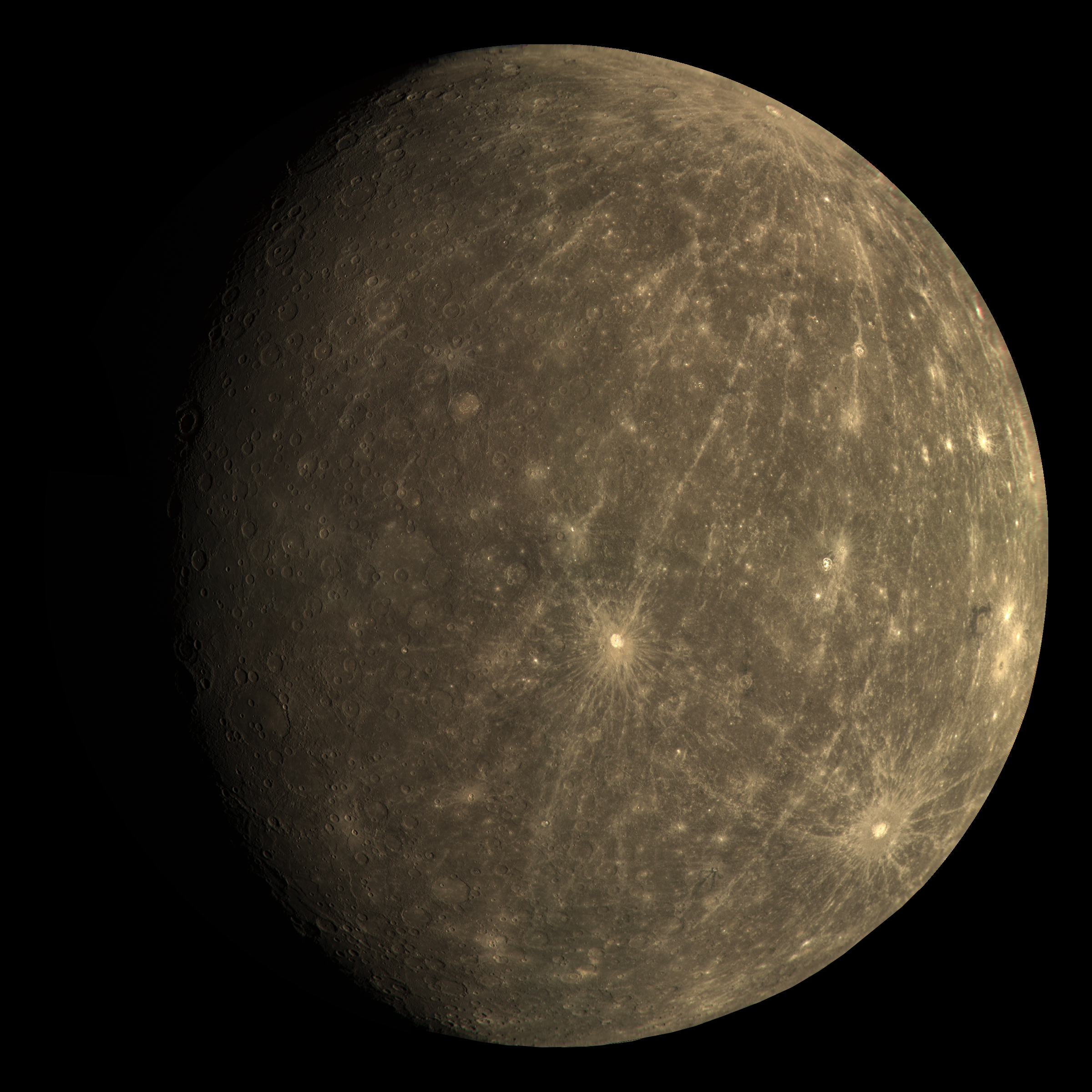
The color mosaic [high resolution version] is four-frame mosaic consisting of MESSENGER MDIS narrow-angle camera images.  This approximately true-color view of Mercury uses the Blue, Green, and Red filters on the Wide-angle camera (the "C", "D", and "E" filters", respectively).  This mosaic was reprojected to an orthographic projection with a resolution of 2.175 kilometers (1.351 miles) per pixel.  It centered near 0.73 degrees South latitude, 320.83 degrees East longitude.  This basically covers the same territory from the global mosaic posted yesterday.  As you can see from this mosaic, there really isn't much color variation in the visible portion of the spectrum, but they do start to show up when comparing the near-infrared and the ultraviolet filter images.


This next mosaic is a five-frame, wide-angle-camera color mosaic taken shortly after closest approach to Mercury during last year's encounter [full-resolution version].  This mosaic is in simple cylindrical projection (more like a standard map) and has a resolution of 288 meters (945 feet) per pixel.  This mosaic shows the equatorial region of Mercury starting just west of the crater Boethius (seen on the boundary between the first two frames) and runs east to the impact basin Homer (visible, though not very conspicuous, in the eastern half of the last frame).


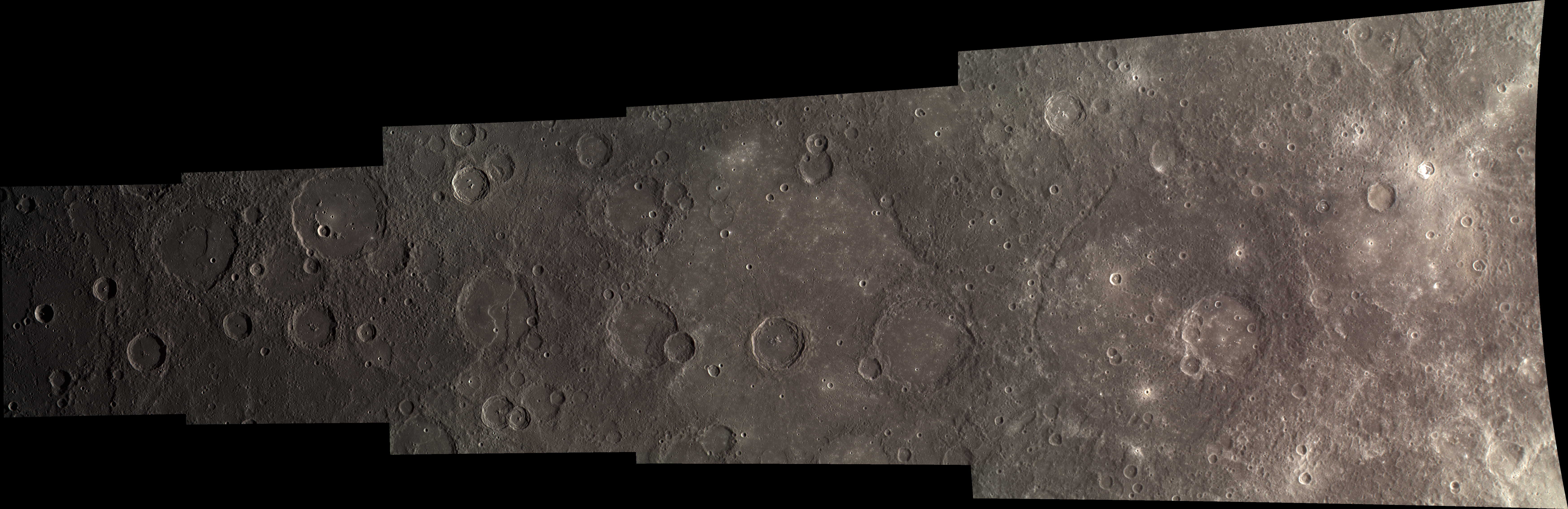
This last mosaic is a 29-frame, narrow-angle-camera mosaic that covers a strip across the equatorial region of Mercury [full-resolution version].  This mosaic is in orthographic projection and has a resolution of 100 meters (328 feet) per pixel.  This mosaic covers much of same area as shown above and runs from just west of the crater Machaut, across portions of the lava-filled basins Boethius, Polygnotus, and Thākur, across three more (larger) lava-filled basins (the last being named Homer), and finally ends at the impact crater Lu Hsun.

I think with that, I am all "Mercuried" out.  There is still maybe two more mosaics I would want to do: the northern hemisphere regional mosaic and the inbound, crescent mosaic.  These are two large mosaics so I may hold off on doing them.  I hope you all like these.

Monday, October 5, 2009

Highlights from the Mercury Global Mosaic

Last night, I posted my completed version of the Departure #4 global mosaic from MESSENGER's second encounter with Mercury in October 2008.  If you haven't had a chance to check it out, I definitely encourage you to do so: Original Post | Full-resolution Global Mosaic.

This morning, I thought I would discuss some of the interesting Mercury geology you can see in this mosaic.  The first area I wanted to discuss is the large impact basin, Raphael, shown at left.  The floor of this 350-kilometer (217-mile) wide impact basin was nearly complete filled by lava flows shortly after its formation.  The lavas pretty much obliterated any trace of the initial impact structures within the basin, like multiple rings, for example.  However, in addition to the lava flows, a debris flow is seen in the southern portion of the basin.  This 185-kilometer (115-mile) long debris flow was likely the result of the collapse of a 200-kilometer (124-mile) long section of the basin's southern rim shortly after Raphael's formation.  It is astonishing just how far this material reached after the 2-kilometer (1.24-mile) tall rim collapsed.  It reached the mid point of the basin!  Now, why did this crater fascinate me?  Well, it got me thinking about which feature came first: the lava flows or the landslide deposit?  The scenario that sounds best to me is that the landslide came first and the lava flows later filled the rest of the basin, lapping up onto the margins of the landslide deposit.  How can I say this?  First, the landslide deposit seems to have an older cratering age than the rest of Raphael's floor, meaning it has more impact craters (though not that much more) superimposed on its surface.  Secondly, the embayment relationship between the lava flows and the landslide deposit suggests that the lava flows filled the floor of the basin and were thick enough to cover up much of the lobate margin of the deposit and lapping up onto its edge before stopping.

Anyways, I thought that was neat.

The other feature I wanted to point out is the impact crater Matabei, shown at right in the center of this crop from the mosaic.  What makes Matabei interesting is the intriguing albedo markings both inside the crater and outside.  Inside, portions of the crater are quite bright.  Outside, several dark "rays" can be seen radiating out from the crater, mostly to its south, suggesting that the crater excavated dark material from below Mercury's surface.  A paper published in Science by the MESSENGER science team (Denevi et al. 2009) back in May suggests that such patterns are the result of layering of regolith (basically impact pulverized rock), old magmatic sills and dikes, and lava flows.  Beneath the surface of Matabei there must have been both dark, "Low-Reflectance Material" (LRM) and bright material that was then excavated by the impact and deposited on the surface.  LRM, according to the Denevi paper, is not uncommon within impact ejecta, but the distinct rays see at Matabei certainly are amusing to look at.

Again, I hope you all liked the mosaic.  The positive response to this mosaic has encouraged me to complete the higher resolution, northern hemisphere mosaic from the second flyby.

EDIT 10/05/2009 01:05 PM: Added a bit more explanation for Matabei.

Global Mosaic from Messenger's 2nd Flyby of Mercury

Normally, I try to stick to Io and the Jupiter system on this blog, but occasionally I do pay attention to what else is going on in the unmanned spaceflight community beyond Cassini/the Saturn system and the Jupiter system.  Last week, the MESSENGER spacecraft performed its last of three flybys of the planet Mercury before it will go into orbit around the planet in 2011.  In response to this flyby, I finally decided to piece together one of the global mosaics from last year's encounter, which covered similar territory.

This mosaic, consisting of 66 MDIS, narrow-angle camera images, was produced using a combination of ISIS3 (to calibrate and reproject each frame) and Photoshop (used to actually piece together each image).  This mosaic could have been produced, I guess, entirely in ISIS3, but I found that trying to create a coherent control network that takes into account issues of camera twist angle and readily apparent range-to-target smear was a next to impossible task (I would like to apologize now to anyone trying to use Tethys in PIRL over the last few days while I was trying to create said control point network).  The end result is the image you see at left.

Click Here to download the full resolution version of this mosaic.  It would probably be best to just right-click and save the link as the full resolution version is a 20 MB PNG image file.  Click the image above for a lower resolution version.


This mosaic is in orthographic map projection with a resolution of 0.6 kilometers (0.37 miles) per pixel.  It is centered around 2 degrees South latitude, 322 degrees East longitude.  The mosaic covers the eastern portions of the terrain covered by Mariner 10 in the 1970s as well as some terrain that wasn't revealed until the MESSENGER encounter on October 6, 2008.  This terrain includes two ray craters at upper right and lower right that had previously only been seen in low-resolution RADAR data from Earth.  The prominent ray crater just below and left of the center of the mosaic is Kuiper, previously observed by Mariner 10.

Some of the images from last week's encounter are slowly making their way to the MESSENGER home page, though versions that can be input into ISIS3 and converted into these huge mosaics won't hit the NASA PDS until sometime next year.

I hope you all enjoy this little treat.  After I get some sleep, I will post more on some of the cool features you can find while searching around this mosaic.  To be honest, my new favorite crater (at least on Mercury) has to be Rafael.  In the morning, I will talk about why.

Image credit: NASA/JHUAPL/CIW/Jason Perry

Monday, September 28, 2009

Carnival of Space #122 @ Cumbrian Sky

The latest edition of the Carnival of Space, the weekly roundup of the best in the Space and Astronomy blogosphere, is now online over at Cumbrian Sky.  Not surprisingly, many of the submitted posts were related to the discovery of water molecules on the Moon, mine included.

Included in the list of blog posts is one explaining some of the details and caveats of the Lunar water discovery over at the Planetary Society blog.  Definitely worth checking out.

Link: Carnival of Space #122 [cumbriansky.wordpress.com]

Thursday, September 24, 2009

Water on Dry Worlds

Updated 09/24/2009 12:03 PM MST based on info from this morning's press conference:

The internet is abuzz this evening regarding the possible discovery of wide-spread "water" or hydroxyl molecules of the surface of Earth's moon, a discovery made by spectrometers on three different spacecraft: M3 on Chandrayaan 1, VIMS on Cassini, and Deep Impact.  The papers, if I understand correctly, will be published later today in this week's issue of the journal Science and I have not had a chance to look at them.  There will also be a press conference later today at 2pm EDT (11am MST) discussing these results.

Why do I bring these results up here on this blog?  Well, according the few reports I have been able to find online, like this one here from Universe Today, from Bad Astronomy, and from NASA Watch, this discovery was made by finding a weak absorption band near 3 microns, associated with water and the hydroxyl ion (OH-), concentrated mostly near the moon's high latitude.  The absorption band found on the Moon is very weak, suggesting a very low concentration of water or OH- in the moon's soil.  The M3 instrument team suggests a concentration of as much as 770 ppm has been observed on the sunlit side of the Moon, according to the NASA Watch posting.  While the discovery isn't quite Moon-shattering, previously water ice (or hydrogen anyway) had only been observed within cold-traps in permanently-shadowed craters near the poles.

A similar absorption band was found on Io using ground-based spectroscopy (Salama et al. 1990) and Galileo NIMS (Carlson et al. 1997 and Cataldo 1999) observations.  In these measurements, a weak absorption band in Io's near-infrared spectrum at 3.15 microns was observed to be ubiquitous across its surface with a concentration of 4 ppm according to Carlson et al. 1997 and 1000 ppm according to Salama et al. 1990, on the order with what has been observed on the Moon.  This absorption band is associated with the O-H stretch transition.  Such an atomic bond between an oxygen and hydrogen atom would be found in water, hydrated minerals, or the hydroxyl ion (OH-).  Small concentrations of this band have also been observed.  An absorption band near 3 microns, attributed to water ice crystals or hydrates mixed with sulfur dioxide frosts, was seen to the north and west of Gish Bar Patera by the Galileo NIMS instrument during the October 2001 I32 encounter (Douté et al. 2004).  The low spectral resolution of NIMS at the time (12 spectral measurements spread out between 1 and 5 microns) makes this result a bit tenuous, but if true would indicate that concentrations of possible water ice on top of the low background levels exist on the surface of Io.

So where does the "water" come from on these two, supposedly dry worlds?  For the Moon, two possible mechanisms are likely.  The first would be recent cometary impacts, which would bring their water to the Moon's surface near the site of these impacts.  Concentrations within the ejecta blankets of several small craters on the moon provide further evidence for this hypothesis, but the pattern of the hydroxyl absorption within the ejecta seems to be more consistent with material from the target body rather than material from the impactor.  The widespread distribution of water or hydroxyl ions across the moon's sunlit surface suggests another explanation.  In this scenario, charged particles, in the form of hydrogen ions and transported from the Sun by the solar wind, impact the Moon's unprotected surface (remember that the Moon is outside Earth's magnetic field most of the time).  These hydrogen ions split oxygen atoms from silicate molecules in the Moon's soil, and combine with newly freed oxygen ions to form hydroxyl ions or water.  As the day progresses and the Moon's surface heats up, these new molecules themselves split up, freeing the hydrogen to space and returning the oxygen to the soil.  The process of water formation from the combination of hydrogen from the solar wind and oxygen in the lunar soil kicks back up the surface starts to cool down in the late afternoon and evening.  Alternatively, the water molecules may become excited and be transported to Moon's polar regions, where they are deposited within those aforementioned cold-traps.

For Io, the solar wind can't reach its surface due to Jupiter's strong magnetic field.  So where does its water come from?  Again, oblique cometary impacts could be a source of water for Io.  The two recent cometary impacts on Jupiter in 1994 and again this year would suggest that Io could be hit by water-rich cometary bodies on a regular basis.  This could certainly be the source for the concentration found near Gish Bar Patera.  For the global ubiquitous concentrations of water or hydroxyl ions, another mechanism maybe necessary.  For example, low concentrations of water might be present in Io's magma, like here on Earth.  Water vapor would then be released during volcanic eruptions and water ice would be deposited on the surface, however, no water vapor has ever been observed within Io's plumes.  Another possibility could be that hydrogen ions from Jupiter's magnetic field break off oxygen from sulfur dioxide and silicate compounds on the surface then combine with them to form OH- or water, akin to the preferred scenario for the Moon.

This discovery of OH molecules on the Moon is certainly interesting, and just goes to show everyone that water is quite common place in the solar system, even in the driest of places.

Graphic above by University of Maryland/F. Merlin/McREL.

Link: Water on the Moon...?  Yep. It's Real. [blogs.discovermagazine.com]

Sunday, September 20, 2009

Io Presentations at EPSC

While normally I remember to cover the big four conferences for planetary science each year (LPSC in March, AGU in May and December, and DPS in the fall), I often forget about the main European planetary science conference, the European Planetary Science Congress or EPSC.  Io science tends to be dominated by American institutions like the University of Arizona, the Jet Propulsion Laboratory, and Arizona State University, so a European conference would be expected to have less Io coverage than those held in the US.  However, this year, three talks and one poster were presented last week in Potsdam, Germany.  Let's take a look at the abstract for these four presentations:
  • The last talk in the Satellite Atmospheres session this past Thursday, September 17, was titled, "First detection of Io's atmosphere at 4.0 micron" and was presented by Emmanuel Lellouch et al. Lellouch and his colleagues observed Io in the near-infrared using the CRIRES spectrometer at the Very Large Telescope in Chile in July 2008.  These measurements allowed the authors to observe an absorption band of sulfur dioxide gas at 4.0 μm.  With the adaptive optics system at VLT, they were also able to spatial resolve variations in the absorption band, looking for differences in atmospheric column density between the polar region and the equator.  Lellouch et al. believe that these observation open up a new avenue for monitoring Io's dynamic atmosphere.
  • The Satellite Surfaces and Interiors oral session this past Wednesday, September 16 hosted two Io talks.  The first was titled, "Volcanism on Io: New Insights from Global Geologic Mapping" and was presented by David Williams et al.  This talk and abstract provide an update to the Io geologic mapping project, a subject Williams presented at this year's Lunar and Planetary Sciences Conference, which I discussed in greater depth earlier this year.  This geologic map displays the distribution of various morphologic and color units across Io's surface.  Using software such as ArcGIS™ will allow researchers to use the map to conduct various lines of research, including comparing the areas of various mountain units with their heights, looking at the areal extent of the various plains units, and seeing how ongoing volcanism change these areal extent of the different lava flow units.  The authors also plan to assess the distribution of different flow units to assess regional variations in the style of volcanism (sulfur versus silicate volcanism, for example) and compare these units to observed volcanic hotspots to look for correlations between eruption style and unit types.  The Io Geologic map was completed in February 2009 and has been submitted to the USGS for peer review.  A similar global geologic map of Ganymede was also presented at the conference, which has garnered some press coverage (but not Io's, bah I say, BAH!) .
  • The other Io talk at the Surfaces session was titled, "Continued Observations of Io's Volcanic Activity" and was presented by Imke de Pater et al.  In this abstract, de Pater briefly presents new results from observations of Io in the near-infrared using the adaptive optics system at Keck in Hawaii.  These results include new observations of volcanic hot spots on Io as well as the distribution of sulfur dioxide frost across Io's surface.  While the abstract left out specifics, the authors spent more time advocating for additional telescopic observations of Io.  Regular observation runs were conducted during the Galileo mission and the New Horizons flyby in 2007, but outside of that flyby, Io monitoring has been sparse the last few years.  Regular monitoring is important for understanding Io's heat flow and its active volcanism. de Pater et al. also advocate for the inclusion of narrow angle cameras on board Jupiter-bound missions, particularly EJSM, to provide for monitoring of Io and other satellites in the system.
  • Finally, Ashley Davies, Laszlo Keszthelyi, and Alfred McEwen presented a poster titled, "Determining Io Lava Eruption Temperature: Strategies for a New Mission to the Solar System's Most Dynamic Satellite."  These authors presented a similar poster at LPSC earlier this year, which was discussed here a bit more extensively.  This abstract discusses how the desire to measure the temperature of Ionian lava using near-infrared camera observations of lava fountains and skylights (holes in the roofs of lava tubes).  The authors explain that near-simultaneous, high-resolution color imaging during Io flybys by either a dedicated Io mission (such as the Io Volcano Observer) or by another Jupiter system mission (like EJSM) would be necessary for determining these lava temperatures without the issues from short-term variability (on the order of a few seconds) of lava fountains.  The authors also state that these observations would need to be preformed over Io's night-side to avoid contamination from sunlight.
With EPSC now passed and DPS abstracts online for that meeting in two weeks, we now have to wait for AGU abstract to be posted online.  The Fall AGU meeting is scheduled for December 14-18 and abstracts for this meeting are usually posted online in mid- to late-October.  At last year's fall meeting, five Io-related talks and posters were presented, so we will see what this year brings.

Link: European Planetary Science Congress [meetings.copernicus.org]

Saturday, September 19, 2009

Carnival of Space #121 @ Next Big Future

This week's Carnival of Space, the 121st of its name, has been posted over at the blog Next Big Future.  Check it out to read the best posts this week in the space blogosphere.  Read about new results concerning Jupiter's aurorae, from the Lunar Reconnaissance Orbiter, and a treatise on spotting the International Space Station.

Speaking of the latest in the space blogosphere, I direct your attention to one new blog and another reactivated blog.  The former is Dr. Schenk's 3D House of Satellites, where new stereo images and movies will be posted based on data from Voyager, Galileo, and Cassini.  His last few posts include movies showing the topography of Conamara Chaos on Europa, the Uranian moon Miranda, and the south polar region of Enceladus using images acquired during two encounters last year.  Schenk promises to add stereo views of the Callanish impact crater on Europa as well as some views of Io, though that will take a longer to prepare due to Io's funky phase functions and surface changes.

The latter blog is Ted Stryk's Planetary Images from Then and Now.  Stryk posts reprocessed versions of spacecraft images, including those from early Mars missions, Voyager, and Galileo.  One such image revealed one of Neptune's small, inner satellites, Despina, transiting its parent planet and casting a shadow on its atmosphere.

Link: Carnival of Space 121: Our moon, Jupiter's moon, black holes, and Space Technology Now and in the Future [nextbigfuture.com]

Final Version of the Io Decadal Survey White Paper Posted

The final draft of the Io Decadal Survey White Paper has been posted online.  The white paper consists of two sections: the first summarizes the state of Io science, the justification for NASA sending additional missions, and the outstanding questions that should be addressed by future exploration of the satellite; the second discusses an exploration strategy for addressing these remaining questions.  The other submitted white papers can be found on the National Academies website; Van Kane has a good summary on his blog of these other papers.  I previously posted a note about the recommendations for future missions to Io based on an earlier draft of the white paper.

Let's take a look at the two Io white papers.  The first, Justification and Science Objectives, takes a look at the reasons why other planetary scientists should be interested in exploring Io, the outstanding questions left by the exploration of Io by Galileo and New Horizons, and the science objectives that a future Io mission or series of Io missions should attempt to accomplish.  In addition to the fact that Io is just plain awesome and everyone knows it ("Finally, as one of the most spectacular places in the Solar System, Io has unique public
appeal, and Io exploration offers many opportunities to attract and engage public interest in
planetary science."), the authors point out that studying Io provides opportunities to understand processes that are important to examine in general, including: satellite-magnetosphere interactions; the mechanics of tidal heating, an important process for Io as well as Europa, Ganymede, and Enceladus, as well as for extra-solar planetary systems; volcanism, particularly that found on the Moon and Archean Eon Earth; and the dynamics of thin atmospheres, particularly those which are strongly driven by surface temperature and vapor pressure. The authors also identified eight science objectives that an Io exploration campaign would attempt to accomplish (the sub-headings are my own notes):
  1. Determine the magnitude, spatial distribution, temporal variability, and dissipation
    mechanisms of Io’s tidal heating. (We would like to add “and implications for the coupled
    orbital-thermal evolution of Io and Europa.”)
    1. The latter goal can be helped by the examination of Europa to be performed by EJSM.
  2. Determine Io’s interior structure, e.g., whether it has a magma ocean.
  3. Determine whether Io has a magnetic field.
    1. This fits into the previous objective.  As explained later in Part 1, understanding the state of the core, its Fe/S ratio, and its size would help us understand the result obtained by Galileo that suggests that Io does not have a magnetic field.  Resolving the conundrum of why Io can be so active and not have one might help us better understand how planetary magnetosphere are created.
  4. Understand the eruption mechanisms for Io’s lavas and plumes and their implications for
    volcanic processes on Earth, especially early in Earth’s history when its heat flow was
    similar to Io’s, and elsewhere in the solar system.
    1. Two good places to provide comparative studies would be the Moon and Mercury.  While these two worlds are dead as a doornail now (deader actually), earlier in their histories, they experienced volcanic eruptions similar to those we see on Io now, particularly flood basalt eruptions and pyroclastic flows.
  5. Investigate the processes that form Io’s mountains and the implications for tectonics under
    high-heat-flow conditions that may have existed early in the history of other planets.
    1. In addition to the high-resolution observations to be obtained by Io-centric missions discussed in Part 2 of the white paper, additional information could be gained for this goal from the Ice-Penetrating Radar (IPR) on board the Jupiter Europa Orbiter during its two of its close flybys.
  6. Understand Io’s surface chemistry, including volatiles and silicates, and derive magma
    compositions (and ranges thereof), crustal and mantle compositions and implications for the
    extent of differentiation, and contributions to the atmosphere, magnetosphere, and torus.
  7. Understand the composition, structure, and thermal structure of Io’s atmosphere and
    ionosphere, the dominant mechanisms of mass loss, and the connection to Io’s volcanism.
  8. Investigate the neutral and plasma densities and energy flows in the Io plasma torus, plus their
    variations over time, and characterize the ionic radiation belts in the vicinity of Io and their
    influence on the surface.
The second part of the Io white paper, Recommendation for Missions, was more extensively discussed in my last post on this subject.  To answer Ted's comment for that post, where he suggested that IVO, a proposed Discovery-class Io mission, would be the most likely to fly, keep in mind that what is discussed in Part 2 is an exploration program, akin to what is currently going on for Mars.  For Io, this program would start with either a New Frontiers- or Discovery-class mission that would orbit Jupiter and flyby Io on several occasions.  Such a mission could be flown in the 2013-2023 decade covered by this survey.  Following this "Io Observer" mission, the next decade, 2023-2033, could see a follow-on mission that would orbit Io, providing detailed global maps using UV, visible, and near-infrared imagers and a laser altimeter, as well as measuring Io's gravity and possible magnetic fields, and deploy one or more in situ components, such as penetrators, landers, or rovers.  One important task for these in situ missions would be to measure seismic activity using seismometers.  Enough activity should be detected over a period as short as a day to provide a more detailed model of Io's interior structure.  Finally, the authors support telescopic observations of Io from Earth or from space-based platforms, including a UV telescope that would replace the capabilities that will be lost once Hubble is de-orbited and additional ground-based telescopes with adaptive optics capabilities, which would help ease scheduling pressures at telescopes such as Keck II.  These observations would allow for monitoring time-variable phenomenon at Io such as satellite-magnetosphere interactions, Io's atmosphere, and its volcanic activity.

Additional white papers can be found at the National Academies website as well as summaries at Van Kane's blog.  These white papers will be used as input into the upcoming Decadal Survey report, which will outline the direction planetary science should go within NASA over the next decade.  How much will be possible is up in the air as the planetary budget is projected to remain pretty flat over the next decade.  For Io, since the recommendations call for a fairly modest program over the next decade (one mission in either the New Frontiers or Discovery programs) with the major mission to be started in the decade following, it isn't impossible that such a program could fly.  What remains to be seen is how much NASA and the community will take to heart the first suggestion made by the authors of the Io white paper:
We recommend that NASA pursue a balanced solar system exploration program between life-focused and physical-science focused missions.
Link: Future Io Exploration for 2013-2022 and Beyond, Part 1: Justification and Science Objectives and Future Io Exploration for 2013-2022 and Beyond, Part 2: Recommendations for Missions [www8.nationalacademies.org]

Friday, September 18, 2009

Io Talks at DPS 2009

The science program as well as the abstracts for this year's DPS meeting were posted online a few weeks ago. DPS 2009 will be taking place in Fajardo, Puerto Rico, and as such, I won't be going. Hopefully the organizers will be able to broadcast the meeting oral sessions like they did for last year's meeting, but I guess that will depend on the infrastructure at the El Conquistador Resort. The webcasts last year allowed me to post about each of the Io talks here on this blog.

The 2009 Meeting of the Division of Planetary Sciences will be held between October 4 and 9, 2009.

In this year's science program, there are four Io talks and one poster planned. All four Io talks will be held during the Galilean Satellites oral session on the afternoon of Friday, October 9. The Io-related poster will be in the Decadal Survey White Papers section during the poster session on the evening of Tuesday, October 6. Here is a brief summary of the talks and posters to be presented:
EDIT 09/19/2009 4:17 pm: Fixed links to abstracts...hopefully...  If you are having trouble with the links, just go to the two sessions with Io talks and posters and click the links their for the abstracts: Galilean satellites oral session and Decadal Survey White Papers poster session.

Link: DPS 2009 Meeting [dps09.naic.edu]

Thursday, September 17, 2009

Paper: Spectroscopy of Io Eclipse Reappearances

Last week, a new paper was published in press (the paper has been approved for publication, but hasn't found a slot in the dead-tree version of the journal yet) in the journal Icarus discussing spectroscopic observation of Io as it emerged from the shadow of Jupiter. The paper is titled "Eclipse reappearances of Io: Time-resolved spectroscopy" and was written by Dale Cruikshank, Josh Emery, Katherine Kornei, Giancarlo Bellucci, and Emiliano d'Aversa.

In this new paper, the authors discuss spectroscopic observation of Io acquired using NASA's Infrared Telescope Facility (IRTF) in Hawaii during five eclipse reappearances in April, May, and June 2004. These observations were intended as a follow-up to results from Cassini VIMS observations in Bellucci et al. 2004 taken during that spacecraft's Jupiter flyby during New Year's 2001 that showed a brightening of Io's surface in the near-infrared and a deepening of several strong sulfur dioxide absorption bands following Io's emergence from Jupiter's shadow. This result continues a 40-year-long mystery concerning the interaction between Io's atmosphere and its surface during and after an eclipse by Jupiter.

Unlike lunar eclipses, when the Earth passes between the Sun and our Moon and which happen about once a year, or every 13 orbits of the Moon around the Earth, eclipses of Io by Jupiter occur about once each Ionian day. This is due the large size of Jupiter compared to Earth and the much lower axial tilt of Jupiter and its main satellite system. Each Ionian lunar eclipse lasts about 2 hours and 22 minutes. During this time, the temperature of Io's surface cools due to the sudden lack of sunlight. As Io cools down as the eclipse progresses, atmospheric Sulfur dioxide (SO2) condenses onto the surface. Check out a post I wrote earlier this year on another paper for more details on this process.

Depending on the amount of SO2 that condenses onto the surface, the fresh frost should be visible shortly after Io emerges from behind Jupiter's shadow as a brightening of Io's surface compared to its appearance prior to being eclipsed, and it should quickly dim as the frost sublimates from the surface now that the Sun is able to heat it up. In addition, the strong SO2 absorption bands at 3.56 μm, 3.78 μm, 4.07 μm, and 4.37 μm would be deeper than they were prior to the eclipse and should become shallower during the first 60-90 minutes after each eclipse and particularly in the first 15 minutes as the fresh, fine-grained SO2 frost sublimates back into the atmosphere. Results from multiple studies using ground-based and spacecraft observations over the last 40 years, since Binder and Cruikshank 1964 revealed a brightening of Io of 10 percent following an eclipse by Jupiter, have been inconsistent with some showing such a brightening, and others showing none. As explained in this new paper, Nelson et al. 1993 found that post-eclipse brightenings are likely to be rare as a fresh SO2 frost layer several millimeters thick would be required to explaining the magnitude of the brightenings that were seen, and it would take longer than 15 minutes to sublimate that layer away. In addition, modeling of Io's atmosphere during an Io eclipse by Moore et al. 2009 suggests that SO2 condensation onto the surface would be curtailed to some degree by atmospheric heating by the Io plasma torus and by non-condensable species like Sulfur monoxide preventing SO2 in Io's upper atmosphere from condensing.

Cruikshank et al. examined their observations taken at IRTF and found no evidence of changes in Io's albedo or the area of three SO2 absorption bands at 3.56 μm, 3.78 μm, and 4.07 μm. What changes were observed were either the result of the rotation of Io during the 60-90 minutes of each observation run, were found in one absorption band but not in the other three, or were the result of observation noise or the thick airmass of Earth's atmosphere. Therefore, the authors were not able to confirm the VIMS results published by Bellucci et al. 2004. The authors suggested that the two conflicting results could be due to the background frost coverage in the area observed by the two groups of researchers. VIMS observed Io's trailing hemisphere which is thought to have the least abundant SO2 frost coverage while the Cruikshank et al. group observed the sub-Jupiter hemisphere, SO2 abundance is higher. The lower SO2 abundance would have made condensed SO2, even if in a very thin layer, more noticeable compared to the sub-Jupiter hemisphere.

In other results, Cruikshank et al. observed additional SO2 absorption bands between 2.11 and 2.24 μm, including a faint one at 2.198 μm that the authors thought they were first to see in Io's near-infrared spectrum. Another weak absorption band at 2.1255 μm was mapped by Laver and de Pater and the results of that study were published earlier this year and discussed on this blog. Cruikshank et al. also observed Io's emission spectrum while the satellite was still in the shadow of Jupiter during the observation run on June 22, 2004. They did not find convincing evidence for condensed SO2 in Io's atmosphere, which would be expected in Io's volcanic plumes. This negative result could be the result of the temporal variability of Io's plumes.

Finally, the table of contents for the October 2009 issue of Icarus has been published online. No Io-related papers in this issue, but there are a series of papers covering Jupiter's Oval BA, also known as Red Spot Jr.

Link: Eclipse reappearances of Io: Time-resolved spectroscopy (1.9-4.2 μm) [dx.doi.org]

Friday, September 11, 2009

New Hubble Images of Jupiter

On Wednesday, NASA released a number of images acquired by the Hubble Space Telescope as part of its re-commissioning period following the Shuttle Repair and Service mission back in May. One of the images released is a full-disk color image of Jupiter taken four days after the impact of a ~0.3 kilometer (330-yard) wide comet or asteroid in the giant planet's south polar region. The temporary impact scar can be seen as dark splotch at bottom right. A portion of this image was released back in July as part of the global campaign to monitor the impact scar. In addition to the impact scar, this image also shows some beautiful atmospheric waves in Jupiter's northern hemisphere.

Another great image released by the Hubble team shows the Butterfly Nebula as captured by the new Wide Field Camera 3. The image shows the glowing gas and dust cast off by the dying star at the center of the image (unseen because of the large amount of dust between the star and us). Very striking!

Link: Collision Leaves Giant Jupiter Bruised [www.hubblesite.org]

Friday, August 28, 2009

Io Decadal Survey White Paper

The Planetary Science Decadal Survey is now well underway as the community discusses how NASA should spend its money in the discipline over the decade from 2013 to 2023. For the outer planets, the previous decadal survey made a Pluto flyby mission and a Jupiter atmospheric orbiter two of its main priorities. These mandates later morphed into the New Horizons and Juno missions. At this point in the process this go around, various groups in the community are producing white papers, documents that provide details as to what should be the priorities over the next decade for their subject, be it technology, planetary astronomy, Titan, Europa, or Io, for example. NASA's Outer Planets Assessment Group (OPAG) website has several drafts for some of these white papers, including the latest draft of the Io white paper. Additional submitted white papers can be found on the decadal survey website (check out some of the ones at the bottom of that page for a laugh).

The Io white paper being authored by Dave Williams from ASU with many others, including myself, in the Io community providing input. The paper is split up into two parts: Part 1 discusses why exploring Io should be important to the rest of the community and what kinds of science goals are needed for a future mission to the satellite; Part 2 explores the types of missions that should be sent to Io in the next decade and beyond.

While the first part of the white paper roughly follows the document from the previous decadal survey, explaining why exploration of Io is important, the second parts provides updates for recommendations to the NASA Space Science Division for future Io exploration:
  1. A balanced program between life-focused and general exploration missions
  2. A more modest (compared to EJSM) 'Io Observer' Discover- or New Frontiers-class mission
  3. The support of the IVO mission, currently being studied for the next Discovery AO
  4. New Frontiers-class mission concepts for the next New Frontiers AO that allows radioisotope power sources
  5. An Io orbiter in the 2023-2033 timeframe to follow-up on the discoveries of a Jupiter-orbiting 'Io Observer'
  6. Io in-situ missions in the same timeframe, including penetrators, landers, and rovers that would help constrain the size and physical state of Io's core and better understand Io's surface and lower atmospheric chemistry
  7. A space-based ultraviolet telescope to replace Hubble with diffraction-limited capability in the next decade
  8. Long-lived Jupiter missions that would provide opportunities to observe Io over long-time frames (Juno and EJSM may provide these types of observations over the next two decades)
  9. Expanding the time available for planetary astronomy on 10-meter class telescopes with Adaptive Optics capability. Such time availability would allow for long-term studies of Io's volcanic activity even without a spacecraft in the Jupiter system
  10. Including support for ground-based observation programs with Jupiter system missions to follow-up on discoveries of volcanic eruptions
These recommendations highlight the need to study Io's time-variable phenomena and to close the gaps in temporal coverage of Io's volcanic activity, whether it be using Jupiter-system missions (dedicated to Io or not) or Earth-based telescopes.

Link: Planetary Science Decadal Survey White Papers [www8.nationalacademies.org]

Tuesday, August 18, 2009

Video of Io Eclipse on Ganymede

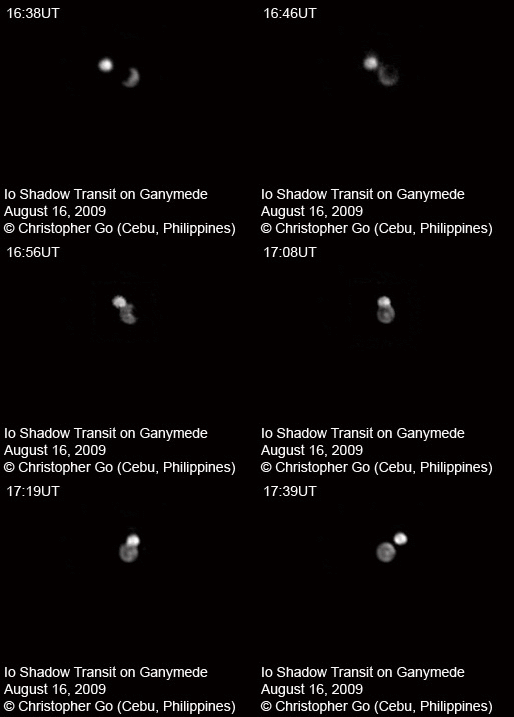
As Jupiter and Earth reached their closest approach for 2009 (also known as opposition when the Earth is between Jupiter and the Sun), Christopher Go captured a number of excellent views of Jupiter and its major satellites over the weekend with his telescope in the Philippines. Included in these images was an eclipse on Ganymede caused by the shadow of Io crossing the larger satellite's surface. This is the opposite of what I've been talking about for much of the summer, where the shadow of Ganymede crossed Io's surface.

The animated gif of the incredible imaging sequence is presented at right. Don't forget to check out the rest of Christopher Go's Jupiter images on his website.

Link: Jupiter in 2009 [jupiter.cstoneind.com]