Wednesday, March 12, 2008

Little Bits 'O the Day - March 12, 2008

A few random items for today:

Sulfur dioxide and Sulfur in Tvashtar's Plume

There is a nice blog post by Ted Stryk, guest blogging for the Planetary Society at the Lunar and Planetary Sciences Conference, on some of the presentations from last night's poster sessions and yesterday afternoon's lunar session. One of posters Ted highlights is the one by Kandis Lea Jessup and John Spencer titled, "Detailed Analysis of the Tvashtar Plume Spectral Behavior." I highlighted the abstract for this poster last week.

Ted reports that the authors have determined that the S2 to SO2 ratio in the Tvashtar plume was between 0.01 and 0.02. In other words, in their measurements based on images taken by Hubble last February, the plume consisted of significantly more Sulfur dioxide than diatomic Sulfur. This value would seem to be in conflict with the presence of a red ring plume deposit, which is thought to be caused by the deposition of sulfur from Io's plumes. However, measurements of the Pele plume suggest that the Sulfur to Sulfur dioxide in these larger plumes can vary between 0.01 and 0.3, so the low ratio at Tvashtar may not be representative of the average.

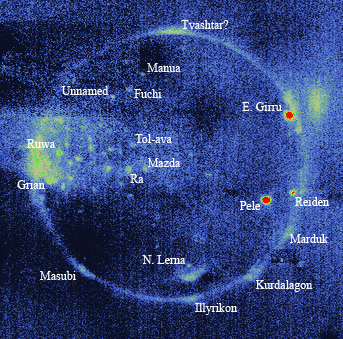
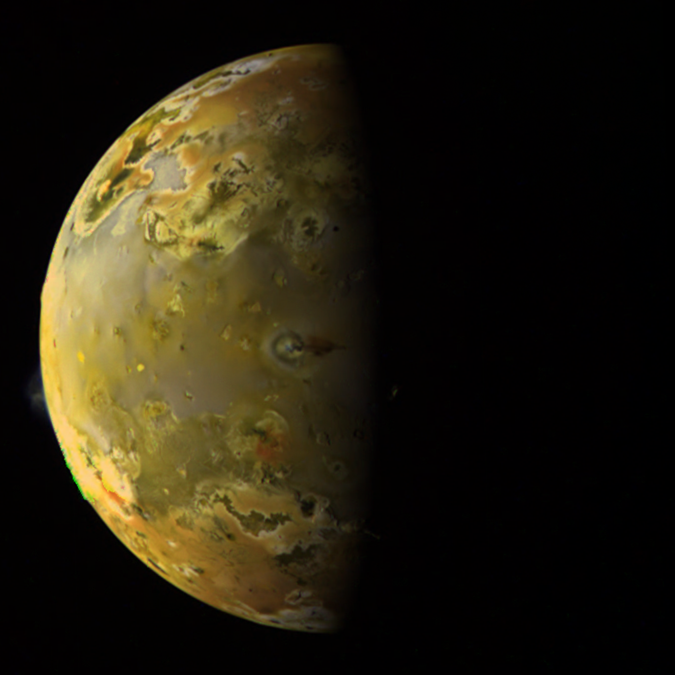
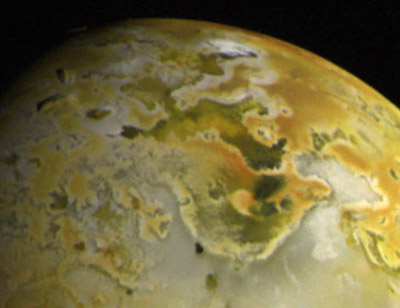
Another consequence of the low S2/SO2 ratio is that the high optical depth seen in the Hubble WFPC2's F255W filter (an ultraviolet filter that senses gases in Io's plumes, rather than the dust seen in visible wavelength images like the LORRI images above) was not due to absorption by S2, but instead is due to SO2.

An interesting result. Definitely indicates that Tvashtar's plume was quite gas rich.

Tuesday, March 11, 2008

Galilean Satellites Poster Session Tonight

Checking up on the blog before after today's LPSC sessions? Don't forget to visit the Galilean Satellites poster session in the Athletic Center of the South Shore Harbor Resort and Conference Center. Yeah, you have to make the long trek all the way over from the hotel to the athletic center, but you'll be glad you did. Show the Io poster presenters some love by stopping by their posters.

If you are there, please feel free to share your thoughts. Trash the Europa map and praise the Io one. Have at it. ;) (Don't actually trash it, a lot of work was put into it, even if it is Europa)

LPSC 2008: Heat Flow from Dark Volcanic Fields

I've covered all the Io-related abstracts in tomorrow night's (wait, now tonight's) poster session covering the Galilean Satellites. Yeah, Io got lumped in with *shiver* Europa (in my mind, there are United Nations peace keepers between the Io and Europa poster boards), Ganymede (everyone's second favorite schizophrenic moon), and Callisto (thanks to the discovery of rings around Rhea, Callisto now possesses the sole title of most boring moon ever). So, if you are at LPSC, be sure to visit the poor Ionians as they will most likely shoved along the back wall like they were last year. Please, show them some love.

Anyways, I am rambling on here. There is an additional Io-related abstract submitted to the LPSC conference, a print-only abstracted by Glenn Veeder, Dennis Matson, Ashley Davies, and Torrence Johnson titled, "Io: Heat Flow from Dark Volcanic Fields." The authors examined the distribution of dark flow fields on Io and examine their contribution to Io's high heat flow (the total amount of heat released in a given time period from the interior). As a print-only abstract, the results presented in this abstract will not be presented at a talk or a poster at LPSC.

The authors focused on dark flow fields, areas where lava has flowed across Io's flat(ish) plains, rather than those flows within the topographic confines of a patera. It is thought that these flows are compound pahoehoe silicate lava flows, built up by small outbreaks on top of older flows punctuated by period of high eruption rates that rapidly grow the lava (akin to flood basalts on Earth). They determined that dark flow fields are not distributed evenly across all longitudes with a peak near the center of the anti-Jovian hemisphere (in the abstract, the anti-Loki hemisphere). Flows seen near this peak include Prometheus, Zamama, Thor, Culann, Volund, and Mycenae Regio. This correlates well with a peak in the distribution of volcanic centers and paterae. The authors note that a correlation is not seen at the other peak in volcanic centers and paterae near 325° West, which includes Loki.

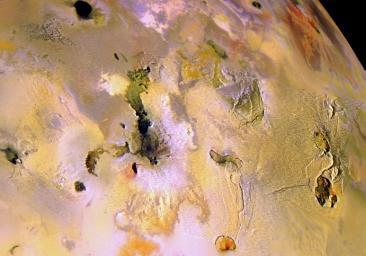
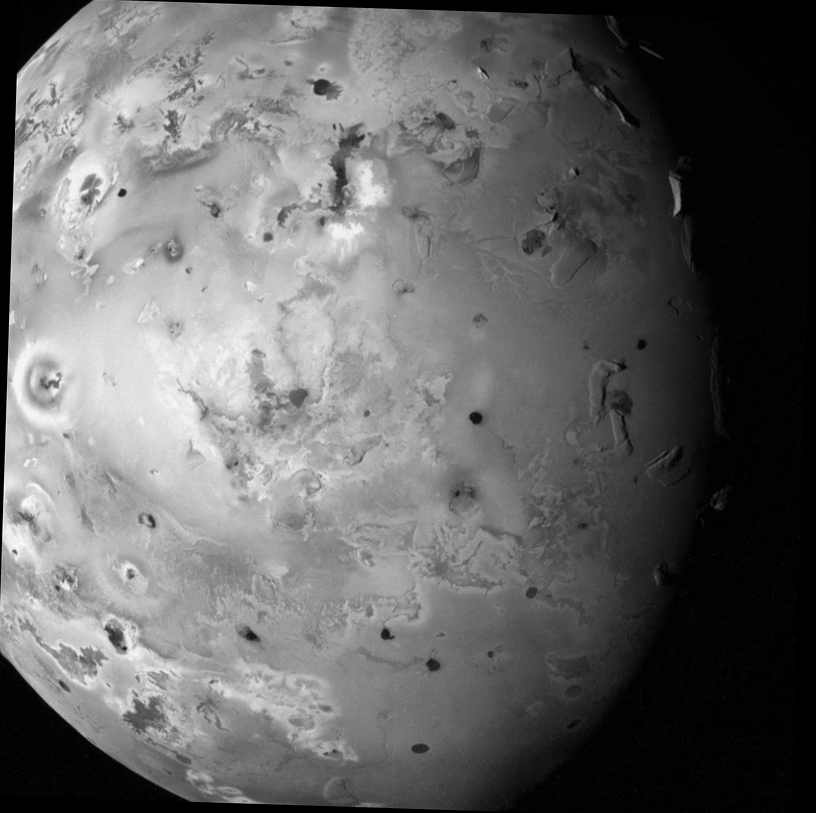
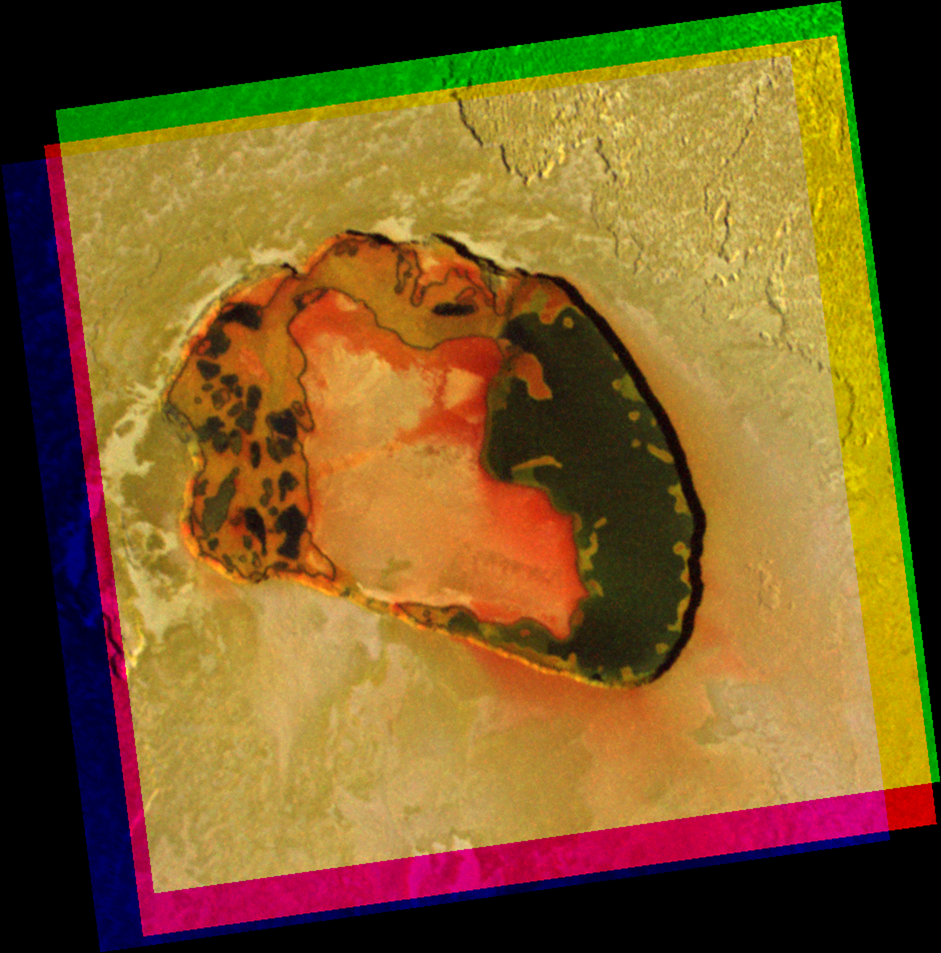
The authors then examined the contribution these lava flows make to Io's total heat flow. In the abstract, they focused on two prominent flow fields: Lei-Kung Fluctus (shown above, big flow field on Io's northern trailing hemisphere) and Amirani. Using NIMS and PPR data from Galileo, the authors calculated that that the two lava flows contribute 4.5x10¹¹ W and 1.5x10¹² W to Io's total heat flow, which is on the order of 1014 W. In total, the 24 flow fields the authors examined contribute approximately 10% to Io's total heat flow, equivalent to Loki Patera. It should be noted that the authors mapped about 3x10⁵ km2 worth of dark flows. This is about 25% of the total amount of dark lava flows covering Io's surface according to the mapping done by Williams et al., so that 10% figure maybe an underestimate. I can't tell, but it also seems like they assumed an effective temperature (basically an average temperature for the entire flow field) to come up with their heat flow numbers for at least some of the fields they mapped.

An interesting abstract. I will be interested in seeing how their dark flow mapping compares to what Williams et al. has done (this also sounds like the kind of project that global geologic mapping is suited for), particularly since Williams et al. mapped a factor of 4 more dark flows material than Veeder et al. did.

Link: Io: Heat Flow from Dark Volcanic Fields [www.lpi.usra.edu]

Monday, March 10, 2008

New Template

I changed the Blogger template used for The Gish Bar Times. While the previous version looked a little more sleek than this one, I also thought it was a little difficult to see sidebar headings and links. They show up a lot easier now, though I still want to experiment with customizing the page. Not today but maybe sometime in the next week I will create a custom header graphic.

Comment away on what you think. And feel free to use the comment system and not just send me emails.

Not in Houston

For the last time, I am not in Houston. My current location is nearly 1,100 miles from the conference center (by car). So, I am not at LPSC this year. Don't blame me, blame LPSC being a week earlier this year (and not coinciding with the U of A's Spring Break). Blame Enceladus. Blame Titan not being cool enough lately.

Even though I am not at LPSC, there are a few attendees blogging about their experience. Emily Lakdawalla is reporting from the first day of LPSC and the MESSENGER and SELENE Special Sessions for the Planetary Society. Rebecca Bemrose-Fetter and Pamela Gay are blogging for Astronomy Cast Live, so far giving plenty of details on today's sessions. Rebecca and Pamela do a remarkable job handling the MESSENGER results, despite not being geologists. I could follow what they were trying to convey, anyway.

Io transiting across Jupiter

Anthony Wesley from Murrumbateman, Australia took a few nice images yesterday using his 13" Newtonian telescope of Io transiting across the face of Jupiter. Quite a nice collection also showing the shadow of Io on Jupiter's cloudtops.

Some nice images by astrophotographers in the southern hemisphere as Jupiter is just a bit too far south still for most of us here up north.

Link: Jupiter Image 2008/03/09(UT) [alpo-j.asahikawa-med.ac.jp]

Sunday, March 9, 2008

LPSC 2008: Global Geologic Mapping of Io

The final Io-related poster that will be presented during Tuesday's poster session at the Lunar and Planetary Sciences Conference is titled "Global Geologic Mapping of Io: Preliminary Results" by Williams et al.

This is an update on the author's three-year global mapping project. They are nearly finished with their work and will present a preliminary version of their global geologic map at LPSC. They hope to have a completed version submitted to the USGS by June.

Global geologic maps help scientists assess the relationships between different types of terrains as well as calculate what percentage of the surface is covered by a particular unit. For example, one project the author's plan on using the map for is to determine whether NIMS hotspots are correlated with dark lava flows, while PPR hotspots are correlated with bright lava flows. The Near-Infrared Mapping Spectrometer (NIMS) was sensitive to shorter, infrared wavelengths (1-5 microns) and thus sensed thermal emission from hotspots with temperatures greater than 200 K, often warmer than that when NIMS observed the day-side of Io. The Photopolarimeter-Radiometer (PPR) was sensitive to thermal infrared wavelengths and thus looked at cooler hotspots down to those just above the background temperature. At several locations, these hotspots were not correlated, suggesting that some PPR hotspots were related to sulfur volcanism, while NIMS hotspots were related to silicate volcanism. The authors plan to investigate that possibility.

Based on their geologic map, the authors determined that the most common surface type on Io is the plains unit, covering 66% of the surface. The next most common is the lava flow unit, covering nearly 28% of the surface.

By the way, if you want to read all of my posts covering the Io abstracts for this year's LPSC conference, you can check out the special page just for them. Still got one more to go.

Link: Global Geologic Mapping of Io: Preliminary Results [www.lpi.usra.edu]

C10 and I27 Reprocessed Images

Finished up on reprocessing images from Galileo orbit C10 and worked a bit more on images from orbit I27 today.

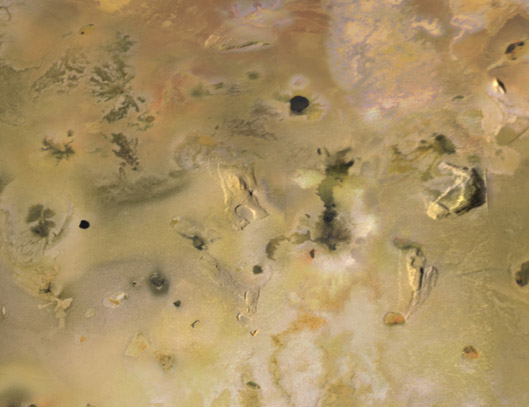
Images from Galileo orbit C10 were acquired on September 18 and 19, 1997. Images from this encounter showed the aftereffects of eruptions at Pillan, Masubi, and West Zal during the summer of 1997. 10ISIOGLOC03 shows the trailing hemisphere of Io at 5 km/pixel. The dark pyroclastic deposits from the Pillan eruption are seen to the northwest of Pele (the volcano at the center of the ring of red material at lower left). 10ISIOGLOC01 shows the leading hemisphere. New plume deposits were seen at a volcano west of Zal Patera and at Masubi in that observation. 10ISIOTOPO02 revealed mountains and other topographic features between 60 and 90 West Longitude.

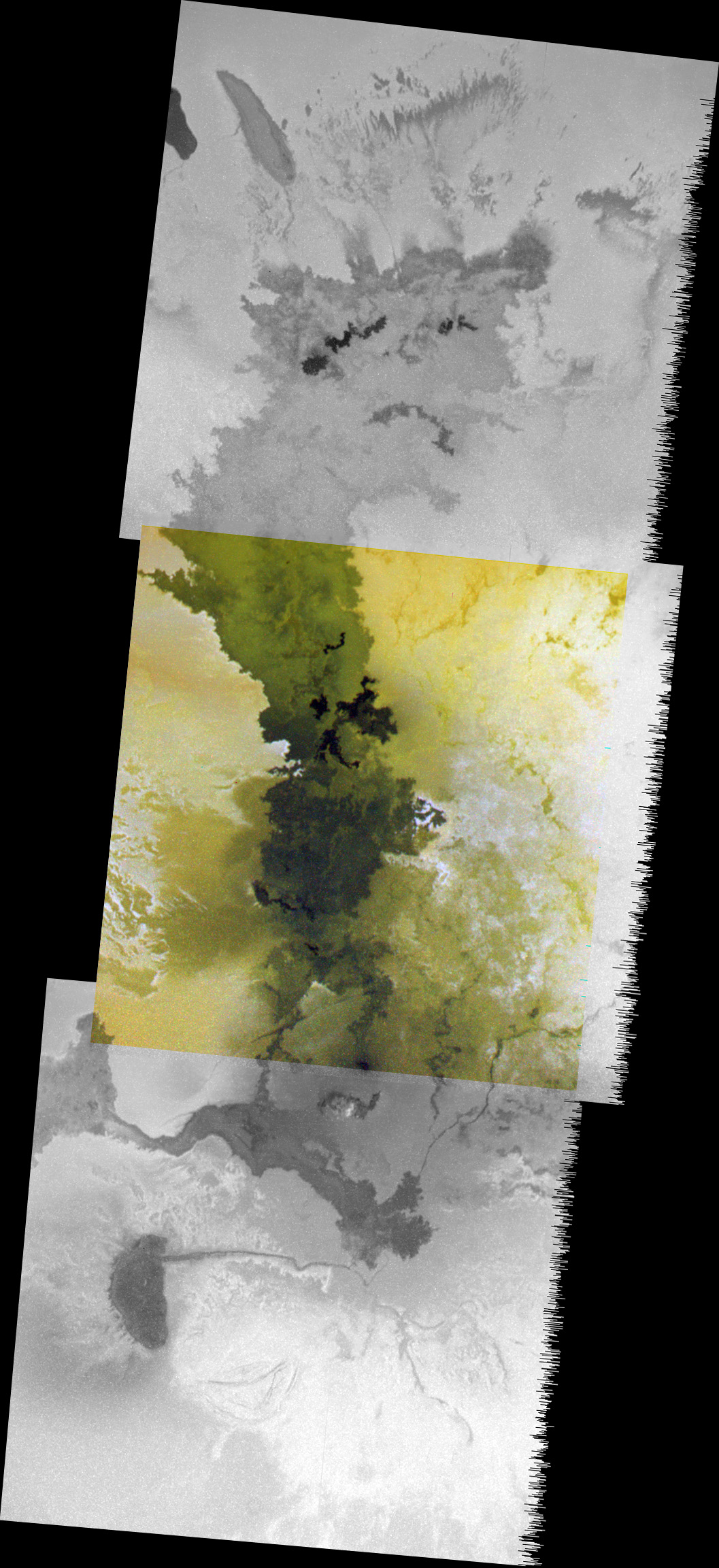
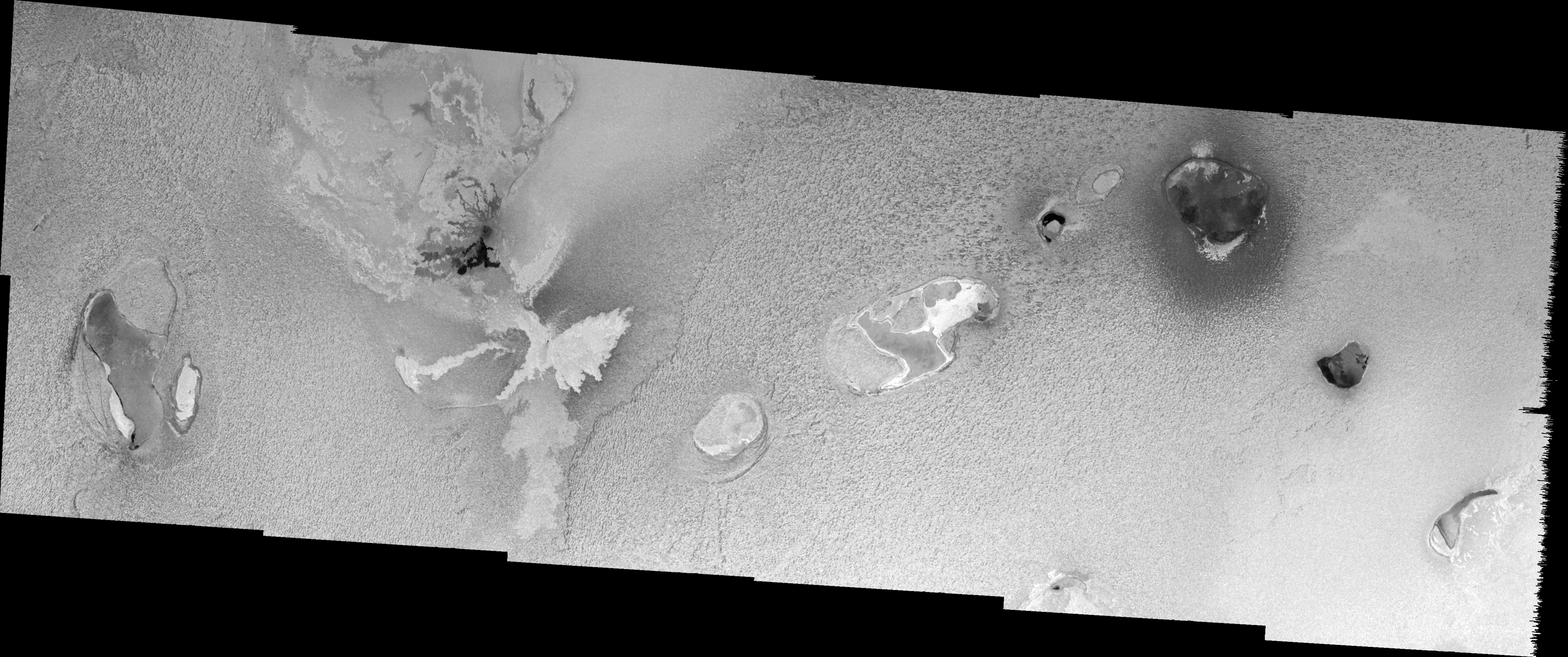
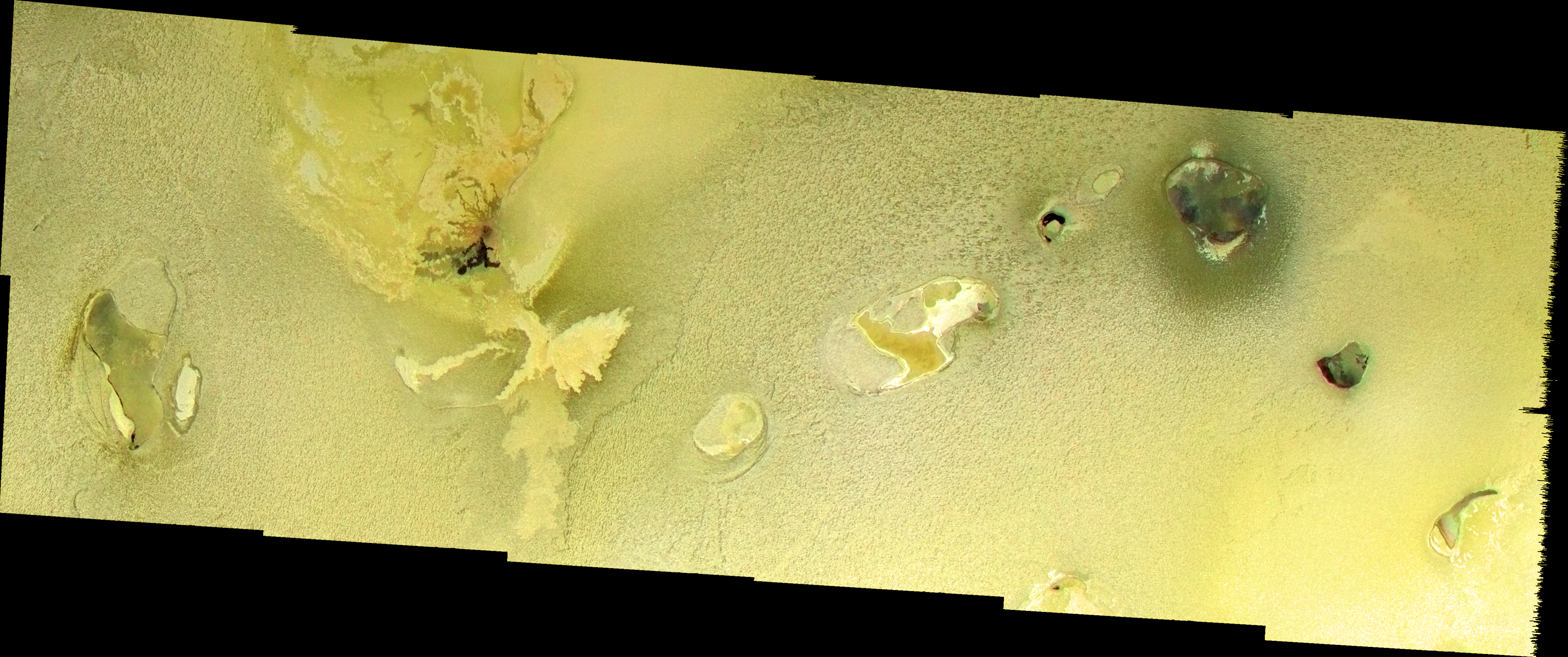
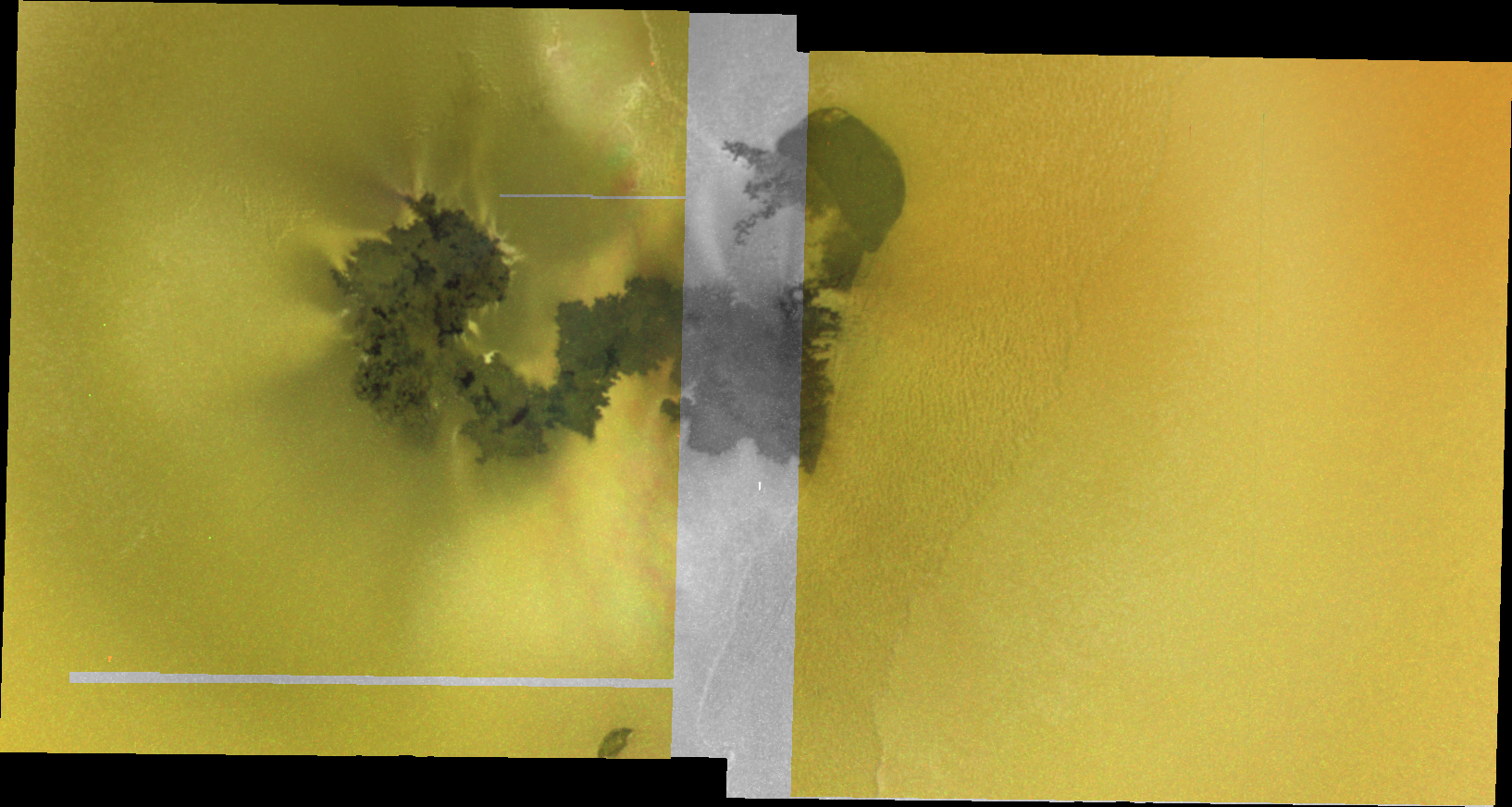
As I mentioned last night, I put together the CAMAXT01 mosaic from Galileo's February 2000 flyby of Io. This mosaic shows the region between Chaac Patera and Camaxtli Patera on Io's antijovian hemisphere at 185 m/pixel. I have now finished a version of the mosaic that combines the high-resolution clear filter data and lower resolution color data from orbit C21. Definitely worth checking out. A similar product was released shortly after the flyby. For my version, I used Moses Milazzo's "true" color version of the C21 mosaic, whereas the official version used the false color mosaic. In addition, the release version was posted before all of the fourth frame of the mosaic was returned to Earth, so this version has the entire mosaic.

Hope you all like.

Link: Galileo Images of Io [pirlwww.lpl.arizona.edu]

LPSC 2008: Io Eclipse Observations

Julie Rathbun and John Spencer have a poster a this week's Lunar and Planetary Sciences Conference entitled, "Io Eclipse Observations: Does Loki Dominate Io's Infrared Flux?"

Rathbun has published a few papers over the last few years on the episodic brightening experienced at Loki and what these brightenings might tell us about the Loki's eruption style. The conclusion she reached in her 2006 paper "Loki, Io: New ground-based observations and a model describing the change from periodic overturn" is that Loki Patera is a periodically overturning lava lake. According to the model presented in that paper, the surface of the Loki lava lake founders when it has cooled and thickened to the point that is negatively buoyant compared to the lava below. The time between this episodic overturning of the lava lake crust varies depending on the amount of vesicles (basically gas bubbles) within the lava crust. Essentially, the more vesicles within the lava crust, the less dense it becomes, and thus the longer it takes since the last brightening before the crust overturns again. As I mentioned in a previous blog post, Rathbun's overturning lava lake model isn't the only one published to explain Loki's behavior.

This attention focused on Loki is the result of its apparent dominance of Io's thermal flux. Rathbun and Spencer examine data taken by NASA's Infrared Telescope Facility atop Mauna Kea in Hawaii to see if Loki does in fact dominate Io's thermal flux when it is observed in eclipse. When researchers observe Io at this facility, they observe it when Io is in eclipse so they can separate flux from reflected sunlight and thermal flux from the satellite's volcanoes. If they observe Io during an occultation just as it is going behind Jupiter, or just egresses from behind Jupiter (depending on when it is in eclipse), they can measure the moon's thermal flux as it more or less of the satellite is hidden behind Jupiter. This method can help pinpoint the location of hotspots on Io's surface. Measurements were also taken of Io's full-disk while the satellite was in eclipse. Such measurements were performed at more wavelengths but their low resolution makes it difficult to pinpoint the location of individual hotspots.

Using a model Rathbun et al. developed in 2006, the authors predict Loki's brightness at 2.2 and 4.8 micron based on the volcano's brightness at 3.5 microns and the duration of the eruption episode. They determined that the 2.2 microns brightness is a close match, but they assumed that the entire thermal flux from Io at 2.2 microns came from Loki. The authors indicate that they will look at the occultation data to determine the percentage of the flux from other volcanic eruptions in order to see just how much Loki dominates Io's thermal flux.

Link: Io Eclipse Observations: Does Loki Dominate Io's Infrared Flux? [www.lpi.usra.edu]

Saturday, March 8, 2008

LPSC 2008: An Assessment of Near-Surface Conditions Conducive to Ionian Sulfur Flows

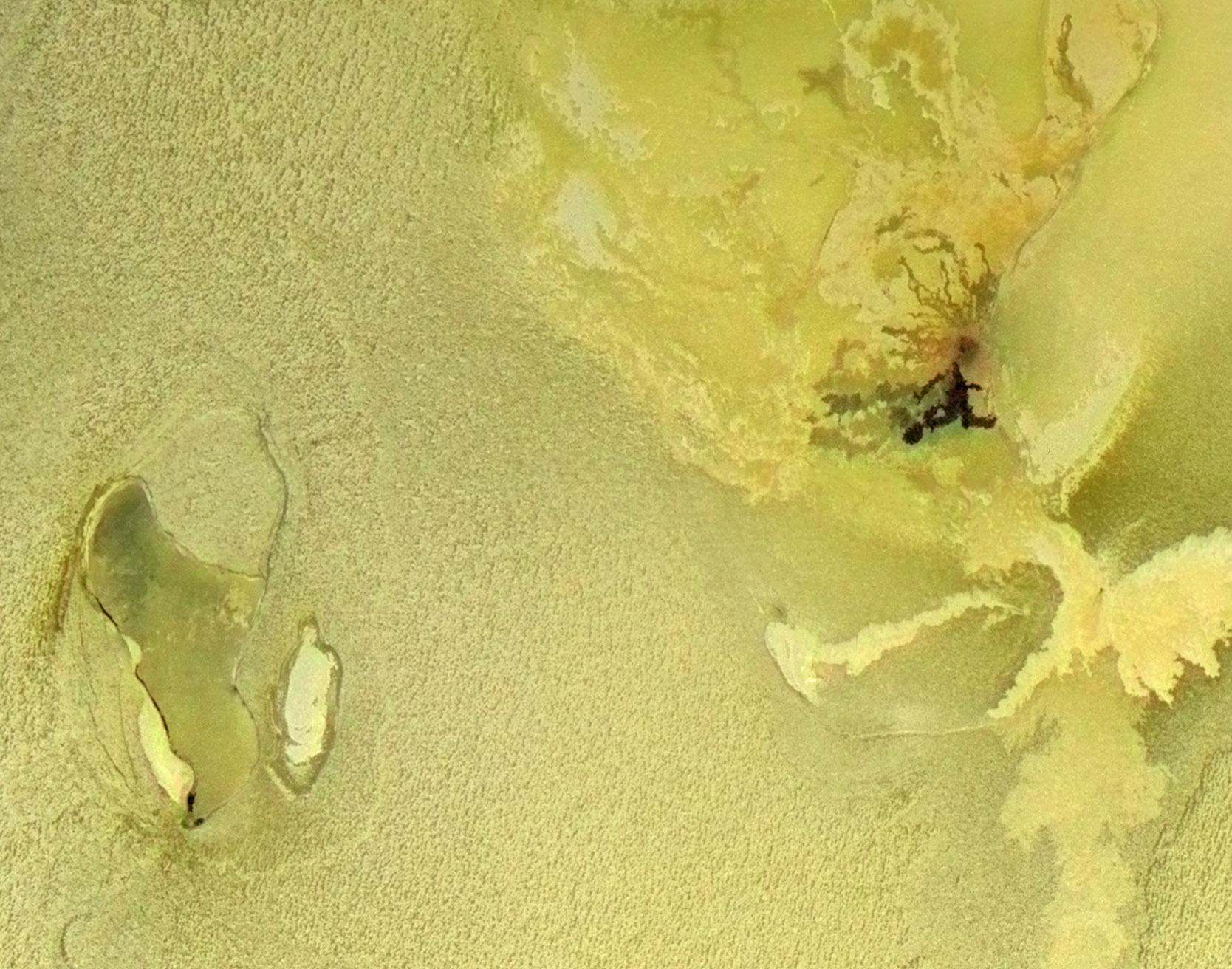
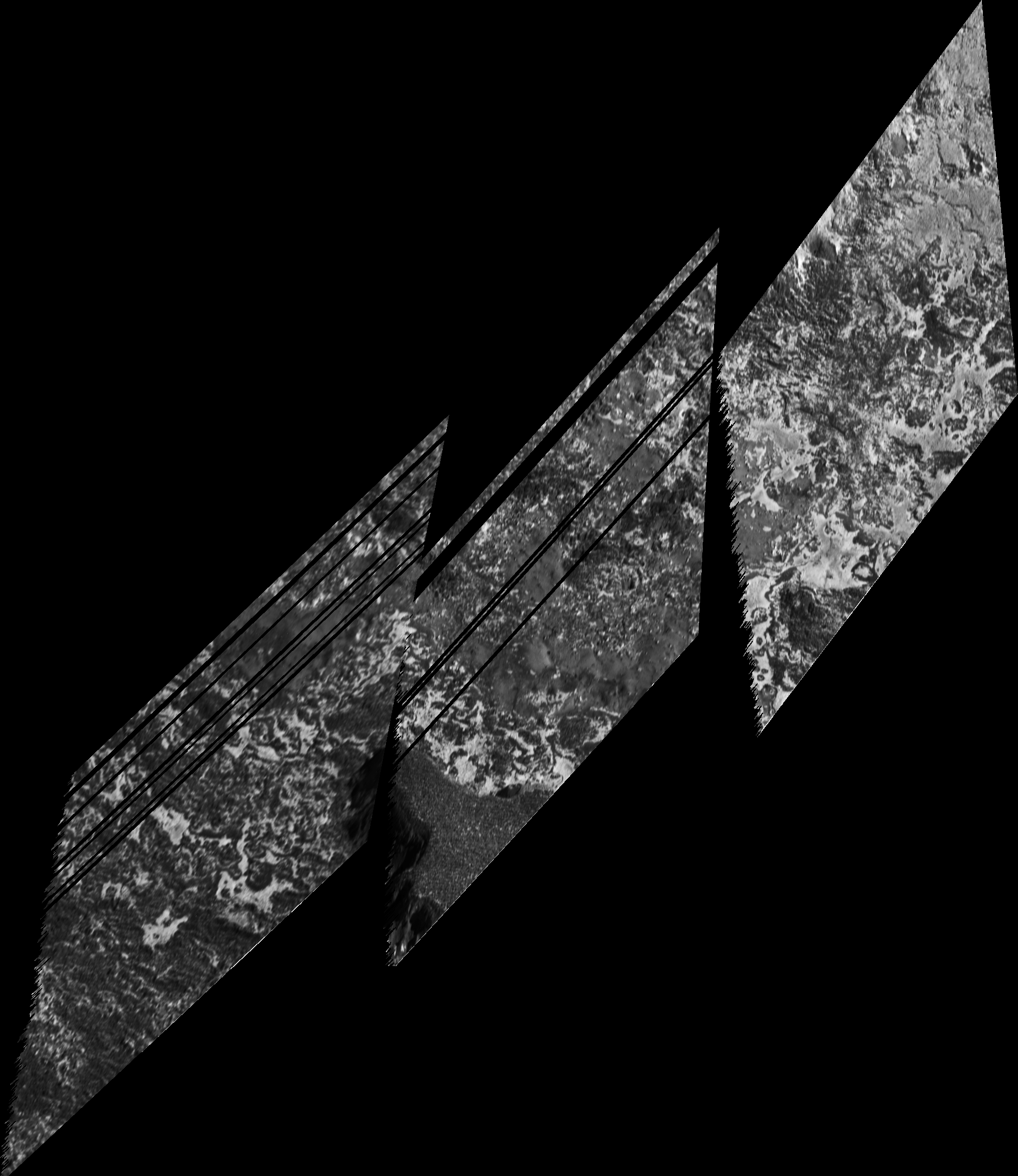
Arizona State University's Ramses Ramirez, Dave Williams, and Ron Greeley have a poster at next week's Lunar and Planetary Sciences Conference titled, "An Assessment of Near-Surface Conditions Conducive to Ionian Sulfur Flows." In this poster, the authors look at whether the bright flows seen at Sobo Fluctus (left) could have been generated secondary sulfur flows heated by a near-surface magma chamber.

In the model used by Ramirez et al., they consider a near-surface magma chamber whose heat is conducted by the surrounding silicate-sulfur country rock to the surface. They then estimated the amount of sulfur that would be melted by such a magma body and compared that to the size of the flows seen at Sobo Fluctus.

The authors determined that the amount of sulfur melted by a near-surface magma body was insufficient to explain the bright flows seen at Sobo. They suggest that the flows are instead primary sulfur flows, erupted from a vent with lava originating in a sulfur magma chamber below the surface.

Interesting work that further suggests the possibility of sulfur flows on Io, at least at some select locations. Many of these flows seem to occur outside of paterae. One possibility is that such activity is usually part of the first stages of paterae formation.

To create the above image of Sobo Fluctus, I reprocessed the entire CAMAXT01 mosaic from I27, which covers the region between Chaac Patera and Camaxtli Patera. Hope you all enjoy!

Link: An Assessment of Near-Surface Conditions Conducive to Ionian Sulfur Flows [www.lpi.usra.edu]

Friday, March 7, 2008

I27 Prometheus - Reprocessed (and what is that dark spot in the window?)

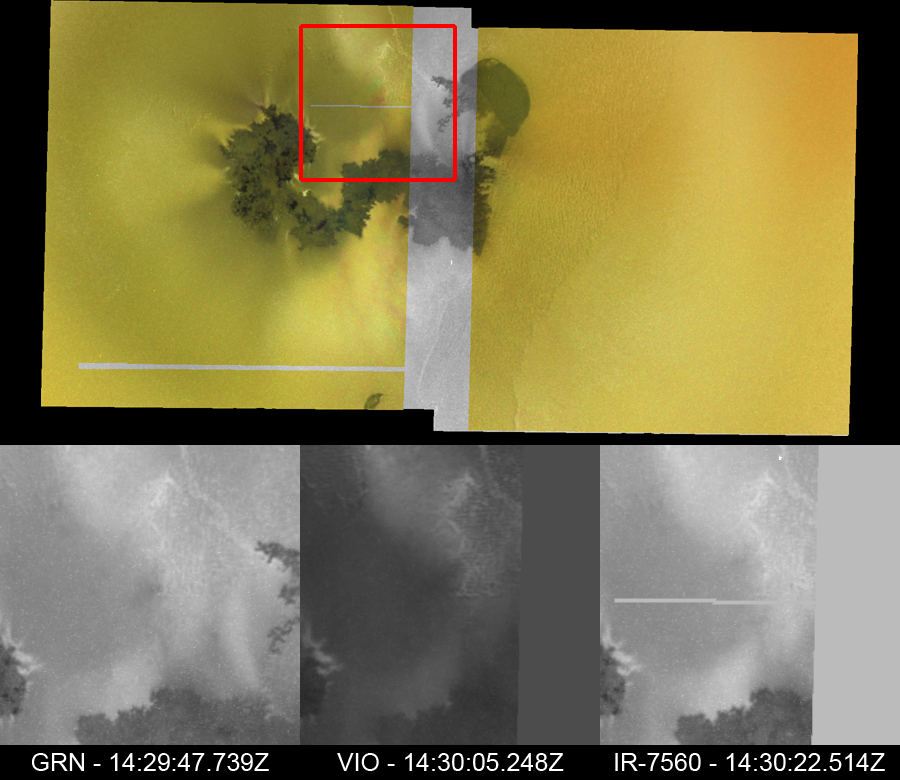
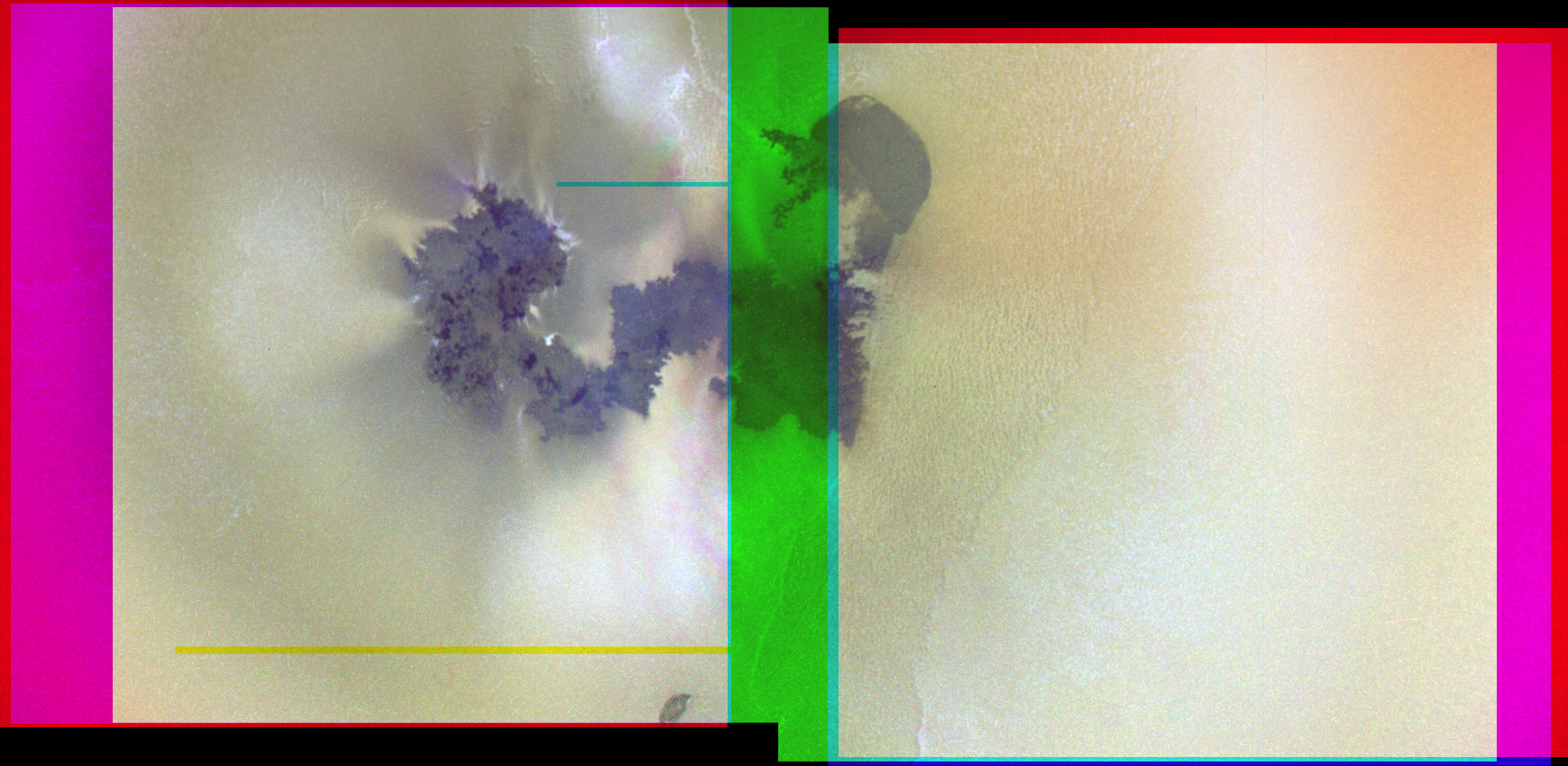
I ended up reprocessing a couple of mosaics from I27, the 27ISSAPPNG01 observation and the 27ISPROMTH02 observation. The later is one of my probably the least presented of the high-resolution Io color observations from Galileo. Most people know of the Tupan, Culann, or Tvashtar color sequences, but not this one as much. Not sure why, sure it has that strip where there is only green filter data, but it still looks very nice, IMHO.

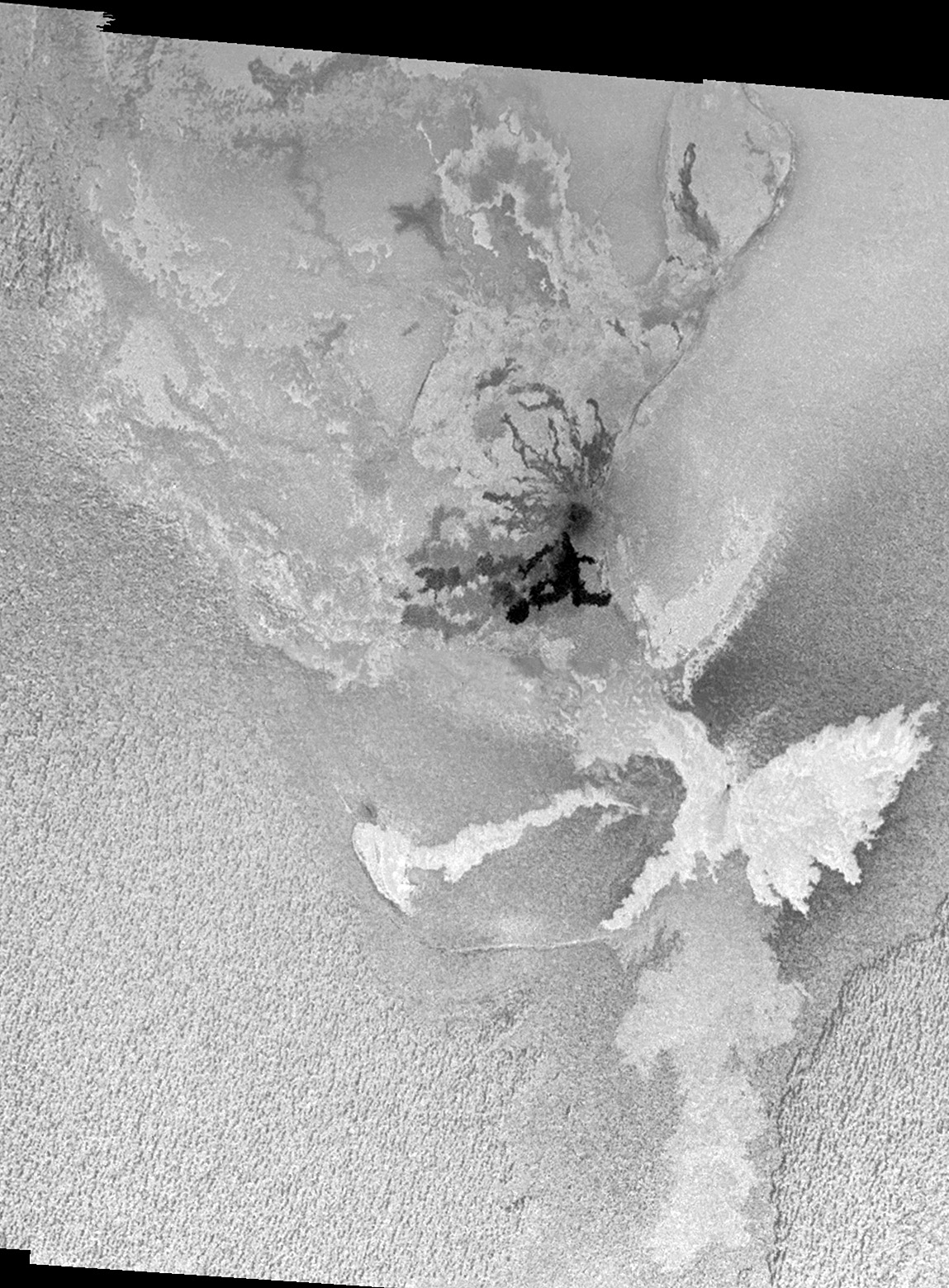
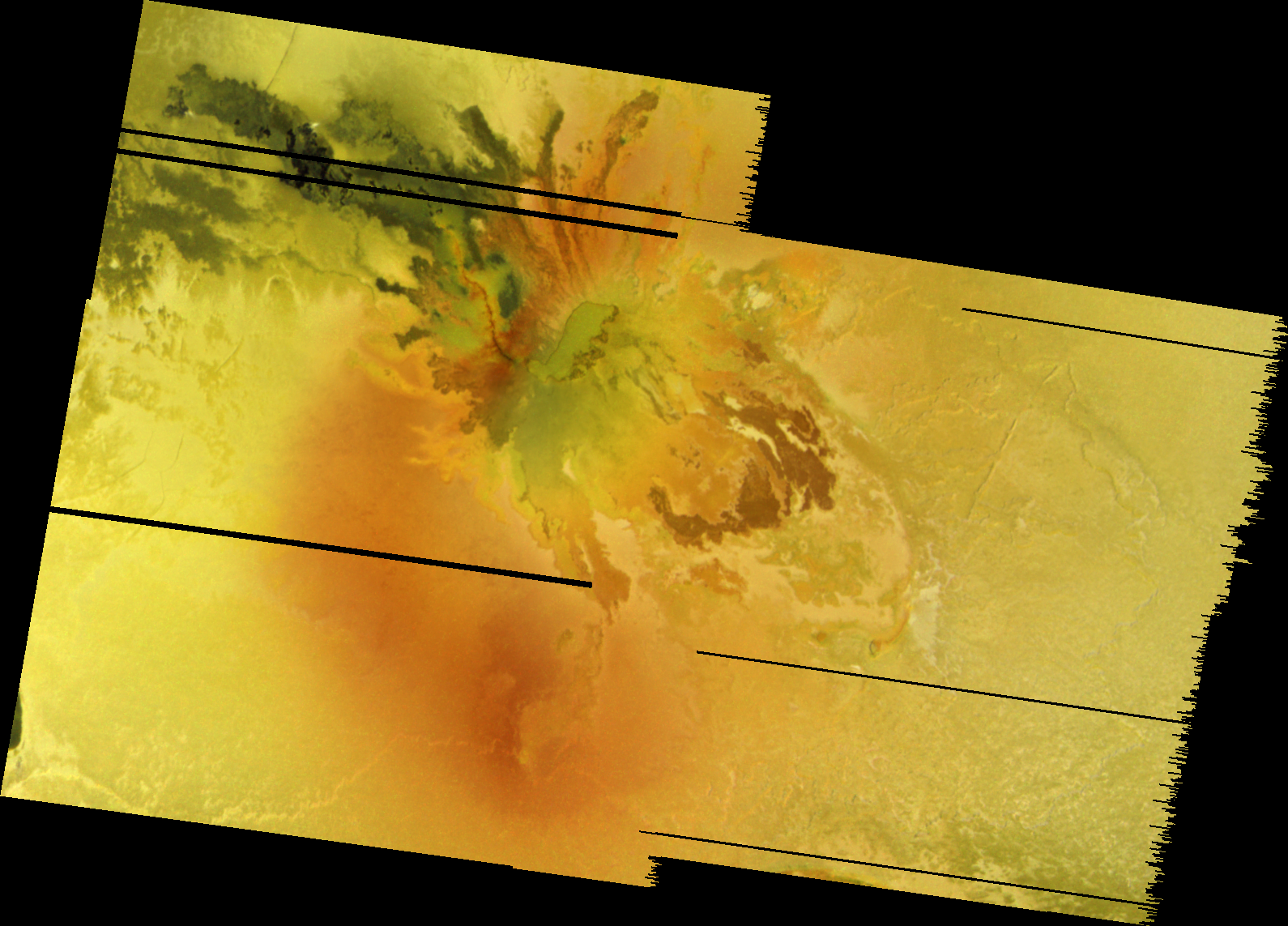
27ISPROMTH02 shows the Prometheus volcano: its lava flows, patera, and plume deposits. The color here is a little stretched compared to natural color since it uses the near-infrared IR-7560 filter instead of red, along with the GREEN and VIOLET filters. Data from this observation was used to show how much new lava flowed out onto the surface between October 1999 and February 2000, indicating that the flow rate was 10 times greater than at Kilauea (a nice new flow from there just reached the Pacific, most news sites have cool video).

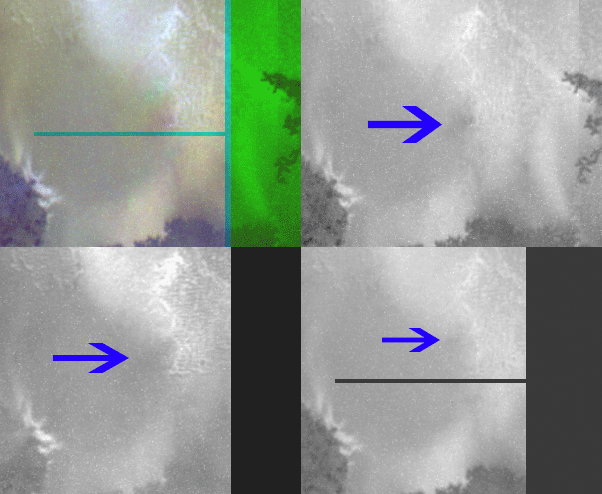
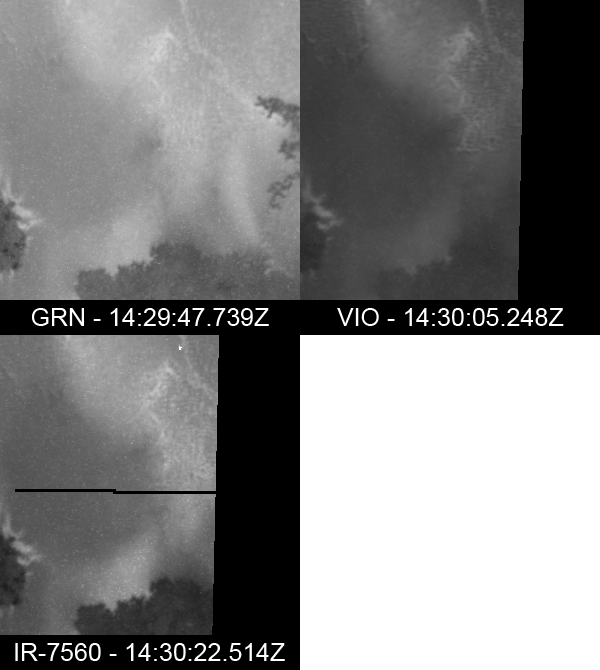
The observation also contains a rather interesting feature. There is a diffuse dark spot that moves from southeast to northwest between filters between the main patera and the western end of the Prometheus flow field. To illustrate this dark spot, I've created a little image product showing all three filter images separately and two animated gifs: one with an arrow pointing out the feature and the other without said arrow. The dark spot is near the center of each cutout. Similar moving dark features maybe seen south of the flow field. I posted on the Unmannedspaceflight.com forum about this feature last year when I first uploaded this observation on my Galileo Images of Io website. I post this again here to see what other people's thoughts are. Taking this with the possible shifting features south of the flow field, my guess is that this features is probably some kind of clump (or shadow of a clump) in Prometheus' plume. Thoughts?

Link: I27 Images [pirlwww.lpl.arizona.edu]

Thursday, March 6, 2008

LPSC 2008: Links between Volcanism and Tectonism on Io

Continuing my series of posts on the Io-related posters and abstracts for next week's Lunar and Planetary Sciences Conference, we look at Giovanni Leone et al.'s poster "Links between Volcanism and Tectonism on Io: A Comparative Study of Monan Patera, Amirani, and Prometheus". In their abstract, the authors developed models for the subsurface structures underneath Monan, Amirani, and Prometheus by looking at the tectonic structures on the surface, such as mountains and fractures, and the shapes of the paterae.

The central thesis of their work is that the same faults that act as zones of weakness that leading to the thrusting upward of the many mountains that dot the ionian landscape are also used as conduits for magma in deep-seated reservoirs to reach the surface. They used images Galileo took of these three volcanic center to model the relationship between faults, subsurface magma reservoirs, and volcanic features on the surface.

For Prometheus, their subsurface model includes three magma reservoir: a primary reservoir in the asthenosphere, a secondary reservoir at around 17 km below the surface in the middle of the lithosphere, and a shallow reservoir between 3 and 5 km below the surface. They suggest that the three reservoirs maybe connected by a thrust fault that bounds the western margin of Prometheus Mensa, a low, lumpy mesa to the east of the Prometheus volcano, and the eastern margin of Prometheus Patera. This thrust fault was the source of the N-S lava flow seen by Voyager at Prometheus and the 75-km long lava flow that developed between Voyager and Galileo. The authors suggest, based on superposition relationships between individual lava flows in the main flow field, that this thrust fault became clogged with cooled magma and a new conduit was activated on the western side of the flow field, feeding the flows that generate the main Prometheus plume. It should be noted though that thermal emission was seen by NIMS at the thrust fault as well as the western end of the flow field, so lava is exposed at the surface in both areas (at least it was eight years ago). There is also a small plume deposit reddish material emanating from the thrust fault, suggesting that it is still active as a primary vent.

Their analysis of the images of the Amirani and Monan volcanoes suggests that those two volcanoes, as well as Maui Patera, are fed by the same magma reservoir systems. Their model suggests that branching conduits from the shallow magma reservoir underneath the Amirani vent feed Maui Patera (to the southwest of the Amirani vent) and Monan Patera (to the southeast of the Amirani vent). Diapirs in the asthenosphere imping on the base of the lithosphere cause the uplifting of nearby mountains Monan Mons and an unnamed mountain to the southwest of Maui Patera. They also suggest the presence of a cold pluton (basically a solidified magma reservoir, though the term applies to any body of magma that has solidified below the surface).

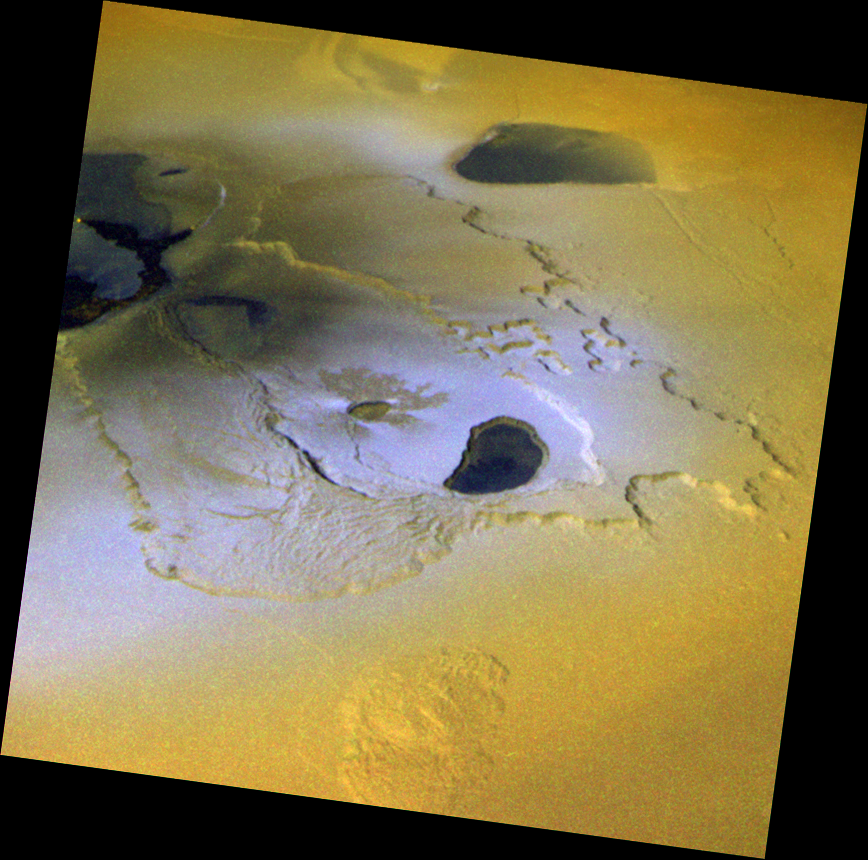
A very interesting abstract. I particularly like the discussion on the subsurface connection between different volcanoes like Amirani and Monan. Such connections can be inferred in other regions as well, particularly where nearby, normally quiescent, volcanoes erupt in a relatively short span of time. Interesting examples include the volcanoes of the Tvashtar Paterae (basically four separate volcanoes partially surrounded by two mesas) and Thor.

Link: Links between Volcanism and Tectonism on Io: A Comparative Study of Monan Patera, Amirani, and Prometheus [www.lpi.usra.edu]

Jupiter and Io animation

Welp, Io still exists as of Monday...

Mike Salway posted on the Cloudy Nights Telescope Reviews forum a nice animation created from images he acquired using his 12" Newtonian from New South Wales, Australia. Definitely worth checking out at the link below. Once at the forum thread, just click on animation.

The ALPO-Japan website has a nice image taken about 27 minutes before the start of Salway's animation by Anthony Wesley from Murrumbateman, Australia. It shows Io against Jupiter's North Tropical Zone (I think that's right, you can correct me in the comments if I am wrong).

Link: Jupiter + Io (+animation) [www.cloudynights.com]

C9 Reprocessed Images

Just got done with the C9 set of images (calibrated, noise-filtered, and combined into color images). These images were acquired on June 27 and 28, 1997, more than 10.5 years ago. Each of these color images were released via the Planetary Photojournal at the time, but these images do differ a bit in term of color saturation and balance compared to the official release products. There are a couple of eclipse observations and an over-exposed Pele plume observation (that doesn't show the Pele plume, as far as I know) that I haven't processed yet. I might get to the second eclipse observation if I can figure out how to properly handle them in ISIS. I think I just have to forgo calibrating those images.

Oh, I just had an idea, too late at night to see if I am right. Maybe the images remain 8-bit after calibration. Perhaps I can fix that.

Anyways, here are the three observations that I worked on this evening:

C9ISPHOTOM01 is a low-resolution, low-phase angle color sequence the leading and sub-jovian hemispheres. The image was taken to better understand the photometric properties of different surface materials. Features on Io's surface can differ drastically in appearance depending on phase angle. For example, compare Tarsus Regio, the bright region at bottom center in C9ISPHOTOM01, at this low phase angles to its appearance at moderate phase angles (like in the next image, C9ISSRFMON01). This observation was released in 1997 by the Galileo Project as PIA01220.

C9ISSRFMON01 is moderate-resolution, moderate-phase angle observation covering the leading hemisphere of Io. For this image, I merged a full-resolution clear filter image with a half-resolution, summed Red-Green-Violet color image. I also posted both separately. A similar merged product was released at the time as PIA00740. This observation was designed to look at topographic features between 30° and 65° West Longitude.

C9ISSRFMON03 is a moderate-resolution, moderate-phase angle observation covering the anti-jovian hemisphere of Io. The big discovery at the time from this observation was the plume over Pillan as part of the major eruption just north of that volcano during the summer of 1997. Hubble observations taken at the same time, IIRC, provided the first indication that something was gone at Pillan, but the plume was initially attributed to Reiden Patera, a volcano a short ways to the southeast. After the C9 eclipse observations were returned in mid- to late-July 1997, it became clear that a major eruption was occurring at Pillan. The surface changes produced by the Pillan eruption were revealed in observations acquired during the next Galileo orbit in September 1997.

Link: C9 Images [pirlwww.lpl.arizona.edu]