Saturday, March 22, 2008

Icarus April 2008 Issue

The April issue of the prominent Planetary Science journal Icarus is now online for subscribers. Among the articles in this issue are two that are directly related to Io. The first, by José Luis Alvarellos, Kevin J. Zahnle, Anthony R. Dobrovolskis and Patrick Hamill, is titled "Transfer of mass from Io to Europa and beyond due to cometary impacts." In that paper, the authors presents the results of modeling ejecta from impacts onto the surface of Io and where that ejecta eventually end up. The second paper, by Donia Baklouti, Bernard Schmitt and Olivier Brissaud, is titled "S2O, polysulfuroxide and sulfur polymer on Io's surface?" In that paper, the authors discuss laboratory spectral measurements of S2O and other polysulfuroxide and experiments to see if condensates from these compounds are stable on Io's surface.

I will try to read through these papers this weekend and give a more thorough review of them here tomorrow.

Link: Science Direct - Icarus, Volume 194, Issue 2, Pages 399-858 (April 2008) [www.sciencedirect.com]

Evaluating the Flagship Concept Studies

The Outer Planets Assessment Group (OPAG), a community forum within NASA designed to help focus outer solar system exploration and to ensure that NASA mission decisions for the outer solar system have community input, released the results of a peer review of the Outer Solar System Flagship concept studies conducted and released last year. The peer review resulted in the downselection from four mission down to three. It had previously been known that the Enceladus mission concept was not selected for further study, but the document provides the rationale behind that rejection. Apparently, it was felt that the concepts developed did not adequately address the primary science goal of an Enceladus mission: to determine the biological potential of the south polar region. The other three missions, the Europa Explorer, the Jupiter System Observer, and the Titan Explorer, were given more favorable reviews with the Europa mission receive the best review.

For those who haven't seen them, there are pretty extensive PDFs covering each flagship mission concept on OPAG website. Io science is best dealt with by the Jupiter System Observer with four targeted flybys in the baseline trajectory. The baseline JSO mission also provides for repeated observations during the Jovian orbital tour as well as during the Ganymede orbit segment, where a top resolution of 775 m/pixel would be possible with the high-resolution camera. The Europa Explorer also includes a monitoring program (only before the Europa orbit segment of the mission), but EE as baselined never comes closer than 267,000 km to Io, providing images with a resolution of at best 2.67 km/pixel.

The other big news in the Downselection document is that NASA will be cooperating with ESA for the next phase mission concept studies. For this purpose, the Jupiter Science Observer and Europa Explorer missions have been combined into a single mission with two spacecraft (NASA providing Europa Explorer and ESA providing Jupiter System Observer). The Titan mission concept has been split between NASA and ESA with NASA proving the Titan Orbiter and ESA providing some type of in situ probe (either a lander or a balloon). Not sure what to make of this last bit of news. This might be good news since this could mean that both Europa Explorer AND Jupiter System Observer could fly as two component of a single, international mission, rather than only one being selected. With Europa Explorer getting favorable reviews and the favorite (at least IMO) to be selected, this could be good news.

Link: Downselection Results for 2007 Outer Planet Flagship Studies [www.lpi.usra.edu]

Friday, March 21, 2008

Three More Mosaics from I24

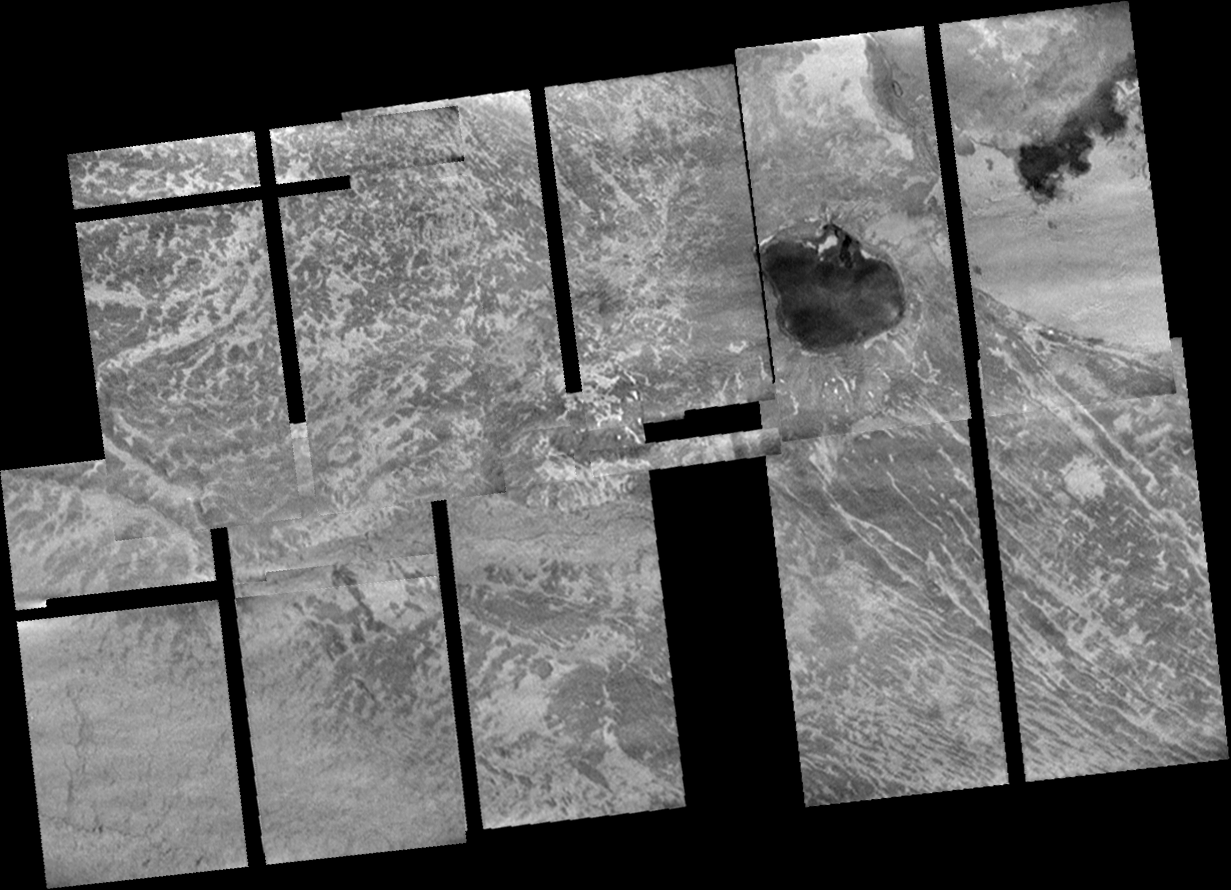
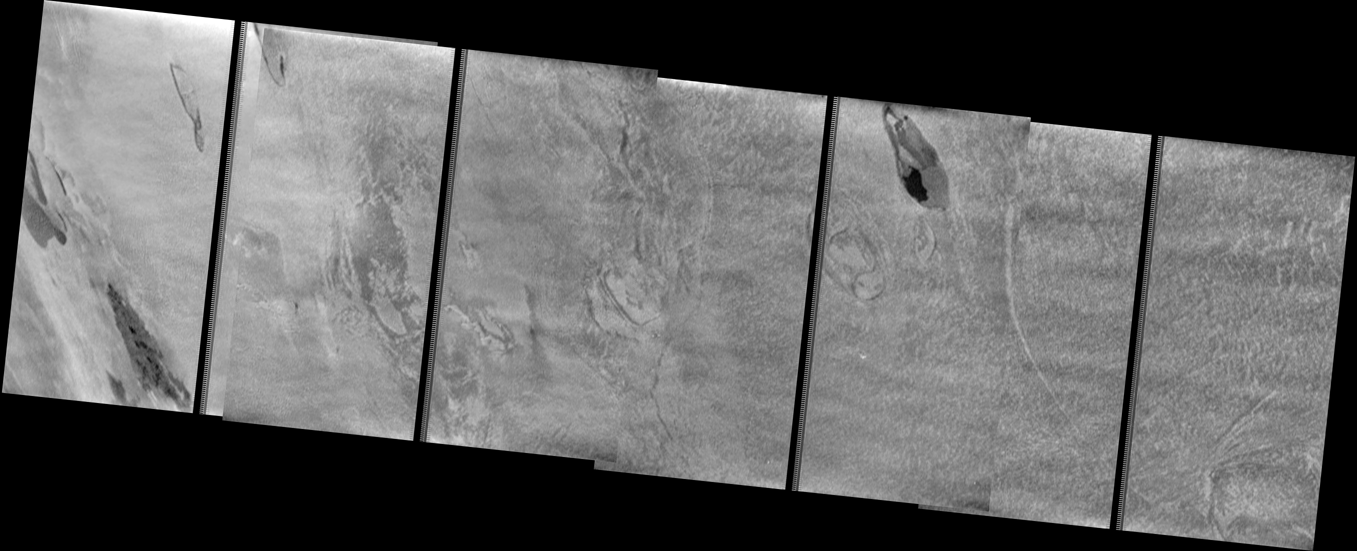
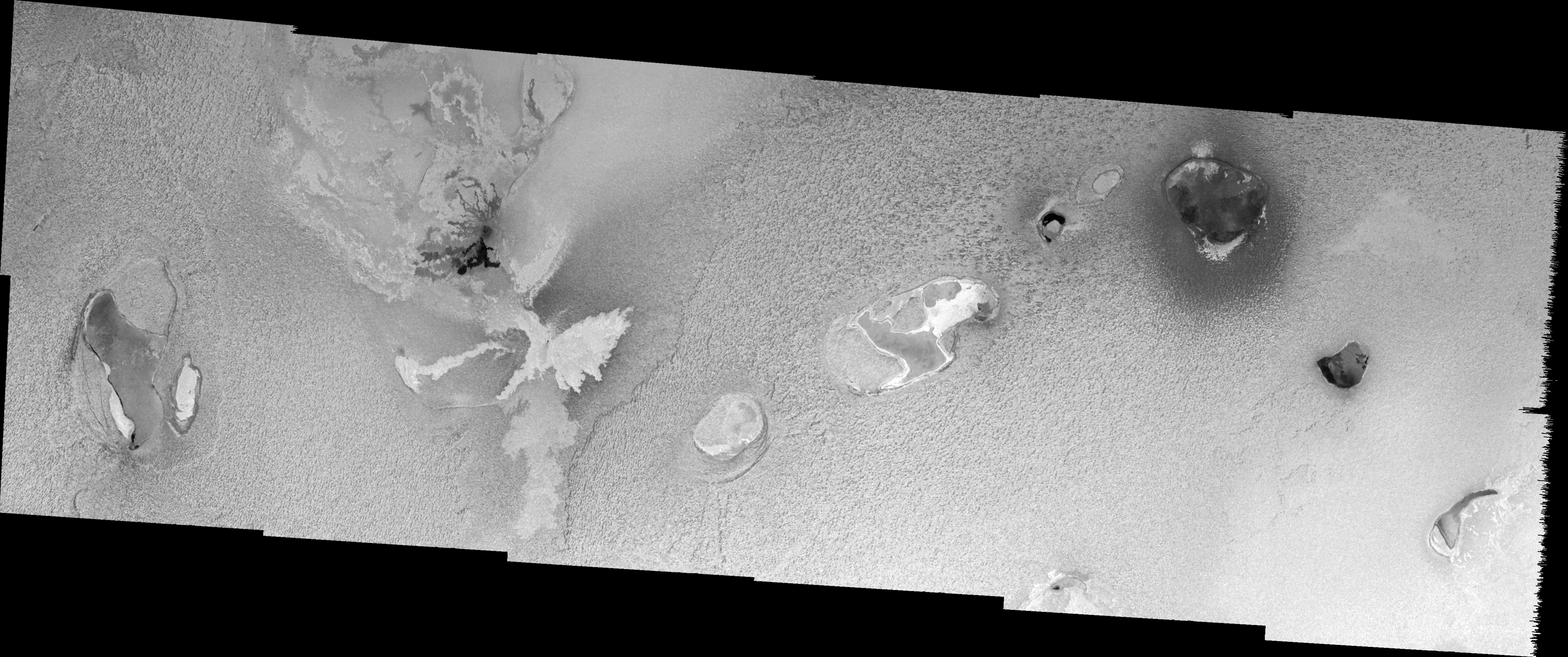
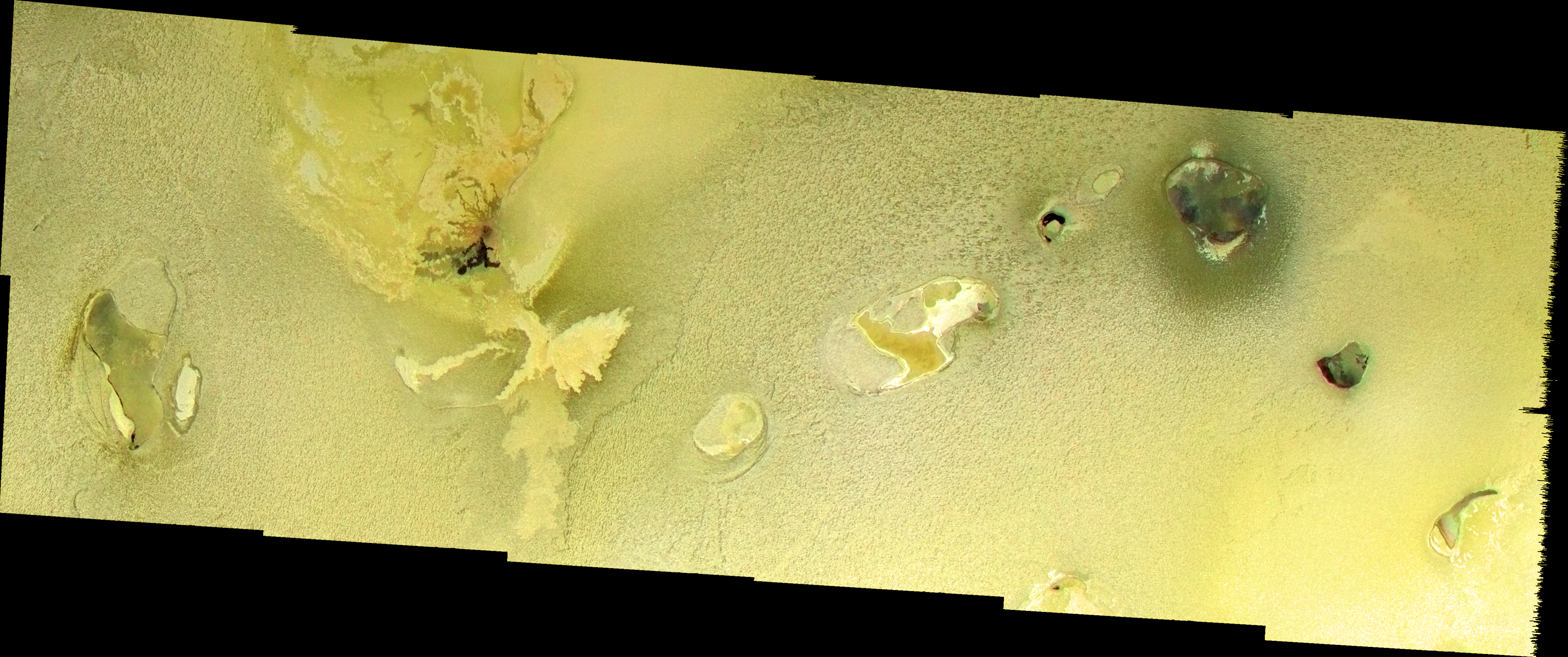
I finished up three more mosaics this evening from 1999's I24 flyby: 24ISPROMTH01, 24ISTOHIL_01, and 24ISDORIAN01. PROMTH01 covers the lava flow at Prometheus, while TOHIL_01 and DORIAN01 cover the mountains Tohil Mons and Dorian Montes, respectively.

A quick note on these images: these are the full-size mosaics. The original images were taken in 2x2 summation mode, which became corrupted before the I24 flyby. So the original raw images were 400x400 pixels in size (as opposed to 800x800 pixels for the normal mode images). As part of the unscrambling process, these images were doubled in size, to 800x800. The final unscrambled images submitted to the PDS were in that doubled size. During the course of my processing of these mosaics, I resampled each image back down to their original 400x400 size, whereas most of the released mosaics from the Galileo project left the images in that doubled form. I think by resizing the images back down to the size they were taken in, the quality of the final product is improved. So for example, you can clearly see the difference in the Pillan mosaic mentioned in the previous post between the smeared images (taken with 21-ms exposure times) and the crisper images (taken with 12-ms exposure times). I don't think this difference is as apparent in the expanded images originally released.

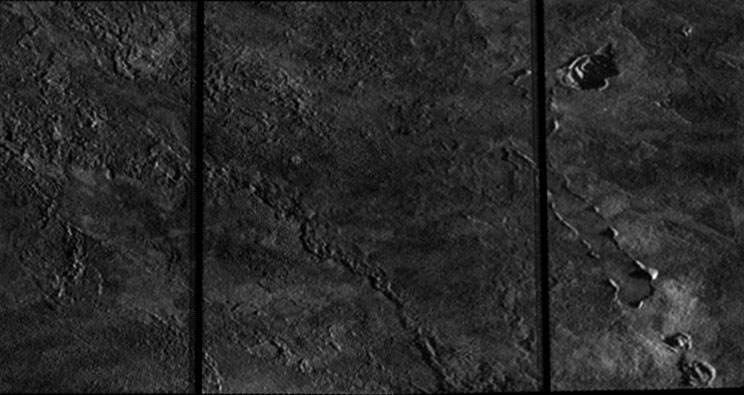
Okay, now on to the mosaics I've posted tonight. The first is 24ISPROMTH01. This mosaic covers the southern part of the Prometheus flow field and the surrounding bright terrain. The flow as crenulated margins as lava flowed around hillocks that cover the surrounding terrain before they cover them. The flow field itself is covered in numerous darker patches that represent new lava flows that hadn't yet been covered by brighter volatiles. It is rather interesting to compare the dark patches to those that show up in four months later. Many of the darker patches seen in I24 had faded while new dark flows showed up. These outbreaks are thought to be created when tubes channel lava from the main vent along a fissure at the eastern end of the flow field (seen between the last and second-to-last frame in 24ISPROMTH01) westward where the lava then emerge as sheet flows. Similar behavior was recently seen at the flows coming from Kiluaea (just imagine that channel is covered).

The next mosaic is 24ISTOHIL_01. This mosaic covers Tohil Mons, a 5.4 km tall mountain on Io's anti-Jovian hemisphere, and two volcanoes, Radagast Patera and Tohil Patera. Both volcanoes are in the upper right frame. Radagast is the dark, mitten-shaped depression; Tohil Patera pretty much covers the whole right side of the upper right frame. Yes, trust me, there is a mountain there. Images acquired during the I32 flyby show the area in low-sun conditions if you don't believe me. If you looks closely, you will note a small surface change within Radagast Patera, where a small, fan-shaped lava flow formed between I24 and I32. Also, comparisons between the two observations can give you an idea of what albedo patterns seen in I24 correspond to which topographic feature in I32.

Finally, there is 24ISDORIAN01. Like the Tohil observation, this shows a tall mountain (Dorian Montes) at high-sun conditions, making the mountain nearly invisible. You can still make out some topographic features that are marked by albedo markings as well. At least two volcanoes are visible in this mosaic: a pair of lava flows associated with Marduk Fluctus in the first frame and Haokah Patera in the third.

Still got plenty more to go. Stay tuned.

Link: Galileo I24 images [pirlwww.lpl.arizona.edu]

Thursday, March 20, 2008

Mosaics from I24 Reconstructed Images

I've started processing some of the mosaics from the Galileo I24 flyby that took place on October 11, 1999. Most of the images acquired during this flyby were taken in 2x2 summation mode, so the images had half the resolution of normal mode images. Unfortunately, an error in the camera, that began on the previous orbit, caused these images to become scrambled. Luckily, an algorithm was developed that reconstructed the scrambled images.

So tonight I started working through some of these for my images page, particularly the 24ISPILLAN01, 24ISCOLCHS01, and 24ISZAMAMA01 mosaics. Ordinarily, I would initially process these images in ISIS before piecing the mosaics together in Photoshop. Unfortunately, these reconstructed images aren't fully in PDS-compatible format so ISIS can work with them beyond the initial conversion to ISIS. So I can't reproject them, which would make it easier to piece them together. So everything was done in Photoshop, piecing them together and adjusting each image so that they would fit together. I think the results turned out pretty well.

24ISPILLAN01 covers a lava flow that formed during the summer of 1997 north of Pillan Patera on Io's trailing hemisphere. The flow can be seen as the darker material on the western two-thirds of the mosaic. According to Williams et al. 2001, the lava flow appears to have been emplaced as a turbulent sheet flow, with few apparent channels. Several pits are also seen that maybe rootless cones, formed from the interaction between the hot, flowing lava and the sulfurous frost beneath. On the eastern third of the mosaic, the terrain that existed before eruption can be seen. It appears hummocky with at least one apparent flow margin, suggestive of a prior eruption at this location. It isn't certain if the hummocky nature of the surface existed before the 1997 eruption, or if it is related to pyroclastic processes that occurred during that event.

24ISCOLCHS01 is a high-resolution mosaic covering Ot Mons in the central part of Colchis Regio. The mountain is covered in numerous hummocks, similar to the surface of the northern component of Hi'iaka Montes, and is likely related to the degradation of the mountain.

24ISZAMAMA01 covers the southern portion of the Zamama lava flow (a major volcanic center during the 1990s) and the surrounding terrain. The Zamama vent is just to the upper left of the mosaic and is surrounded by lava flows radiating out from it (see this image from the 24ISZAMAMA02 observation for context). The toes of some of the flows that radiate south can be seen at the far left hand side of the mosaic. To the east of those are bright, incised channels that might be related to sulfur volcanism. Portions of the main Zamama lava flow can be seen through the rest of the mosaic. This flow has a relatively bland surface with crenulated margins.

There are plenty more mosaics to work on but it is getting quite late here. Hope you all enjoy these.

Link: Galileo I24 images [pirlwww.lpl.arizona.edu]

Wednesday, March 19, 2008

Moses Milazzo's Going Away Party

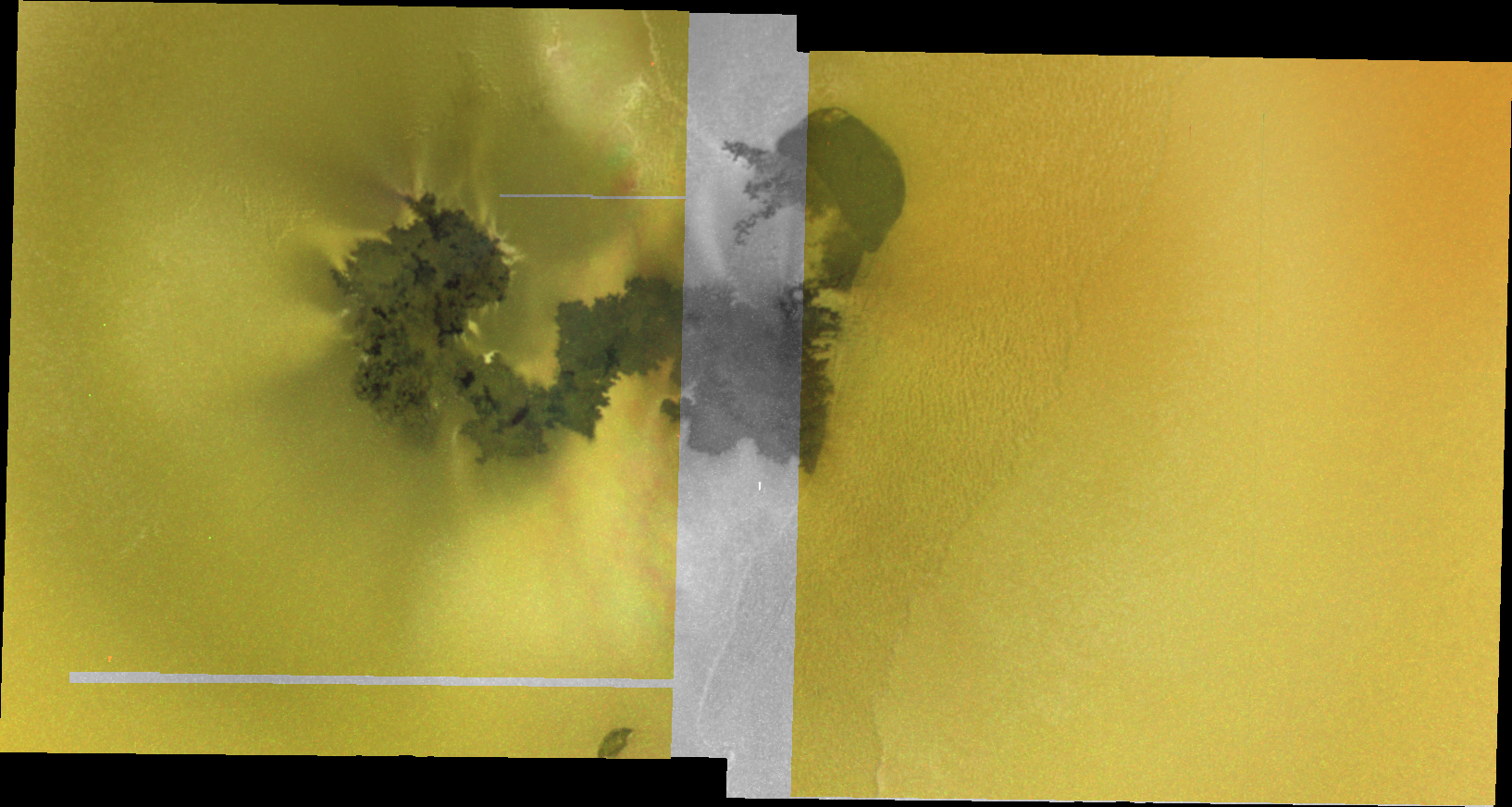
The denizens of the Planetary Image Research Laboratory (PIRL) had a going away potluck lunch today for Moses Milazzo and Chris Okubo. Both are working on the HiRISE project for PIRL's director (and my boss), Alfred McEwen. Moses Milazzo has been at PIRL since 1997. At one point, he worked pretty heavily on Galileo image processing, particularly Galileo cartographic work and mosaics of Io. A couple of the more prominent mosaics that he worked on that were released during the Galileo mission include the C21 color mosaic (left) and merged low-resolution color-high resolution greyscale data from the Io flybys (like this one of the Culann-Tohil region).

Moses will now be moving on to the USGS Astrogeology department in Flagstaff, Arizona. Good luck to him there. This also makes me the last of the "Io-era" holdouts.

Tuesday, March 18, 2008

Solfataras at Kilauea

The Honolulu Star-Bulletin reported today on a brand new gas vent at the Halema`uma`u crater at the Kilauea volcano on the island of Hawaii. This gas vent, also known as a solfatara or fumerole, has emitted a large amount of sulfur dioxide, sulfur trioxide, and water vapor over the last few days to the point where health warnings and closures have been issued for the area around Kilauea. Also in the last few days, dull red glowing material has been visible near these vents. The temperature of this material is only 772 K, which might be indicative of molten sulfur.

Solfataras might be a good terrestrial analog for Io's Prometheus-type plumes. These plumes are thought to be formed when silicate lava interacts with sulfur dioxide frost on the surface.

Link: Glowing sulfur stumps brains at volcano site [starbulletin.com]

UV Io footprint leading spot

I got a chance to read the Io footprint paper that was published on Saturday and made the space news rounds yesterday. The article is titled, "UV Io footprint leading spot: A key feature for understanding the UV Io footprint multiplicity?", and was published in the journal Geophysical Research Letters (Geophys. Res. Lett. or GRL) by Bertrand Bonfond et al.

The Io footprint is an auroral glow at Jupiter's north and south polar regions that is generated by infalling ions traveling along Alfvén waves between Io and Jupiter. This connection between Io and Jupiter is an Alfvén wing known as the Io Flux Tube. This connection is bent with respect to the magnetic field lines depending on Io's position in the plasma torus as Alfvén waves travel slower through dense plasma (like in the torus). So if Io's is at its furthest point in its orbit above the plasma torus (the torus is tilted with respect to Io's orbit by 7 deg., as is Jupiter's magnetosphere), the waves travel essentially along the magnetic field lines to the north polar Io footprint since it travels through less plasma, while they are significantly bent as they travel to the south polar footprint. Also, the auroral emission at the north polar footprint is brighter than in the south. The reverse is true if Io is at its furtherest point below the torus in its orbit.

The authors looked at observations of the Io footprint in the UV from the Hubble telescope acquired between 1997 and 2007. They noted several spots in addition to the main Io footprint. In most cases, they resolved fainter spots trailing the main bright spot, and in some cases, a faint spot leading the main spot. They found that when Io is at its highest point above the torus in its orbit, the spots trailing the Io footprint in the north were at their brightest and there was a spot leading the Io footprint in the south. They found the reverse when Io was at its farthest point below the plasma torus; there were multiple bright spots trailing the main footprint in the south, and a leading spot in the north.

They interpret this data to indicate that the leading spot is the result of a connection along magnetic field lines between the brighter Io footprint and the other spot near the other pole (remember the fainter spot also trails the brighter footprint because the Alfvén waves that make it have to travel through more plasma in the plasma torus). The secondary spots trailing the brighter Io footprint are created by a connection along magnetic field lines from the fainter Io footprint to the brighter one. Since the fainter one trails, the waves will impact Jupiter's upper atmosphere behind the brighter spot.

A pretty interesting paper with an elegant model. Since I am not a plasma physicist, I can evaluate the model to see whether it passes the non-sense test, but as a non-specialist, it seemed to make sense to me.

ADDED: I replaced the original image in this post with a cartoon schematic illustrating the various connections that create the Io footprint. The blue connections are the Alfvén wings between Io and Jupiter. The connection to the south pole basically follows the magnetic field lines between Io and Jupiter because it doesn't encounter much plasma (in the cartoon, Io is near its southernmost point in its orbit so most of the Io plasma torus is above it). The connection to the north is bent as the Alfvén waves are slowed by the plasma torus. The red connections are the magnetic field lines that connection the Io footprint in one pole to the other pole.

Link: UV Io footprint leading spot [www.agu.org]

Arthur C. Clarke Dead at Age 90

The Associated Press is reporting that Arthur C. Clarke, author of such Sci-fi classics as 2001: A Space Odyssey and Rendezvous with Rama, died today at his home in Colombo, Sri Lanka at the age of 90.

While in recent years he has been more known for his imaginative interpretations of Mars polar imagery, his vision of the future laid out in the 2001 series has certainly influenced my opinion on the possibilities of mankind and what we can do if we put our minds to it. More than anyone else, the ideas he presented provided an optimistic view of the future, unlike the dystopian visions presented in so many modern sci-fi films. Unlike Star Trek, though, his stories were consistent not only with harshness of space, but that even in the future, man's foibles won't magically disappear (or be covered up by technology). Yet, these failings need not lead us into some kind of apocalyptic scenario.

For a good representation of Io in fiction, check out Clarke's early 80s novel, "2010". The first novel in the series actually took place in the Saturn system and the other two novels, "2061" and "3001", took place after his detonation of Jupiter.

Link: Author Arthur C. Clarke dies [www.cnn.com]

Monday, March 17, 2008

Auroral Spot Leading Io Footprint on Jupiter

A new paper just published in Geophysical Research Letters by B. Bonfond et al. has been making the rounds around various space websites today titled, "UV Io footprint leading spot: A key feature for understanding the UV Io footprint multiplicity?" I am not a space physics person so I usually wouldn't cover a paper like this here on this blog, but it isn't every day that Io makes the news.

The best overview I have seen is by Phil Plait over at Bad Astronomy. Space Physics is not my specialty, so I think he explained what the authors found better than I can, but I am going to try anyway... Another good overview can be found at space.com.

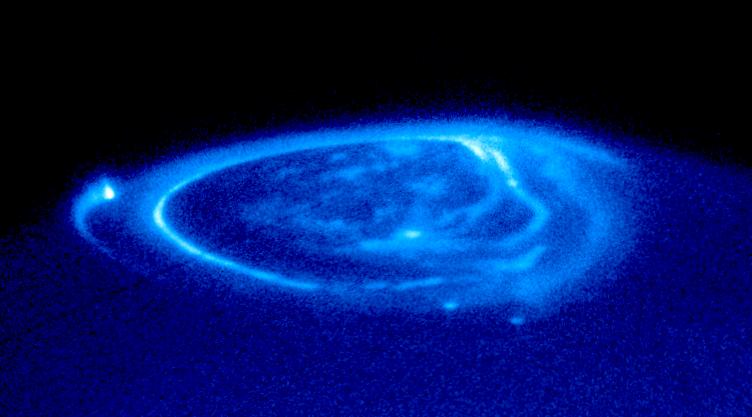
The paper covers the Io footprint within Jupiter's aurorae. The "footprint" is a glow caused by charged particles, originating from Io, impacting Jupiter's upper atmosphere. You can see the footprint in the image above as the bright glow on the left. The footprint is not a single glow but has various structures, including a tail behind it and a fainter spot in front of it. It is the fainter "leading spot" that is the subject of this paper. This leading spot is the result of a connection in Jupiter's magnetic field between the Io footprint at Jupiter's northern and southern polar regions.

This news even made the Yahoo front page with the headline, "'Glowing spots' on Jupiter caused planet's volcanic moon." I know, they forgot the word 'by' between 'caused' and 'planet's', but still, I did a spit take when I saw that. Great, let's give the Electric Universe people something to foam about...

I haven't had a chance to peruse the paper yet. I'll take a look at it tomorrow, and report here if there is anything that Phil hasn't already mentioned.

Link: UV Io footprint leading spot [www.agu.org]

Io Transiting Across Jupiter

Several observers in Australia and The Philippines observed a transit of Io across the disk of Jupiter yesterday (Universal Time). The images some of these observers acquired are posted on the ALPO-Japan website. Anthony Wesley acquired an image just prior to the transit showing Io's shadow on Jupiter's cloud tops. Christopher Go acquired two images showing Io against the cloud tops of Jupiter. Io's reddish coloration is quite visible. Tomio Akutsu acquired similar images, though he also acquired images in other filter like in the UV, near-IR, and the 889 nm methane band. Io stands out quite well in those last two IR filters.

Link: Jupiter Image 2008/03/16(UT) [alpo-j.asahikawa-med.ac.jp]

Saturday, March 15, 2008

Highlights o' the Week

It has been a busier week than usual thanks the Lunar and Planetary Sciences Conference, quite a few images added to my Galileo Io Images website, and some news on the New Frontiers 3 front.
Enjoy the weekend! I got to get back to playing Halo 3 (yeah, I've gotten a little tired of playing Guitar Hero 3 for the time being).

Galileo E15 Reprocessed Images

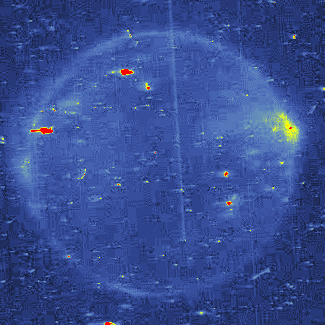
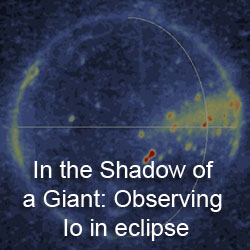
Between bouts of playing Guitar Hero III that I picked yesterday, I finished up reprocessing images from Galileo orbit E15. These images were acquired between May 30 and June 1, 1998. The highlight of this flyby were a series of images acquired during two eclipses on early on May 31 and late on June 1. These sequences included several clear filter observations and color sequences designed to examine hotspots at Io's volcanoes and auroral glows. I didn't have much success processing the color images but you can check out the best of them in the Planetary Photojournal. The best of the clear filter images can be seen in all its color-coded glory at left. The two brightest hotspots visible here are Camaxtli Patera (left) and an unnamed patera at 42° North, 92° West (upper left). A few other hotspots that are visible include Zal, Kanehekili, and Janus.

Two sunlit sequences were returned from E15. The first, 15ISHIPHAS01, was taken 20 minutes prior to the eclipse image above. Some surface changes (mostly related to changes in the distribution in Sulfur dioxide) were noted around Kanehekili by Geissler et al. 2004 compared to images taken in November 1997. The other, 15ISKANEHI01, was taken shortly after the end of the second eclipse and shows the trailing hemisphere of Io at half-phase.

Link: Galileo E15 Images [pirlwww.lpl.arizona.edu]

Thursday, March 13, 2008

Galileo E11 Reprocessed Images

Yesterday, I posted on one of the images I had worked on from the Galileo's E11 orbit, that last of that spacecraft's primary mission. This evening, I finished processing the rest of the images (except for the eclipse images) from that orbit.

These images were acquired on November 7-8, 1997 and for the most part show Io at high phase angles. These observations were designed to look at the state of Io's plume activity at the end of Galileo's primary mission. In these images, a total of five plumes were observed: Prometheus, Zamama, Marduk, Pillan, and Kanehekili. The Pillan and Kanehekili plumes were only observed twice by Galileo, while the other three were observed at various times throughout the Galileo mission.

The Kanehekili plume stood out to me while looking through these images. The plume is visible in the 11ISKANEHI01 observation. Enhancing the contrast of the VIOLET filter reveals something rather interesting about the Kanehekili plume: there are two eruption columns separated by about 70 km. This would suggest that there are two plumes at Kanehekili (or at least two plume sources within the flow field). Both were formed as different flow lobes from Kanehekili 1997 eruption overtook an area of sulfur dioxide frost and launched the frost skyward. Similar behavior was seen at the Masubi flow field last year by New Horizons, though the separation between plume sources was greater in the latter case. The Kanehekili plume was also observed in May 1997. Only one eruption column was seen at the time.

Link: Galileo E11 Images [pirlwww.lpl.arizona.edu]

Io Observer recommended, still won't happen

The Space Studies Board released their recommendations for the mission options for the next New Frontiers mission Announcement of Opportunity, due out in June. They recommended a wide-variety of missions highlighted in the Decadal Survey from a few years ago including: Lunar South Pole-Aiken Basin Sample Return, Venus In Situ Explorer, Comet Surface Sample Return, Network Science (a multi-lander mission to either Venus, Mercury, the Moon, or Mars), Trojan/Centaur Reconnaissance, Asteroid Rover/Sample Return, Ganymede Observer, and drum-roll please, an Io Observer. Nice to see that an Io Observer is still at least among the top eight missions for its class.

It, however, still won't happen this time around due to the restriction placed on the program by the lack of available plutonium for RTGs or nuclear-electric propulsion sytems (only enough currently for the Mars Science Laboratory, the next Discovery mission, and the next Flagship mission to the outer solar system). I do like the addition by the study group of "Innovative Mission Ideas", basically suggesting to NASA that the New Frontiers AO be as open as possible to all types of (preferably non-Mars) missions that fit within the cost cap.

The link to the report is below. Just click on "Read this book online, free." Thanks to Bruce Moomaw for the tip.

ADDED: I should note that Pamela over at Astronomy Cast Live posted on that blog that Jim Green, the Director of the Planetary Science Division at NASA, stated during a meeting either last night or tonight, that the New Frontiers AO will be open to all missions except to Earth and the Sun that fit within the budget and power source constraints. Preference will be given to those proposals that fit within those nine mission profiles mentioned above. Now, we just need to figure a way to do an Io Observer mission with solar panels (and not fry them in the process...).

ADDED: Quick correction. The SSB recommended a Trojan Asteroid/Centaur reconnaissance mission, not a sample return.

Link: Opening New Frontiers in Space: Choices for the Next New Frontiers Announcement of Opportunity [www.nap.edu]

Wednesday, March 12, 2008

Io and Amalthea from Galileo Orbit E11

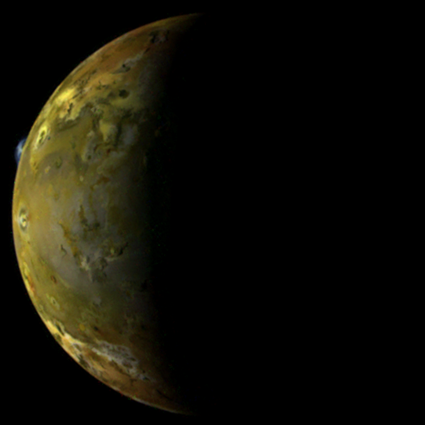
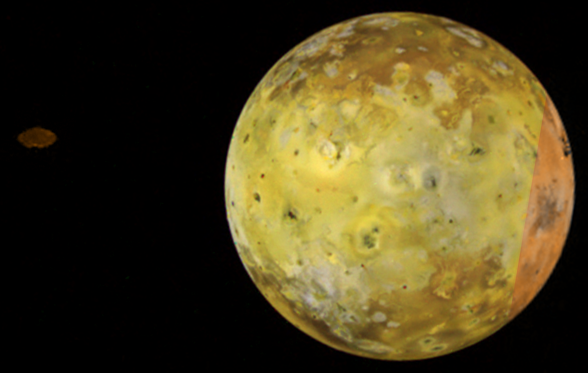
I was working a little bit on the Galileo E11 dataset this afternoon. I am switching over to work on Enceladus images now that data from today's Cassini encounter are hitting the ground. I thought I would share the one image I did get done with today. The image at left is from the 11ISLOWPHA01 observation and shows Io's sub-Jovian hemisphere in RED-GREEN-VIOLET color (with a little bit of "Voyager" color on the right edge where there is no GREEN filter data). The RED filter image also captured Amalthea, one of Jupiter's small inner satellites, as it passed through the field of view at the time.

Surface features can appear quite different on Io depending on the phase angle. This image was acquired when Galileo was almost directly between Io and the Sun, a low phase angle. The 11ISTOPO__01 observation, acquired seven hours later, shows much of this same area at a moderate phase angle. Some lava flows and plume deposits stand out more at moderate phase angles than at low phase angles.

Link: E11 Images [pirlwww.lpl.arizona.edu]