This week's Carnival of Space, the 121st of its name, has been posted over at the blog Next Big Future. Check it out to read the best posts this week in the space blogosphere. Read about new results concerning Jupiter's aurorae, from the Lunar Reconnaissance Orbiter, and a treatise on spotting the International Space Station.
Speaking of the latest in the space blogosphere, I direct your attention to one new blog and another reactivated blog. The former is Dr. Schenk's 3D House of Satellites, where new stereo images and movies will be posted based on data from Voyager, Galileo, and Cassini. His last few posts include movies showing the topography of Conamara Chaos on Europa, the Uranian moon Miranda, and the south polar region of Enceladus using images acquired during two encounters last year. Schenk promises to add stereo views of the Callanish impact crater on Europa as well as some views of Io, though that will take a longer to prepare due to Io's funky phase functions and surface changes.
The latter blog is Ted Stryk's Planetary Images from Then and Now. Stryk posts reprocessed versions of spacecraft images, including those from early Mars missions, Voyager, and Galileo. One such image revealed one of Neptune's small, inner satellites, Despina, transiting its parent planet and casting a shadow on its atmosphere.
Link: Carnival of Space 121: Our moon, Jupiter's moon, black holes, and Space Technology Now and in the Future [nextbigfuture.com]
Saturday, September 19, 2009


Final Version of the Io Decadal Survey White Paper Posted
 The final draft of the Io Decadal Survey White Paper has been posted online. The white paper consists of two sections: the first summarizes the state of Io science, the justification for NASA sending additional missions, and the outstanding questions that should be addressed by future exploration of the satellite; the second discusses an exploration strategy for addressing these remaining questions. The other submitted white papers can be found on the National Academies website; Van Kane has a good summary on his blog of these other papers. I previously posted a note about the recommendations for future missions to Io based on an earlier draft of the white paper.
Let's take a look at the two Io white papers. The first, Justification and Science Objectives, takes a look at the reasons why other planetary scientists should be interested in exploring Io, the outstanding questions left by the exploration of Io by Galileo and New Horizons, and the science objectives that a future Io mission or series of Io missions should attempt to accomplish. In addition to the fact that Io is just plain awesome and everyone knows it ("Finally, as one of the most spectacular places in the Solar System, Io has unique public
appeal, and Io exploration offers many opportunities to attract and engage public interest in
planetary science."), the authors point out that studying Io provides opportunities to understand processes that are important to examine in general, including: satellite-magnetosphere interactions; the mechanics of tidal heating, an important process for Io as well as Europa, Ganymede, and Enceladus, as well as for extra-solar planetary systems; volcanism, particularly that found on the Moon and Archean Eon Earth; and the dynamics of thin atmospheres, particularly those which are strongly driven by surface temperature and vapor pressure. The authors also identified eight science objectives that an Io exploration campaign would attempt to accomplish (the sub-headings are my own notes):
- Determine the magnitude, spatial distribution, temporal variability, and dissipation
mechanisms of Io’s tidal heating. (We would like to add “and implications for the coupled
orbital-thermal evolution of Io and Europa.”) - The latter goal can be helped by the examination of Europa to be performed by EJSM.
- Determine Io’s interior structure, e.g., whether it has a magma ocean.
- Determine whether Io has a magnetic field.
- This fits into the previous objective. As explained later in Part 1, understanding the state of the core, its Fe/S ratio, and its size would help us understand the result obtained by Galileo that suggests that Io does not have a magnetic field. Resolving the conundrum of why Io can be so active and not have one might help us better understand how planetary magnetosphere are created.
- Understand the eruption mechanisms for Io’s lavas and plumes and their implications for
volcanic processes on Earth, especially early in Earth’s history when its heat flow was
similar to Io’s, and elsewhere in the solar system. - Two good places to provide comparative studies would be the Moon and Mercury. While these two worlds are dead as a doornail now (deader actually), earlier in their histories, they experienced volcanic eruptions similar to those we see on Io now, particularly flood basalt eruptions and pyroclastic flows.
- Investigate the processes that form Io’s mountains and the implications for tectonics under
high-heat-flow conditions that may have existed early in the history of other planets. - In addition to the high-resolution observations to be obtained by Io-centric missions discussed in Part 2 of the white paper, additional information could be gained for this goal from the Ice-Penetrating Radar (IPR) on board the Jupiter Europa Orbiter during its two of its close flybys.
- Understand Io’s surface chemistry, including volatiles and silicates, and derive magma
compositions (and ranges thereof), crustal and mantle compositions and implications for the
extent of differentiation, and contributions to the atmosphere, magnetosphere, and torus. - Understand the composition, structure, and thermal structure of Io’s atmosphere and
ionosphere, the dominant mechanisms of mass loss, and the connection to Io’s volcanism. - Investigate the neutral and plasma densities and energy flows in the Io plasma torus, plus their
variations over time, and characterize the ionic radiation belts in the vicinity of Io and their
influence on the surface.
Additional white papers can be found at the National Academies website as well as summaries at Van Kane's blog. These white papers will be used as input into the upcoming Decadal Survey report, which will outline the direction planetary science should go within NASA over the next decade. How much will be possible is up in the air as the planetary budget is projected to remain pretty flat over the next decade. For Io, since the recommendations call for a fairly modest program over the next decade (one mission in either the New Frontiers or Discovery programs) with the major mission to be started in the decade following, it isn't impossible that such a program could fly. What remains to be seen is how much NASA and the community will take to heart the first suggestion made by the authors of the Io white paper:
We recommend that NASA pursue a balanced solar system exploration program between life-focused and physical-science focused missions.Link: Future Io Exploration for 2013-2022 and Beyond, Part 1: Justification and Science Objectives and Future Io Exploration for 2013-2022 and Beyond, Part 2: Recommendations for Missions [www8.nationalacademies.org]
Friday, September 18, 2009
Io Talks at DPS 2009
 The science program as well as the abstracts for this year's DPS meeting were posted online a few weeks ago. DPS 2009 will be taking place in Fajardo, Puerto Rico, and as such, I won't be going. Hopefully the organizers will be able to broadcast the meeting oral sessions like they did for last year's meeting, but I guess that will depend on the infrastructure at the El Conquistador Resort. The webcasts last year allowed me to post about each of the Io talks here on this blog.
The 2009 Meeting of the Division of Planetary Sciences will be held between October 4 and 9, 2009.
In this year's science program, there are four Io talks and one poster planned. All four Io talks will be held during the Galilean Satellites oral session on the afternoon of Friday, October 9. The Io-related poster will be in the Decadal Survey White Papers section during the poster session on the evening of Tuesday, October 6. Here is a brief summary of the talks and posters to be presented:
- The first talk of the Galilean Satellites session is titled, "Strong Tidal Dissipation In Io And Jupiter From Astrometric Observations" and is by Valery Lainey et al. The talk will summarize their results from examining astrometric data of the Galilean satellites over the last century and what the motions of these moons tell us about the rate of tidal dissipation within Io. They found that the dissipation rate is on the same order as Io heat flow, suggesting that Io is in thermal equilibrium. These results were published in a paper in the journal Nature earlier this year and were discussed in more detail on this blog then.
- The next talk will be by Daniel Allen and Jani Radebaugh and is titled, "Temperature and Variability of Three Ionian Volcanoes." The authors examined the brightness and color temperature of three volcanoes on Io (Pillan, Wayland, and Loki), observed by Cassini's narrow-angle camera during several eclipses during the New Year's 2001 Cassini encounter. The abstract and talk provide an update to the results presented at this year's Lunar and Planetary Sciences Conference back in March, including updated temperature estimates for the three volcanoes. They found a cooling trend for Pillan and Wayland, suggestive of a cooling lava flow, as well as an apparent shut down of a vent at Wayland during one of the eclipses. Loki was found to be more variable, consistent with an active lava lake.
- John Spencer et al. will present the next talk in the Galilean satellites session, titled, "Changes in Io's Atmosphere in 2009: Atmospheric Inflation Near Perihelion?". During his talk, Spencer will present spectroscopic observations of Io's atmosphere acquired in June 2009 which suggests that Io's atmosphere undergoes an increase in column density (the amount of gas over a given area on Io's surface) as the Jupiter system approaches perihelion. This would be the result of increased sublimation of sulfur dioxide frost from Io's surface from the increased surface temperatures. The vapor-pressure equilibrium relationship between SO2 surface frost and atmosphere SO2 gas is sensitive enough that even the 5.6 K temperature difference between aphelion and perihelion is expected to produce a 7x difference in atmospheric SO2 vapor pressure. This data was also discussed in more detail by John Spencer in June in the Planetary Society Blog.
- The final Io talk in the Galilean satellites session will be presented by Jessica Lovering and is titled, "Analysis of the New Sodium Emission Feature Discovered in Io’s Wake". The discovery of this Jupiter-ward sodium jet was presented at last year's DPS and was discussed to an extent on this blog then.
- The Io poster covers the Io Decadal Survey White Paper and will be presented by David Williams. The two white papers were discussed on this blog earlier.
Link: DPS 2009 Meeting [dps09.naic.edu]
Thursday, September 17, 2009
Paper: Spectroscopy of Io Eclipse Reappearances
 Last week, a new paper was published in press (the paper has been approved for publication, but hasn't found a slot in the dead-tree version of the journal yet) in the journal Icarus discussing spectroscopic observation of Io as it emerged from the shadow of Jupiter. The paper is titled "Eclipse reappearances of Io: Time-resolved spectroscopy" and was written by Dale Cruikshank, Josh Emery, Katherine Kornei, Giancarlo Bellucci, and Emiliano d'Aversa.
In this new paper, the authors discuss spectroscopic observation of Io acquired using NASA's Infrared Telescope Facility (IRTF) in Hawaii during five eclipse reappearances in April, May, and June 2004. These observations were intended as a follow-up to results from Cassini VIMS observations in Bellucci et al. 2004 taken during that spacecraft's Jupiter flyby during New Year's 2001 that showed a brightening of Io's surface in the near-infrared and a deepening of several strong sulfur dioxide absorption bands following Io's emergence from Jupiter's shadow. This result continues a 40-year-long mystery concerning the interaction between Io's atmosphere and its surface during and after an eclipse by Jupiter.
Unlike lunar eclipses, when the Earth passes between the Sun and our Moon and which happen about once a year, or every 13 orbits of the Moon around the Earth, eclipses of Io by Jupiter occur about once each Ionian day. This is due the large size of Jupiter compared to Earth and the much lower axial tilt of Jupiter and its main satellite system. Each Ionian lunar eclipse lasts about 2 hours and 22 minutes. During this time, the temperature of Io's surface cools due to the sudden lack of sunlight. As Io cools down as the eclipse progresses, atmospheric Sulfur dioxide (SO2) condenses onto the surface. Check out a post I wrote earlier this year on another paper for more details on this process.
Depending on the amount of SO2 that condenses onto the surface, the fresh frost should be visible shortly after Io emerges from behind Jupiter's shadow as a brightening of Io's surface compared to its appearance prior to being eclipsed, and it should quickly dim as the frost sublimates from the surface now that the Sun is able to heat it up. In addition, the strong SO2 absorption bands at 3.56 μm, 3.78 μm, 4.07 μm, and 4.37 μm would be deeper than they were prior to the eclipse and should become shallower during the first 60-90 minutes after each eclipse and particularly in the first 15 minutes as the fresh, fine-grained SO2 frost sublimates back into the atmosphere. Results from multiple studies using ground-based and spacecraft observations over the last 40 years, since Binder and Cruikshank 1964 revealed a brightening of Io of 10 percent following an eclipse by Jupiter, have been inconsistent with some showing such a brightening, and others showing none. As explained in this new paper, Nelson et al. 1993 found that post-eclipse brightenings are likely to be rare as a fresh SO2 frost layer several millimeters thick would be required to explaining the magnitude of the brightenings that were seen, and it would take longer than 15 minutes to sublimate that layer away. In addition, modeling of Io's atmosphere during an Io eclipse by Moore et al. 2009 suggests that SO2 condensation onto the surface would be curtailed to some degree by atmospheric heating by the Io plasma torus and by non-condensable species like Sulfur monoxide preventing SO2 in Io's upper atmosphere from condensing.
Cruikshank et al. examined their observations taken at IRTF and found no evidence of changes in Io's albedo or the area of three SO2 absorption bands at 3.56 μm, 3.78 μm, and 4.07 μm. What changes were observed were either the result of the rotation of Io during the 60-90 minutes of each observation run, were found in one absorption band but not in the other three, or were the result of observation noise or the thick airmass of Earth's atmosphere. Therefore, the authors were not able to confirm the VIMS results published by Bellucci et al. 2004. The authors suggested that the two conflicting results could be due to the background frost coverage in the area observed by the two groups of researchers. VIMS observed Io's trailing hemisphere which is thought to have the least abundant SO2 frost coverage while the Cruikshank et al. group observed the sub-Jupiter hemisphere, SO2 abundance is higher. The lower SO2 abundance would have made condensed SO2, even if in a very thin layer, more noticeable compared to the sub-Jupiter hemisphere.
In other results, Cruikshank et al. observed additional SO2 absorption bands between 2.11 and 2.24 μm, including a faint one at 2.198 μm that the authors thought they were first to see in Io's near-infrared spectrum. Another weak absorption band at 2.1255 μm was mapped by Laver and de Pater and the results of that study were published earlier this year and discussed on this blog. Cruikshank et al. also observed Io's emission spectrum while the satellite was still in the shadow of Jupiter during the observation run on June 22, 2004. They did not find convincing evidence for condensed SO2 in Io's atmosphere, which would be expected in Io's volcanic plumes. This negative result could be the result of the temporal variability of Io's plumes.
Finally, the table of contents for the October 2009 issue of Icarus has been published online. No Io-related papers in this issue, but there are a series of papers covering Jupiter's Oval BA, also known as Red Spot Jr.
Link: Eclipse reappearances of Io: Time-resolved spectroscopy (1.9-4.2 μm) [dx.doi.org]
Friday, September 11, 2009
New Hubble Images of Jupiter
 On Wednesday, NASA released a number of images acquired by the Hubble Space Telescope as part of its re-commissioning period following the Shuttle Repair and Service mission back in May. One of the images released is a full-disk color image of Jupiter taken four days after the impact of a ~0.3 kilometer (330-yard) wide comet or asteroid in the giant planet's south polar region. The temporary impact scar can be seen as dark splotch at bottom right. A portion of this image was released back in July as part of the global campaign to monitor the impact scar. In addition to the impact scar, this image also shows some beautiful atmospheric waves in Jupiter's northern hemisphere.
Another great image released by the Hubble team shows the Butterfly Nebula as captured by the new Wide Field Camera 3. The image shows the glowing gas and dust cast off by the dying star at the center of the image (unseen because of the large amount of dust between the star and us). Very striking!
Link: Collision Leaves Giant Jupiter Bruised [www.hubblesite.org]
Friday, August 28, 2009
Io Decadal Survey White Paper
 The Planetary Science Decadal Survey is now well underway as the community discusses how NASA should spend its money in the discipline over the decade from 2013 to 2023. For the outer planets, the previous decadal survey made a Pluto flyby mission and a Jupiter atmospheric orbiter two of its main priorities. These mandates later morphed into the New Horizons and Juno missions. At this point in the process this go around, various groups in the community are producing white papers, documents that provide details as to what should be the priorities over the next decade for their subject, be it technology, planetary astronomy, Titan, Europa, or Io, for example. NASA's Outer Planets Assessment Group (OPAG) website has several drafts for some of these white papers, including the latest draft of the Io white paper. Additional submitted white papers can be found on the decadal survey website (check out some of the ones at the bottom of that page for a laugh).
The Io white paper being authored by Dave Williams from ASU with many others, including myself, in the Io community providing input. The paper is split up into two parts: Part 1 discusses why exploring Io should be important to the rest of the community and what kinds of science goals are needed for a future mission to the satellite; Part 2 explores the types of missions that should be sent to Io in the next decade and beyond.
While the first part of the white paper roughly follows the document from the previous decadal survey, explaining why exploration of Io is important, the second parts provides updates for recommendations to the NASA Space Science Division for future Io exploration:
- A balanced program between life-focused and general exploration missions
- A more modest (compared to EJSM) 'Io Observer' Discover- or New Frontiers-class mission
- The support of the IVO mission, currently being studied for the next Discovery AO
- New Frontiers-class mission concepts for the next New Frontiers AO that allows radioisotope power sources
- An Io orbiter in the 2023-2033 timeframe to follow-up on the discoveries of a Jupiter-orbiting 'Io Observer'
- Io in-situ missions in the same timeframe, including penetrators, landers, and rovers that would help constrain the size and physical state of Io's core and better understand Io's surface and lower atmospheric chemistry
- A space-based ultraviolet telescope to replace Hubble with diffraction-limited capability in the next decade
- Long-lived Jupiter missions that would provide opportunities to observe Io over long-time frames (Juno and EJSM may provide these types of observations over the next two decades)
- Expanding the time available for planetary astronomy on 10-meter class telescopes with Adaptive Optics capability. Such time availability would allow for long-term studies of Io's volcanic activity even without a spacecraft in the Jupiter system
- Including support for ground-based observation programs with Jupiter system missions to follow-up on discoveries of volcanic eruptions
Link: Planetary Science Decadal Survey White Papers [www8.nationalacademies.org]
Tuesday, August 18, 2009
Video of Io Eclipse on Ganymede
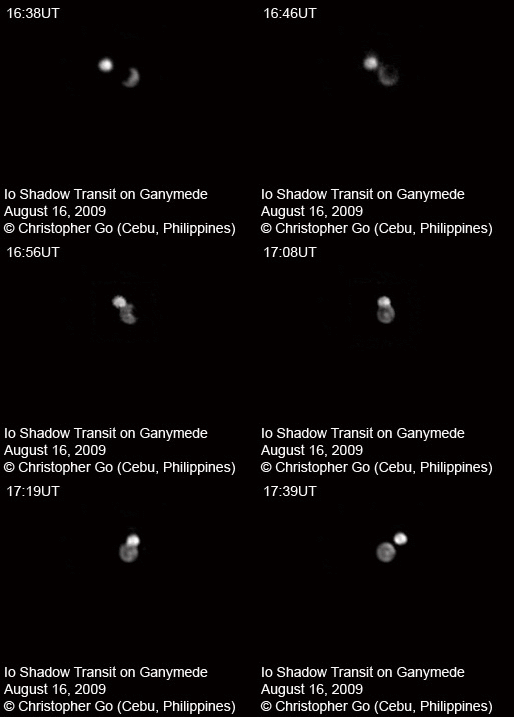 As Jupiter and Earth reached their closest approach for 2009 (also known as opposition when the Earth is between Jupiter and the Sun), Christopher Go captured a number of excellent views of Jupiter and its major satellites over the weekend with his telescope in the Philippines. Included in these images was an eclipse on Ganymede caused by the shadow of Io crossing the larger satellite's surface. This is the opposite of what I've been talking about for much of the summer, where the shadow of Ganymede crossed Io's surface.
The animated gif of the incredible imaging sequence is presented at right. Don't forget to check out the rest of Christopher Go's Jupiter images on his website.
Link: Jupiter in 2009 [jupiter.cstoneind.com]
Wednesday, July 22, 2009
July 22 Eclipse of Io by Ganymede
Later this morning, Io's trailing hemisphere will experience a total solar eclipse when Ganymede passes between Io and the Sun. The eclipse runs roughly from 13:34 to 13:39 UTC (14:08-14:14 UTC as seen from Earth). The video below was created in Celestia and shows the eclipse both from above Io, showing the shadow of Ganymede cross Io's surface, and from the surface of Io, showing Ganymede pass in front of the Sun.
Computer Animation of the total eclipse of the Sun by Jupiter's moon Ganymede over the trailing hemisphere of Io on July 22, 2009. First half shows a view from 4500 miles above Io's trailing hemisphere. Second half zooms in on the sun from an unnamed volcanic pit showing the total eclipse. The animation runs from 13:30 to 13:40 UTC on July 22, 2009.
EDIT 07/22/2009 10:06 AM: Fixed the title of the article, changing Jupiter to Ganymede. Obviously, a Jupiter eclipse is nothing special. A Ganymede one is.
Computer Animation of the total eclipse of the Sun by Jupiter's moon Ganymede over the trailing hemisphere of Io on July 22, 2009. First half shows a view from 4500 miles above Io's trailing hemisphere. Second half zooms in on the sun from an unnamed volcanic pit showing the total eclipse. The animation runs from 13:30 to 13:40 UTC on July 22, 2009.
EDIT 07/22/2009 10:06 AM: Fixed the title of the article, changing Jupiter to Ganymede. Obviously, a Jupiter eclipse is nothing special. A Ganymede one is.
Monday, July 20, 2009
Jupiter Impact Confirmed by IRTF
 The impact of a small asteroid or comet into Jupiter's atmosphere, first observed by astronomer Anthony Wesley (let's be honest, anyone who takes the kinds of pictures he does of Jupiter is not an amateur), has been confirmed in observations taken by NASA's Infrared Telescope Facility (IRTF) atop Mauna Kea on the island of Hawaii. The image shown at left reveals the impact to be glowing quite brightly in the near-IR, in a methane absorption band at 1.65 microns
Based on additional images taken by ground-based telescopes, the impactor came in from below Jupiter, striking the South polar region sometime between 07:00 and 14:11 UTC on Jupiter's nightside. Several dark spots in addition to the main impact site are visible with a faint, fan-like plume deposit to the west and north of the impact site. Similar plume deposits were seen at Shoemaker-Levy 9 impacts 15 years ago this week in 1994.
EDIT 07/20/2009 06:23 PM: New Scientist has an article with an image taken by Keck II. The IR data from Keck seems to suggest the possibility of multiple impactors.
EDIT 07/20/2009 11:33 PM: Looks like the image from Keck II in the New Scientist article is a bit of a double exposure, making it look like multiple impact sites.
In case you missed it, an hour ago I posted some of my thoughts on this, the 40th Anniversary of the Apollo 11 landing. Don't forget to post a comment there about when you think the first humans will land on Io (never is a possible answer, but not one I necessarily agree with).
Link: New NASA Images Indicate Object Hits Jupiter [jpl.nasa.gov]
Apollo's Legacy 40 Years Later
 40 years ago today, two astronauts from a small, liquid water-rich planet called Earth made their first steps into the new frontier, landing on that planet's only natural satellite. These first steps were seen by people around the world, and people from around the world looked on with pride, regardless of nationality, creed, or race.
Today, humanity still explores space, but it has been 37 years since we last traveled beyond low-Earth orbit and gone to another world. We have ceded the role of explorer to our robots. This is not to say that this entirely bad. People from around the world still marvel in awe at the images returned from the Mars rovers, still going strong well past their warranty with the only thing keeping them back is the occasional tall dune or patch of soft soil, the Cassini spacecraft, orbiting Saturn and returning incredible photos and data about that world and its many moons, or the Lunar Reconnaissance Orbiter, which returned incredible photos of the hardware the Apollo astronauts left behind on the Moon just last week. While it has been a great privilege to get a chance to work on the data that these robot explorers send back, I still feel that humanity has retreated in its quest for space.
There has always been a conflict, budget-wise, between manned and unmanned exploration of space, competing for money in the narrow budgets of the various national or European space agencies and flame wars on web forums dedicated to space exploration. The topic is often so toxic that it is even banned from one of the forums I moderate, Unmannedspaceflight.com. I feel that one can't necessarily live without the other. Without a healthy manned spaceflight program, the pressure to fund a healthy unnamed one will be lower for the powers that be. We are already seeing budgets that are getting tighter for the space science division at NASA, creating potential funding problem for projects like the Europa/Jupiter System Mission. Manned spaceflight gives unmanned missions an additional purpose, to scout and map places in the solar system that we may send people to in the next few generations, or to explore places that humans will probably never visit in person (like Venus). They can provide additional infrastructure for manned mission, such as acting as communication relays. In the end, I feel that without a healthy manned spaceflight program, we can kiss the current unmanned program goodbye, ceding such a program to the Europeans or the Chinese. While we may still fund an unmanned program, it would look much more like the European one. Such a program would only allow for limited funding for outer solar system missions.
We should go back to the Moon. We should go to Mars with people. Given how much and how often Mars Sample Return has been delayed, we might as well go with a manned mission at this rate. Most critically, we must NOT treat landing on these worlds as the goal. That was the #1 mistake of the Apollo program. By treating the landing as the goal, everything else, like science, additional landings, (semi-)permanent settlement, seemed pointless and a waste of money. Why continue to send people if the goal was just to land there, take pictures, and go home. The Moon is not Disneyland. It isn't Mount Rushmore. The Moon and the Solar System in general is more like the Old West. Neil Armstrong and Buzz Aldrin were more akin to 20th Century versions of Lewis and Clark. They didn't cross a finish line; they opened up a frontier. But because landing was seen as THE goal, the way to beat the Russians, we lost that frontier. If we want it back, we need to start trotting out phrases like "Manifest Destiny" and stop think that we are going to spend a bunch of money to send people to the solar system equivalent of taking pictures with Mickey. It worked in the mid-19th Century for the United States, maybe it will work again for the world.
Kim Stanley Robinson, author of "Red Mars," "Blue Mars," and "Green Mars," has a great editorial in yesterday's Washington Post about how one good reason for permanent settlement on Mars and beyond is to reduce the environmental strain of the human population on the resources of Earth, and he has a good point. He also states that space exploration could be helpful driver for discovering solutions to climate change. Personally, I am pretty sure that Earth's environmental state will be the driving force behind colonization, though not as Robinson envisions, colonizing only "if Earth is healthy." As environmental regulations for extracting energy and other resources on Earth become more draconian, doing so on lifeless worlds like our Moon, Mars, the various rocks of the asteroid belt, and Io would become more profitable and/or necessary.
Finishing this post, I thought I would ask a question for all of you readers out there, given that it has been 40 years since humans first landed on our moon, when do you think humans will first land on Io? See I have to bring this post back on topic ;-) I am definitely interested in hear all of your responses. Just post a comment to this post!
Sunday, July 19, 2009
Impact observed on Jupiter
 15 years ago, the world watched as broken-apart comet Shoemaker-Levy 9 impacted Jupiter's atmosphere in a series of event in July 1994. Well, a similar event seems to have occurred in the last day in Jupiter's south polar region. A new dark spot, similar in size and color to the Shoemaker-Levy 9 impacts was seen by ground-based observers on July 19.
Hopefully more observations will be acquired over the next few days to help confirm this discovery, but it looks quite plausible to me :)
The image at left was captured by Anthony Wesley on 19th July 2009 at 1554UTC from Murrumbateman Australia. The south pole is up, north pole down. The impact site is near the central meridian about an eighth of the way down.
EDIT 07/19/2009 9:23 PM: Wesley's website has been slashdotted so he has mirrored the page to another server. So if you are having trouble accessing the link above, check out http://jupiter.samba.org/
Tuesday, July 14, 2009
Ganymede Eclipse on Io Wednesday Morning
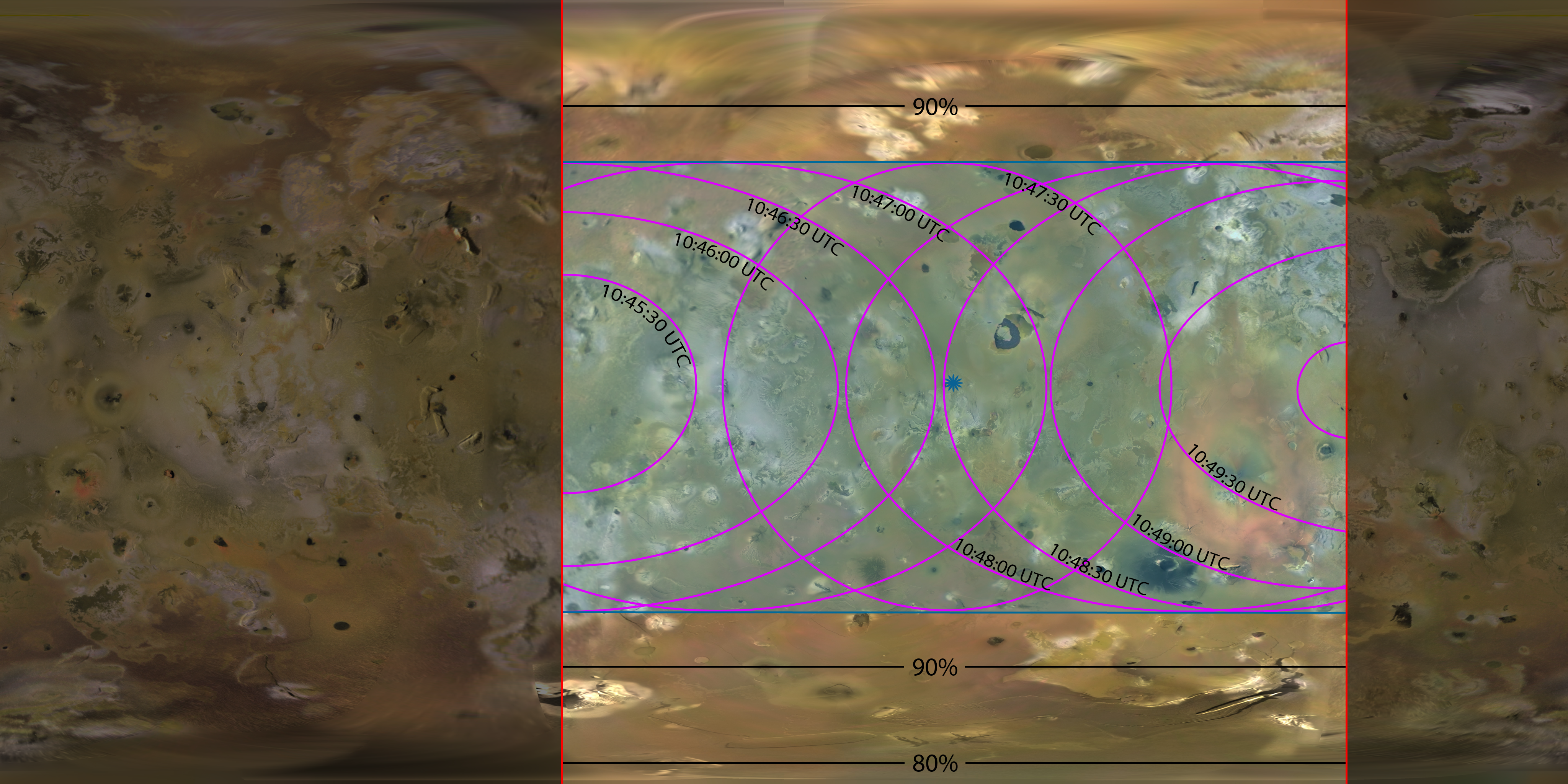
 Tomorrow brings Io's most interesting eclipse this mutual event season as most of Io's trailing hemisphere (51° West-231° West) is plunged into darkness by Jupiter's largest moon, Ganymede. This is the culmination of a series of weekly eclipses by Ganymede on Io. With each weekly eclipse, the center of Ganymede's shadow appears further south on Io. Tomorrow, the center of Ganymede's shadow passes just north of Io's equator. The eclipse takes place tomorrow morning, July 15, between 10:45 and 10:50 UTC (3:45-4:50 MST) on Io. If you have a good telescope and want to try to observe this event, from Earth the penumbral shadow of Ganymede will reach Io at 11:19 UTC, totality will run from 11:21 to 11:25:28 UTC, and end of the eclipse comes at 11:27 UTC. The peak of the eclipse, as observed from Earth, comes at 11:23:14 UTC. The timing of this eclipse should make it a good observation target for observers in the western United States, western South America (like the European Southern Observatory), and Hawaii.
During the eclipse, Ganymede will appear 13' 17.2'' across in Io's sky (compared to our moon, which appears around 30' across in Earth's sky). The sun will appear 6' 19.9". Therefore, it is unlikely that the sun's corona would be seen during the eclipse except near the beginning and end. At its peak near Tol Ava Patera, the eclipse will last 1 minute and 55 seconds long.
For this eclipse, I've created a little fancier video using Celestia and Adobe Premiere. I think I am starting to get along with that latter software package...
Computer Animation of the total eclipse of the Sun by Jupiter's moon Ganymede over the trailing hemisphere of Io on July 15, 2009. First half shows a view from 4500 miles above Io's trailing hemisphere. Second half zooms in on the sun from east of Ra Patera showing the total eclipse. The animation runs from 10:40 to 10:55 UTC on July 15, 2009.
I have also created a nice map showing the area on Io that will experience this eclipse. You can download a full-res version here.
 My post last year on this mutual event season should help provide some information on the science of these types of eclipse as well as occultations.
Monday, July 13, 2009
Notes from the Io Underground
Grrr... I hate when Mondays sneak up on you...
- The 111th Edition of the Carnival of Space is now online over at 21st Century Waves.
- Over the last few weeks, I have been presenting some of the mutual events in the Jupiter system, particularly solar eclipses on Io by either Ganymede or Callisto from the perspective of Io. However, a pair of amateur astronomers, John Sussenbach and Marc Delcroix, captured numerous observations of the solar eclipse on Io by Ganymede on June 24. Delcroix even plotted the brightness of Io versus time as the eclipse progressed. John Sussenbach also took a look at one of the the solar eclipses by Callisto on June 20.
- Plenty of important meetings related to the exploration of Io and the Jupiter system will be taking place this week. This includes a Europa/Jupiter System Mission Joint Science Definition Team (EJSM JSDT) meeting today, an Outer Planets Assessment Group (OPAG) meeting tomorrow, and the EJSM Instrument Workshop on Wednesday through Friday. I might be listening into the EJSM Instrument Workshop for at least some of the talks, but I haven't decided yet.
- Today's Astronomy Picture of the Day showing the volcano Arak Krakatoa erupting at night is pretty awesome. Definitely worth checking out.
- Van Kane has been keeping up with last week's Planetary Science Subcommittee and Decadal Survey Meetings. One of the key issues that seems to be coming to a head is the flat planetary science budget projected in the out years in the current budget proposal. This would cause increasing budget pressure on many projects, not only because of the lack of budget increases (resulting from the poor government revenues) and from cost overruns on some projects, including the albatross of planetary science, the Curiosity rover (née Mars Science Laboratory). According to Kane, Ed Weiler at the PSS meeting stated that there is not enough money in the Planetary Science Division budget projections to fund the Europa/Jupiter System Mission. As Kane stated in his blog, this is definitely bad news.
- Celestia version 1.6 was officially released late last week. Celestia is definitely one of the space simulator, particularly thanks to its support for NAIF Spice kernel files for spacecraft and planetary body trajectories and orientations. The software also has built-in video and screenshot support, which I often take full advantage of for this blog.
Thursday, July 9, 2009
30th Anniversary of the Voyager 2 Flyby of Jupiter
 Thirty years ago today, on July 9, 1979, the Voyager 2 spacecraft encountered Jupiter from a distance of 650,000 kilometers about its cloudtops, marking the second Voyager project flyby of the planet. The encounter provided an opportunity to see the anti-Jupiter hemispheres of Ganymede and Callisto, to monitor changes on Jupiter and Io since the Voyager 1 encounter four months earlier, and to observe Europa up close for the first time.
Back in March, we took an extensive look at the Voyager 1 encounter with Jupiter and Io. The Voyager 1 flyby provided a revolution in our understanding of the giant planet and turned the four Galilean satellites from mere points of light we were only beginning to understand into four separate worlds, each with their own unique geologies. In particular, during the Voyager 1 encounter, active volcanism was observed on Io as well as a narrow ring around Jupiter.
 For Io, the second Voyager encounter did not provide the same revolution in our understanding of that world; the clear star of the July 9 encounter was the cracked world of Europa. While Voyager 1 flew within 20,000 kilometers of Io on March 5, 1979, Voyager 2's trajectory kept the spacecraft outside Europa's orbit and, with Io on the other side of Jupiter during closest approach, Voyager 2 never came close than 1,128,000 kilometers of Io. However, the discovery of active volcanism on Io by Voyager 1 necessitated a change in the schedule of observations for the second encounter, including a 8-hour long sequence of images of a narrowing crescent Io as Voyager 2 receded from Jupiter. This prolonged observation sequence allows Voyager 2 to monitor volcanic plumes along Io's limb, including those at Amirani, Maui, and Loki. From observations such as these, Voyager 2 found that most of the plumes first observed by Voyager 1 were still active during the July 1979 encounter. Only Pele appeared to have shut down, though later observations by Hubble, Galileo, and other spacecraft seem to suggest that the Pele plume is intermittently active. Volund was not observed near the limb of Io during the Voyager 2 encounter, so it could not be determined if that plume was still active.
 Earlier, Voyager 2 had observed Io while it was more illuminated by the Sun, like the image at left. The goal of these observation was to search for surface changes on Io as the result of volcanic activity between the two Voyager encounters. Among the changes observed were two new plume deposits surrounding Surt (probably active during a short, intense eruption in June 1979, but Surt was not viewed near the limb by Voyager 2 to see if it was still active) and Aten Patera. The presence of these changes from large plumes but without the observation of the plumes associated with them have led to the conclusion that large, Pele-type plumes tend to be short-lived compared to more persistent, smaller dust plumes like at Prometheus. Additional surface changes included a larger dark area within Loki Patera, the result of overturning of more surface area of the lava lake that covers much of Loki, and a change in the shape of the Pele plume deposit, from a heart shape to an oval. Subtle changes in the shape and intensity of the Pele plume deposit were also observed by Galileo in the late 1990s and early 2000s.
 Of course, Io wasn't the only world Voyager 2 observed during its encounter 30 years ago. The star of the show was Europa. Europa was poorly observed during the previous Voyager encounter so this one really provided a great leap in our understanding of this icy world. Like Ganymede, Europa's surface was dominated by tectonic structures, ridges and dark, linear bands that criss-cross the surface. Unlike Ganymede, Europa's surface was found to be quite young with very few impact craters, though enough to show that the satellite's surface was much older than Io's. Spectral measurements suggesting a water ice surface, mass estimates between that of Io and Ganymede, and youth surface age soon led to the suggest that just beneath Europa's ice shell lay a liquid water ocean that today is a main focal point for exploration in the Jupiter system.
Voyager 2 never got the same amount of attention that the earlier Voyager 1 encounter did. During the same week, Skylab was slowly approaching its destruction over Australia, dampening press interest in the encounter, along with the perception that this encounter was covering similar territory as the previous one. But Voyager 2 provided an opportunity to follow up on the discoveries made by Voyager 1 by allowing for an adjustment to the observation plan, such as to monitoring Io's volcanic plumes and Jupiter's narrow ring system as Voyager 2 receded from the giant planet. Voyager 2 also allowed imaging scientists to fill out the global map of Ganymede and Callisto by observing their anti-Jovian hemisphere and providing the first close-up look of Europa. The Voyager 2 encounter unfortunately also began a 17-year gap in close-up spacecraft imaging of the Jupiter system. But Voyager 2 went on to bigger and better things, including doing followup observations of the Saturn system in August 1981 as well as our only encounters of Uranus and Neptune in 1986 and 1989, respectively.
For this post, I have posted some movies on Youtube created in Celestia showing the geometry of this encounter:
- Voyager 2 Trajectory through the Jupiter System
- Animation of Io as seen from Voyager 2 in July 1979
- Animation of Io as seen from Voyager 2 in July 1979 - Short Version
Wednesday, July 8, 2009
Paper: Heat Flow from Io's Dark Lava Flows
 A new Io-related paper in the journal Icarus was posted online on Sunday titled, "Io: Heat Flow from Dark Volcanic Fields." The paper is authored by Glenn Veeder, Ashley Davies, Dennis Matson, and Torrence Johnson. The authors in this paper attempt to estimate the amount of Io's overall heat flow that is radiated from the large volcanic lava flow fields that cover a sizable portion of Io's plains, distinguishing these features from the myriad of volcanic pits, the background heat flow, and the big daddy of Ionian volcanoes, Loki Patera, which by itself radiates 5-15% of Io's total heat flow. This research was previously discussed last year on this blog when the authors of this paper submitted a print-only abstract to LPSC 2008.
Dark volcanic fields on Io are thought to consist of recently active, compound silicate lava flows that have erupted onto the plains of Io, rather than being confined within a patera (volcanic pit). Lava flows of many colors have been observed on Io, but it is the black or dark green flows that are thought to be the most recently active silicate flows. These flows tend to be lava channel (or tube)-fed, with smaller outbreaks building and growing the flow field over time. For example, if you look at Amirani above, you see "small", fresher lava flows on top of older, dark green lava. The dark green color comes from the deposition of sulfur on still-cooling, iron-rich silicate lava flows, producing iron sulfide. Brighter flows represent either older silicate flows that cooled enough for sulfur and sulfur dioxide to condense on their surfaces or sulfur-rich lava flows. Either way, bright flows were not considered in this analysis.
Veeder and his colleagues estimated the contribution of Io's dark lava flow fields to Io's total heat flow by first identifying all the dark lava flow fields visible on Io in the USGS global map and calculating the area of each flow field. Their areas were found by measuring the number of pixels below a threshold limit for each dark flow field (the threshold valuing varying with each flow field) while also removing other possible dark features such as paterae. Using this method, the authors identified 28 dark flow fields, including features such as Masubi Fluctus, Marduk Fluctus, Amirani (above left), and Prometheus (above upper right), covering slightly less than 1% of Io's surface. The authors also excluded more transient lava flows like Pillan and Thor, though sources such as these may provide a significant amount of the heat flow contribution from dark flow field heat, even if the specific sources changes over time. The authors then seem to be more focused on persistent volcanoes. The authors note a peak in the distribution of dark lava flows in the anti-Jovian hemisphere of Io, opposite Io's most powerful volcano, Loki Patera.
Next, the authors estimated the effective temperature (akin to an average nighttime temperature of each lava flow) and the total radiating power for each flow. For many of the flows, infrared data, either from the NIMS or PPR instruments on Galileo, is available, allowing for a more accurate estimate of the heat flow of each flow. For cooler flows, more accurate estimates tend to come from the PPR data since much of their heat is radiating out at longer infrared wavelengths to which PPR was more sensitive, compared to NIMS, which was more sensitive to warmer heat sources. However, for more than half of the dark lava flows examined in this study, no radiative power estimate is available. For these flows, the authors assumed an effective temperature of either 130 K or 115 K, depending on whether surface changes or other signs of recent volcanic activity have been observed.
The authors' estimate that the 28 dark flow fields they examined provide 5 x 10¹² Watts to Io's global heat flow, or about 5% of Io's total heat flow. This amount is similar to Loki when it is quiescent. While their effective temperatures are cooler than many of Io's active paterae like Loki Patera or Pele, their larger surface area compared to Loki Patera (an order of magnitude greater) allows them to contribute a large amount of Io's heat flow. It should be noted that this analysis excluded brighter flows, which may provide an even greater percentage of Io's total heat flow despite having even cooler effective temperatures, a possible later research subject as Io's heat flow budget is broken down further (to an extent this has with Glenn Veeder's earlier work on the possible excess heat flow from Io's polar regions).
Link: Io: Heat Flow from Dark Volcanic Fields [dx.doi.org]
In other news, the blog Kentucky Space has the latest edition of the Carnival of Space. Worth checking out to get yourselves caught up on the celestial blogosphere.
Subscribe to:
Posts (Atom)


 Posts
Posts