Saturday, February 28, 2009
Carnival of Space #92 @ The Launch Pad
The next Carnival of Space, Edition #92, is now online at The Launch Pad, a blog at the X-Prize Foundation. Check that out for more on the failed launch of the Orbiting Carbon Observatory (I still want to see an Orbiting Barium Observatory).


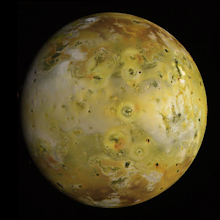
Become a Fan of Io
 Do you use Facebook? Do you like Io? Well, become a Fan of Io on the popular social networking website. I had considered creating such a page on Facebook for a while now, but as you can see, someone did if for me, and that's fine with me.
What use is a "Fan" page on Facebook? Well, it provides some functions of a web forum, allowing people to discuss news and opinions with some of the Web 2.0 functions of users adding their own photos, links, and videos (I'm guessing just embedded stuff from Youtube and the like).
You can also become a friend of Europa, but why would you do a silly thing like that? ;-)
Link: Facebook | Io [www.facebook.com]
Thursday, February 26, 2009
Pillan Color Data from Galileo Orbit I27
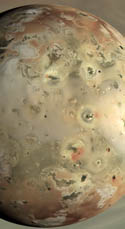
 The other day I posted a link to Ted Stryk's version of a color image acquired of Pillan and nearby features during the I27 encounter in February 2000. At right is my version.
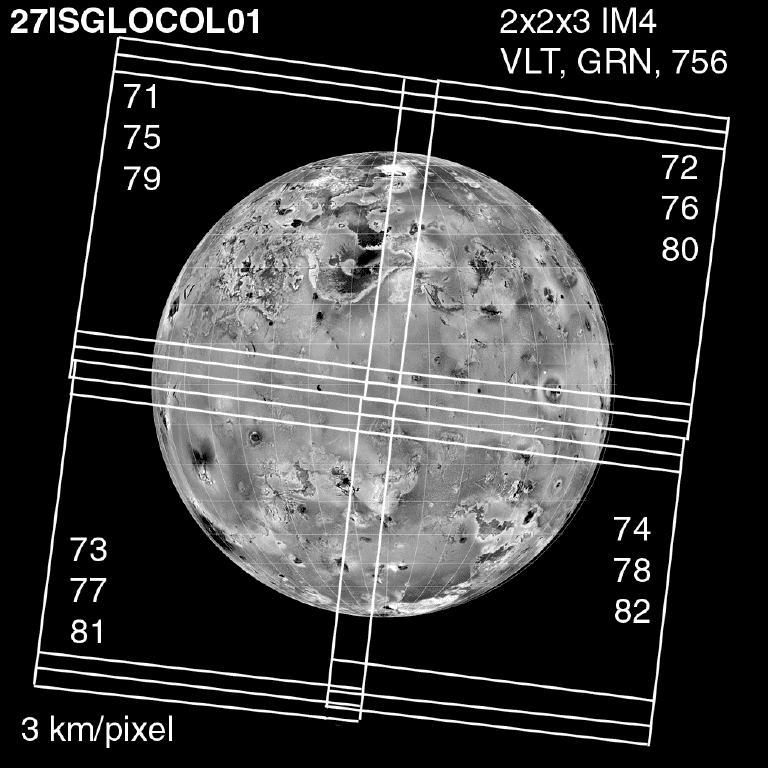
Admittedly, it is a little rattier, but that's what I had to work with from the data set that was returned to Earth. This represents part of a frame from 27ISGLOCOL01, a planned three-color, four-frame mosaic of Io's anti-jovian and trailing hemisphere acquired a few hours after the I27 flyby. Unfortunately, there just wasn't enough time to downlink all the data that was acquired during the flyby before the G28 Ganymede flyby in May 2000. And this GLOCOL01 observation took the brunt of these data volume hits, though for a number of observations only partial frames could be returned. So at the end of the day, this contingency color mosaic was stripped down to these three partial color frames over Pillan. To make things worse, the near-infrared 756 nm filter image (used here for red) had several data cutouts, which unfortunately couldn't be filled by additional passes through the tape recorder on Galileo.
Compare this partial frame from data acquired four months earlier after the I24 flyby (October 1999) and 1.5 months earlier from the E26 orbit (January 2000). One thing that is apparent to me are the two new dark spots at Reiden Patera, near bottom center in the I27 frame above. This again shows activity at Reiden was confined to the margins of the patera, indicated that either Reiden was a large lava lake with fresh eruptions occurring where the lava crust breaks up where it interacts with the patera wall, or that Reiden's vents were limited to the fault lines that shaped the patera.
Link: I27 Images [pirlwww.lpl.arizona.edu]
Wednesday, February 25, 2009
The Gish Bar Times One-Year Anniversary
 Today marks the first birthday for the Gish Bar Times. You can check out the original Welcome message that I posted a year ago this very minute. Despite the lack of a spacecraft at Io during this past year, and there won't be until Juno arrives in 2016, this past year has been pretty exciting with the Outer Planet Flagship Mission contest, a legitimate proposal to send a dedicated mission to Io, and further processing work on Galileo images of Io.
I want to thank all of you for visiting the blog on a regular basis. Your support has really helped spur me to try to write interesting posts on the science and exploration of this exciting, but often forgotten moon of Jupiter. When I started this blog last year, I didn't quite know if a blog about a single moon of Io would work or would find many readers. It took a while for me to really find my voice and write these more substantive posts, but I have grown more and more satisfied by what I've done with place.
When I started this blog, my goal was to talk more about the science side of Io, talking about new volcanic activity observed by ground-based observers, astro-photography posted online, and new papers. In the last year, I was definitely drawn more and more to the exploration side, with quite a few posts dedicated to future approved and proposed missions. In the next year, I'm not sure if there will be quite the level of future mission news now that the flagship mission has been selected. The IVO concept study should be wrapping up in the next few months, but I am not sure how much more it will change from the December 2008 Io Workshop presentation.
So what can you expect from this blog over the next year? Well, it is clear to me that I can't quite sustain this readership in the future by focusing ENTIRELY on Io. Now don't get me wrong, this is an Io blog. It will always be an Io blog. Much of the in-depth coverage on this blog will be dedicated to Io. So, paper summaries and reprocessed images will be about Io. However, to keep the blog fresh, I think it would be a good idea to broaden the topics covered here. So, I will also talk about the other objects in the Jovian system...including Europa if I have to. I will also post on news related to planetary volcanism (on Titan, Mars, Venus, or major eruptions on Earth). I think this will help sustain the viability of this blog in the long term and maintain interest when there isn't much to talk about regarding Io.
Anyways, thanks for reading this little missive. Go ahead and post comments to this post and let me know what you think of this idea.
Paul Schenk on the OP Flagship Selection
Paul Schenk, a planetary scientist from the Lunar and Planetary Institute in Houston, Texas, has a nice post on Unmannedspaceflight.com with his thoughts on last week's EJSM selection. I agree with what he said there, for a lot of planetary scientists, there is a lot that can be done in the Jupiter system, and as he mentions, in the wake of Galileo's successful failure, there is a lot that needs to be done in terms of Jupiter science.
For those who would have preferred the Titan mission, come on, you got EIGHT more years to hopefully look forward to from Cassini. Check out John Spencer's post on the Planetary Society Blog for more info on all the craziness that will happen with Cassini during its Extended-extended mission. The XXM includes 56 flybys of Titan and 12 flybys of Enceladus. I mean, that's more than we have done up to this point. To be honest, I also get excited about the flybys of the little rocks. Maybe it is the excitement of seeing a new world upclose that I've kinda lost from seeing Titan, Dione, Enceladus, etc. images all the time. We got a flyby of the small moon Helene coming up next March during the first extended mission, and during the XXM we have another one of Helene (providing coverage of the unilluminated hemisphere from the first Helene flyby) as well as flybys of Telesto and Methone. So while Titan will not get a flagship mission until the 2025-2035 time frame, the next decade will still be a great time to do Saturn system research.
Right above Paul's post over at UMSF, Ted Stryk posted his version of a partial color frame from Galileo's I27 flyby showing Pillan, Reiden, and parts of the Pele plume deposit. I should probably process my own version of that. That is definitely on my To-do list for tomorrow evening.
Link: Paul Schenk's post at UMSF.com [www.unmannedspaceflight.com]
For those who would have preferred the Titan mission, come on, you got EIGHT more years to hopefully look forward to from Cassini. Check out John Spencer's post on the Planetary Society Blog for more info on all the craziness that will happen with Cassini during its Extended-extended mission. The XXM includes 56 flybys of Titan and 12 flybys of Enceladus. I mean, that's more than we have done up to this point. To be honest, I also get excited about the flybys of the little rocks. Maybe it is the excitement of seeing a new world upclose that I've kinda lost from seeing Titan, Dione, Enceladus, etc. images all the time. We got a flyby of the small moon Helene coming up next March during the first extended mission, and during the XXM we have another one of Helene (providing coverage of the unilluminated hemisphere from the first Helene flyby) as well as flybys of Telesto and Methone. So while Titan will not get a flagship mission until the 2025-2035 time frame, the next decade will still be a great time to do Saturn system research.
Right above Paul's post over at UMSF, Ted Stryk posted his version of a partial color frame from Galileo's I27 flyby showing Pillan, Reiden, and parts of the Pele plume deposit. I should probably process my own version of that. That is definitely on my To-do list for tomorrow evening.
Link: Paul Schenk's post at UMSF.com [www.unmannedspaceflight.com]
Tuesday, February 24, 2009
OPAG March Meeting Agenda
The agenda for next month's OPAG meeting has been posted online. The Outer Planet Assessment Group reports to NASA's Planetary Science Subcommittee on issues related to the exploration of Outer Solar System. The agenda has quite a few interesting items, including presentations by Alfred McEwen on the Io Volcano Observer, Curt Niebur on the current status of the OP flagship program (in the aftermath of EJSM's downselection), and Ron Greeley and Curt Niebur on community participation in EJSM.
I will not be at this meeting, but the powerpoint files for most presentations should be posted online shortly after the meeting. The meeting is scheduled for March 9 and 10 in Bethesda, Maryland.
Link: OPAG March 2009 Meeting Agenda [www.lpi.usra.edu]
I will not be at this meeting, but the powerpoint files for most presentations should be posted online shortly after the meeting. The meeting is scheduled for March 9 and 10 in Bethesda, Maryland.
Link: OPAG March 2009 Meeting Agenda [www.lpi.usra.edu]
Monday, February 23, 2009
Paper: Formation of Mountains on Io
 The second Io paper posted Saturday on the journal Icarus's Articles in Press page is titled, "Formation of mountains on Io: Variable volcanism and thermal stresses". The authors for this paper are Michelle Kirchoff and Bill McKinnon from the Lunar and Planetary Institute in Houston and Washington University in St. Louis. This paper takes a look at the geophysics behind the formation of mountains on Io and why there is a global scale anti-correlation between mountain and volcanic paterae. In a nutshell, they find that variations in volcanic activity can vary the level of thermal stresses in Io's lithosphere, which in concert with subsidence stress (a compressive stress that increases with depth resulting from the high resurfacing rate), leads to the formation of thrust faulting and mountains if that volcanic activity decreases.
Crustal subsidence stress from volcanic resurfacing is one of the dominant compressive stressors on the Ionian lithosphere, but subsidence stress is insufficient to produce thrust faults that reach the surface as each time a fault is formed and moves, the subsidence stress global is that much more reduced. In order for a mountain or a cluster of mountains to be formed at a particular location, a "focusing" mechanism is required. Three hypotheses have been put forth for these mechanisms:
- Jaeger et al. 2003 suggested that mantle plumes impinging on the base of the lithosphere could locally increase the compressive stress at a particular location, resulting in thrust faulting and mountain formation. Kirchoff and McKinnon call this hypothesis "plume-modified subsidence."
- Tackley et al. 2001 suggested that global mantle upwellings and downwellings produce tensile and compressive stresses in the crust. Upwellings results in tensile (extentional) stress on the lithosphere due to crustal thinning and stretching, producing increased volcanic activity. Downwellings result in compressive stress on the lithosphere, producing increased mountain formation. This model was developed in response to the obsevation that while some paterae abut mountains and thus there maybe some local correlations between mountains and volcanic pits, globally these features are anti-correlated. The authors of this paper call this hypothesis "Convection-modified subsidence".
- McKinnon et al. 2001 suggested that decreases in volcanic activity on a regional scale (and thus decreasing the transport of heat from the interior to the surface), could result in heat building up at the base of the lithosphere, causing it to melt. The increase in thermal stresses caused by this melting result in the propagation of thrust faults closer to the surface and would thus support mountain formation (also known as orogenesis). Kirchoff and McKinnon call this hypothesis "thermal-stress-modified subsidence".
- In the coupled case, the thickness of the lithosphere is maintained. Temperatures in the lithosphere increase, causing the region in compressive failure (where stresses surpass Byerlee's Rule) to become larger and more shallow. Eventually the temperatures and stress levels reach a steady state.
- In the uncoupled case, decreasing the resurfacing rate increased heating at the base of the lithosphere, leading it to melt and increasing temperatures throughout the lithosphere (though convection all the way to the surface remains negligible). Over 0.5-1 million years, the crust thins. The resulting thermal stress decreases the depth at which thrust faults could form and propagate. The more the resurfacing rate is reduced, the greater the effect. Increasing the resurfacing rate causes cooling at the base of the lithosphere, thickening it. No steady state is achieved, eventually something has to give, like an increase in volcanic activity.
- The authors also looked at a case where the lithosphere is 50 km thick, instead of 25 km. This just increases the time it takes for the lithosphere to thin enough to bring the brittle compressive zone close enough to the surface to support orogenesis.
The authors then compared their results to the other models. For the plume-modified subsidence hypothesis, stress caused by an impinging mantle plume was not significant compared to crustal stresses. Because tidal heating is focused in the asthenosphere (or upper mantle), heat "plumes" should be downwellings, not upwellings, according to Tackley et al. 2001. For the convection-modified subsidence hypothesis, compressive stress on the lithosphere from mantle downwellings are too small to focus mountain formation. Maximum lithospheric stress are only a few kPa, compared to hundreds of MPa needed for compressive failure.
Finally, the authors examine a potential local cycle of mountain and volcano formation. First, greater volcanic activity increases the resurfacing rate (and thus the subsidence rate). This causes greater compression at depth, which constrains the deep conduits between volcanoes and their deep magma reservoirs, lowering the level of volcanic activity. This does nothing to the level of asthenospheric heat and temperatures increase throughout the lithosphere, leading to melting at its base. This melting causes thermal stresses to propagate to shallower depths, causing compressive failure between 10-20 km, where thrust faults could propagate to the surface, forming mountains. The formation of these faults and mountains relieves the subsidence stresses and thermal stresses in the lithosphere, leading to extension. This then allows magma to ascend to the surface through newly opened conduits as well as form batholiths which can helps deform mountains, such as by fracturing them. Increasing volcanic activity leads to a thickening of the crust back to its normal level. Unlike the view from McKinnon et al. 2001, volcanism does not need to complete shut down for this model to work.
One potential consequence of this cycle is that areas with high numbers of mountain should be beginning to increase their level of volcanic activity, perhaps increase the number of active paterae that abut mountains compared to areas with more paterae but fewer mountains.
Link: Formation of mountains on Io: Variable volcanism and thermal stresses [dx.doi.org]
Carnival of Space #91
The Next Big Future blog has the 91st Edition of the Carnival of Space: Europa, water on Mars, and Dawn, oh my! Definitely worth checking out!
Sunday, February 22, 2009
Paper: Io's Dayside SO2 Atmosphere
 As I pointed out yesterday, two papers were added to the journal Icarus's Articles in Press. The first that I want to summarize here is titled, "Io's Dayside SO2 Atmosphere." The authors of this paper are Lori M. Feaga, Melissa McGrath, and Paul D. Feldman. The authors of this paper examined far-ultraviolet data acquired by the STIS instrument on the Hubble Space Telescope between 1997 and 2001 to see what this dataset can tell us about the density of Io's atmosphere and how it varies across Io's disk.
During the Galileo mission, the Hubble Space Telescope was tasked at various times between 1997 and 2001 with observing Io during the telescope's Space Telescope Imaging Spectrograph (HST/STIS). Feaga et al. took a look at the data in the range of the HI Lyman-α line (around 1216 Å or 121.6 nm) and studied the spatial and temporal variations of that spectral line's emission from Io's surface. This research builds on previous work by Feldman et al. 2000 that found that the level of emission in this far-ultraviolet spectral line is related to the column density of the atmosphere. Gaseous sulfur dioxide is a continuum absorber in this region of the spectrum, so as the column density of the SO2 in Io's atmosphere increases, less of the Lyman-α emission from the sun reaches the surface and is reflected back into space for the HST to observe it. Looking at an example image above, the dark regions on Io's disk (marked by the white circle) are places where Io's atmospheric SO2 is densest and bright areas are where gaseous SO2 is less dense. Feldman et al. 2000 found that Lyman-α emission from Io peaks at the satellite's mid-latitudes and is lowest within the equatorial region, suggesting a latitudinal dependence on the density of Io's atmosphere.
This new paper by Feaga et al. continues the research started in the 2000 paper by looking at the more complete HST/STIS dataset covering a greater longitude range than the earlier work by Feldman et al. This allowed the authors to look into spatial and temporal variations in the SO2 column density. The authors found that Io's atmosphere, in addition to the latitudinal dependence also seen in the earlier work, was densest and had the greatest latitudinal extent on Io's anti-Jovian hemisphere (particularly at the longitude range of Bosphorus Regio) and was narrower in latitudinal extent and less dense on Io's sub-jovian hemisphere. The greatest SO2 column density was seen near 140° at 5 x 1016 cm-2. However, they do note some limitations for their method for deriving SO2 column densities. For example, the densities near the equator are often high enough that the amount of signal from the surface is quite low, low enough to be effected by some of their data reduction procedures, such as removing the Lyman-α emission from the interplanetary medium and removing the effect of albedo variations on Io's surface (their albedo map comes from a nearby wavelength range and was scaled to the extected brightness range expected at 1216 Å). They found few examples of major changes in the density and extent of Io's atmosphere, suggesting that the atmosphere is stable over periods of five years or more.
The authors also looked at how their gaseous SO2 map with the distribution of volcanic hot spots and plumes as well as the distribution of sulfur dioxide frost on Io's surface as found by Doute et al. 2001. They argue that from these comparisons that their results best support a volcanically-driven atmosphere, as the equatorial and anti-jovian concentrations of gaseous SO2 is best comparable with their map of hotspots and plumes. However, it should be noted that their map is still consistent with the distribution of large-grained SO2 as found by Laver and de Pater 2009. In a sublimation-driven atmosphere, SO2 frost in the warmest regions of Io (the equatorial regions) would be the source, so the Laver and de Pater map maybe more relevent for comparison. In addition, in a volcanically-driven atmosphere, I would have expected more examples of changes as the result of variations in volcanic activity, though a few possible examples were found at Pele and Prometheus.
Finally, the authors looked at how their data compares to other measurements made by other researchers. They found that their distribution map is similar to what others have found with Io's anti-jovian hemisphere having a greater latitudinal extent and column densities of SO2 gas than the sub-jovian hemisphere and with greater SO2 column densities near the equator compared to the mid-latitudes and polar regions. They found that column density numbers, particularly in the equatorial regions, tended to be lower than other authors, such as Jessup et al. 2004 and Moullet et al. 2008. The authors suggest that the low signal-to-noise ratio within the equatorial region may make some of the measurements lower limits, though they may not be consistent with some results from Spencer et al. 2005, which predicts much higher column densities at mid-latitudes than what was found in the HST/STIS data.
Link: Io's Dayside SO2 Atmosphere [dx.doi.org]
Weekly Recap
Wow, last week was insane. We had more visitors last week than we have ever had in a month, almost 1,000. Thanks to everyone who stopped by and I hope I can keep some of you around to learn a thing or two about Io. It was also a busy week in terms of posts thanks to the selection of the Europa/Jupiter System Mission as the next Outer Planet flagship mission. So let's take a look at last week in review:
- As I just said, the big news of the week was the Outer Planet Flagship mission downselection announcement. With the Europa/Jupiter System Mission selected, we can now look forward to the next 10 years of mission development and Io observations in the mid-2020s. Last week, we touched on the potential for Io science from ESA's contribution to the mission, the Jupiter Ganymede Orbiter. We also looked at an example of science the Jupiter Europa Orbiter would obtain while in orbit around Europa. This could include constraining the thickness of Europa's water ice shell (though some of these results, such as of Europa's tides with the Laser Altimeter, maybe limited by our knowledge of the satellite's deep interior).
- We also looked at press coverage of the EJSM selection.
- With EJSM approved, we took at look at how the downselection would effect the Io Volcano Observer proposal as well as the Io science questions that still remain.
Saturday, February 21, 2009
Two New Io Papers In-Press
There are two new Io-related papers just posted to Icarus's Articles-in-Press page. In Press articles are papers that have been approved for publication but have not found a spot in the printed journal. The first paper, Io's dayside SO2 atmosphere by Lori M. Feaga, Melissa McGrath, and Paul D. Feldman, covers Hubble Space Telescope observations of Io's atmosphere in the UV. The second paper, Formation of mountains on Io: Variable volcanism and thermal stresses by Michelle R. Kirchoff and William B. McKinnon, reports on modeling of Io's lithosphere and how its tectonics varies as a result of volcanic variability.
I'll post summaries of these two papers here tomorrow and Monday.
I'll post summaries of these two papers here tomorrow and Monday.
Friday, February 20, 2009
Outstanding Science Questions at Io
 Eric posted a few comments yesterday which provided a great suggestion for a blog post. What are the outstanding science questions that remain following Galileo and New Horizons? Can these questions be answered by the Jupiter Europa Orbiter (and Io Volcano Observer)? While better understanding Io's potential habitability by native lifeforms is certainly not one of them, there are at least five I can list here.
Before I do that, I want to point out Van Kane's post on his blog giving some of his closing thoughts on the Flagship mission selection. He pointed to my last post on how the selection of Europa as the target for that mission might effect the Io Volcano Observer and noted that the instruments could be more finally tuned to better answer questions at Io. That idea has crossed my mind. If the cost of IVO can't be brought in line with the Discovery mission cost cap, one potential alternative is to submit beefed up versions of some of IVO's instruments, particularly RCam and the Thermal Mapper, for the JEO Instrument Announcement of Opportunity. RCam's radiation-hard color push-broom camera could be just as effective at observing small-scale features on Europa as it could for determine eruption temperatures on Io. Additional bandpasses on Thermal Mapper compared to the Thermal Imager in JEO's model payload could also be useful for Jupiter on JEO. However, you do still lose the spatial coverage that would be provided by IVO, which would help it be more robust against variability in Io's volcanic activity. For example, what if Amirani was inactive in the mid-2020s?
So with that out of the way, here are five of the top (in my mind) outstanding science questions at Io:
- What is the composition of Io's lava's?
- What is the typical eruption temperature for Io's volcanoes? These first two questions are quite related. Following Galileo, there was consensus that Io's primary lavas were composed of basalt, a silicate lava rich in iron and magnesium and common on the terrestrial bodies in the solar system. However, the exact composition was very poorly constrained by the available data (dark at visible wavelengths, an absorption at 1 micron consistent with iron, and estimated lava temperatures in mafic to ultramafic range). The eruption temperature could be related to the amount of partial melting in Io's mantle. And of course temperature is related to the composition of Io's lavas. Generally the higher the magnesium level, the more mafic it is, the greater the liquidus temperature (and thus the eruption temperature). Understanding the effect of superheating during the ascent of the magma is also important. These questions can be answered through the measurement of Io's thermal emission in the 0.7-1 micron range (like from a near-infrared spectrometer or RCam on IVO) and by looking for absorption and emission features in the near-infrared that are consistent with materials in Io's lava, such as the Christiansen Feature.
- Is tidal heating on Io steady-state or time-variable? One of the potential implications of measurements of Io's heat flow is that Io may be pumping out more heat from its interior than it currently receives from tidal heating as a result of its orbital resonances with Europa and Ganymede. This would indicate that Io is cooling down from a period of much greater tidal heating in its past. A potential way to test this is by high-resolution tracking of the position of Io and Europa over time. One of the mission goals for JEO is to provide this kind of tracking to better constrain the orbital evolutions of Io and Europa. IVO's polar orbits would allow for better thermal emission mapping of Io's polar regions, which are thought to be much warmer than they should be given the lower solar angles.
- How are Io's two major structural landforms, paterae and mountains, formed? Various models following Voyager and again after Galileo have been produced to explain how paterae and mountains form on Io. Sub-surface radar sounding and high-resolution, low sun imaging could go a long way toward looking at the tectonic mechanisms behind how these intriguing features are formed. JEO would provide the sub-surface sounding, while IVO (and JEO to an extent, but longitude coverage would be limited) could provide imaging of a variety of mountains and paterae.
- Does Io have an internal magnetic field? This question may have been answered as a no by Galileo, but closer encounters at different latitudes with a magnetometer-equipped spacecraft would help put this issue to bed. Understanding Io's magnetic environment would help with our understanding of Io's deep interior.
Thursday, February 19, 2009
How EJSM affects the Io Volcano Observer
 With a mission now planned for the Jupiter system in the 2020s, how will the Io Volcano Observer proposal be affected? Would a dedicated Io mission even be necessary?
The Io Volcano Observer and the Jupiter Europa Orbiter would conduct complimentary science. Both spacecraft have high-resolution cameras capable to studying Io's surface in fine detail during flybys as well as monitoring Io's global volcanic activity from a distance. Both can conduct mass spectroscopy of Io's atmosphere and plumes as well as observe Io's thermal inertia. The Jupiter Europa Orbiter would be capable of acquiring observations not currently in IVO's baseline payload such as near-infrared spectroscopy, ground-penetrating radar, laser altimetry, and particle and plasma analysis. So seemingly, the Io Volcano Observer would not be necessary. Not so fast.
The Jupiter Europa Orbiter's instruments are designed to study Europa, with bandpasses of the various instruments and their functionality driven by that requirement. Studying the other bodies in the Jupiter system, while a level 1 science requirement, really is just gravy for the mission. JEO's unique instrumentation, such as the Ground-penetrating radar, can answer quite a few questions that IVO can't. However, the design of the payload for IVO has been defined to specifically answer questions at Io. For example, the camera on IVO would be capable of observing volcanic activity with multiple filters with less than 0.1 seconds between color frames. This allows fairly accurate measurement of the lava temperatures at Io's volcanoes. This can constrain the amount of partial melting in the mantle needed to support the eruption temperature observed. The band passes on the Thermal Mapper, rather than being selected to search for warm spots on an icy world, will be selected to explore different volcanic processes on Io of different ages as well as looking at the silicate composition of these flows.
Also, don't forget that IVO will perform at least seven Io flybys during its 1.5-year primary mission (starting in early 2021), three more than the encounters planned for JEO. In addition, IVO has enough margin in its radiation shield to support seven more encounters, which could be spaced out by as much one year apart to help study the long-term life time of IVO's power source, the two Advanced Sterling Radioisotope Generators (ASRGs). This extended mission could help fill the gap between IVO's primary mission which ends in late 2022 and JEO's arrival in late 2025. This provides the potential for spacecraft monitoring of Io covering almost eight years, similar to Galileo's time at Jupiter.
While the Jupiter Europa Orbiter will perform quite a bit of science at Io, since the instruments are not optimized for Io science, there is still a need for a dedicated mission like Io Volcano Observer. Potentially JEO could allow IVO to trim some costs by reducing some of the redundancy, like the magnetometer instrument. However, the priority for an Io mission may go down in comparision to other potential Discovery-class missions with the EJSM arrrive only a five years later than IVO.
Roundup of News Articles about EJSM
Quite a few news articles have been posted online about the selection of the Europa/Jupiter System Mission as the next Outer Planet Flagship Mission. Many of these report on a telecon between NASA officials and a few members of the press yesterday about this announcement. Perhaps the most interesting new news from this telecon is that the flagship mission is currently not fully funded (though budget projection in the last year have taken into account the flagship mission), though according to Space.com, "NASA is setting aside about $10 million to continue studying design challenges for its Jupiter Europa orbiter."
- Russia, Europe and NASA explore ocean depths of Jupiter’s Europa from the Russian website Pravda. Looks like the Russians are continuing to push their desire to send a lander to Europa.
- It's all systems go for Europa from the Los Angeles Times. The article focuses a bit on the local angle via the Jet Propulsion Laboratory.
- NASA Puts Money on Mission to One of Jupiter's Moons from the Washington Post
- Bold New Missions to Jupiter and Saturn Planned from Space.com
- Europa Selected As Target of Next Flagship Mission from Slashdot (yeah my first approved slashdot article)
- Europa wins next big planetary mission from Nature
Wednesday, February 18, 2009
What's next for the Europa Jupiter System Mission
 The news of the Outer Planet Flagship downselection is beginning to reverberate across the internet and planetary science community. Jim Green, the directory of the Planetary Science Division at NASA, has posted a message to the Science Community on the OPF website. The Planetary Society has also issued a statement on this announcement. You can check that out on Emily Lakdawalla's blog. Also, check out the thread on at UMSF if you wish, though feel free to leave a comment here with your reaction to this news.
Now that the Europa Jupiter System Mission has been selected, what's next for a mission whose launch (nominally) doesn't take place for another 11 years?
Pre-Phase A
Starting today (or last year about this time, depending on how you look at it), EJSM enters Pre-Phase A. Spacecraft development is generally defined in different stages, or phases, of progress, running from Phase A through Phase F. During Pre-Phase A, mission planners will be looking to further refine the mission concept and working on risk mitigation. From now until January 2011, work will be performed on further defining the mission goals of the EJSM, though the Final Reports states that since so much has gone into defining the goals of a Europa mission already, these are not likely to change. Neither are the definitions of the types of instruments that will be needed, though further refining maybe needed in the run up to an instrument Announcement of Opportunity, to be released by NASA in December 2010. So, the majority of the planning work over the next two years will be performed on risk mitigation, particularly with respect to planetary protection and radiation-hardening. Planning done now could be used to save money in the future (particularly in Phase A) and help reduce the chance for cost over runs.
For the Jupiter Ganymede Orbiter, that spacecraft is now in the running for the European Space Agency's Cosmic Visions L-class mission. That's right, despite this downselection, the contest isn't over for JGO. Though JEO is safe, it was selected and it enters Pre-Phase A. The Jupiter Ganymede Orbiter will be squaring off against two astronomy missions: XEUS, an X-ray telescope that will search for black holes and examine the structure of clusters of galaxies, and LISA, a constellation of three spacecraft that will act as a gravitational wave observatory. As currently outlined by ESA, the three missions will be narrowed down to two in October and November of this year. These two missions will then be in a "competive definition phase" during 2010 and 2011, with the downselection to one mission taking place in November 2011. Even then, the decision to proceed with the selected mission "will depend on the financial situation of the programme." So the Jupiter Ganymede Orbiter has a long road ahead of it.
Phase A
During the next stage of development, Phase A, the instruments will be selected and reviewed. According to the final report, a NASA Instrument Announcement of Opportunity is planned in December 2010 with proposals due in March 2011 and payload selected in September 2011. Keep in mind that the instruments outlined in the various reports published for this concept study were model payloads, basically providing a rough idea of what the mission team is looking for out of a particular instrument. Further refinements during Pre-Phase A could obviously change what they are looking for. For example, the mission team may want different frequencies for the Ice-Penetrating Radar than what is outlined in the Final Report. Phase A ends once all the instruments have been selected, reviewed, and approved by NASA HQ.
Looking Forward
With the end of Phase A expected in October 2013, the moves on to the the other phases. During Phase B, which will run about 20 months from October 2013 through June 2015, more detailed designs will be developed for both the spacecraft and the various parts of the spacecraft with preliminary design reviews in late 2014 and early 2015. In Phase C, running for 30 months from June 2015 through December 2017, the various parts and instruments will go through one final review in late 2015 and early 2016 before actually being built. Software and avionics will be developed and integrated and the mission plan and trajectory will start to reach a final state. In Phase D, the various parts and instruments will actually be assembled into a working spacecraft in early 2018. This will be then be followed by rigorous testing to make sure all the spacecraft's parts are working the way they should be and that the spacecraft can handle launch and the environment of space. Finally JEO will be delivered to Kennedy Space Center in Florida in August 2019 and from there it will be launched on a Atlas V in March 2020.
So, now the real work begins (and that was just a very coarse summary above).
EDIT 02/19/2009 1:40am: Corrected the launch vehicle from Delta IV to an Atlas V. Sorry about that.
Europa/Jupiter System Mission Selected!!!
Of course NASA just wants to mess with me, you know that right ;) No sooner do I post a note about how the Flagship mission hasn't been announced, the flagship mission is announced. And the winner is:
The Jupiter System!
This morning, NASA HQ announced the decision to proceed with the EJSM over the Titan option. You can read the announcement press release over at NASA's website. As to the why, predictably it came down to technological readiness:
I will have more in a few hours. In the mean time, for more analysis on the EJSM, check out the Flagship Mission section of this blog.
Tip of the hat to Van Kane.
Link: NASA and ESA Prioritize Outer Planet Missions [www.nasa.gov]
The Jupiter System!
This morning, NASA HQ announced the decision to proceed with the EJSM over the Titan option. You can read the announcement press release over at NASA's website. As to the why, predictably it came down to technological readiness:
NASA and ESA engineers and scientists carefully studied both potential missions in preparation for last week's meeting. Based on these and other studies as well as stringent independent assessment reviews, NASA and ESA agreed that the Europa Jupiter System Mission, called Laplace in Europe, was the most technically feasible to do first. However, ESA's Solar System Working Group concluded the scientific merits of this mission and a Titan Saturn System Mission could not be separated. The group recommended, and NASA agreed, that both missions should move forward for further study and implementation.Basically, they felt the Europa mission is ready to fly now, but the Titan mission should not just be shelved, so look for the Titan people to make a big push during the next flagship mission opportunity.
I will have more in a few hours. In the mean time, for more analysis on the EJSM, check out the Flagship Mission section of this blog.
Tip of the hat to Van Kane.
Link: NASA and ESA Prioritize Outer Planet Missions [www.nasa.gov]
Flagship Mission Selection Still Not Announced
Presumably a lot of you are coming here to check on which target, Titan or Europa, was selected for the next Outer Planets Flagship Mission. Despite the fact that the Downselection meeting was supposed to have taken place last Thursday, as of the time of this post, still no word yet on the outcome of that meeting. Not sure what the delay is all about, so hopefully it will be announced in the next few days.
Looking at the calender, there is an Outer Planets Assessment Group (OPAG) meeting on March 9 and 10 in Bethesda, Maryland. OPAG is a committee that advises NASA's Planetary Science Sub-Committee (PSS) on issues related to the exploration of the outer solar system. Presumably, the downselection panel's findings should be announced before that meeting. So that's taking a look at a worst-case scenario for those (like me) who are waiting quite impatiently.
In the mean time, check out this piece of Europan propaganda, I mean this informative video on Europa (stupid...alliance, the video makes fun of Io...must destroy...). Anyways, sorry there, Dr. Strangelove moment... Check out this video on Youtube from the Discovery channel. Still, that guy called Io ugly!!!
Also, don't forget to check out Van Kane's discussion of the Titan Montgolfière and lake lander over at his Future Planetary Exploration blog.
Looking at the calender, there is an Outer Planets Assessment Group (OPAG) meeting on March 9 and 10 in Bethesda, Maryland. OPAG is a committee that advises NASA's Planetary Science Sub-Committee (PSS) on issues related to the exploration of the outer solar system. Presumably, the downselection panel's findings should be announced before that meeting. So that's taking a look at a worst-case scenario for those (like me) who are waiting quite impatiently.
In the mean time, check out this piece of Europan propaganda, I mean this informative video on Europa (stupid...alliance, the video makes fun of Io...must destroy...). Anyways, sorry there, Dr. Strangelove moment... Check out this video on Youtube from the Discovery channel. Still, that guy called Io ugly!!!
Also, don't forget to check out Van Kane's discussion of the Titan Montgolfière and lake lander over at his Future Planetary Exploration blog.
Monday, February 16, 2009
The Thickness of Europa's Ice Shell from JEO

Following the Galileo mission, the Europa scientists were split into two armed camps: those that felt that the evidence found by Galileo indicated that Europa had a thick ice shell (read: the ocean did not "communicate" with the surface) and those that thought Europa had a much thinner ice shell (read: the ocean did "communicate" with the surface). Okay, they weren't literally armed, though I hear they had to put metal detectors at the entrances to the Europa sessions at LPSC. In the thin ice case, the ice shell would be on the order of a few kilometers thick (Greenberg et al. 2000), while in the thick ice case, the ice shell would be 10 to 30 kilometers thick (Pappalardo et al. 1999). Knowing the thickness of the ice shell is important for understanding Europa's habitability as well as designing a future submarine that might explore the ocean beneath. Obviously digging through two km of ice is quite a bit different from digging through 30. Knowing the thickness of the ice shell is also important for understanding Europa's surface geology. With a thin shell, chaotic terrain and double ridges can be explained by break-throughs of the crust by the underlying water ocean. With a thick shell, these features are better explained by a convecting ice layer producing diapirs, which imping on the surface.
While in orbit around Europa, the Jupiter Europa Orbiter would use four primary measurements to constrain the thickness of the ice and water shells: gravity and topography measurements, radar sounding, and magnetometer data. In a previous post, I reported on the types of science the Ice-Penetrating Radar can obtain at Io, but the instrument's primary purpose is identifying shallow water pockets and detecting the ice-water interface at Europa. The ability of the IPR to detect the ice-water interface can vary depending on a number of factors. For example, in the thick ice case, the ice shell is expected to be split into an upper, brittle cold ice layer and a lower, ductile warm ice layer. The warm ice layer has a much higher dielectric constant, and this would reduce the penetration depth of the radio signal IPR transmits. Heavy fracturing of the ice layer can also reduce the penetration depth. Using a tectonic models, the team reports that penetration depths of 15 km are expected. The study team thinks that even a non-detection of the ice-water interface with IPR can be useful as a lower bound. Magnetometer measurements can be used to constrain the thickness of the water ocean by measuring the strength of the induced magnetic field at Europa.
Another pair of measurements of the ice shell thickness are gravity and topography. This requires the use of the antenna for Doppler tracking and the Laser altimeter for altitude measurements. These would be used to derive Europa's Love numbers, h2 and k2. The Love number h2 is dependent on the tidal deformation of Europa's surface and can be measured by calculating the difference between laser altimetry of the same point on the surface at different times of day. Combining the two Love numbers can constrain the thickness of the ice shell as these numbers are a function of the rigidity of the shell.
Based on the measurements acquired by the Jupiter Europa Orbiter, the thickness of Europa's water ice shell can be constrained and the thick and thin water ice shell debate should be settled. However, depending on the thickness of that shell, it maybe difficult to derive a specific value for its thickness. The Ice-Penetrating Radar may not be able to see the ice-water interface if the shell is thicker than 15-30 km, which would be expected from the thick ice shell interpretation. If the shell is more on the order of less than 10 km, the ice thickness should be pretty well determined.
Sunday, February 15, 2009
Io Science with the Jupiter Ganymede Orbiter
 In my previous articles on the Europa/Jupiter System Mission, I have focused on the kinds of science that the Jupiter Europa Orbiter (JEO) can gather at Io, and rightly so. Of the two components of the mission, JEO will be the probe that will flyby Io, perform high-resolution science observations of that satellite. In addition, only the Jupiter Europa Orbiter has a narrow-angle camera capable of studying Io's geology and surface changes with spatial resolutions of better than 10 kilometers per pixel during most orbits during the Jupiter tour segment for that spacecraft, and while in Europa orbit. But can the ESA-supplied Jupiter Ganymede Orbiter still provide useful science at Io, even though it never comes within 650,000 km of Io? Let's delve a bit into the ESA Assessment Report for JGO to find out.
The Jupiter Ganymede Orbiter (JGO) is a solar-powered space probe designed to study Jupiter's two outer Galilean satellites, Ganymede and Callisto, extensively. To reduce the radiation dosage that could harm the solar panels, JGO never approaches Jupiter from closer than Ganymede's orbit. So, during the Jupiter tour phase of that probe's mission, from JOI on February 4, 2026 till GOI on May 22, 2028, spends its time flying by Ganymede and Callisto repeatedly. To support Callisto science, JGO will spend a year from February 2027 to February 2028 in a resonant orbit with Callisto, which allows the probe to encounter the moon 19 times. In May 2028, JGO goes into orbit around Ganymede, first in an elliptical 200x6000 km orbit, then in a circular, near-polar, 200-km altitude orbit. JGO would finally be crashed into Ganymede on February 6, 2029.
To support the science goals at these two icy satellites, JGO will carry a similar complement of instruments as the Jupiter Europa Orbiter, with a few exceptions. Like JEO, the Jupiter Ganymede Orbiter will carry an ice-penetrating radar, wide- and medium-angle cameras, a mid-infrared thermal mapper, a visible/near infrared imaging spectrometer, a laser altimeter, and an ultraviolet imaging spectrometer. Unlike JEO, JGO is not currently outfitted with a narrow-angle camera or an ion and neutral mass spectrometer, though the NAC is at the top of the JGO team's wish list. The NAC was dropped from the initial spacecraft baseline payload so the pointing accuracy needed for the spacecraft could be reduced, which helped to reduce JGO's cost. The Jupiter Ganymede Orbiter would carry a sub-millimeter wave sounder which would be used to better understand the dynamics of Jupiter's stratosphere and to measure local wind speeds and temperatures on Jupiter. This helps fill in gaps in our knowledge of Jupiter's atmosphere left behind by Juno.
Lacking a narrow-angle camera and with JGO never coming closer than 650,000 km of Io during its mission, what kinds of science could we possibly expect from the Jupiter Ganymede Orbiter? In terms of direct imaging of Io's surface, the best instrument might be the visible and near-infrared imaging spectrometer (VIRHIS). From Ganymede's orbit, the VIRHIS instrument would have a spatial resolution (using its high-spatial resolution mode at wavelengths between 400-2200 nm) of 81-185 km/pixel. This would allow JGO to monitor Io's volcanic activity at spatial scales comparable to the NIMS instrument during Galileo's primary mission of 1996-1997. VIRHIS could also be used to investigate the distribution of SO2 across Io's surface. In combination with a similar instrument on JEO, during the Jupiter Tour phase, this would allow more continuous coverage of Io's volcanic activity as JGO could observe Io while JEO was near apojove, and vice versa. JGO could also observe Io when JEO is more intensively observing Europa during the satellite orbital stage. The medium-angle camera on JGO could observe Io at pixel scales of 165-375 km/pixel, which is comparable to Hubble. These pixel scales are not as useful for surface science (not at visible wavelengths anyway), and might be more useful for "Kodak Moment™" shots in conjunction with Jupiter or the other Galileans. The Thermal Mapping can also observe Io's thermal emission at longer wavelengths, but at a peak resolution from Ganymede orbit of 325 km/pixel.
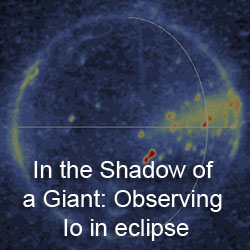
Both the JEO Final Report and the JGO Assessment Report discuss the potential for synergistic science between the two orbiters, such as at Io. For example, while JEO is encountering Io, JGO could observe Io from a distance, focusing on the state of the Io Plasma Torus (observing the structure using JGO's ultraviolet imaging spectrometer) and the state of Io's atmosphere. These observations would help to put the Europa Orbiter's in-situ data in context. In another example, while JEO monitors a major volcanic eruption on Io and its effects on the plasma torus, JGO could look for effects on the Jovian magnetosphere as a whole. While Io is in eclipse, the two spacecraft could observe Io's plasma interactions in three-dimensions. Low-spatial resolution observations of Io from JGO could also help to increase phase angle and longitude coverage of bolometric albedo measurements, which can help to constrain Io's thermal inertia and from there heat flow. Finally, JEO and JGO could link up to acquire radio occultations of satellite atmospheres, such as Io's. This would allow scientists to probe Io's night-side atmosphere for example, which would be impossible simply using a direct-to-Earth link for a radio occultation except for near dawn and dusk. The JEO Final Report suggests that the two spacecraft could also be used to acquire stereo coverage of Io's plumes, but without a narrow-angle camera, such observations may not be possible (or as useful).
While the Jupiter Ganymede Orbiter, the European Space Agency's contribution to the EJSM, would not come very close to Io because of the high-radiation environment, the instruments onboard JGO would provide some useful complimentary science to what could be acquired by JEO. JGO could use its Visual and Near-Infrared Imaging Spectrometer to monitor Io's volcanic activity at spatial scales comaprable to Galileo's during that spacecraft's primary mission. These observations would improve upon similar observations by JEO by increasing temporal coverage. JGO could also provide synergistic science by observe magnetospheric and atmospheric structures at Io while JEO is flying by the moon.
Link: Jupiter Ganymede Orbiter ESA Assessment Report [sci.esa.int]
Weekly Roundup
Well, the flagship mission downselection wasn't announced last week, but that doesn't mean last week wasn't quite busy as we took at look at several more LPSC abstracts and the more detailed reports for the Europa/Jupiter System Mission. So let's take a look back at the week that was at the Gish Bar Times for those who are just joining us:
- We took at look at six more abstracts submitted for next month's Lunar and Planetary Science Conference. We saw how Jani Radebaugh's research group up at Brigham Young University have looked at the distribution of dark-floored paterae on Io and how that might relate to tidal heating models as well as temperature estimates of a few of the fainter hotspots seen in Cassini eclipse data acquired at the turn of the millennium. We saw how Julie Rathbun and John Spencer continue to delve into their ground-based observations of Io taken during the New Horizons encounter and this data puts the NH results in context. We saw how McDoniel et al.'s DSMC modeling of Ionian volcanic plumes have shown that even irregularly-shaped vents can produce roughly symmetric plumes (except for close to the vent) and plume deposits. Finally, we took another look at the Io Volcano Observer proposal and the proposal team's work to optimize their thermal instrument's bandpasses to best support Io science.
- The NASA/ESA Outer Planet Flagship Mission downselection panel meeting took place on Thursday, February 12. While the panel's decision (whether they picked one mission or passed the buck to yet another committee...) has not been publicly announced, the more detailed final reports for the different NASA and ESA components of these two mission were finally publicly released. The release of these reports has allowed me (and Van Kane over at Future Planetary Exploration) to report on the instruments and potential scientific return of these two missions. So far I have primarily focused on the possible science results at Io, particularly of JEO in general and by the Ice-Penetrating Radar in particular.
Friday, February 13, 2009
Using Ground-penetrating Radar at Io
 Yesterday we took a more detailed look at the types of observations that are being planned for the Europa/Jupiter System Mission (if it's selected as the next flagship mission). The Final Report for the Jupiter Europa Orbiter also provided us with details of the encounters planned in the current reference trajectory for the mission. One of the types of observations that I want to talk about today is sub-surface sounding using the Ice Penetrating Radar (IPR). This is a type of observation that has never been done at Io and I have become curious as to what IPR (or a similar instrument) could see if it were turned at Io.
The Ice Penetrating Radar would work in a similar fashion to the MARSIS and SHARAD instruments currently at Mars on board Mars Express and Mars Reconnaissance Orbiter, respectively. Using a pair of antennae, IPR would emit pulses of high-power radio waves at the surface of the target body. These waves would first bounce off the surface and then structures in the sub-surface which become more difficult to detect the deeper you get as the signal returned becomes fainter. Basically, when the radio waves first encounter the surface, some of the waves are bounced back to the spacecraft, while others bounce down into the sub-surface, where it will then encounter another reflecting surface. This layer (or fault plane) will then bounce radio waves upward back toward the spacecraft or further into the sub-surface. This process continues until the amount of signal from a sub-surface layer doesn't rise above the noise level or is interfered with by other signals coming back.
The IPR will have two frequency modes: a 5-MHz (60-m wavelength) deep mode and a 50-MHz (6-m wavelength) shallow mode. When JEO is orbiting Europa, the shallow mode would be used to identify near-surface pockets of water while the deep mode would be used to search for the interface between the ice crust and the liquid water ocean beneath. At Europa, the IPR is expected to be able to sense layers as deep as 3 km using the shallow mode and 30 km using the deep mode. There are trade-offs to using each mode. While the 5-MHz mode can sense much deeper into the Europan sub-surface, it has a lower vertical resolution, 100 meters. The 50-MHz mode can not penetrate as deeply, but the vertical resolution in this mode is 10x better, 10 meters. So the shallow mode would be able to over thinner layers and smaller structures than the deep mode could. So the mode used on a particular orbit of Europa would need to be chosen based on what the scientists are trying to look for: small pockets of water near the surface or a broader perspective on the thickness of the water-ice crust. IPR also has a raw data mode, which would record the high-bit rate, unprocessed data for processing on the ground (rather than in the instrument electronics). This mode would be used for high-science value targets but the JEO final report doesn't provide information on which wavelengths would be used (at the moment I presume both).
The IPR would be used during two of the Io flybys, Io-1 and Io-4 - the two low-altitude encounters currently planned. For both encounters, the raw data mode would be used for the two minutes surrounding closest approach, providing a 1000-km long swath across Io's surface. During these encounters, the Laser Altimeter would also be used to help verify the surface heights measured by IPR. Now, obviously, near-surface properties of Io and Europa's crust are quite different. Io's near-surface should consist of a mix of basaltic rock and sulfur and sulfur dioxide ices. These differences in the material properties of their lithosphere should result in differences in the depth IPR can penetrate into Io's crust compared to the values given in the Final Report for Europa orbital science. Now, the best figures I could find for radio sounding penetration depths in basalt suggests that IPR should be able to sense layers as deep as 50-wavelengths below the surface. This would translate to 300 meters for the 50-MHz mode and 3 km for the 5-MHz mode. I am not sure if the vertical resolution also scales (1/10th of the ice penetration depths). For this discussion, I will presume that it doesn't. If any of these figures seem incorrect, please let me know so I can post a correction.
 Now with those depths and vertical resolutions, what kinds of structures would IPR see? Let's take a look at two potential swaths, shown at left. During the two minutes surrounding closest approach during the July 2026 Io-1 encounter (300 km at C/A), the JEO spacecraft would pass just north of an unnamed active volcano, then travel southeast across the Maui portion of the large Amirani flow field, then across an active patera thought to be the source vent for Amirani, and then over the older flows at Amirani as well as the plume deposit from the volcano. After passing over Amirani, JEO would continue to travel southeast, finally passing over the 6-km tall mountain Monan Mons. During the two minutes surrounding closest approach during the December 2026 Io-4 encounter (75 km at C/A), JEO would pass over four paterae, including two active volcanoes: Malik Patera and Altjirra Patera (the two dark patera under the flight path, left and right respectively). No topographic structures beyond these paterae are under the flight path. The flight path would also cross a couple of old flow lobes associated with Arusha Patera.
Using the 5-MHz band, assuming a penetration depth of 3 km and a vertical resolution of 100 meters, IPR could look at tectonic structures in the upper crust as well as search for shallow magma reservoirs. As far as tectonic structures go, IPR could look at the faults that underlie the mountain Monan Mons. This mountain is thought to have been uplifted by imbricate thrust faulting, and IPR could try to look for these faults to test this hypothesis. IPR could also look at the connection between tectonism and volcanism by look at how deeply paterae bounding faults penetrate. Do these faults reach as far down as the shallow magma reservoirs? It should be pointed out that most of these reservoirs are expected to be located at depths between 4 and 10 km, so they maybe too deep for IPR to detect. However, Leone et al. 2008 reported that Prometheus' shallow reservoir could have a rough as shallow as 3 km below the surface, so it might be possible for IPR to detect magma bodies below the surface of Io.
Using the 50-MHz band, assuming a penetration depth of 300 meters and a vertical resolution of 10 meters, IPR could examine near-surface layering of sulfur and sulfur dioxide with basaltic lava flows, comparing the depth of these layers with evidence for sapping. A 10-meter vertical resolution might be enough to resolve layering from individual eruptions, though it would be insufficient to resolve individual flow lobes, which would be on the order of one-meter thick. The 50-MHz band could be useful for looking at layering in the plains of Io, which would allow scientists to better understand how they've been built up over time.
As you can see, both IPR modes could be very useful for examining some important science questions for Io, particularly the origin of mountains and paterae by examining sub-surface structures hidden by the surface layer of sulfur and sulfur dioxide frosts and ices. IPR can also examine how fractured Io's crust really is. If a choice had to be made between the shallow and deep modes on each encounter (meaning the raw data mode doesn't use both bands), I think it would be better to use the deep mode during the first encounter over Amirani, due to its usefulness for exploring deep structures such as mountain-forming faults and shallow magma reservoirs. For the other encounter, both modes could be used, but I think the lack of mountains, and the use of deep mode to explore the deeper structure under Amirani, would make the shallow mode a bit more useful for exploring how the plains are built up and for looking at the shallow sub-surface of the volcanoes in this region. Regardless of which mode is used, it would be very useful if context images from the wide- or medium-angle camera were acquired during closest approach so that structures observed by IPR and the Laser altimeter can be correlated with structures on the surface.
Thursday, February 12, 2009
Io Science with EJSM Part Deux
 Now that the more detailed mission studies for both the Jupiter Europa Orbiter and the Jupiter Ganymede Orbiter are now online, we can delve a little deeper into the science plans for Io. For some background from the Joint Summary Reports posted last month, check out my first Io Science with EJSM post. Again, Van Kane will cover the Titan stuff from the TSSM in detail. Don't forget that the downselection meeting was today (no, I don't know who won), and an announcement should be made some time early next week.
The only comment that I have about the TSSM reports is that the ESA people should have checked with me to make sure that they had the right longitude system for that map of mine they were using. Though really they didn't have to, Kraken Mare was on that version of the ISS map [see the TSSM In-Situ Elements Assessment Report, page 71], and they still had their landing site off by 180 degrees.
The JEO Final Report is a fairly extensive document detailing the current of state of our knowledge of the Jovian system, the science objectives for the Jupiter Europa Orbiter and the Europa/Jupiter System Mission as a whole, the mission concept (including model payload, mission design, and spacecraft design using floor and baseline budgets), and planned science operations. The document itself weights in at almost 500 pages so it is a bit difficult to summarize the entire document in a single post. This document is more extensive than the EJSM Joint Summary Report discussed earlier. That's why I've chosen for this first post to focus on the Io-related science plans and mission concept.
The Final Report defines two primary science investigations for Io that would be performed by JEO: Investigate the nature and magnitude of tidal dissipation and heat loss on Io and Investigate Io's active volcanism for insight into its geological history and evolution (particularly of its silicate crust). These science objectives fit with in the mission goal of understanding Europa in the context of the Jupiter System.
To accomplish these goals, the JEO team would use most if not all of the instrument payload, which while not optimized for Io science, would go a long way to furthering our understanding of Io place in the Jupiter system and its evolution. For example, using the imaging systems, the JEO team plans to image 30% of Io with a resolution better than 1 km, which is comparable to coverage provided by Galileo and Voyager. The also plan on imaging 20% of Io at better than 200 meters/pixel (compared to 3% for Galileo), 5% at better than 50 m/pixel (compared to ~1% for Galileo) and a still to-be-determined amount at better than 10 m/pixel. 10 m/pixel imaging may be precluded by the slow reaction wheel turn time and fast speed of the two, planned close flybys of Io. In addition, the JEO team plans to acquire two Ice Penetrating RADAR swaths, 1000 km long, of Io during those two encounters. These would allow observations of sub-surface structures such as fault planes and shallow magma reservoirs. No information is provided on how deep IPR could sense in silicate rock. The Thermal Instrument will observe Io's night-side in order to better constrain Io's heat flow, which is important for understanding tidal heating on Io.
 The above figure shows the ground track for the four planned Io flybys. The first, taking place shortly before JOI on December 21, 2025, would have an altitude of 1000 km and would be used to help setup the the Jupiter Orbit Insertion maneuver. As currently planned, no remote sensing observation would be acquired so as to reduce the risk to the all-important JOI, though further study if EJSM is selected would be conducted to see how much risk there actually is. The Io gravity assist would help save 200 m/s in delta-V, which amounts to a dry mass increase of 160 kg, over an earlier plan to use a Ganymede flyby before JOI to help slow the spacecraft into orbit around Jupiter. Even with the additional shielding that will be required, this still amounts to more than 100 kg in mass margin.
Between July and December 2026, three additional encounters will be performed [please note again, that details of these encounters would change, but we can still discuss them as they are described in the Final Report].
The first will take place on July 9, 2026 and will have a close approach altitude of 300 km. On approach, JEO will be able to view portions of the anti-jovian and trailing hemispheres, between 150° and 260° West longitude, at high resolution. The more northerly approach also provides an opportunity to view the north polar region at high emission angles. The Amirani plume maybe visible along the bright limb. That will be useful as the close approach point for Io-1 is directly above the Amirani plume source. If the structure of the Amirani plume is similar to Thor's (as seen by Galileo in 2001), then this encounter would allow JEO to sample the high-altitude gas plume at Amirani. The Ion and Neutral Gas Spectrometer should be able to measure the abundances of various gas components in the plume, which could provide another method for measuring the volatile abundances on Io's surface. The Ice Penetrating Radar and Laser Altimeter should be used during this encounter. The ground track for JEO during Io-1 passes over the mountains Euxine Mons and Monan Mons with an altitude of less than 1000 km, so LA should be able to provide height and structure information about the mountains, while IPR should provide quite a bit of information about near-surface faults and flexure, which can provide a lot of details about Io's crust. IPR could also help our understand of the shallow magma reservoirs and conduits for the Amirani volcano. Because the spacecraft will use reaction wheels to control pointing near close approach, the spacecrafts speed relative to Io at C/A (9 km/s), will require a kind of skeet shoot to keep the LA and IPR pointed at Io nadir and INMS pointed in the direction of motion. So these observations maybe limited to the few minutes surrounding close approach.
The second encounter (Io-2) would take place on September 3, 2026, shortly before perijove on the next orbit. This encounter is a slower, relatively high-altitude (3125 km) flyby over the south polar region of Io. This should allow high resolution (less than 50 m/pixel) NAC imaging of the south polar region. The high altitude, however, precludes Ice Penetrating RADAR observations. Inbound, JEO will observe, like the previous encounter, the terrain between 150° and 260° West longitude at low phase angles. The lower latitude of the Io-2 encounter should allow for stereo analysis of this region, which would greatly expand topographic information from the limited swaths acquired by LA and IPR. Outbound, JEO would observe the sub-jovian hemisphere in Jupiter-shine, providing an opportunity for the Thermal Instrument and the VIS-IR Spectrometer to observe Io's volcanic activity and thermal emission.
 The third encounter (Io-4) would take place on December 27, 2026, two orbits after Io-2 and would include the closest approach altitude of the four encounters, only 75 km. At such a low altitude, the high priority is to sample a plume using the INMS. However, the close approach point is located between Malik and Altjirra Patarae, where no previous plume has been observed. If the IPR is pointed at nadir when JEO flies over Malik and Altjirra, the spacecraft could go a long way toward constraining the formation models of Ionian paterae by looking at the sub-surface structure of these two (fault planes and perhaps shallow magma reservoirs). Once again, inbound JEO should be able to image the portions of the anti-jovian and trailing hemispheres between 150° and 260° West longitude in sunlight. The Final Report includes a detailed observation scenario for I4, ±30 minutes of closest approach, which is graphically shown at right. IPR would observe Io ±1 minute surrounding closest approach. The most of the optical remote sensing instruments would operate prior to close approach, except TI whould would be run continuously after closest approach. The laser altimeter would acquire a ground track ±6 minutes surrounding closest approach.
 In addition to these flybys, sixteen non-targeted encounters during the Jupiter tour with close approaches distances between 56,300 km and 479,000 km have been identified. Most of these encounters would provide opportunities to monitor activity on Io's anti-jovian hemisphere with resolutions ranging from 560 m/pixel to 4.8 km/pixel. One interesting opportunity comes on October 29, 2026 when JEO approaches the trailing hemisphere from a distance of 185,428 km. This should allow imaging of the Pele-Loki hemisphere at resolutions approach 1.85 km/pixel. While not as good as the 500 m/pixel imaging planned (and lost due to budget constraints) for orbit A34 in November 2002, this non-targeted flyby should provide a nice change to image Pele at reasonable emission angles, Loki, and Ra as well as terrain last best seen by Voyager 1 near the south pole. During these encounters and other opportunities during the Jupiter tour and during the fourth Europa Campaign, JEO will conduct monitoring observation, searching for surface changes, plumes (both longitudinal coverage to search for them and to create plume movies), and monitoring the evolution of Io's volcanic activity over a 2.5- to 3-year time scale.
I think I'm pretty well exhausted from typing this up. I will try to writeup more tomorrow and over the weekend. In the mean time, you all can check out the two EJSM final reports for the Jupiter Europa Orbiter and the Jupiter Ganymede Orbiter. Really, more info than my brain can handle at the moment.
Io Volcano Observer at LPSC
 The Lunar and Planetary Science Conference will see two Io Volcano Observer posters. The first, by Alfred McEwen et al., is titled "Io Volcano Observer (IVO)". This poster will provide an overview of the mission concept, with the abstract providing quite a few details of the planned payload. The second, by Keszthelyi et al, is titled "Optimal Wavelengths for Studying Thermal Emission from Active Volcanoes on Io". This poster will look at some of the work that has gone into filter selection and instrument design for IVO's radiation-hard camera (RCam) and Thermal Mapper (ThM).
Much of the information in McEwen's abstract was previously reported on in my post, The Uber Io Volcano Observer Post, so I don't think I need to completely repeat myself. The abstract does include a clearer description of the imaging system to be used on IVO, RCam. The camera would use a 2000x2000 CMOS detector. The half of the detector will allow RCam to be used as a clear-filter framing camera, for taking opnav,clear filter global images, and plume movies. The other half "will be covered by up to 15 spectral filters from 200-1000 nm, each covering ~64 lines for digital Time-Delay Integration (dTDI)." For 256 lines, the instrument will have 16 sets of 4 filters, with each filter using 4 lines. The four filters McEwen's suggests using are 400-600 nm (blue-green), 600-800 nm (red), >800 nm (IR1), and >950 nm (IR2). This would allow RCam to take near-simultaneous color images that will be necessary for measuring the hottest lava temperatures as they can change over times scales of less than a second. Other filters that RCam could use include UV bandpasses (for atmospheric processes and for looking at SO2 frost), other narrow filters for looking at atmospheric composition (Na, O), mineralogy bandpasses from 800-1000 nm, and methane bands (for looking at Jupiter's atmosphere).
The second abstract by Keszthelyi et al. takes a look at the best filters to use on RCam and Thermal Mapper for measuring lava temperatures. Different bandpasses would work best for measuring lavas of different ages. For example, RCam would be used to look at lava less than a second after they emerge from the surface (such as at a lava fountain) as well as magma in lava tubes made visible through skylights. This would be supported by the two near-infrared bandpasses on RCam. Ratioing pixel values between the two would allow scientists to calculate eruption temperatures between 1200 and 1800 °C. The digital Time-Delay Integration system used by RCam would also support the need for less than 0.1 seconds between acquisition of the different color filter data.
The Thermal Mapper will use up to 10 bands in the infrared portion of the spectrum to examine Io's surface composition, thermal inertia, and thermal emission. Some of the bands that will be included would be selected based on the type of volcanic process mission scientists wish to examine. These processes occur at different time scales, which based on the cooling rate of lava on Io, can be related to different peak temperatures. The wavelengths picked (2, 3, 4, 6, and 8 microns) were chosen because they cover peak emission wavelengths for each of the time scales the scientists want to look at (processes that occur over a period of seconds, minutes, days, and months). Other bands the scientists would hope to include are 15 and 20 microns that would be used to search for SO2 at its triple point as well as to look at global heatflow. Additional bands could be included to search for the Christiansen Feature between 7.5 and 9.5 microns, which would provide additional information on the mineralogy of Io's lavas. The Christiansen Feature increases in wavelength with decreasing SiO2 content. So the CF for minerals typical of felsic lavas like rhyolite would be closer to 7.5-8 microns, while the CF for minerals typical of mafic lavas, the dominent type on Io,would be closer to 8.5-9.5 microns.
Way cool stuff!
Link: Optimal Wavelengths for Studying Thermal Emission from Active Volcanoes on Io [www.lpi.usra.edu]
Subscribe to:
Posts (Atom)


 Posts
Posts