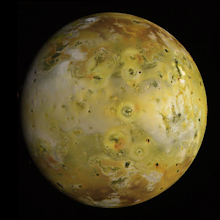
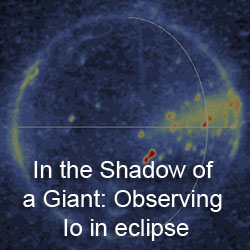
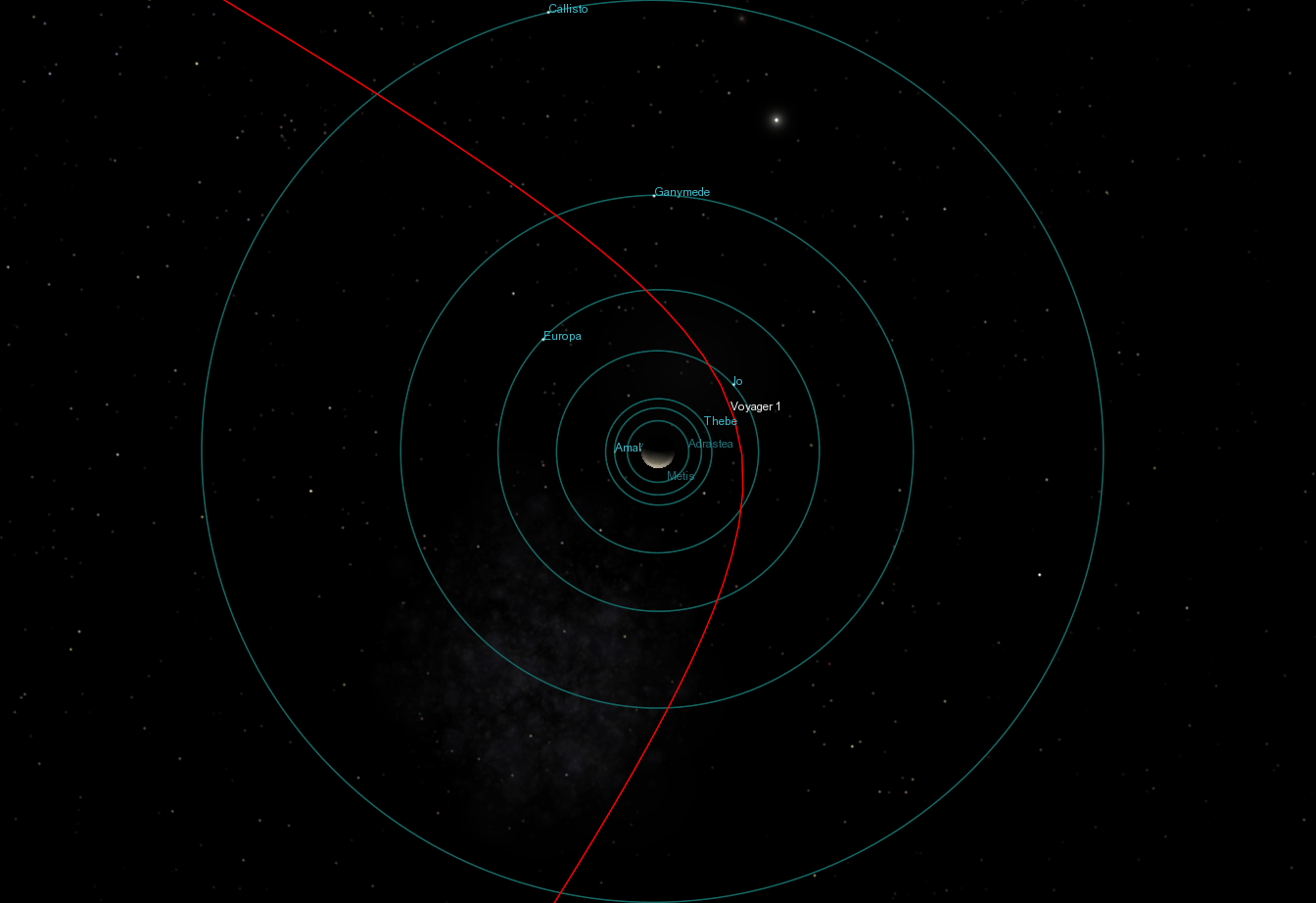
JPL will be host a webcast and chat on their Ustream channel at http://www.ustream.tv/nasajpl covering outer planet satellites like Io. The topic is called "Moons: The Weirdest Planets in Our Solar System" and has the following description:
Moons are fantastic worlds - with features unlike anything seen on Earth: giant sulfur-spewing volcanoes, globally cracked ice-covered surfaces, liquid lakes of hydrocarbons, and colossal watery plumes. Many of these worlds also happen to be the most likely places for life to evolve outside the Earth. How cool is that?
The webchat takes place at 7pm PDT (10pm EDT) tonight.
Link: Moons: The Weirdest Planets in Our Solar System [www.ustream.tv]
Showing posts with label Events. Show all posts
Showing posts with label Events. Show all posts
Thursday, July 22, 2010


Thursday, February 25, 2010
The Gish Bar Times Two-Year Anniversary
 Today marks the second birthday for the Gish Bar Times. You can check out the original Welcome message that I posted two year ago. The last year has seen a number of commemorations of various anniversaries related to Io, including the flybys of Voyager 1 and 2 in 1979, the Galileo flyby in October 1999, and the discovery of Io by Galileo in 1610. Focusing on these anniversaries in the last year has been a large driver of content here on the blog in addition to the usual discussions over new papers and meeting abstracts.
Now during last year's birthday message, I said that I would expand our content to include more discussion of the other Galilean satellites of Jupiter. To some extent I did this, with posts on the delivery of oxygen to Europa's ocean, but for the most part, I've continued to stay focused on Io here on Gish Bar Times. I think in the end, the focus will remain on Io, but if there is an interesting story regarding the other Jovian moons, I won't hesitate to post about it, but it won't be prominent in our coverage. Last year, I was concerned about maintaining readership levels while maintaining a focus on one Jovian moon, but in the last year, we have gone from 51 unique visitors per day in 2009 to 107 so far this year. In each of the six months, the number of unique visitors has exceeded those of any previous month except for February and March 2009 when the Outer Planet Flagship Mission was selected.
So what can you expect over the next year? Well, recently I have gotten into writing more articles on various Io topics, such as surface features or the exploration of Io. I think what you can expect is more connection between my write ups on Wikipedia and posts here, which I think will be of interest to readers here. If I am wrong about that, let me know, but I think that could help both in the coverage of Io on Wikipedia and provide new and interesting content for the blog. So in the next year, expect to see more overview articles on the various volcanoes of Io. Of course, we will continue to cover the Outer Planet Flagship Mission, the Discovery mission AO, and new papers and mission abstracts.
In the next few days, you can expect some minor changes to the layout of the blog, to make it feel more like a website than just a simple blog. The first step in this plan was done on Monday when we moved the site to its new URL: http://www.gishbartimes.org. That move is now complete, and some of the tools I had that were temporarily gone are now back online. This includes comment deletion, so spammers, your window of opportunity to run wild here has now closed. I will add additional features, such as static pages and a table of contents below the title.
So with two years down, here's to another!
Sunday, February 14, 2010
Happy Valentine's Day from Io

Both are somewhat cardioid-shaped. Interestingly enough, both volcanoes have similar characteristics. Both paterae have evidence of multiple floor levels, with the lowest portion (to the upper right on Inti, to the left on the other volcano) showing the most signs of activity. Activity at both features tends to also be confined to the outer margins of the paterae, though the volcano on the right has a lower floor that is covered almost entirely by a dark lava flow or lava lake. The majority of both volcanoes have an albedo similar to that of their surroundings, suggesting that lava has not flowed over their floors (except for the lower portions of the floor) in a very long time (>100 years, I'd say). Finally, both show evidence for structural control, pre-existing faults that for part of the boundary for the volcano. This is particularly evident in the volcano on the right, with has a number of straight margins.
Again, tip of the hat to Phil Plait. And Happy Valentine's Day!
Link: Happy Valentine’s Day. Love, Rhea [blogs.discovermagazine.com]
Thursday, January 7, 2010

Thursday, July 9, 2009
30th Anniversary of the Voyager 2 Flyby of Jupiter
 Thirty years ago today, on July 9, 1979, the Voyager 2 spacecraft encountered Jupiter from a distance of 650,000 kilometers about its cloudtops, marking the second Voyager project flyby of the planet. The encounter provided an opportunity to see the anti-Jupiter hemispheres of Ganymede and Callisto, to monitor changes on Jupiter and Io since the Voyager 1 encounter four months earlier, and to observe Europa up close for the first time.
Back in March, we took an extensive look at the Voyager 1 encounter with Jupiter and Io. The Voyager 1 flyby provided a revolution in our understanding of the giant planet and turned the four Galilean satellites from mere points of light we were only beginning to understand into four separate worlds, each with their own unique geologies. In particular, during the Voyager 1 encounter, active volcanism was observed on Io as well as a narrow ring around Jupiter.
 For Io, the second Voyager encounter did not provide the same revolution in our understanding of that world; the clear star of the July 9 encounter was the cracked world of Europa. While Voyager 1 flew within 20,000 kilometers of Io on March 5, 1979, Voyager 2's trajectory kept the spacecraft outside Europa's orbit and, with Io on the other side of Jupiter during closest approach, Voyager 2 never came close than 1,128,000 kilometers of Io. However, the discovery of active volcanism on Io by Voyager 1 necessitated a change in the schedule of observations for the second encounter, including a 8-hour long sequence of images of a narrowing crescent Io as Voyager 2 receded from Jupiter. This prolonged observation sequence allows Voyager 2 to monitor volcanic plumes along Io's limb, including those at Amirani, Maui, and Loki. From observations such as these, Voyager 2 found that most of the plumes first observed by Voyager 1 were still active during the July 1979 encounter. Only Pele appeared to have shut down, though later observations by Hubble, Galileo, and other spacecraft seem to suggest that the Pele plume is intermittently active. Volund was not observed near the limb of Io during the Voyager 2 encounter, so it could not be determined if that plume was still active.
 Earlier, Voyager 2 had observed Io while it was more illuminated by the Sun, like the image at left. The goal of these observation was to search for surface changes on Io as the result of volcanic activity between the two Voyager encounters. Among the changes observed were two new plume deposits surrounding Surt (probably active during a short, intense eruption in June 1979, but Surt was not viewed near the limb by Voyager 2 to see if it was still active) and Aten Patera. The presence of these changes from large plumes but without the observation of the plumes associated with them have led to the conclusion that large, Pele-type plumes tend to be short-lived compared to more persistent, smaller dust plumes like at Prometheus. Additional surface changes included a larger dark area within Loki Patera, the result of overturning of more surface area of the lava lake that covers much of Loki, and a change in the shape of the Pele plume deposit, from a heart shape to an oval. Subtle changes in the shape and intensity of the Pele plume deposit were also observed by Galileo in the late 1990s and early 2000s.
 Of course, Io wasn't the only world Voyager 2 observed during its encounter 30 years ago. The star of the show was Europa. Europa was poorly observed during the previous Voyager encounter so this one really provided a great leap in our understanding of this icy world. Like Ganymede, Europa's surface was dominated by tectonic structures, ridges and dark, linear bands that criss-cross the surface. Unlike Ganymede, Europa's surface was found to be quite young with very few impact craters, though enough to show that the satellite's surface was much older than Io's. Spectral measurements suggesting a water ice surface, mass estimates between that of Io and Ganymede, and youth surface age soon led to the suggest that just beneath Europa's ice shell lay a liquid water ocean that today is a main focal point for exploration in the Jupiter system.
Voyager 2 never got the same amount of attention that the earlier Voyager 1 encounter did. During the same week, Skylab was slowly approaching its destruction over Australia, dampening press interest in the encounter, along with the perception that this encounter was covering similar territory as the previous one. But Voyager 2 provided an opportunity to follow up on the discoveries made by Voyager 1 by allowing for an adjustment to the observation plan, such as to monitoring Io's volcanic plumes and Jupiter's narrow ring system as Voyager 2 receded from the giant planet. Voyager 2 also allowed imaging scientists to fill out the global map of Ganymede and Callisto by observing their anti-Jovian hemisphere and providing the first close-up look of Europa. The Voyager 2 encounter unfortunately also began a 17-year gap in close-up spacecraft imaging of the Jupiter system. But Voyager 2 went on to bigger and better things, including doing followup observations of the Saturn system in August 1981 as well as our only encounters of Uranus and Neptune in 1986 and 1989, respectively.
For this post, I have posted some movies on Youtube created in Celestia showing the geometry of this encounter:
- Voyager 2 Trajectory through the Jupiter System
- Animation of Io as seen from Voyager 2 in July 1979
- Animation of Io as seen from Voyager 2 in July 1979 - Short Version
Saturday, May 2, 2009
My 365 Days of Astronomy Podcast
My podcast for the 365 Days of Astronomy should be online later today, if it isn't already. The topic of my podcast is "It's the Season for Eclipses in the Jupiter System." Here is the summary I submitted for this edition:
I hope you all have a chance to check it out! You can also read the blog post that was the genesis for this podcast.
Link: 365 Days of Astronomy - It's the Season for Eclipses in the Jupiter System [365daysofastronomy.org]
In 2009, as it does every six years, the Jupiter system experiences equinox. While Jupiter's low axial tilt makes the passing of season much less noticeable than on Earth, Mars, or Saturn, equinox does bring a season of eclipses for Jupiter's moons. From Earth, astronomers can observe these eclipses as well as occultations, when one moon passes in front of another. Today, we will discuss the useful science gained from eclipses and occultations as well as a few of the eclipses coming up in the Jupiter system, focusing primarily on Jupiter's innermost large moon, Io.I cover both the equinoxes to be experienced by Jupiter and Saturn in the podcast, looking at the unique events that can be observed during the months surrounding equinox as well as look at the types of changes that occur in these two systems as the seasons change.
I hope you all have a chance to check it out! You can also read the blog post that was the genesis for this podcast.
Link: 365 Days of Astronomy - It's the Season for Eclipses in the Jupiter System [365daysofastronomy.org]
Thursday, March 12, 2009
Journey to Jupiter
Don't forget that tonight's new episode of Naked Science on the National Geographic Channel will cover the Galileo mission to Jupiter. The show starts at 8pm EDT (or 7pm MST, at least on HD channel). The webpage has a 3 minute long trailer for the show, so you can check that out now.
As far as other news goes, there is a press release about how Jupiter may have eaten its young and that the Galilean satellites we see today are the survivors of this early, cannibalistic period. Also, Emily Lakdawalla has a post on her blog discussing New Horizons images of the Neptune and Triton taken late last year.
Link: Naked Science -Journey to Jupiter [channel.nationalgeographic.com]
As far as other news goes, there is a press release about how Jupiter may have eaten its young and that the Galilean satellites we see today are the survivors of this early, cannibalistic period. Also, Emily Lakdawalla has a post on her blog discussing New Horizons images of the Neptune and Triton taken late last year.
Link: Naked Science -Journey to Jupiter [channel.nationalgeographic.com]
Tuesday, March 10, 2009
A Final Look Back at Voyager 1 at Io
 Over the last few days, we've been taking a look back at the Voyager 1 encounter with Jupiter and its volcanic moon, Io, that took place 30 years ago on March 5, 1979. For those of you who are just joining us, here are some quick links to those posts:
- 30th Anniversary of the Voyager 1 Flyby of Io - We take a look at the encounter itself as well as an animation created in Celestia showing the encounter
- More on the 30th Anniversary of the Voyager 1 Encounter - Based on an excerpt from "Voyage to Jupiter", a NASA-publication about the two Voyager encounters of the Jovian system
- Voyager 1 Southern Hemisphere Mosaic and Taking another look at Voyager 1 images of Io - We re-examined some of the images acquired by Voyager 1 during its flyby as I reassembled some of the mosaics the spacecraft acquired, including one covering much of the southern, pro-jovian hemisphere of Io. By looking at some of the wide-angle camera images, it looks like we can fill in some of the low-resolution gap in the global map of Io, particularly over Masubi and the terrain just east of Shamshu Patera.
- 30th Anniversary of the Discovery of Volcanism on Io - Finally, we looked back at the discovery of Active Volcanism on Io, of volcanic plumes on Io.
Before Voyager's close-up look in 1979, not much was known about Io. We knew from spectroscopic studies of Io and its environment that Io had sulfur on its surface and that is was surrounded by a cloud of sodium. From the earlier Pioneer 10 and 11 encounters, we also knew that Io was centered in one of Jupiter's radiation belt. This led to the hypothesis that the sodium cloud surrounding Io was the result of sputtering of an evaporite deposit, rich in sulfur and halite (also known as table salt), on Io's surface. In terms of its interior and geology, Io was expected to have an ancient surface similar to Earth's own moon considering that both worlds have a similar size and mass.
This model obviously changed as a result of the Voyager 1 flyby. Instead of an ancient surface, Voyager found a geologically active world with volcanism and mountains produced through tectonic motion. The images and spectra returned by the spacecraft provide brilliant confirmation for the model by Stan Peale, Patrick Cassen, and R. T. Reynolds that Io's interior was heated by the varying tidal pull of Jupiter on Io. This variation in the tidal pull is the result of the forced eccentricity in Io's orbit induced by the moon's orbital resonance with two other Galilean satellites of Jupiter, Europa and Ganymede. Over the next few years following the Voyager flybys, two competing models of Io's interior and geology developed. Simplifying things a bit, the two models basically attempted to explain what the composition of Io's lavas were.
 In one model, all the volcanism on Io could be explained with sulfur. In this model, Io was overlain with a thick layer of sulfur and sulfur dioxide. The top layer of this sulfur would be solid, but it liquefied the further down you went, until you had a nearly global sulfur ocean underlying a solid sulfur crust. Imagine Europa with its water ice shell and water ocean underneath, but with sulfur instead of water. The multi-colored flows Voyager observed were explained as being the result of sulfur and its various allotropes flowing out across the surface; the dark volcanic pits were filled with boiling, pitch black sulfur. Underlying this sulfur shell was the silicate lithosphere. This lithosphere had to be active itself, as the mountains on Io had to consist primarily of silicates in order to sustain the heights seen by Voyager. In these cases, the mountains consist of parts of the silicate crust poking up above the sulfur shell. Silicate volcanism was thought possible beneath this shell, as silicate magma reaches up to the level of the sulfur-silicate interface before forming a sill and heating the sulfur above it. This model of primarily sulfur volcanism was supported not only by Io's multi-colored surface, but also by the temperatures seen at Io's volcanoes by the IRIS instrument on Voyager.
 In the other model of Io's interior and volcanism, Io's crust consisted primarily of silicate rock with only a thin veneer of sulfur and sulfur dioxide. In this case, Io's lavas consisted of silicate rock, like volcanism on Earth (with some exceptions), with a sulfur enrichment. At the time of the Voyager flybys, this model was supported by the topographic structures visible on Io, which were not thought to be supportable by a crust that consisted primarily of sulfur. However, the thermal data to back it up didn't really come until 1986 when an eruption on Io's leading hemisphere was observed from Earth, and the blackbody radiation temperatures of the eruption were too high to be explained by sulfur. Other eruptions, including an eruption at Surt in June 1979, also had temperatures too high to be explained by sulfur. The lower temperatures seen by Voyager could be explained by the fact the IRIS instrument's wavelength band-passes were in the mid-infrared, wavelengths too long to sense the high-temperatures consistent with silicate volcanism. The discoveries made by Galileo in the 1990s and early 2000s seemed to put the nail in the coffin for the sulfur volcanism model as high-temperature volcanism (> 1000 K) was observed at many active volcanoes on Io and absorption bands consistent with orthopyroxene were found in some of Io's pyroclastic deposits.
 The current consensus view of Io's volcanism, interior, and geology is in many ways seems like a merging of these two models. This consensus view was published in 2004 by Keszthelyi et al.. In this model, Io's crust consists primarily of silicate rock. As depth decreases, or as your approach the surface from Io's interior, the amount of sulfur in the lithosphere increases. This sulfur and sulfur dioxide is constantly being brought back up the surface, or recycled, by silicate volcanism. However, as silicates rise through the lithosphere from deeper magma reservoirs, they stall out as they become neutrally buoyant and form sills. These sills heat up the sulfur near it, which then melt, forming a depression on the surface and leading to sulfur volcanism (and some silicate volcanism as well). Over time, this depression deepens, allowing more silicates to reach the surface until the sill is unroofed and the bottom of the depression, or patera, becomes a silicate lava lake. I posted a more detailed explanation of this process last week.
The Voyager encounter with Io in March 1979 greatly increased our knowledge of Io as well as the rest of Jupiter system. It changed how we view the worlds of the outer solar system, making us scientists always expect the unexpected when we look at these worlds, even with an orbital mission like Cassini, where we have found active cryovolcanism on Enceladus and a dynamic climate system on Titan capable of producing large lakes at that moon's pole and great sand dune seas and canyonland terrain in the equatorial region.
It has been a pleasure looking back at the Voyager encounter with all of you. I hope you all enjoyed the mosaics I have put together over the last few days :) And thanks to Emily Lakdawalla for the shout-out on her blog.
Monday, March 9, 2009
Quick Notes
Just a few quick notes:
- The Outer Planets Assessment Group (OPAG) meeting is going on today and tomorrow in Bethesda, Maryland (see the Agenda). I am not there, but the presentations should be online later this week or next, and I will discuss them here when they do. One of the presentations to be given tomorrow covers the Io Volcano Observer.
- The National Geographic Channel will have an episode of Naked Science titled "Journey to Jupiter" covering Galileo and the new Europa/Jupiter System Mission on Thursday, March 12 at 8pm EDT. Might be worth checking out.
- Van Kane has a great post on his blog on the new Planetary Science Decadal Survey.
Sunday, March 8, 2009
30th Anniversary of the Discovery of Volcanism on Io
 Imagine you were a scientist on the Voyager Imaging Team 30 years ago today. Only days before, Voyager 1 had passed through the Jovian system, returning thousands of images of Jupiter and its moons. The Galilean moons Voyager revealed had strange and fascinating vistas: cratered Callisto, grooved Ganymede, streaked Europa. Perhaps the strangest of these four worlds was Io. It was clear from the images that were coming down in the days following Voyager's close pass that Io was a world that was constant renewing its surface. Instead of impact craters that were prevalent on most worlds, Io had none and was covered in apparent volcanic features. Given the lack of impact features on the surface, Io was likely even active today.
On Friday, March 8, 1979 at 13:28 UTC, Voyager 1 pointed its narrow-angle camera at Io, 4.5 million kilometers away, one last time. Thirty-eight minutes later, the image was received on Earth. The image was taken to help establish the position of Voyager in space. By comparing the position of Io in the image with known background stars also found in the image, the navigation team could determine if additional maneuvers were needed to keep the spacecraft on track for an encounter with Saturn in November 1980. This task was assigned to Linda Morabito, the cognizant engineer of the Optical Navigation Imaging Processing System at JPL. Among the first things she saw when looking at this image, just as you might have when you saw the same image above, was the crescent-shaped feature just off the limb of Io. Over the next day, she and other Voyager navigation engineers and scientists worked to eliminate the possibilities of what this feature could be. When the crescent, now thought of as a cloud was shown to be assocated with a possible volcanic feature (now known as Pele), this seemed to nail this down as a volcanic plume. There was even another plume (now known as Loki) just beyond the terminator, catching the first bits of morning sunlight.
A more detailed account than I can ever give of the discovery of volcanism on Io can be found on the Planetary Society website and was told by none other than Linda Morabito Kelly.
 The discovery of active volcanism on Io was announced at a press conference on Monday, March 12, 1979. By then more plumes had been found as earlier images of Io were re-examined and areas of high thermal emission were being found by Voyager's Infrared Interferometer Spectrometer (IRIS) . For example, in the mosaic I posted earlier today (and if you haven't checked that out, I couldn't recommend to do so more!), two plumes are visible along the limb: Masubi and Pele. I've created a special version showing these plumes in the mosaic. Masubi is at lower left and Pele is at right. These two plumes show the two main types of plumes on Io. Masubi is a smaller, dust plume, also known as a Prometheus-type plume. It has an umbrella-like shape, with a dense central column (in this case TWO central columns) and a bright shock canopy. Pele is the archtype of the Pele-type or gas plumes. In this case, there is no central, dense, eruption column and the shock canopy has a filamentary structure.
I guess for me, the discovery of active volcanism on Io was perhaps more significant for me personally than the Apollo landings, or any of the other major events in the history of spaceflight. While I was not around for either event (I hate to make some of you feel any older, but yes, I was still 4.5 years away when Voyager 1 flew by Jupiter), that discovery, along with the Galileo and Cassini missions were most significant for me to decide to work in this field. Seriously, I could have been in law school right now. Thanks Voyager 1!
Later today, I will be working on a few more mosaics from Voyager 1, though these won't be anywhere nearly as big as the one I posted earlier today. Seriously, have you checked it out yet‽ One will be a reprocessing of the PPS support imaging strip and the other will be a higher resolution mosaic over Io's south polar region. I am trying to stick using the Voyager imaging teams different mosaic designs when deciding which images to use for these mosaics. That's why Loki is missing in the Southern Hemisphere mosaic; it wasn't covered in that mosaic design. It WAS covered in the lower resolution, 4-color northern hemisphere mosaic, but that one has a lot more missing images and smeared images, so it will take me a bit longer to figure out how to parse that one down.
And have you checked out that mosaic I did earlier ;)
Link: Discovery of Io's Volcanoes [members.fortunecity.com]
Thursday, March 5, 2009
More on the 30th Anniversary of the Voyager 1 Encounter
 I found a copy online of the NASA publication, "Voyage to Jupiter," by David Morrison and Jane Samz. This publication provides some great insights into the Voyager encounters with Jupiter in 1979, the science investigations the two spacecraft performed and the new knowledge they obtained. The document also has a day-by-day account of the activities of the spacecraft and the science and engineering teams for both Voyager encounters. Below is an excerpt covering the Io encounter by Voyager 1, 30 years ago today. Don't forget to check out the post immediately below this one for some of my own thoughts and a nice animation of the encounter with Io. Later this week, I will post more about the discovery of active volcanism on Io, which occurred a few days after the flyby, and on how scientists viewed Io and its geology following the encounter.
Monday, March 5. Many celebrities, including the Governor of California, spent the night at JPL to witness the historical occasion. In Washington, D.C., as special TV monitor was set up in the White House for the President and his family.Link: Voyage to Jupiter [eric.ed.gov]
Shortly before closest approach to Jupiter, Voyager began its intensive observations of Io. Much of this information, taken while the Australian station was tracking the spacecraft, was recorded on Voyager's onboard tape-recorder for playback later that day. But even before the results of that imaging were known, Larry Soderblom was calling Io "one of the most spectacular bodies in the solar system." As more and more vivid photos of Io appeared on the monitors, members of hte Imaging Team in the Blue Room buzzed with excitement. "This is incredible." "The element of suprised is coming up in every one of these frames." "I knew it would be wild from what we saw on approach but to anticipate anything like this would have required some sort of heavenly perspective. I think this incredible."
At 7:35 a.m. Voyager was scheduled to pass through the flux tube of Io, the region in which tremendous electric currents were calculated to be flowing back and forth between the satellite and Jupiter. Norm Ness suggested, after examining the magnetometer data, that Voyager skirted the edge of the flux tube, and that the current in the tube was about one million amps. As the flux tube results were received, champagne bottles began to pop in the particles and fields sciences offices, in celebration of the successful passage through the inner magnetosphere. Meanwhile, at 7:47 a.m., closest approach to Io occured, at a range of only 22 000 kilometers. Voyager was 25 000 times closer to this satellite than were the watchers on Earth.
At 8 a.m. a special press conference was held to mark the successful Jupiter flyby. Noel Hinners, Associate Administrator for Space Science and the highest ranking NASA official present, congratulaed all those who made the Voyager Mission a success. The encounter was the "culmination of a fantastic amount of dedication and effort. The result is a spectacular feat of technology and a beginning of a new era of science in the solar system. Just watching the data come in has been fantastic. I had a fear that things on the satellites were going to look like the lunar highlands. Nature wins again. If we're going to see exploration of this nature occurring in the 1980s and 1990s we must continue to expound the results of what we're finding here, the role of exploration in the history of our country, what it means to us as a vigorous national society."
At the regular 11 a.m. press briefing, Brad Smith glowed. "We're recovering from what I would call the most exciting, the most fascinating, what may ultimately prove to be the most scientifically rewarding mission in the unmanned space program. The Io pictures this morning were truly spectacular and the atmosphere up in the imaging area was punctuated by whoops of joy or amazement or both." The new color photo of Io taken the night before was released, showing strange surface features in tones of yellow, orange, and white. The image defied description; the Imaging Team used terms like "grotesque," "diseased," "gross," "bizarre." Smith introduced the picture with the comment, "Io looks better than a lot of pizzas I've seen." Larry Soderblom added, "Well, you may recall [that we] told you yesterday that when we flew by we'd figure all of this out. I hope you didn't believe it."
One thing was certain: There were no impact craters on Io. Unless the satellites of Jupiter had somehow been shielded from meteoric impacts that cratered objects such as the Moon, Mars, and Mercury, the absence of craters must indicate the presence of erosion or of internal processes that destroy or cover up craters. Io did not look like a dead planet. Imaging Team member Hal Masursky, looking at the "pizza picture, estimated that the surface of Io must be no more than 100 million years old -- that is, some agent must have erased impact craters during the last 100 million years. This interpretation depended on how often cratering impacts occur on Io. No one could be sure that there had been any interplanetary debris in the Jovian system to impact the surfaces of the satellites. Perhaps none of them would be cratered. The forthcoming flybys of Ganymede and Callisto would soon provide this information.
As encounter day drew to a close, celebrations took place all over JPL. For many, however, the excitement was tempered by exhaustion. After 48 hours of intense activity, sleep was imperative for some. But the close approach to Callisto was still to come, as was an examination of the data already received.
30th Anniversary of the Voyager 1 flyby of Io
 30 years ago today, the Voyager 1 spacecraft encountered the first planet in the Voyager programs decade-long epoch tour of the outer solar system. While Pioneer 10 and 11 were the first space probes to reach Jupiter, proving passage through the asteroid belt was possible, Voyager 1 opened up the worlds of Jupiter system to humanity, turning these moons from mere points of light into fully-realized worlds.
Voyager 1 flew within 19,000 km of Io, making it the best resolved world during the spacecraft's passage through the Jupiter system. The world Voyager 1's cameras revealed was unlike anything planetary scientists. Instead of being dead with numerous impact craters, like our own moon, they found a world with strange pits, flow terrain, an incredible diversity of albedo markings, and mountains 10-20 km tall. Global mosaics revealed a dark, horseshoe shaped pit, an albedo marking shaped like a hoof-print (in keeping with the myth of Io, a lover of Zeus who was transformed into a cow to protect her from Zeus's wife, Hera).
Animation of the Voyager 1 Flyby of Io on March 5, 1979
 Voyager 1's highest-resolution images covered the southern pro-jovian hemisphere of Io, an area not seen again at high resolution (Galileo's best images of the region were on the order of 10-20 km/pixel). You can see my attempt to piece together Voyager 1's highest resolution mosaic, though I can't seem to find where I put the original project files... These images revealed numerous large, volcanic pits, low scarps that cross Io's generally flat terrain, and large mountains. But not a single impact crater, unlike any other solid-body world in the solar system imaged to that point.
Recent volcanic activity on Io would explain the lack of impact craters on its surface. Within a short time after a crater forms, the feature is filled in with lava and pyroclastic material. An explanation for these amazing images came in the form of a paper published in the journal Science only three days before the Voyager encounter by Stan Peale, Patrick Cassen, and R. T. Reynolds. They suggested that the varying tidal pull on Io by Jupiter, created by the orbital resonances with the other Galilean satellites, would heat up and partially melt Io's interior. This internal heat would then be released in the form of volcanic activity.
This only left the question of whether Io was still active.
 Voyager 1 provided a wealth of information about not just Io, but the other moons in the Jovian system as well as Jupiter itself. Images revealed three additional small moons of Jupiter (later named Metis, Adrastea, and Thebe) orbiting near Amalthea, as well as narrow ring of material confirming a prediction made by Acuña and Ness 1976 based on Pioneer charged particle data. Voyager 1's cameras also revealed in detail the cratered and grooved surface of Ganymede and the ancient surface of Callisto. The spacecraft never came very close to Europa and could only hint at the amazing surface features seen by Voyager 2 four months later and Galileo 16 years later. Voyager imaging scientists did note a lack of obvious impact features as well as dark, linear streaks criss-crossing Europa's surface.
The Voyager 1 flyby of the Jupiter system 30 years ago today truly opened up the moons of the outer planets to humanity. The robotic explorer transformed the four Galilean satellites from points of light in the sky to worlds with geology and amazing vistas. The discoveries made at Io, of a world of abundant active volcanism, were perhaps the most amazing of a truly incredible encounter. Later this week, we'll look back at the discovery of active volcanism on Io and on the post-Voyager view of Io's interior and how it compares to our view now.
Wednesday, February 25, 2009
The Gish Bar Times One-Year Anniversary
 Today marks the first birthday for the Gish Bar Times. You can check out the original Welcome message that I posted a year ago this very minute. Despite the lack of a spacecraft at Io during this past year, and there won't be until Juno arrives in 2016, this past year has been pretty exciting with the Outer Planet Flagship Mission contest, a legitimate proposal to send a dedicated mission to Io, and further processing work on Galileo images of Io.
I want to thank all of you for visiting the blog on a regular basis. Your support has really helped spur me to try to write interesting posts on the science and exploration of this exciting, but often forgotten moon of Jupiter. When I started this blog last year, I didn't quite know if a blog about a single moon of Io would work or would find many readers. It took a while for me to really find my voice and write these more substantive posts, but I have grown more and more satisfied by what I've done with place.
When I started this blog, my goal was to talk more about the science side of Io, talking about new volcanic activity observed by ground-based observers, astro-photography posted online, and new papers. In the last year, I was definitely drawn more and more to the exploration side, with quite a few posts dedicated to future approved and proposed missions. In the next year, I'm not sure if there will be quite the level of future mission news now that the flagship mission has been selected. The IVO concept study should be wrapping up in the next few months, but I am not sure how much more it will change from the December 2008 Io Workshop presentation.
So what can you expect from this blog over the next year? Well, it is clear to me that I can't quite sustain this readership in the future by focusing ENTIRELY on Io. Now don't get me wrong, this is an Io blog. It will always be an Io blog. Much of the in-depth coverage on this blog will be dedicated to Io. So, paper summaries and reprocessed images will be about Io. However, to keep the blog fresh, I think it would be a good idea to broaden the topics covered here. So, I will also talk about the other objects in the Jovian system...including Europa if I have to. I will also post on news related to planetary volcanism (on Titan, Mars, Venus, or major eruptions on Earth). I think this will help sustain the viability of this blog in the long term and maintain interest when there isn't much to talk about regarding Io.
Anyways, thanks for reading this little missive. Go ahead and post comments to this post and let me know what you think of this idea.
Wednesday, January 7, 2009
Happy Io Discovery Day!
 Happy Io Discovery Day to one and all!! On this date in 1610, Galileo Galilei took a look at Jupiter through his new telescope and observed three stars near the giant planet. Over the next few nights, Galileo observed these stars (and found a fourth on January 13) and came to the startling conclusion that these objects were in orbit around Jupiter and were not part of the fixed background of stars, providing another nail in the coffin of the Geocentric world view.
Of course, Galileo isn't the only astronomer who claimed to have discovered the Galilean Satellites. Simon Marius, a German astronomer, claimed at the time to have observed them in December 1609. Because Galileo published first, Galileo is now generally regarded as the discoverer, but Marius' names for the Galilean satellites have stuck: Io, Europa, Ganymede, and Callisto.
A good overview of Galileo's observations, published in Sidereus Nuncius in March 1610, can be found on the JPL website, but here is the translation of the pertinent part:
On the 7th day of January in the present year, 1610, in the first hour of the following night, when I was viewing the constellations of the heavons through a telescope, the planet Jupiter presented itself to my view, and as I had prepared for myself a very excellent instrument, I noticed a circumstance which I had never been able to notice before, namely that three little stars, small but very bright, were near the planet; and although I believed them to belong to a number of the fixed stars, yet they made me somewhat wonder, because they seemed to be arranged exactly in a straight line, parallel to the ecliptic, and to be brighter than the rest of the stars, equal to them in magnitude . . .When on January 8th, led by some fatality, I turned again to look at the same part of the heavens, I found a very different state of things, for there were three little stars all west of Jupiter, and nearer together than on the previous night.Don't forget, only one more year until the 400th anniversary of Io's discovery.
Link: Discovery of the Galilean Satellites [www2.jpl.nasa.gov]
Monday, December 22, 2008
Io Eclipses in 2009
Next year is the season of eclipses in the outer solar system. Both Jupiter and Saturn will both see the beginning of northern spring next summer. Equinox at both planets also means mutual event season. Astronomers use this time to observe occultations of two moons, when one moon appears to pass in front of another (see this example from Cassini, when Rhea passed in front of Enceladus). Mutual event season is also a season of shadows, when the shadows of the giant planets' moons cause eclipses on other moons or the rings.
At Io, the scientifically most useful type of mutual event have been occultations. By monitoring the brightness of Io as another moon occults it, an astronomer can determine the location of hotspots on the surface by measuring the time when bright IR sources are occulted then later reappear. Robert Howell measured quite a few of these occultations during prior mutual event seasons in 1996-1997 and 2003. See his LPSC abstract from 2003 for an overview. Using these occultations, Howell could not only determine whether or not Loki was active, for example, but also which part of its patera was hot. Recent developments in adaptive optics technology have greatly improved the spatial resolution of ground-based observations, seemingly reducing the need for making such measurements now that they rival them in resolution. However, these adaptive optics observations are only performed at a few of the largest telescopes in the world, like Keck and ESO, which may observe at best a few nights out of the year. Occultation measurments can be acquired by much smaller telescopes equipped with a high-speed, infrared photometer.
The only potential barrier to the events being observed next year is that Saturn will be undergoing a similar ring-plane crossing at about the same time. With a larger orbit, Saturnian equinoxes happen more rarely, every 15 years as opposed to every 6 years for Jupiter. With Cassini in orbit around Saturn making concurrent observations, this ring-plane crossing has even more importance. Therefore, Jupiter's mutual event season may take a lesser priority for astronomers worldwide. [NOTE: After publishing this post, I saw a NASA press release mentioning that Saturn's ring plane crossing will occur as Saturn nears conjunction, when Saturn will be near the sun. So maybe Jupiter's mutual events won't take as much of a backseat since so many of the "good" events occur around opposition, when Jupiter will be opposite the sun in the sky.]
In addition to equinoxes, Io will experience eclipses of the Sun by two other Galilean satellites: Ganymede and Callisto. All but two of the total eclipses seen from Io will be by Ganymede. Ganymede eclipses occur a week, beginning on June 9 and ending on August 5. The early eclipses are best seen in the north polar region, while the later eclipses are best seen over the south polar region.
Here is an overview of the most interesting eclipses:
 The eclipse covering the most terrain on Io will be the total solar eclipse by Ganymede on July 15, 2009 at 10:47 UTC. The total solar eclipse will be visible across much of Io's sub-Jupiter hemisphere between 48 North and South latitude, and 232-52 West longitude. The polar regions will experience a partial eclipse. During the eclipse, Ganymede will appear 13' 17.2'' across in the sky (compared to our moon, which appears around 30' across in Earth's sky). The sun will appear 6' 19.9". Therefore, it is unlikely that the sun's corona would be seen during the eclipse except near the beginning and end. At its peak, the eclipse will last 1 minute and 55 seconds long.
 The only total solar eclipses by Callisto visible from Io will both occur on June 20, 2009. These eclipses will primarily be visible in the south polar region of Io, on the trailing hemisphere side. The first eclipse occurs at 04:32 UTC, while the second occurs at 09:01 UTC. A third total eclipse would be visible on June 3, however totality starts after a Jovian eclipse has started. June will also see two, multiple Ganymede eclipse days, with two eclipses on June 9 and three on June 16.
At Io, the scientifically most useful type of mutual event have been occultations. By monitoring the brightness of Io as another moon occults it, an astronomer can determine the location of hotspots on the surface by measuring the time when bright IR sources are occulted then later reappear. Robert Howell measured quite a few of these occultations during prior mutual event seasons in 1996-1997 and 2003. See his LPSC abstract from 2003 for an overview. Using these occultations, Howell could not only determine whether or not Loki was active, for example, but also which part of its patera was hot. Recent developments in adaptive optics technology have greatly improved the spatial resolution of ground-based observations, seemingly reducing the need for making such measurements now that they rival them in resolution. However, these adaptive optics observations are only performed at a few of the largest telescopes in the world, like Keck and ESO, which may observe at best a few nights out of the year. Occultation measurments can be acquired by much smaller telescopes equipped with a high-speed, infrared photometer.
The only potential barrier to the events being observed next year is that Saturn will be undergoing a similar ring-plane crossing at about the same time. With a larger orbit, Saturnian equinoxes happen more rarely, every 15 years as opposed to every 6 years for Jupiter. With Cassini in orbit around Saturn making concurrent observations, this ring-plane crossing has even more importance. Therefore, Jupiter's mutual event season may take a lesser priority for astronomers worldwide. [NOTE: After publishing this post, I saw a NASA press release mentioning that Saturn's ring plane crossing will occur as Saturn nears conjunction, when Saturn will be near the sun. So maybe Jupiter's mutual events won't take as much of a backseat since so many of the "good" events occur around opposition, when Jupiter will be opposite the sun in the sky.]
In addition to equinoxes, Io will experience eclipses of the Sun by two other Galilean satellites: Ganymede and Callisto. All but two of the total eclipses seen from Io will be by Ganymede. Ganymede eclipses occur a week, beginning on June 9 and ending on August 5. The early eclipses are best seen in the north polar region, while the later eclipses are best seen over the south polar region.
Here is an overview of the most interesting eclipses:
 The eclipse covering the most terrain on Io will be the total solar eclipse by Ganymede on July 15, 2009 at 10:47 UTC. The total solar eclipse will be visible across much of Io's sub-Jupiter hemisphere between 48 North and South latitude, and 232-52 West longitude. The polar regions will experience a partial eclipse. During the eclipse, Ganymede will appear 13' 17.2'' across in the sky (compared to our moon, which appears around 30' across in Earth's sky). The sun will appear 6' 19.9". Therefore, it is unlikely that the sun's corona would be seen during the eclipse except near the beginning and end. At its peak, the eclipse will last 1 minute and 55 seconds long.
 The only total solar eclipses by Callisto visible from Io will both occur on June 20, 2009. These eclipses will primarily be visible in the south polar region of Io, on the trailing hemisphere side. The first eclipse occurs at 04:32 UTC, while the second occurs at 09:01 UTC. A third total eclipse would be visible on June 3, however totality starts after a Jovian eclipse has started. June will also see two, multiple Ganymede eclipse days, with two eclipses on June 9 and three on June 16.
Subscribe to:
Posts (Atom)


 Posts
Posts