- The 111th Edition of the Carnival of Space is now online over at 21st Century Waves.
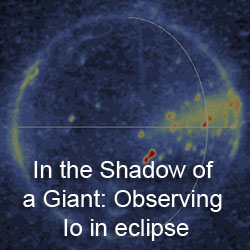
- Over the last few weeks, I have been presenting some of the mutual events in the Jupiter system, particularly solar eclipses on Io by either Ganymede or Callisto from the perspective of Io. However, a pair of amateur astronomers, John Sussenbach and Marc Delcroix, captured numerous observations of the solar eclipse on Io by Ganymede on June 24. Delcroix even plotted the brightness of Io versus time as the eclipse progressed. John Sussenbach also took a look at one of the the solar eclipses by Callisto on June 20.
- Plenty of important meetings related to the exploration of Io and the Jupiter system will be taking place this week. This includes a Europa/Jupiter System Mission Joint Science Definition Team (EJSM JSDT) meeting today, an Outer Planets Assessment Group (OPAG) meeting tomorrow, and the EJSM Instrument Workshop on Wednesday through Friday. I might be listening into the EJSM Instrument Workshop for at least some of the talks, but I haven't decided yet.
- Today's Astronomy Picture of the Day showing the volcano Arak Krakatoa erupting at night is pretty awesome. Definitely worth checking out.
- Van Kane has been keeping up with last week's Planetary Science Subcommittee and Decadal Survey Meetings. One of the key issues that seems to be coming to a head is the flat planetary science budget projected in the out years in the current budget proposal. This would cause increasing budget pressure on many projects, not only because of the lack of budget increases (resulting from the poor government revenues) and from cost overruns on some projects, including the albatross of planetary science, the Curiosity rover (née Mars Science Laboratory). According to Kane, Ed Weiler at the PSS meeting stated that there is not enough money in the Planetary Science Division budget projections to fund the Europa/Jupiter System Mission. As Kane stated in his blog, this is definitely bad news.
- Celestia version 1.6 was officially released late last week. Celestia is definitely one of the space simulator, particularly thanks to its support for NAIF Spice kernel files for spacecraft and planetary body trajectories and orientations. The software also has built-in video and screenshot support, which I often take full advantage of for this blog.
Showing posts with label Software. Show all posts
Showing posts with label Software. Show all posts
Monday, July 13, 2009
Notes from the Io Underground
Grrr... I hate when Mondays sneak up on you...


Tuesday, February 3, 2009
New Version of Google Earth with Support for additional Planets
 Yesterday, Google released the fifth version of its popular freeware program, Google Earth. Once of the added features that has caught a lot of attention is the inclusion of Mars and Earth's ocean floor. The Mars addition is particularly fascinating, pulling data from multiple missions (MRO, MGS, Mars Odyssey, and Mars Express) to create a realistic Mars simulator. One of the best features of Google Earth is the flight simulator, which combined with the new "Google Mars", would allows users to fly down Valles Marineris. Though, if they are like me, they crash the simulated plane into the canyon walls.
The new button that allows you to switch between Earth and Mars also seems to imply that other planets, perhaps moons, might be supported in the future. I would certainly love to see "Google Io". However, at this point, stereo data is pretty limited. But it would still be neat.
The image I used from Google Earth above shows the summit crater of Mauna Loa.
Link: Google Earth [earth.google.com]
Wednesday, April 2, 2008
Fun with Celestia and Tohil Mons
 <- Lookie what I made. This image uses Celestia to simulate the view from Galileo shortly after the I32 flyby in October 2002. The big thing is the use of an elevation map by Paul Schenk of Tohil Mons, near the terminator just below center. Compare this image to the view capture by Galileo, 32ISTERMIN01.
Very nice if I do say so myself. Now I just need topo maps of all the other mountains on Io ;)
Friday, March 28, 2008
More Playing with Celestia
 For the last few days, I've been having a lot of fun playing around with Celestia, an open-source 3D space visualization program. I've gotten the Jupiter and Saturn systems working just fine with NAIF spice kernels, got all the moons rotating correctly, and so on. Now I decided to play around with making a bump map for Io. You can see the state of this bump map at left, implemented in Celestia. I got most of the paterae in this area looking about how they should. The mountains take a little more time and require a lot of hand editing. I'm not quite satisified with the blocky appearance of the mountains, may have to try some smoothing.
I am also a little concerned by the way it shows mountains and other topography. Mountains are visible way to far around the dark side of the terminator (these things aren't that tall). They are also way to visible at low phase angles. But at phase angles like that above, I am pretty happy with the results.
Thursday, March 27, 2008
Jupiter System in Celestia
 Sorry for the lack of updates in the last few days. I have been hard at work correcting some issues I've been having with Celestia both with my Saturn/Cassini plugin (which I need for work to create the graphics in the CICLOPS Looking Ahead articles) and my Jupiter/Galileo plugin. The issue stemmed from attempting to update these plugins to support new features in the bleeding edge version of the 3D Space visualization program. After several days of wanting to kill my computer (must...get...more...RAM) and a lot of help from Chris Laurel, one of Celestia's developers, I think I got everything sorted out, at least with the Jupiter/Galileo plugin.
All this plugin does is use NAIF Spice kernels to generate the position of Galileo, Jupiter, the Galilean Satellites, Amalthea, and Thebe for much improved precision. For example, using the default trajectory file for Galileo in Celestia, and the orbits used for Jupiter and Io, the close approach altitude for the I24 flyby was -1000 km (or thereabouts), obvious not correct. Using Spice Kernels, the C/A altitude is given as 610.5 km, less than a kilometer off the official value. This new update for Celestia allow me to have one version of Jupiter and its moons as opposed to having one Jupiter for before the period covered by the Spice kernels, one during, and one after.
This plugin also adds support for improved precision of each bodies rotation, which may vary due to libration.
The plugin is located at http://pirlwww.lpl.arizona.edu/~perry/Celestia/JupiterSpice.zip. Warning, that file is 163 MB in size.
Keep in mind that his requires the absolutely latest version of Celestia, Version 1.5. Not only that, but you need the latest SVN version, basically a nightly build. The previous link is for the Windows XP file (just copy the Celestia.exe file in that SVN zip file over the Celestia.exe where you installed Celestia). Keep in mind that this build may contain bugs so definitely use with caution. I haven't had an issues with it that I couldn't attribute to having a slow laptop.
Subscribe to:
Posts (Atom)


 Posts
Posts