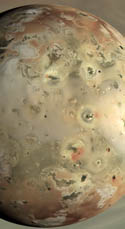
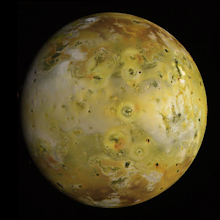
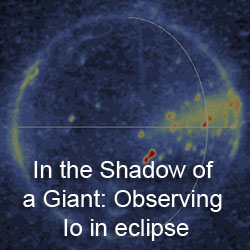
Yesterday, the Space Telescope Institute released a set of images as well as a movie of Jupiter acquired during a rare triple moon-shadow transit on January 24. During the event, Io, Europa, and Callisto aligned so that the three moons and their shadows appeared to move across the face of Jupiter. The next such triple-event won't take place until 2025. The Hubble images were even sharp enough to spot some of Io and Callisto's large scale albedo markings (like the flow field around Io's Isum Patera or the bright patch in the middle of Callisto's Asgard impact basin). With a keen eye, you can even spot the small inner moons, Amalthea and Thebe, and their shadows as two pairs of faint dark spots passing between Io and Callisto against the bright equatorial zone.
The difference in the crispness of the moons' shadows results from their different distances from Jupiter. Io is much closer to Jupiter than Callisto, so when it easily eclipses the Sun when it passes in front of it in Jupiter's sky. Callisto is farther away, so it appears to be closer in size to the Sun so there is a more narrow zone where it completely eclipses it (the umbra) and a wider zone where only a partial eclipse occurs (the penumbra), similar to solar eclipses on the Earth.
Opposition for Jupiter is today, and now that the moon is moving further away from Jupiter in the night sky, this is a great time to observe it and its Galilean satellites. Great ground-based images are showing up, including these sets taken by Anthony Wesley and Christopher Go.
Link: Hubble Captures Rare Triple-Moon Conjunction [hubblesite.org]
Link: ALPO-Jupiter Images from February 5 [alpo-j.asahikawa-med.ac.jp]
Showing posts with label Europa. Show all posts
Friday, February 6, 2015
Wednesday, March 10, 2010
Two more Europa mosaics
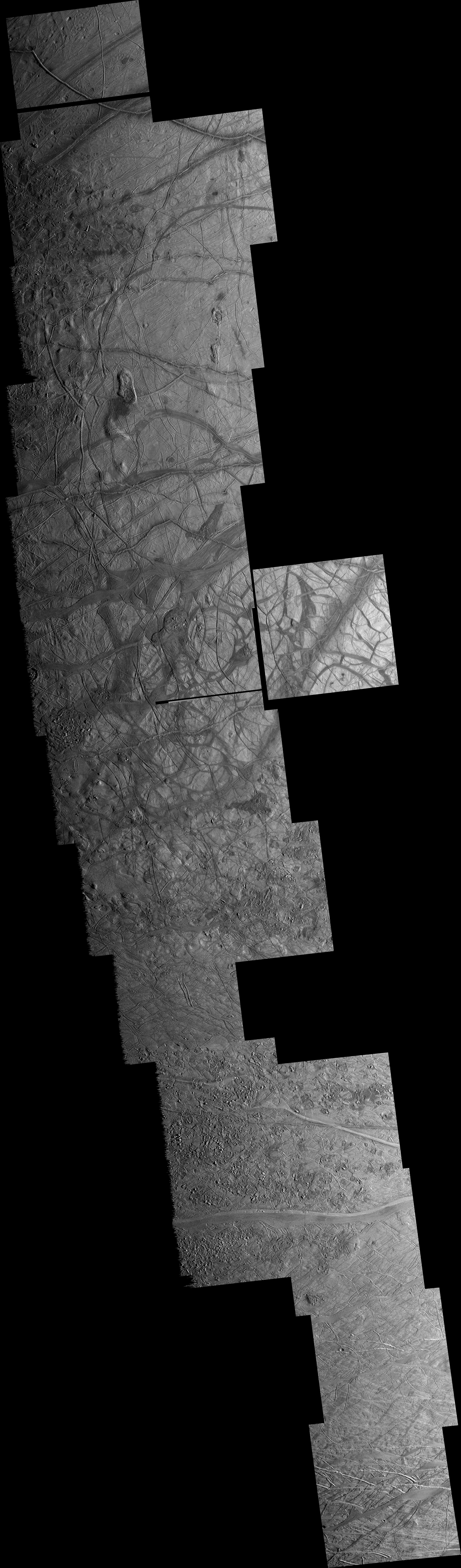
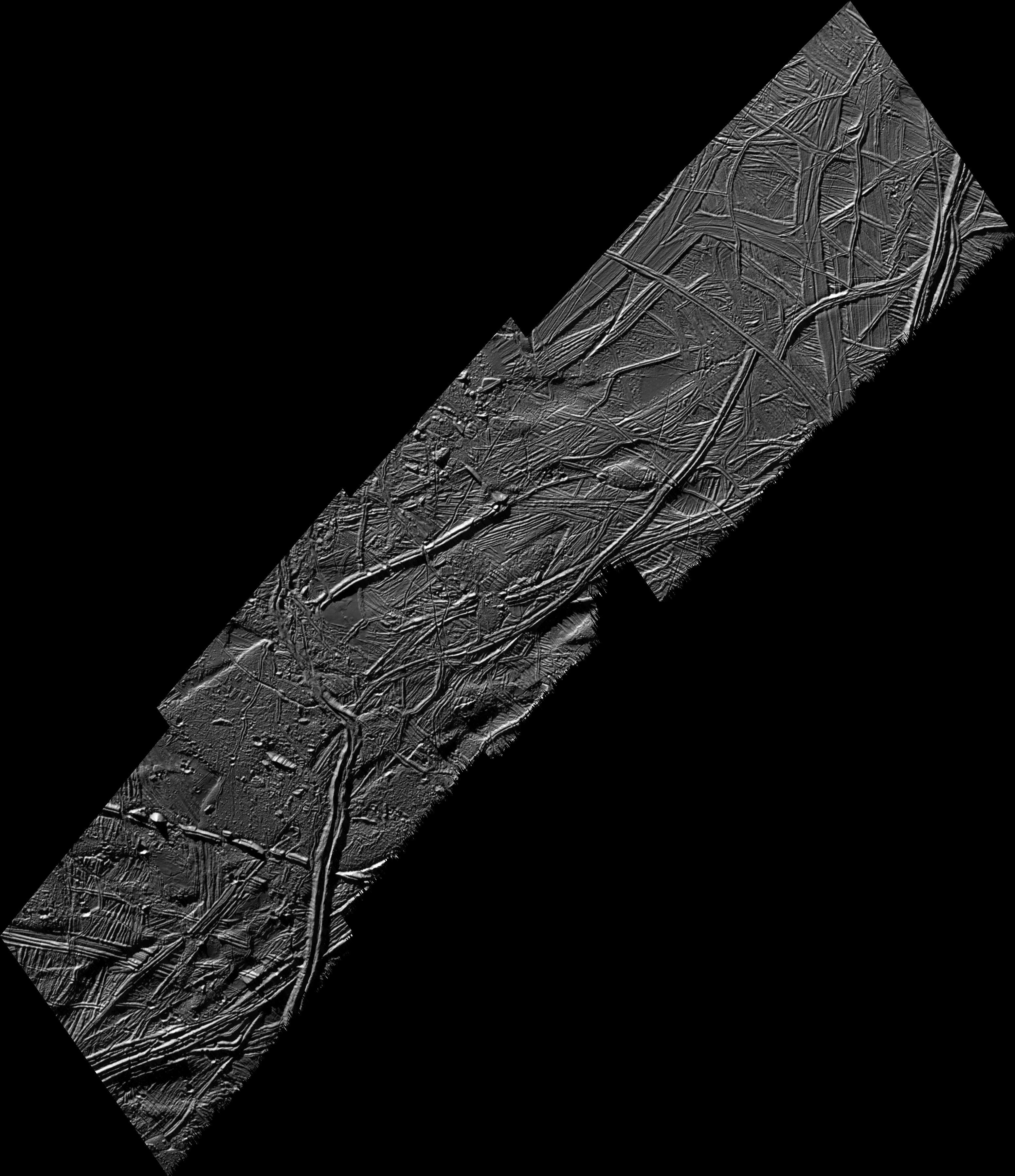
Okay, two more Europa mosaics then I'm done. Honestly, I just made these because I hadn't seen them online and I have been been reading from the recently published Europa book and these help me follow along. But I promise, I won't desecrate this blog with any more of this vile Europan filth anymore ;-)- 15ESREGMAP01 - This mosaic covers the terrain north from the 17ESREGMAP01 mosaic presented yesterday. This mosaic runs from Mehen Linea in the top frame, across the intersection of Minos and Udaeus Lineae, and finally to the lenticulated terrain northwest of Dyfed Regio. A portion of the middle of this mosaic was covered by the higher resolution mosaic, 19ESRHADAM01. This mosaic has a resolution of 228 meters per pixel.
- 15ESREGMAP02 - This mosaic covers the terrain north from the 17ESREGMAP02 mosaic presented yesterday. This mosaic covers the famous, mitten-shaped chaos region, Murias Chaos as well as two good sized impact craters, Brigid (three quarters of the way down) and Maeve (in the top frame).
Tuesday, March 9, 2010
19ESRHADAM01 - Galileo Mosaic of Europa
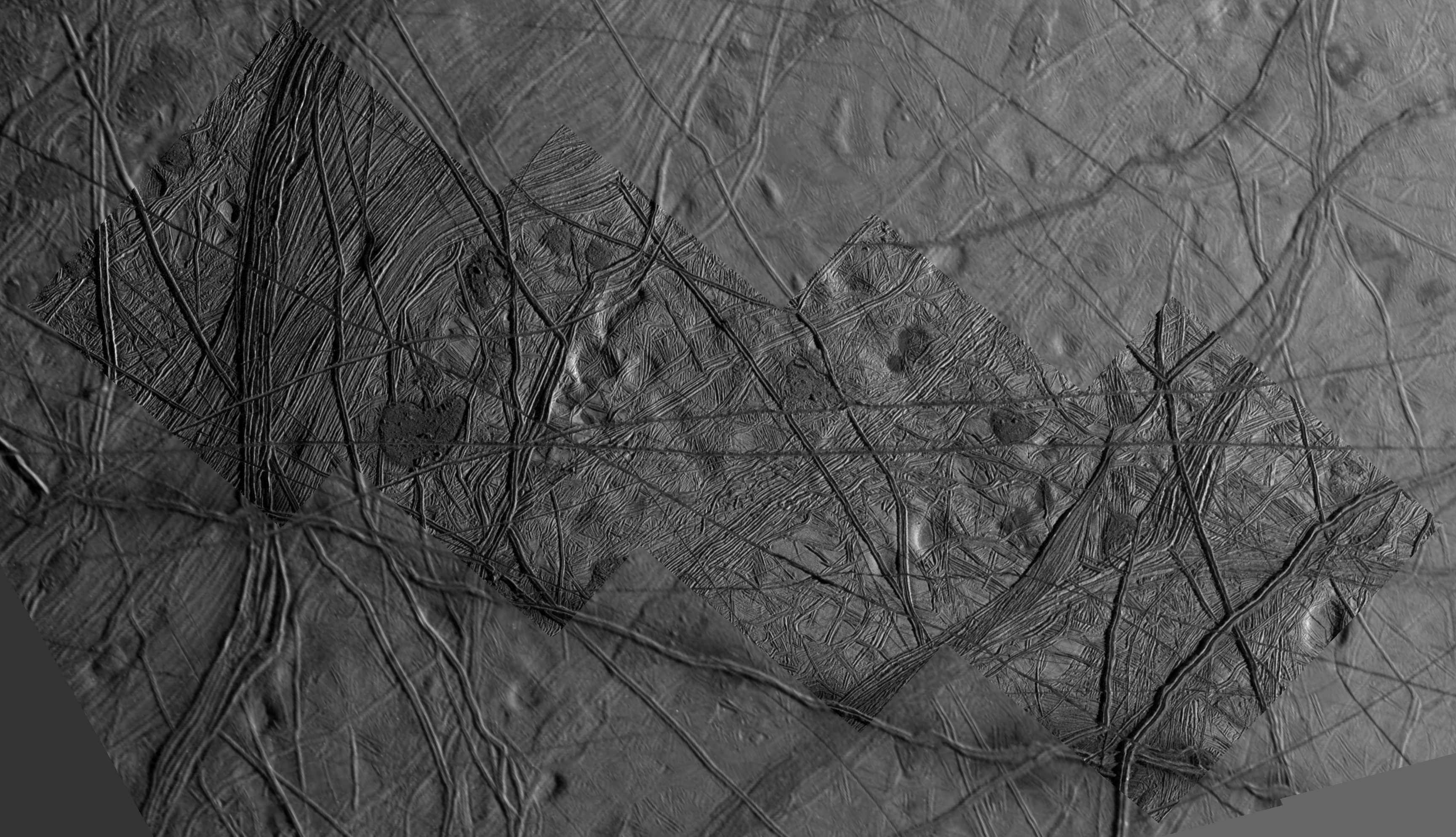
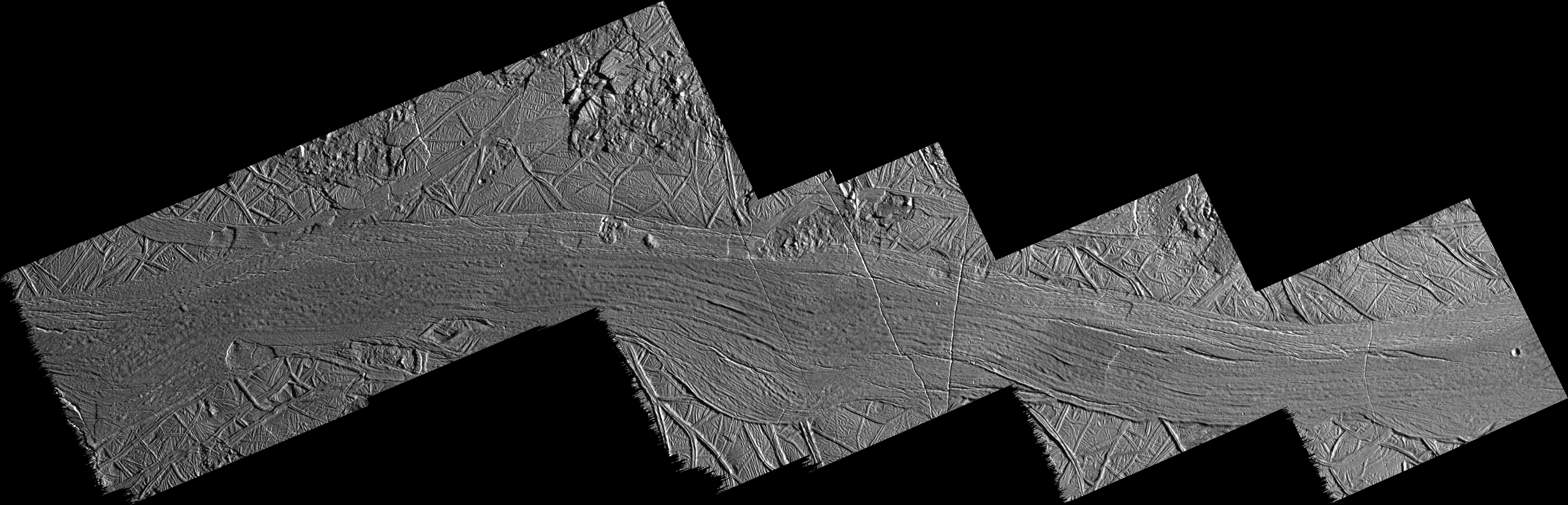
Just because Europa (or her publicist) on Facebook asked nicely, I present the following mosaic, 19ESRHADAM01. This four-frame mosaic was taken on February 1, 1999 and was intended to cover a portion of Rhadamanthys Linea, a double-ridge on Europa's northern anti-Jupiter hemisphere. The view at right is just southwest of the prominent intersections of Udeaeus, Minos, and Cadmus Lineae. Clicking on the image at right will take you to a smaller version of the image, or you can download the full-resolution version by clicking here [3.57 MB PNG image]. The full-resolution version has a pixel scale of 62 meters per pixel and is centered near 35° N, 225° W. The two background frames come from the 15ESREGMAP01 mosaic.
The target of the mosaic was Rhadamanthys Linea, which runs left-to-right in the bottom half of the image, was only covered by the bottom corners of the four frames. This mosaic instead, highlights a region of lenticulated terrain. Lenticulae are region of small chaos or depressions on Europa surface, often appearing darker than the surrounding terrain. Many of these dark chaos regions disrupt or destroy the pre-existing ridged terrain, like the two-lobed dark area in the second frame from the left. Another disruptive feature is a fracture that runs through all four frames from left to right, that cuts into pre-existing ridges.
And now for something completely different...
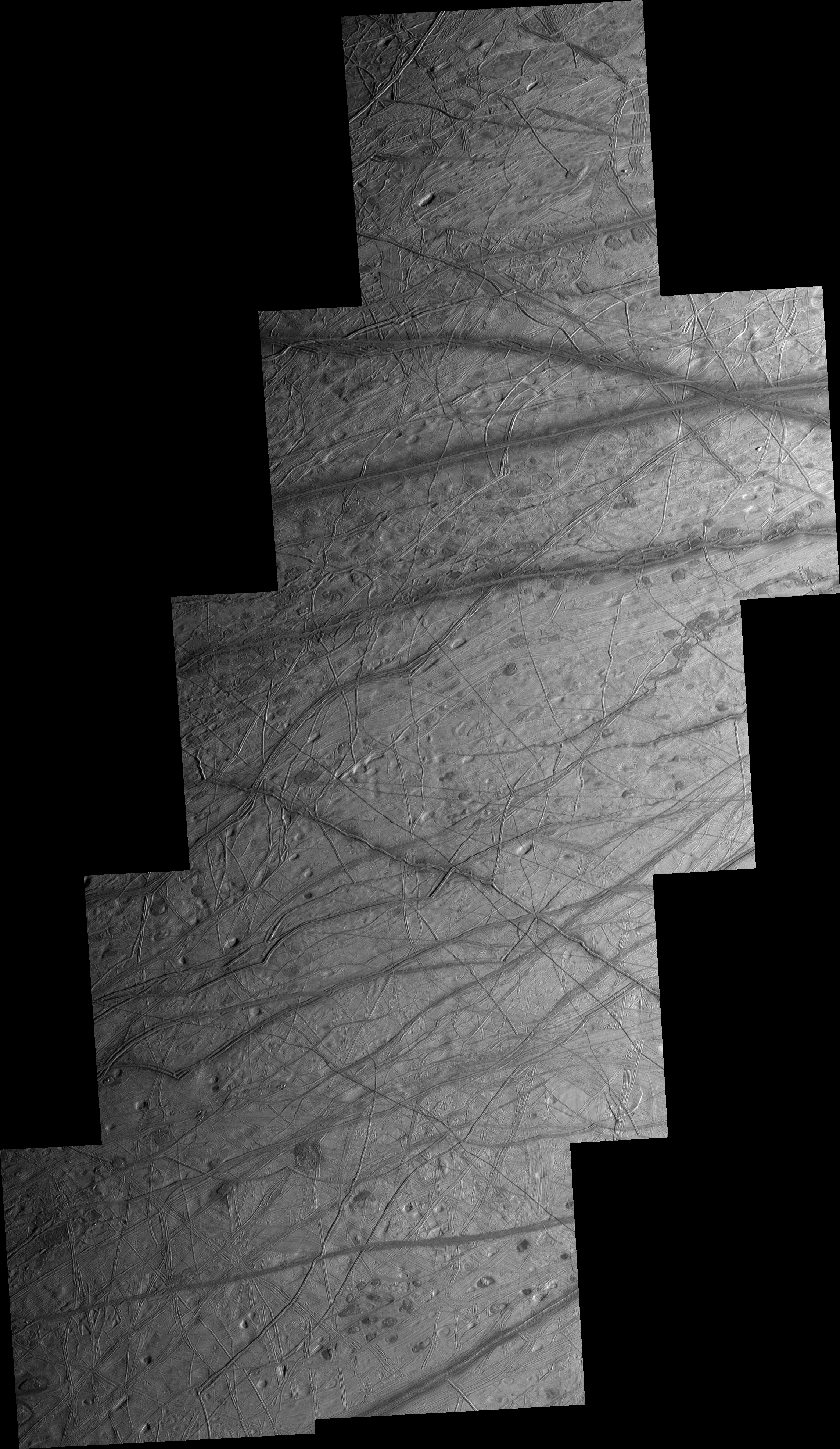
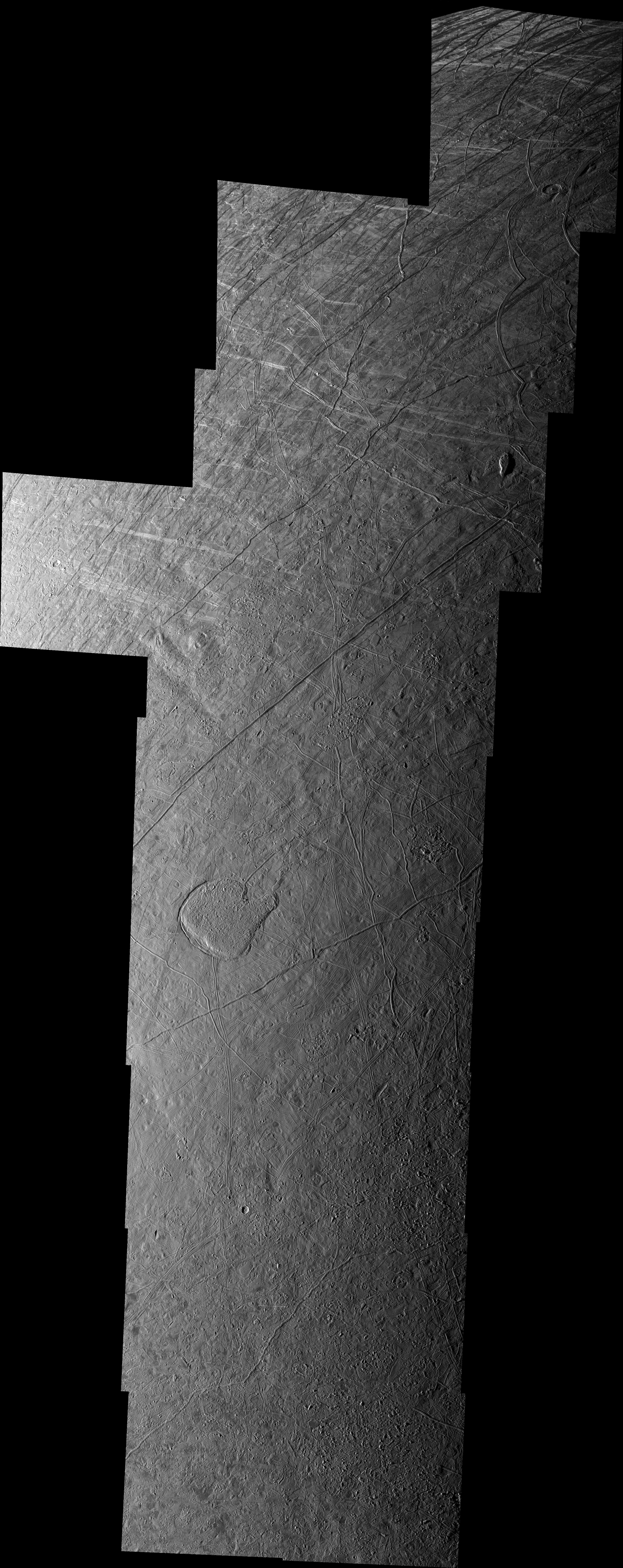
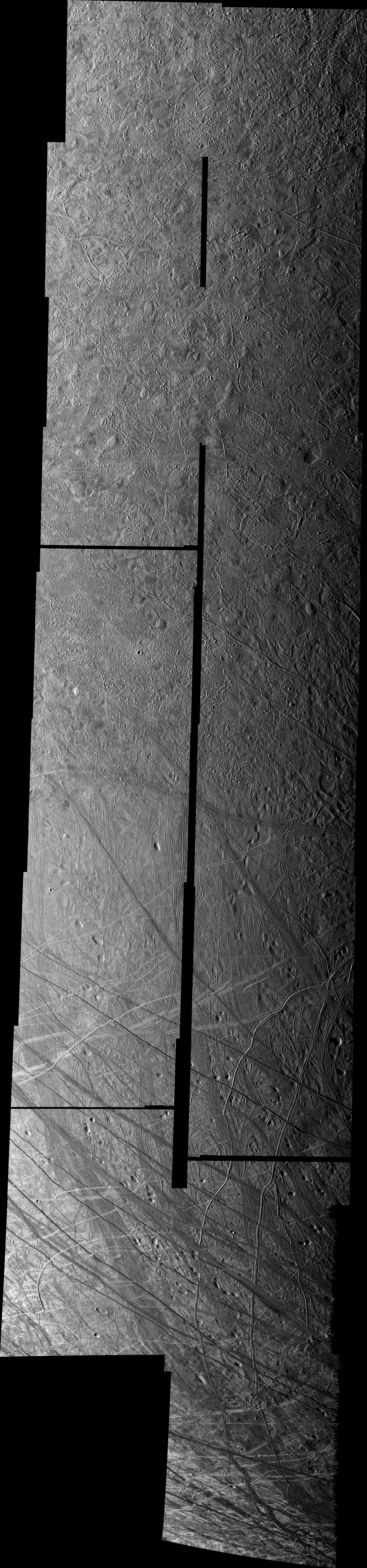
Here are some Europa mosaics from September 1998 for all of you. Don't ask me why I made these mosaics of Europa this evening...- 17ESREGMAP01 - 233 meter per pixel mosaic of a north-south strip centered around 210° West, running south from around 15° N to 65° S Latitude. The mosaic covers portions of Belus Linea near the top of the mosaic, runs south covering Castalia Macula and portions of Argadnel Regio, then finishes up over portions of Onga, Katreus, Agenor, and Astypalaea Lineae.
- 17ESAGENOR03 - 46 meter per pixel mosaic across portions of Agenor Linea. This includes the western seven frames out of ten due to a gap in the mosaic.
- 17ESSOUTHP01 - 43 meter per pixel mosaic across portions of the south polar region of Europa near 79° S, 128° W.
- 17ESREGMAP02 - 211 meter per pixel mosaic of a north-south strip centered around 77° West, running sourth from around the equator to the limb near the south pole. The mosaic covers portions of Euphemus Linear near the top of the mosaic, across an area of chaotic terrain on Europa's leading hemisphere, south to a series of ridges (such as Sarpedon Linea). Several impact craters are visible, including: Cliodhna (middle top), Uaithne (fresh crater on top of a dark ridge about three quarters of the way down), and Grainne (larger crater in bottom left frame).
Saturday, February 13, 2010
The Giant Book of Europa
Yes, I know that buying a book all about Europa makes me a traitor... I know, I know...
Link: Europa (University of Arizona Space Science Series) (Hardcover) [www.amazon.com]
Monday, October 19, 2009
Carnival of Space #125 @ Orbiting Frog
The blog Orbiting Frog has this week's edition of the Carnival of Space, the 125th edition. The Carnival of Space provides a summary of the week that was in the space and astronomy blogosphere. So it is definitely worth checking out to get yourself up to speed. Orbiting Frog, certainly one of the better blog names I've seen.
Looking elsewhere, there are a few interesting blog posts to point out. Dr. Paul Schenk has shared some new 3D movies and images based on his model of the Callanish impact basin on Europa at his Stereo Moons blog. Callanish is a multi-ring impact basin, kind of a miniature version of the Valhalla basin seen on Callisto. The much smaller size, yet similar morphology, is the result of the thinner ice shell at Europa compared to Callisto's. The impact of the 3-5 kilometer wide comet or asteroid likely did not penetrate through to the liquid layer, but the ductile bottom layer of the ice shell disrupted the formation of the crater, leaving a series of concentric rings surrounding a relatively low and hummocky center rather than a central peak impact basin. A similar process occurred at Tyre elsewhere on Europa.
Elsewhere, Ted Stryk processed an old opnav from Galileo showing Ganymede and Io, and gave it some color.
Link: Carnival of Space #125 [orbitingfrog.com]
Looking elsewhere, there are a few interesting blog posts to point out. Dr. Paul Schenk has shared some new 3D movies and images based on his model of the Callanish impact basin on Europa at his Stereo Moons blog. Callanish is a multi-ring impact basin, kind of a miniature version of the Valhalla basin seen on Callisto. The much smaller size, yet similar morphology, is the result of the thinner ice shell at Europa compared to Callisto's. The impact of the 3-5 kilometer wide comet or asteroid likely did not penetrate through to the liquid layer, but the ductile bottom layer of the ice shell disrupted the formation of the crater, leaving a series of concentric rings surrounding a relatively low and hummocky center rather than a central peak impact basin. A similar process occurred at Tyre elsewhere on Europa.
Elsewhere, Ted Stryk processed an old opnav from Galileo showing Ganymede and Io, and gave it some color.
Link: Carnival of Space #125 [orbitingfrog.com]
Friday, October 9, 2009
Model Projects More Oxygen in Europa Ocean than Previously Expected
The Galilean satellites session at this year's DPS meeting was held today in Fajardo, Puerto Rico. I am not at the meeting, but you can check out my thoughts on the Io-related abstracts for this meeting that I posted a few weeks ago. While I haven't heard word on what was presented at the Io talks, there is a new press release today covering one of the Europa talks, "Vertical Transport through Europa’s Crust: Implications for Oxidant Delivery and Habitability," by Richard Greenberg.At this talk, Greenberg presented results on the production of oxygen through radiolysis and photolysis of water. During these processes, some water molecules on Europa surface are broken down into their oxygen and hydrogen components by high-energy particles in Jupiter's magnetosphere and photons from the Sun. Greenberg combined this research with estimates of Europa's resurfacing rate to determine how much oxygen is delivered to the satellite's sub-surface ocean. He found that given this resurfacing rate, the concentration of oxygen in Europa's ocean would exceed those of the Earth, making possible not only microbial like, but the kinds of multi-cellular aquatic like we are more familiar with. Greenberg also notes that an initial, 2-billion year delay in this process would prevent the premature oxidation of organic compounds that would have prevented the development of life.
So for those who dream of eating Europa calamari, you just got a big boost today. Now we just need to find organic compounds at Europa... otherwise, all you have is a quite oxygenated, but sterile, ocean.
Link: Press Release - Vertical Transport through Europa’s Crust: Implications for Oxidant Delivery and Habitability [dps.aas.org]
Wednesday, February 18, 2009
Flagship Mission Selection Still Not Announced
Presumably a lot of you are coming here to check on which target, Titan or Europa, was selected for the next Outer Planets Flagship Mission. Despite the fact that the Downselection meeting was supposed to have taken place last Thursday, as of the time of this post, still no word yet on the outcome of that meeting. Not sure what the delay is all about, so hopefully it will be announced in the next few days.
Looking at the calender, there is an Outer Planets Assessment Group (OPAG) meeting on March 9 and 10 in Bethesda, Maryland. OPAG is a committee that advises NASA's Planetary Science Sub-Committee (PSS) on issues related to the exploration of the outer solar system. Presumably, the downselection panel's findings should be announced before that meeting. So that's taking a look at a worst-case scenario for those (like me) who are waiting quite impatiently.
In the mean time, check out this piece of Europan propaganda, I mean this informative video on Europa (stupid...alliance, the video makes fun of Io...must destroy...). Anyways, sorry there, Dr. Strangelove moment... Check out this video on Youtube from the Discovery channel. Still, that guy called Io ugly!!!
Also, don't forget to check out Van Kane's discussion of the Titan Montgolfière and lake lander over at his Future Planetary Exploration blog.
Looking at the calender, there is an Outer Planets Assessment Group (OPAG) meeting on March 9 and 10 in Bethesda, Maryland. OPAG is a committee that advises NASA's Planetary Science Sub-Committee (PSS) on issues related to the exploration of the outer solar system. Presumably, the downselection panel's findings should be announced before that meeting. So that's taking a look at a worst-case scenario for those (like me) who are waiting quite impatiently.
In the mean time, check out this piece of Europan propaganda, I mean this informative video on Europa (stupid...alliance, the video makes fun of Io...must destroy...). Anyways, sorry there, Dr. Strangelove moment... Check out this video on Youtube from the Discovery channel. Still, that guy called Io ugly!!!
Also, don't forget to check out Van Kane's discussion of the Titan Montgolfière and lake lander over at his Future Planetary Exploration blog.
Monday, February 16, 2009
The Thickness of Europa's Ice Shell from JEO
Okay, after I saw Emily practically dare me to talk about something other than Io with respect to these flagship missions, I thought fine, I will break my one rule here and talk about...Europa. Cue dramatic prairie dog! In particular, I want to look at perhaps one of the most important science goals for the Europa/Jupiter System Mission: determining the thickness of Europa's water-ice shell.
Following the Galileo mission, the Europa scientists were split into two armed camps: those that felt that the evidence found by Galileo indicated that Europa had a thick ice shell (read: the ocean did not "communicate" with the surface) and those that thought Europa had a much thinner ice shell (read: the ocean did "communicate" with the surface). Okay, they weren't literally armed, though I hear they had to put metal detectors at the entrances to the Europa sessions at LPSC. In the thin ice case, the ice shell would be on the order of a few kilometers thick (Greenberg et al. 2000), while in the thick ice case, the ice shell would be 10 to 30 kilometers thick (Pappalardo et al. 1999). Knowing the thickness of the ice shell is important for understanding Europa's habitability as well as designing a future submarine that might explore the ocean beneath. Obviously digging through two km of ice is quite a bit different from digging through 30. Knowing the thickness of the ice shell is also important for understanding Europa's surface geology. With a thin shell, chaotic terrain and double ridges can be explained by break-throughs of the crust by the underlying water ocean. With a thick shell, these features are better explained by a convecting ice layer producing diapirs, which imping on the surface.
While in orbit around Europa, the Jupiter Europa Orbiter would use four primary measurements to constrain the thickness of the ice and water shells: gravity and topography measurements, radar sounding, and magnetometer data. In a previous post, I reported on the types of science the Ice-Penetrating Radar can obtain at Io, but the instrument's primary purpose is identifying shallow water pockets and detecting the ice-water interface at Europa. The ability of the IPR to detect the ice-water interface can vary depending on a number of factors. For example, in the thick ice case, the ice shell is expected to be split into an upper, brittle cold ice layer and a lower, ductile warm ice layer. The warm ice layer has a much higher dielectric constant, and this would reduce the penetration depth of the radio signal IPR transmits. Heavy fracturing of the ice layer can also reduce the penetration depth. Using a tectonic models, the team reports that penetration depths of 15 km are expected. The study team thinks that even a non-detection of the ice-water interface with IPR can be useful as a lower bound. Magnetometer measurements can be used to constrain the thickness of the water ocean by measuring the strength of the induced magnetic field at Europa.
Another pair of measurements of the ice shell thickness are gravity and topography. This requires the use of the antenna for Doppler tracking and the Laser altimeter for altitude measurements. These would be used to derive Europa's Love numbers, h2 and k2. The Love number h2 is dependent on the tidal deformation of Europa's surface and can be measured by calculating the difference between laser altimetry of the same point on the surface at different times of day. Combining the two Love numbers can constrain the thickness of the ice shell as these numbers are a function of the rigidity of the shell.
Based on the measurements acquired by the Jupiter Europa Orbiter, the thickness of Europa's water ice shell can be constrained and the thick and thin water ice shell debate should be settled. However, depending on the thickness of that shell, it maybe difficult to derive a specific value for its thickness. The Ice-Penetrating Radar may not be able to see the ice-water interface if the shell is thicker than 15-30 km, which would be expected from the thick ice shell interpretation. If the shell is more on the order of less than 10 km, the ice thickness should be pretty well determined.
Following the Galileo mission, the Europa scientists were split into two armed camps: those that felt that the evidence found by Galileo indicated that Europa had a thick ice shell (read: the ocean did not "communicate" with the surface) and those that thought Europa had a much thinner ice shell (read: the ocean did "communicate" with the surface). Okay, they weren't literally armed, though I hear they had to put metal detectors at the entrances to the Europa sessions at LPSC. In the thin ice case, the ice shell would be on the order of a few kilometers thick (Greenberg et al. 2000), while in the thick ice case, the ice shell would be 10 to 30 kilometers thick (Pappalardo et al. 1999). Knowing the thickness of the ice shell is important for understanding Europa's habitability as well as designing a future submarine that might explore the ocean beneath. Obviously digging through two km of ice is quite a bit different from digging through 30. Knowing the thickness of the ice shell is also important for understanding Europa's surface geology. With a thin shell, chaotic terrain and double ridges can be explained by break-throughs of the crust by the underlying water ocean. With a thick shell, these features are better explained by a convecting ice layer producing diapirs, which imping on the surface.
While in orbit around Europa, the Jupiter Europa Orbiter would use four primary measurements to constrain the thickness of the ice and water shells: gravity and topography measurements, radar sounding, and magnetometer data. In a previous post, I reported on the types of science the Ice-Penetrating Radar can obtain at Io, but the instrument's primary purpose is identifying shallow water pockets and detecting the ice-water interface at Europa. The ability of the IPR to detect the ice-water interface can vary depending on a number of factors. For example, in the thick ice case, the ice shell is expected to be split into an upper, brittle cold ice layer and a lower, ductile warm ice layer. The warm ice layer has a much higher dielectric constant, and this would reduce the penetration depth of the radio signal IPR transmits. Heavy fracturing of the ice layer can also reduce the penetration depth. Using a tectonic models, the team reports that penetration depths of 15 km are expected. The study team thinks that even a non-detection of the ice-water interface with IPR can be useful as a lower bound. Magnetometer measurements can be used to constrain the thickness of the water ocean by measuring the strength of the induced magnetic field at Europa.
Another pair of measurements of the ice shell thickness are gravity and topography. This requires the use of the antenna for Doppler tracking and the Laser altimeter for altitude measurements. These would be used to derive Europa's Love numbers, h2 and k2. The Love number h2 is dependent on the tidal deformation of Europa's surface and can be measured by calculating the difference between laser altimetry of the same point on the surface at different times of day. Combining the two Love numbers can constrain the thickness of the ice shell as these numbers are a function of the rigidity of the shell.
Based on the measurements acquired by the Jupiter Europa Orbiter, the thickness of Europa's water ice shell can be constrained and the thick and thin water ice shell debate should be settled. However, depending on the thickness of that shell, it maybe difficult to derive a specific value for its thickness. The Ice-Penetrating Radar may not be able to see the ice-water interface if the shell is thicker than 15-30 km, which would be expected from the thick ice shell interpretation. If the shell is more on the order of less than 10 km, the ice thickness should be pretty well determined.
Wednesday, January 21, 2009
Europa Jupiter System Mission Summary Report
As mentioned in the previous post, the Joint Summary Reports for the two mission concepts vying to be NASA's next Outer Planet Flagship Mission have been publicly released [obviously the most important news story to come out of yesterday]. These reports provide an overview of the science goals and mission design of each mission. More detailed reports for each component of both proposals have not been publicly released, probably because of their greater length and technical detail, it is taking longer to edit the reports to make them safe for public consumption [can't let the terrorists get to Europa first...and blow it up, now can we? Wait, is that an option? ;-)] So while it is "only" the summary, there are still a lot of interesting nuggets to be gleaned. Also note that because this is an Io-centric blog, I will only post a summary of the Europa Jupiter System Mission (henceforth EJSM).As another reminder, down-selection is planned for next Friday, January 30 at a NASA/ESA Decision Board with a public announcement planned for either February 3 or 4 at ESA's Science Program Committee meeting.
Following the nice, purty cover (provided by the incomparable Michael Carroll) and a graphical summary of the summary report, the EJSM summary report is divided into nine chapters, three of which I will comment on in this post: Science Goals and Objectives, Mission Concept, and Cost and Schedule.
The first major section of the report covers objectives and science goals. Two main goals are cited for EJSM: Determine whether the Jupiter System harbors habitable worlds and Characterize the processes within the Jupiter System. These goals fit within the overall theme of the mission: The emergence of habitable worlds around gas giants. The sub-goals under the first mission goal (let's call it "Habitability" for short) really don't seem to fit the stated goal. The sub-goals, like comparing the exospheres, plasma environment, and magnetospheric interactions of the icy satellites, don't seem to work towards achieving the habitability goal, with the exception for determining surface composition [hey, you never know, they could find organics along the Europan ridges] and identifying sites for future in-situ exploration [which could, you know, ACTUALLY look for life and study possible habitable environments]. All the other sub-goals would fit better under the other primary goal (let's call that one Processes). In short, I feel that the mission planners are unfortunately committing my Cardinal Sin Numero Uno, using astrobiology to sell a non-astrobiology mission.
In the next section, Mission Concept, the report covers the two flight components to be flown for this mission -- the NASA-supplied Jupiter Europa Orbiter (JEO) and the ESA-supplied Jupiter Ganymede Orbiter (JGO) -- their model payloads and nominal mission plans. To simplify things, the model payloads for payloads are virtually identical (though with differences in the needs of the instruments on the two spacecraft). These instruments include: a laser altimeter, a radio science experiment (with a Ka-band transponder and ultra-stable oscillator), Ice Penetrating Radar, Visible-IR Spectrometer, an Ultraviolet Spectrometer, an Ion and Neutral Mass Spectrometer (JEO-only), Thermal Instrument, Narrow-Angle Camera (JEO-only), Wide- and Medium-Angle Camera, a Magnetometer, Plasma and Particle Analyzers, and a Sub-millimeter Wave Sounder (JGO-only). The narrow-angle camera on JEO will have an IFOV similar to Galileo's SSI, or about 10 microradians per pixel. This provides for a resolution of 10 meters per pixel at a distance of 1000 km. The report also lists the descope order for Jupiter Europa Orbiter. A few of the higher order priorties would effect Io science if the mission were to be descoped, including the loss of color imaging on the NAC, the mass spectrometer, OpNav Functionality (which would limit flyby altitudes to 500 km and up, though without the Mass spectrometer, closer approaches might be lower priority), and the thermal instrument. Luckily, the loss of the NAC entirely is far down on the list. The lack of a narrow-angle camera on JGO as well as the fact that it stays mostly beyond the orbit of Ganymede will likely limit that spacecraft's contribution to Io science with the exception of coordinated observations with JEO and for near-IR observations during the Jupiter System phase of the mission.
The mission plan remains similar to what we have heard earlier at OPAG meetings in 2008. Basically, both spacecraft will launch in the First Quarter of 2020 into a Venus-Earth-Earth Gravity Assist trajectory. JEO would arrive at Jupiter in December 2025 with an Io flyby (with probably little to no remote sensing) shortly before. JGO would arrive shortly after in February 2026. JEO would then conduct a Jupiter System Science Campaign that would last from JOI until the spacecraft enters Europa orbit in July 2028. The first year of this campaign would include three more Io flybys to be conducted in the second half of 2026. One of these flybys could have a close approach distance of 75 km for mass spectrometer measurements of a plume (though that would require specfic targeting, which would go against the otherwise opportunistic nature of the targeting of these satellite flybys). JGO would conduct significant Callisto science (with 19 flybys while that spacecraft is in a resonant orbit) during 2027 before going into orbit around Ganymede in May 2028. Following these spacecraft's orbital missions, they would be crashed into their respective icy satellites.
The Summary report only briefly covers the cost of this mission. JEO's full lifecycle cost is expected to be $3.8 Billion in inflation-adjusted costs. JGO's cost is not reported (apparently, it's classified, though the planners expect it to stay below the 650 Million Euro cost cap (that includes all costs, like the launcher).
While I would prefer to post a more detailed post about Io science with JEO when that spacecraft's more detailed report is posted online, I may give it a try tomorrow. Until then, I need sleep... Oh, and Van Kane seems to have found out that the reports are online too ;-)
Link: EJSM Joint Summary Report [opfm.jpl.nasa.gov]
Monday, May 5, 2008
Things I Missed Playing Grand Theft Auto
Okay, I have some time to post some items I missed last week because I was busy helping Niko Bellic get revenge in Liberty City:
- According to Io9.com, Europa is the awesomest moon in the Solar System. Of course that is wrong, it isn't. Not by a long shot. Io is just as colonize-able as Titan (pick your poison: radiation or carcinogenic sand dunes). Ganymede is more so than Europa (using amount of radiation as a metric). And why does Enceladus have one blip for "Potential to colonize" but Phobos and Deimos get four. Thanks to Juramike at UMSF.com for the heads up.
- Io has been hiding out from the astrophotographers over the last few weeks. Christopher Go captured a nice view of Jupiter with Io's shadow on May 1. "Asimov" posted some of his captures of Io and Jupiter from this morning on the South Celestial Pole forum.
- I still haven't read that Io footprint paper.
Sunday, March 23, 2008
Transfer of mass from Io to Europa and beyond due to cometary impacts
Yesterday I posted that the new issue of the journal Icarus is now online. Two papers in the issue are directly related to Io. The first is titled, "Transfer of mass from Io to Europa and beyond due to cometary impacts," by José Luis Alvarellos, Kevin J. Zahnle, Anthony R. Dobrovolskis and Patrick Hamill. In this paper, the authors describe their modeling of ejecta from impacts onto the surface of Io, determining where that ejecta eventually end up in the Jovian system, and calculating how much mass is transferred from Io to the other major satellites in the system.They modeled the ejection process two different ways. First, they assumed the surface of Io is a regolith and an impact will fling pre-existing blocks or rubble out from the crater. Second, they used a model by Jay Melosh et al. (1986), where the impact ejects chunks known as spalls out from a more competent or hard rock target. Based on what is known of Io's surface, where volcanic resurfacing occurs at a faster rate than impact gardening, the authors state that the latter model is likely more applicable.
The authors simulated impacts at the apex (center of the leading hemisphere), the antapex (the center of the trailing hemisphere), the sub-jovian point, the anti-jovian point, and the south pole. From the two models described above, the authors were able to calculate the velocities of particles generated by the impact as well as how much ejecta is generated by the impact of a generic 1.5 km wide Jupiter-family comet. Finally, 600 test particles with velocities fast enough to escape Io's Hill Sphere were injected into a model of the Jovian system to see where these particles would end up after an integration of 10,000 years.
The authors determined that the vast majority of the ejecta would wind up reimpacting Io, 93% in the rubble model, 86% in the spall model. This is expected since the particles start out in Io-crossing orbits. Their simulations found that between 5% ("Rubble" model) and 9% ("Spall" model) of the test particles end up impacting Europa, typically in a few decades to a couple of centuries. In the spall model, 4.6% of the test particles impacted Ganymede and less than one percent impacted Callisto. Only a handful in that same model ended up either impact Jupiter or one of the small inner satellites, entered heliocentric space, or survived the 10,000 year simulation. Typically, more ejecta reimpacted Io in the rubble model (where initial velocities are less so they start out in less eccentric orbits) than in the spall model, where their higher initial velocities put them in orbits that crossed that of the other Galileans.
Based on the percentage of material transferred from Io to one of the other satellites, estimates of the amount of ejecta per impact (typically 3x the mass of the impactor), and the impact rate on Io, the authors estimated the amount of mass transferred from Io to one of the other Galileans per million years. They estimate that approximately 3.1×10¹⁴ g and 1.6×10¹⁴ g are transferred to Europa and Ganymede via impact ejecta every million years, making Io a significant source of minerals and nutrients to the surfaces of those moons. That's in addition to the mass transferred via sputtering.
Link: Transfer of mass from Io to Europa and beyond due to cometary impacts [dx.doi.org]
Tuesday, February 26, 2008
Europa: Featured Article of the Day
Just as I am going to bed (finally, yes, I know, it is 2am in the morning), what do I find to my horror when I do a quick check of Wikipedia: Europa is the Featured Article of the Day. To be honest, it isn't a bad article. It does spend a too much time on astrobiology and comparatively little time on Europa's surface features. That, in my mind, demonstrates all that is wrong with Europan science. Last time I checked, no life has been found on Europa. It spends plenty of time talking about Black Smokers and extremophile life, which is all well and good, but until we find life on Europa, that has nothing to do with that moon. The article also spends quite a bit of time on canceled missions to Europa, but preciously little article space to missions that have explored Europa or ones that have a good chance of exploring it.Anyways, so that article is on Wikipedia if you want to check that out.
Link: Main Page - Wikipedia, the free encyclopedia [en.wikipedia.org]
Subscribe to:
Posts (Atom)