Showing posts with label Lava Flows. Show all posts

Wednesday, July 8, 2009

Paper: Heat Flow from Io's Dark Lava Flows

A new Io-related paper in the journal Icarus was posted online on Sunday titled, "Io: Heat Flow from Dark Volcanic Fields." The paper is authored by Glenn Veeder, Ashley Davies, Dennis Matson, and Torrence Johnson. The authors in this paper attempt to estimate the amount of Io's overall heat flow that is radiated from the large volcanic lava flow fields that cover a sizable portion of Io's plains, distinguishing these features from the myriad of volcanic pits, the background heat flow, and the big daddy of Ionian volcanoes, Loki Patera, which by itself radiates 5-15% of Io's total heat flow. This research was previously discussed last year on this blog when the authors of this paper submitted a print-only abstract to LPSC 2008.

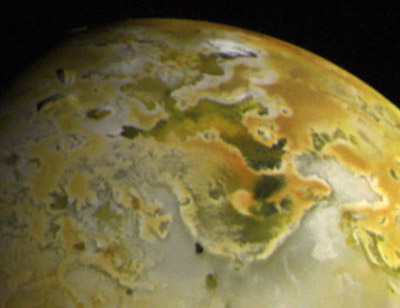
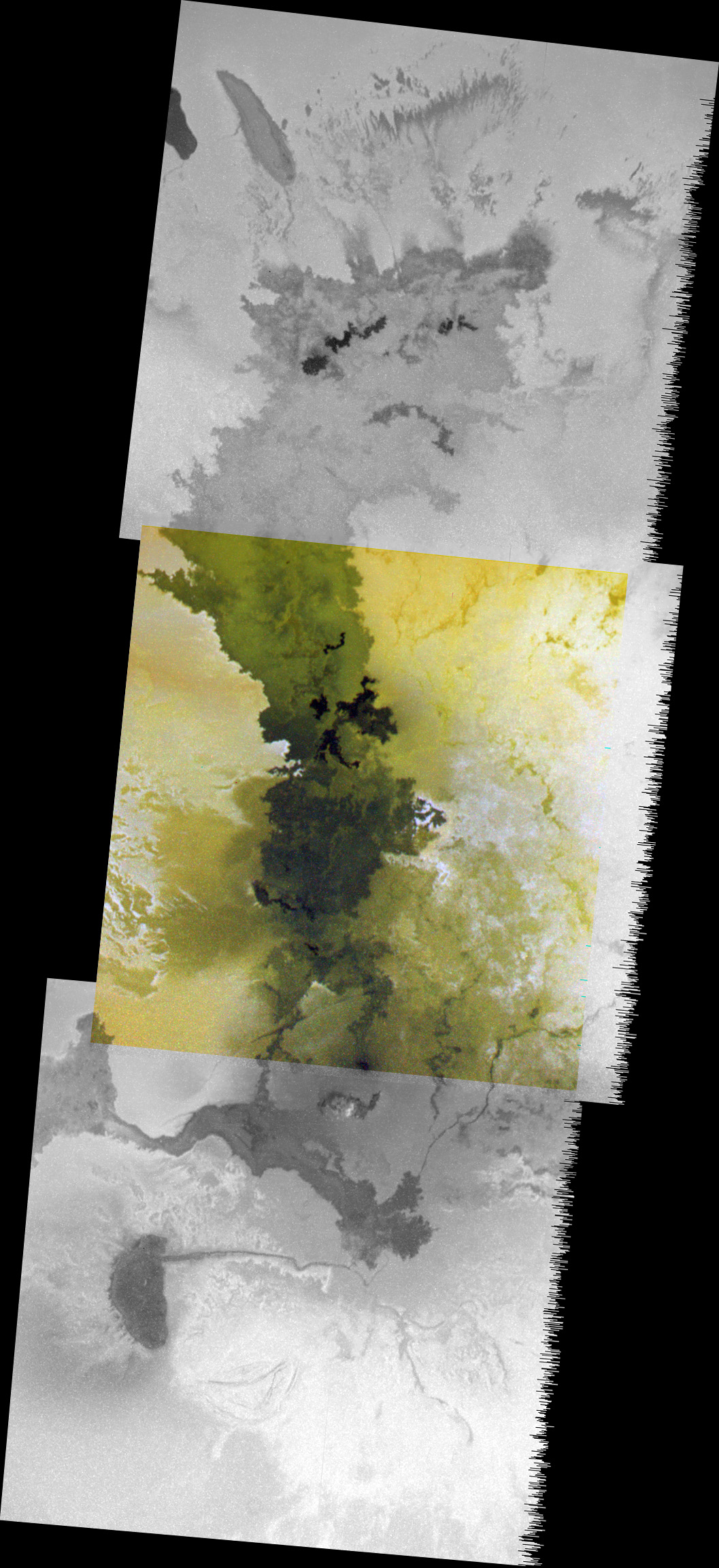
Dark volcanic fields on Io are thought to consist of recently active, compound silicate lava flows that have erupted onto the plains of Io, rather than being confined within a patera (volcanic pit). Lava flows of many colors have been observed on Io, but it is the black or dark green flows that are thought to be the most recently active silicate flows. These flows tend to be lava channel (or tube)-fed, with smaller outbreaks building and growing the flow field over time. For example, if you look at Amirani above, you see "small", fresher lava flows on top of older, dark green lava. The dark green color comes from the deposition of sulfur on still-cooling, iron-rich silicate lava flows, producing iron sulfide. Brighter flows represent either older silicate flows that cooled enough for sulfur and sulfur dioxide to condense on their surfaces or sulfur-rich lava flows. Either way, bright flows were not considered in this analysis.

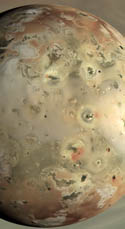
Veeder and his colleagues estimated the contribution of Io's dark lava flow fields to Io's total heat flow by first identifying all the dark lava flow fields visible on Io in the USGS global map and calculating the area of each flow field. Their areas were found by measuring the number of pixels below a threshold limit for each dark flow field (the threshold valuing varying with each flow field) while also removing other possible dark features such as paterae. Using this method, the authors identified 28 dark flow fields, including features such as Masubi Fluctus, Marduk Fluctus, Amirani (above left), and Prometheus (above upper right), covering slightly less than 1% of Io's surface. The authors also excluded more transient lava flows like Pillan and Thor, though sources such as these may provide a significant amount of the heat flow contribution from dark flow field heat, even if the specific sources changes over time. The authors then seem to be more focused on persistent volcanoes. The authors note a peak in the distribution of dark lava flows in the anti-Jovian hemisphere of Io, opposite Io's most powerful volcano, Loki Patera.

Next, the authors estimated the effective temperature (akin to an average nighttime temperature of each lava flow) and the total radiating power for each flow. For many of the flows, infrared data, either from the NIMS or PPR instruments on Galileo, is available, allowing for a more accurate estimate of the heat flow of each flow. For cooler flows, more accurate estimates tend to come from the PPR data since much of their heat is radiating out at longer infrared wavelengths to which PPR was more sensitive, compared to NIMS, which was more sensitive to warmer heat sources. However, for more than half of the dark lava flows examined in this study, no radiative power estimate is available. For these flows, the authors assumed an effective temperature of either 130 K or 115 K, depending on whether surface changes or other signs of recent volcanic activity have been observed.

The authors' estimate that the 28 dark flow fields they examined provide 5 x 10¹² Watts to Io's global heat flow, or about 5% of Io's total heat flow. This amount is similar to Loki when it is quiescent. While their effective temperatures are cooler than many of Io's active paterae like Loki Patera or Pele, their larger surface area compared to Loki Patera (an order of magnitude greater) allows them to contribute a large amount of Io's heat flow. It should be noted that this analysis excluded brighter flows, which may provide an even greater percentage of Io's total heat flow despite having even cooler effective temperatures, a possible later research subject as Io's heat flow budget is broken down further (to an extent this has with Glenn Veeder's earlier work on the possible excess heat flow from Io's polar regions).

Link: Io: Heat Flow from Dark Volcanic Fields [dx.doi.org]

In other news, the blog Kentucky Space has the latest edition of the Carnival of Space. Worth checking out to get yourselves caught up on the celestial blogosphere.

Wednesday, October 29, 2008

The Curious Case of Reiden Patera

Meet Reiden Patera. On the surface, it is an ordinary volcanic pit on Io. But in reality, it is anything but ordinary. Every few years, this particular volcano becomes just another part... of the Twilight Zone.

Okay, I am not Rod Sterling. However, today I thought I would write a little post on this curious volcano. Actually, it is quite ordinary. Our best resolution images are at only 1.5 km/pixel. It has never been the site of an outburst. However this volcano in the shadow of Pillan has gone through an interesting cycle of activity since the feature was first observed by Voyager 1 in 1979.

Reiden Patera is a 73-km wide volcanic depression located on Io's trailing hemisphere a couple hundred kilometers to the southwest of Pillan Patera. Reiden's proximity to Pillan causes occasional confusion between the two features when trying to identify the source of thermal emission in eclipse and near-infrared images of this region of Io. Reiden generally has a dark green floor with dark spots scattered around the margin of the patera. Surrounding the patera, there is normally a bright annulus, which is then surrounded by a dark annulus. The closest analog seen at high resolution by Galileo would be Camaxtli Patera, a similar-sized volcano on Io's anti-Jupiter hemisphere. Like Reiden, Camaxtli has a floor with a patchwork of bright deposits and dark lava flows, and has concentric bright and dark halos surrounding the depression. Reiden, like Camaxtli, has a roughly polygonal outline, with several straight margins, suggestive of structural control, by pre-existing tectonic faults, of the patera margin. A possible landslide deposit can be seen along Reiden's northern margin.

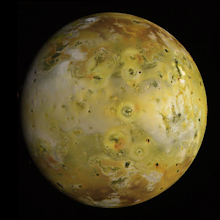
As you can see in the above montage, the appearance of Reiden changed during the course of the Galileo mission. During the first few orbits, several dark spots were seen along the margin, some appearing over time. This suggested on-going volcanic activity centered on the patera margin, and this is substantiated in the thermal data acquired by NIMS and SSI. The camera onboard Galileo, SSI, detected a hotspot at Reiden during the mission's first orbit in late June 1996 (G1). NIMS, the near-infrared spectrometer on Galileo, may have detected a hotspot at Reiden during the second and third orbits (early-September and early-November 1996, respectively), though Lopes et al. 1997 attributes the observed thermal emission to Pillan instead. Changes observed in images acquired in February 1997 (E6) suggests that Reiden was active until shortly after the November 1996, but SSI did show that Reiden had decreased in activity by E6 (in fact, Reiden was not visible in SSI eclipse observations like it was in G1). The lack of changes in images acquired in April 1997 (G7) provides further evidence that the eruption at Reiden had ended. By the next orbit, the outburst eruption at nearby Pillan had begun.

Over the next few years, Reiden remained an inactive volcano, and the dark lava flows seen along its margins began to turn from black to dark green. In images acquired in September 1997 (C10), even the dark halo surrounding Reiden was gone, but the inner, bright halo remained. How much topography and the nearby Pillan eruption played in this change isn't clear, but it appears that Reiden's bright halo maybe located on a low, topographic rise that surrounds Reiden as it was not covered by Pillan's pyroclastic deposits and the topographic rise acted as an impedment to the pyroclastic flow. This provides further evidence that Io's dark silicate deposits, associated with some volcanoes like Pillan, Tvashtar, Pele, and Babbar, are deposited in a process akin to terrestrial basal surges compared to the umbrella-like gas plumes Io is so famous for. As Pillan's dark deposit faded in 1998 and 1999, the dark halo seen when Reiden was active remained absent.

Reiden reactivated by late 2000 as it was seen as a hotspot by Cassini ISS during that spacecraft's distant flyby on December 30, 2000. Galileo during this time observed a darkening at Reiden, further suggesting that activity had resumed. In addition, Galileo observed fresh reddish deposits to the east and northwest of Reiden, perhaps from this new eruption. During a flyby in October 2001 (I32), Reiden was seen at higher resolution. This observation revealed fresh dark material (compared to comparable data acquired in October 1999) along most of its margin, except to the north (where there is a landslide). Reiden may have reactivated as early as October 1999 (I24), when two dark spots were observed along the margin of the patera, near its southwestern margin and along the southern part of the landslide deposit.

Reiden was also seen as active by New Horizons in LORRI imager data and was seen as a dark feature with a bright halo. During the Voyager flybys, it appeared similar to its appearance during the first few orbits of the Galileo mission, though with a dark spot along its northeastern margin, suggesting that Reiden was active during the Voyager mission.

Reiden, though named after the Japanese god of thunder (or was it the Mortal Kombat character...), has long been in the shadow of more famous volcanoes like Pillan and Pele, volcanoes that occasional affect the appearance of Reiden and its surrounding terrain. However, the history of activity at Reiden is an interesting one, where several distinct eruption cycles have been observed by multiple spacecraft. All of Reiden's activity has been confined to small effusive eruptions along the depression's margins. This would suggest that perhaps Reiden is a large lava lake, but there is no evidence of a massive crustal recycling event like those seen at Loki, a more classic example of a lava lake on Io. It is possible that magma uses the faults that bound the depression as conduits to reach the surface, explaining why flows are confined to the margins of the patera. However, a passive lava lake would explain the small eruption along the southern margin of the landslide deposit seen during C3 and I24, as the margin of the landslide would likely not be structurally controlled. It is also possible that this northern bright area is not a landslide, but a cool "island", similar to those seen at Loki and Tupan, two volcanoes thought to be lava lakes.

Hope you all enjoyed this look at Reiden Patera. I hope to post similar articles about other "forgotten" volcanoes here in the future.

Sunday, September 21, 2008

Eruption at Piton de la Fournaise

A fresh eruption at Reunion Island's Piton de la Fournaise volcano today produced a new basaltic lava and a large lava pond and an increase in SO2 concentration within its eight kilometer-wide caldera. Thomas Staudacher, from the volcano observatory on Reunion captured the view at left of the caldera showing this fresh flow. While this eruption seems pretty minor, Piton de la Fournaise (or Le Volcan to the local residents) has recently seen an uptick in activity. According to the AFP, an eruption in April 2007 resulted in the partial collapse of the volcano's caldera and included vigorous fire fountaining that reached upwards of 200 meters into the air.

Link: Le volcan du Piton de la Fournaise sur l'île de la Réunion [fournaise.info]

Tuesday, March 11, 2008

LPSC 2008: Heat Flow from Dark Volcanic Fields

I've covered all the Io-related abstracts in tomorrow night's (wait, now tonight's) poster session covering the Galilean Satellites. Yeah, Io got lumped in with *shiver* Europa (in my mind, there are United Nations peace keepers between the Io and Europa poster boards), Ganymede (everyone's second favorite schizophrenic moon), and Callisto (thanks to the discovery of rings around Rhea, Callisto now possesses the sole title of most boring moon ever). So, if you are at LPSC, be sure to visit the poor Ionians as they will most likely shoved along the back wall like they were last year. Please, show them some love.

Anyways, I am rambling on here. There is an additional Io-related abstract submitted to the LPSC conference, a print-only abstracted by Glenn Veeder, Dennis Matson, Ashley Davies, and Torrence Johnson titled, "Io: Heat Flow from Dark Volcanic Fields." The authors examined the distribution of dark flow fields on Io and examine their contribution to Io's high heat flow (the total amount of heat released in a given time period from the interior). As a print-only abstract, the results presented in this abstract will not be presented at a talk or a poster at LPSC.

The authors focused on dark flow fields, areas where lava has flowed across Io's flat(ish) plains, rather than those flows within the topographic confines of a patera. It is thought that these flows are compound pahoehoe silicate lava flows, built up by small outbreaks on top of older flows punctuated by period of high eruption rates that rapidly grow the lava (akin to flood basalts on Earth). They determined that dark flow fields are not distributed evenly across all longitudes with a peak near the center of the anti-Jovian hemisphere (in the abstract, the anti-Loki hemisphere). Flows seen near this peak include Prometheus, Zamama, Thor, Culann, Volund, and Mycenae Regio. This correlates well with a peak in the distribution of volcanic centers and paterae. The authors note that a correlation is not seen at the other peak in volcanic centers and paterae near 325° West, which includes Loki.

The authors then examined the contribution these lava flows make to Io's total heat flow. In the abstract, they focused on two prominent flow fields: Lei-Kung Fluctus (shown above, big flow field on Io's northern trailing hemisphere) and Amirani. Using NIMS and PPR data from Galileo, the authors calculated that that the two lava flows contribute 4.5x10¹¹ W and 1.5x10¹² W to Io's total heat flow, which is on the order of 1014 W. In total, the 24 flow fields the authors examined contribute approximately 10% to Io's total heat flow, equivalent to Loki Patera. It should be noted that the authors mapped about 3x10⁵ km2 worth of dark flows. This is about 25% of the total amount of dark lava flows covering Io's surface according to the mapping done by Williams et al., so that 10% figure maybe an underestimate. I can't tell, but it also seems like they assumed an effective temperature (basically an average temperature for the entire flow field) to come up with their heat flow numbers for at least some of the fields they mapped.

An interesting abstract. I will be interested in seeing how their dark flow mapping compares to what Williams et al. has done (this also sounds like the kind of project that global geologic mapping is suited for), particularly since Williams et al. mapped a factor of 4 more dark flows material than Veeder et al. did.

Link: Io: Heat Flow from Dark Volcanic Fields [www.lpi.usra.edu]