Showing posts with label Hubble. Show all posts

Friday, February 6, 2015

Hubble Observes Last Month's Triple-Moon Conjunction

Yesterday, the Space Telescope Institute released a set of images as well as a movie of Jupiter acquired during a rare triple moon-shadow transit on January 24.  During the event, Io, Europa, and Callisto aligned so that the three moons and their shadows appeared to move across the face of Jupiter.  The next such triple-event won't take place until 2025.  The Hubble images were even sharp enough to spot some of Io and Callisto's large scale albedo markings (like the flow field around Io's Isum Patera or the bright patch in the middle of Callisto's Asgard impact basin).  With a keen eye, you can even spot the small inner moons, Amalthea and Thebe, and their shadows as two pairs of faint dark spots passing between Io and Callisto against the bright equatorial zone.

The difference in the crispness of the moons' shadows results from their different distances from Jupiter.  Io is much closer to Jupiter than Callisto, so when it easily eclipses the Sun when it passes in front of it in Jupiter's sky.  Callisto is farther away, so it appears to be closer in size to the Sun so there is a more narrow zone where it completely eclipses it (the umbra) and a wider zone where only a partial eclipse occurs (the penumbra), similar to solar eclipses on the Earth.

Opposition for Jupiter is today, and now that the moon is moving further away from Jupiter in the night sky, this is a great time to observe it and its Galilean satellites.  Great ground-based images are showing up, including these sets taken by Anthony Wesley and Christopher Go.

Link: Hubble Captures Rare Triple-Moon Conjunction [hubblesite.org]
Link: ALPO-Jupiter Images from February 5 [alpo-j.asahikawa-med.ac.jp]

Wednesday, June 16, 2010

No Debris Field from the June 3 Impact

A new set of images of Jupiter, taken a few days after the June 3 impact of a small asteroid or comet, was released on the website for the Hubble Space Telescope today.  The research group, which includes Mike Wong, Heidi Hammel, and Amy Simon-Miller, focused on finding a small debris field that might have resulted from the impact, similar to the ones seen from last year's asteroid impact and the Shoemaker-Levy 9 impacts in July 1994.

To date, no such debris field has been spotted by amateur, ground-based telescopes, but it had been hoped that with Hubble's superior resolution, it might be able to spot a small, dark spot from the impact.  Instead, as you can see above, even with Hubble's larger eyes, no impact scar is visible.  This suggests that the impactor was too small to penetrate very deep into Jupiter's atmosphere, but instead burned up in the upper atmosphere, akin to meteor fireballs on Earth.  Since these events are so brief, it is possible that similar Jovian meteors maybe fairly common, but because of their brief duration (< 3 seconds), they just hadn't been noticed before.  Leigh Fletcher on his Twitter feed has noted that the Keck, Gemini, and IRTF observatories at Hawaii's Mauna Kea and VLT in Chile have also obtained views of the impact site, so maybe they will be able to spot a residual thermal hotspot from the site.  He seems to suggest that no such scar has been seen though.

While it failed to detect an impact scar from the Jovian meteor, the Hubble data was able to provide images of the changes that have occurred in Jupiter's atmosphere over the last six months.  The South Equatorial Belt (SEB), normally the reddish-brown southern complement to the similar North Equatorial Belt (NEB) which bracket the bright Equatorial Zone (EZ), brightened during the end of 2009.  From ground-based scopes, this makes Jupiter appear as if it only has one dark belt, as opposed to the normal two.  This also makes the Great Red Spot more visible since it is surrounded by mostly bright clouds.  Hubble detected a high-altitude layer of ammonia clouds over the SEB, obscuring the darker clouds below.  The Hubble image also points to the beginning of the end for these high clouds, as a series of dark spots along the southern margin of the SEB were also seen.  Similar spots were seen near the end of earlier SEB brightenings.

Link: Hubble - Mysterious Flash on Jupiter Left No Debris Cloud [www.hubblesite.org]

Friday, September 11, 2009

New Hubble Images of Jupiter

On Wednesday, NASA released a number of images acquired by the Hubble Space Telescope as part of its re-commissioning period following the Shuttle Repair and Service mission back in May. One of the images released is a full-disk color image of Jupiter taken four days after the impact of a ~0.3 kilometer (330-yard) wide comet or asteroid in the giant planet's south polar region. The temporary impact scar can be seen as dark splotch at bottom right. A portion of this image was released back in July as part of the global campaign to monitor the impact scar. In addition to the impact scar, this image also shows some beautiful atmospheric waves in Jupiter's northern hemisphere.

Another great image released by the Hubble team shows the Butterfly Nebula as captured by the new Wide Field Camera 3. The image shows the glowing gas and dust cast off by the dying star at the center of the image (unseen because of the large amount of dust between the star and us). Very striking!

Link: Collision Leaves Giant Jupiter Bruised [www.hubblesite.org]

Monday, May 11, 2009

Hubble Servicing Mission Launches

The Space Shuttle Atlantis launched earlier today to perform the fourth and last servicing mission of the Hubble Space Telescope. This Shuttle mission should restore the functionality of the Advanced Camera for Surveys (ACS) and the Space Telescope Imaging Spectrograph (STIS). The shuttle astronauts should also install two additional instruments: the Cosmic Origins Spectrograph (COS) - a high-spectral resolution ultraviolet spectrometer - and the Wide Field Camera 3, an upgrade from WFPC2.

Hubble over the years has made a number of discoveries at Io including observing surface changes between Voyager and Galileo (such as a major eruption at Ra between 1994 and 1995) and sulfur gas in Pele's plume. These discoveries were made using the full-set of instruments onboard the space telescope, and no doubt these new instruments would certainly be useful for the study of Io, particularly studying the gases in Io's atmosphere using the COS spectrometer. Because of the high demand on telescope time, Hubble is not well suited for change detection, but certainly comparisons between any chance images of Io could be used for this purpose, but they would need to be large changes like the one at the Ra Patera eruption.

Link: Hubble Servicing Mission 4 [sm4.gsfc.nasa.gov]

Tuesday, March 18, 2008

UV Io footprint leading spot

I got a chance to read the Io footprint paper that was published on Saturday and made the space news rounds yesterday. The article is titled, "UV Io footprint leading spot: A key feature for understanding the UV Io footprint multiplicity?", and was published in the journal Geophysical Research Letters (Geophys. Res. Lett. or GRL) by Bertrand Bonfond et al.

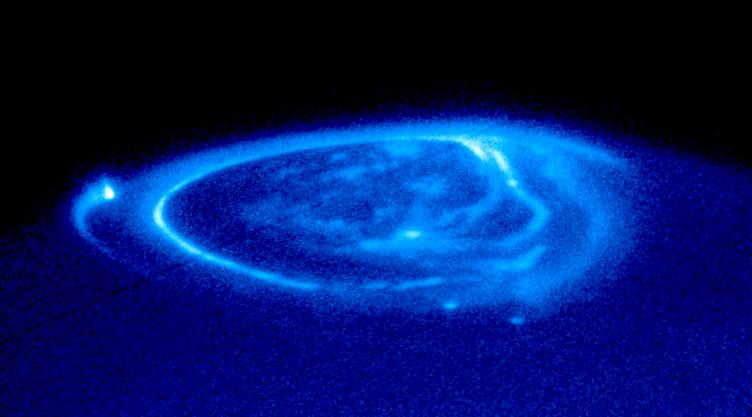
The Io footprint is an auroral glow at Jupiter's north and south polar regions that is generated by infalling ions traveling along Alfvén waves between Io and Jupiter. This connection between Io and Jupiter is an Alfvén wing known as the Io Flux Tube. This connection is bent with respect to the magnetic field lines depending on Io's position in the plasma torus as Alfvén waves travel slower through dense plasma (like in the torus). So if Io's is at its furthest point in its orbit above the plasma torus (the torus is tilted with respect to Io's orbit by 7 deg., as is Jupiter's magnetosphere), the waves travel essentially along the magnetic field lines to the north polar Io footprint since it travels through less plasma, while they are significantly bent as they travel to the south polar footprint. Also, the auroral emission at the north polar footprint is brighter than in the south. The reverse is true if Io is at its furtherest point below the torus in its orbit.

The authors looked at observations of the Io footprint in the UV from the Hubble telescope acquired between 1997 and 2007. They noted several spots in addition to the main Io footprint. In most cases, they resolved fainter spots trailing the main bright spot, and in some cases, a faint spot leading the main spot. They found that when Io is at its highest point above the torus in its orbit, the spots trailing the Io footprint in the north were at their brightest and there was a spot leading the Io footprint in the south. They found the reverse when Io was at its farthest point below the plasma torus; there were multiple bright spots trailing the main footprint in the south, and a leading spot in the north.

They interpret this data to indicate that the leading spot is the result of a connection along magnetic field lines between the brighter Io footprint and the other spot near the other pole (remember the fainter spot also trails the brighter footprint because the Alfvén waves that make it have to travel through more plasma in the plasma torus). The secondary spots trailing the brighter Io footprint are created by a connection along magnetic field lines from the fainter Io footprint to the brighter one. Since the fainter one trails, the waves will impact Jupiter's upper atmosphere behind the brighter spot.

A pretty interesting paper with an elegant model. Since I am not a plasma physicist, I can evaluate the model to see whether it passes the non-sense test, but as a non-specialist, it seemed to make sense to me.

ADDED: I replaced the original image in this post with a cartoon schematic illustrating the various connections that create the Io footprint. The blue connections are the Alfvén wings between Io and Jupiter. The connection to the south pole basically follows the magnetic field lines between Io and Jupiter because it doesn't encounter much plasma (in the cartoon, Io is near its southernmost point in its orbit so most of the Io plasma torus is above it). The connection to the north is bent as the Alfvén waves are slowed by the plasma torus. The red connections are the magnetic field lines that connection the Io footprint in one pole to the other pole.

Link: UV Io footprint leading spot [www.agu.org]

Monday, March 17, 2008

Auroral Spot Leading Io Footprint on Jupiter

A new paper just published in Geophysical Research Letters by B. Bonfond et al. has been making the rounds around various space websites today titled, "UV Io footprint leading spot: A key feature for understanding the UV Io footprint multiplicity?" I am not a space physics person so I usually wouldn't cover a paper like this here on this blog, but it isn't every day that Io makes the news.

The best overview I have seen is by Phil Plait over at Bad Astronomy. Space Physics is not my specialty, so I think he explained what the authors found better than I can, but I am going to try anyway... Another good overview can be found at space.com.

The paper covers the Io footprint within Jupiter's aurorae. The "footprint" is a glow caused by charged particles, originating from Io, impacting Jupiter's upper atmosphere. You can see the footprint in the image above as the bright glow on the left. The footprint is not a single glow but has various structures, including a tail behind it and a fainter spot in front of it. It is the fainter "leading spot" that is the subject of this paper. This leading spot is the result of a connection in Jupiter's magnetic field between the Io footprint at Jupiter's northern and southern polar regions.

This news even made the Yahoo front page with the headline, "'Glowing spots' on Jupiter caused planet's volcanic moon." I know, they forgot the word 'by' between 'caused' and 'planet's', but still, I did a spit take when I saw that. Great, let's give the Electric Universe people something to foam about...

I haven't had a chance to peruse the paper yet. I'll take a look at it tomorrow, and report here if there is anything that Phil hasn't already mentioned.

Link: UV Io footprint leading spot [www.agu.org]

Monday, March 3, 2008

LPSC 2008: Detailed Analysis of the Tvashtar Plume Spectral Behavior

In the second LPSC abstract highlighted on this blog, Kandis Lea Jessup and John Spencer present the work they have done on Hubble images of Io taken during last year's New Horizons encounter. In particular, they are using the images they acquired at different wavelengths with Hubble's Wide Field and Planetary Camera 2 to study the spectral behavior of the Tvashtar plume.

While the images acquired by Hubble have a lower spatial resolution than those taken by New Horizons' LORRI camera (180 km per pixel for the WFPC2 versus at top resolution of 11.2 km per pixel for LORRI), the WFPC2 has a higher spectral resolution than New Horizons' MVIC instrument, particularly at ultraviolet wavelengths which is particularly important for identifying gases within Io's plumes. Jessup and Spencer observed Io and the Tvashtar plume on multiple occassions last February, allowing the authors to examine the plume's reflectance spectra (i.e. looking at how much light reflects off the plume, which can depend on composition, particle size, and phase angle) and absorption spectra (i.e. looking at how much light from the background Jupiter passes through the plume to Hubble).

The authors found the plume to be most noticeable in both sets of observation in the ultraviolet F255W filter, indicative of S2 gas in the plume. The authors had a similar result at Pele in 2000. They do note that the Tvashtar plume has a much higher optical depth in the F255W filter than Pele.

Interesting work. They do promise to present more work on how optical depth varies by wavelength for both Pele and Tvashtar in their poster. It is so interesting to see just how similar the Pele and Tvashtar plumes despite the apparent difference in volcanic styles: Pele being a vigorously erupting lava lake and Tvashtar being a fissure eruption. Must have to do with the magmas at both locations having a higher volatile content, allowing the formation of a bright lava fountain at Tvashtar and a constantly overturning lava lake at Pele. Note the fact that as far as I know, Pele and Tvashtar are the only two volcanoes where using relatively short exposures, it is easy to see their hotspots in the daylight, at wavelengths less than 1 micron, and at relatively low resolutions.

Link: Detailed Analysis of the Tvashtar Plume Spectral Behavior [www.lpi.usra.edu]