Tuesday, March 4, 2008

LPSC 2008: Validation of Volcanic Thermal Emission Models


JPL's Ashley Davies has published several papers over the last 11 years presenting his cooling model for terrestrial and ionian lava flows. I know this is a gross over-simplification (I'm sorry, Ashley) but basically the model inputs the near-infrared thermal spectrum of a hotspot and some appropriate physical parameters (initial eruption temperature, flow thickness, porosity, etc.), and outputs flow age, area, temperature, and flow rate (note to self: apparently I don't have his 1996 paper from Icarus on my laptop). The model has also been used to investigate eruption styles at different Ionian volcanoes.

This abstract by Davies and a cast of several covers a test on the model to see how well it reproduces the near-infrared spectrum of a lava lake on Mount Erebus on Ross Island, Antarctica. The test was needed in order to see how close to reality the model is when dealing with volcanoes on Io where we can't (at the moment) just go out and more directly measure the composition, temperature, and flow rate.

The authors imaged the Erebus lava lake (shown above) using an infrared camera and derived an integrated thermal spectrum from that data. The authors compare the model fits obtained from both one- and two-temperature fits to the Erebus data, similar to those performed by other groups on Galileo NIMS data, and from the Davies (1996) model. While the two-temperature fit modeled the lava lake well with respect to areal extent, the Davies (1996) model appears fairly robust when modeling the Erebus lava lake. One issue they do note is that in order to obtain this match, they used an eruption temperature that was 175 K warmer than what it actually is at Erebus. The authors promise further investigation on this issue and how it might affect the parameters they use for modeling Ionian lava lakes (since obviously eruption temperature is poorly constrained on Io).

Link: Validation of Volcanic Thermal Emission Models Using Ground-Truthed Data of the Erebus volcano (Antarctica) Lava Lake: Implications for Io [www.lpi.usra.edu]

Galileo G7 and G8 Reprocessed Images

Tonight, I finished up on reprocessing Galileo images of Io from orbits G7 and G8. I've posted them up on my Galileo Images of Io website.

Io images from orbit G7 (early April 1997) consist of three observations covering the leading and trailing hemispheres at moderate phase angles. The images of the trailing hemisphere provided an excellent opportunity of observe topographic features located between 265° and 325° West Longitude. One thing I never noticed before when looking at those two, clear filter images is a split mountain near 23° S, 295° West. Double ridge or split mountains are a common occurrence on Io and include such named mountains as Ionian Mons, Danube Planum, and Mongibello Mons. I should point out that this isn't a new discovery, the mountain is listed in Io After Galileo, for example. I just never noticed it before. It is pretty distinctive in color maps of the area, I just never recognized it as a mountain.

Io images from orbit G8 (early May 1997) rarely see the light of day. Seriously, I don't think a single one was released publicly except on the PDS website as raw images. I guess after the Pillan eruption made all the headlines a couple months later, no one cared about poor old Kanehekili or Prometheus, two plumes seen in the G8 dataset. The G8 images were taken to look at the state of plume activity on Io. Kanehekili and Prometheus are the two most obvious plumes visible, but the Amirani and Marduk plumes are also visible, if you look hard enough at the relevant violet filter images.

Starting with G8, I've started a new processing technique for situations where only two filters are available. Usually this situation occurs when only the violet and green filter images were returned in an observation or there is a gap in one of the filters (usually either green or red). In those situations, I am trying out "Voyager" color. In the case where I have only Green and Violet filter images available, I use the green filter for the red channel, the violet filter for the blue channel, and a mix of 61% Green Filter and 39% Violet filter for the green channel to create a pseudo-blue filter image. I got those numbers from Björn Jónsson's attempt at creating true-color Io images from the Galileo dataset. I am still processing these types of images the "normal" way, using the green filter for the red and green channels and the violet filter for the blue channel. Let me know which you like better.

Onward to C9.

Link: Galileo Images of Io [pirlwww.lpl.arizona.edu]

Monday, March 3, 2008

LPSC 2008: Detailed Analysis of the Tvashtar Plume Spectral Behavior

In the second LPSC abstract highlighted on this blog, Kandis Lea Jessup and John Spencer present the work they have done on Hubble images of Io taken during last year's New Horizons encounter. In particular, they are using the images they acquired at different wavelengths with Hubble's Wide Field and Planetary Camera 2 to study the spectral behavior of the Tvashtar plume.

While the images acquired by Hubble have a lower spatial resolution than those taken by New Horizons' LORRI camera (180 km per pixel for the WFPC2 versus at top resolution of 11.2 km per pixel for LORRI), the WFPC2 has a higher spectral resolution than New Horizons' MVIC instrument, particularly at ultraviolet wavelengths which is particularly important for identifying gases within Io's plumes. Jessup and Spencer observed Io and the Tvashtar plume on multiple occassions last February, allowing the authors to examine the plume's reflectance spectra (i.e. looking at how much light reflects off the plume, which can depend on composition, particle size, and phase angle) and absorption spectra (i.e. looking at how much light from the background Jupiter passes through the plume to Hubble).

The authors found the plume to be most noticeable in both sets of observation in the ultraviolet F255W filter, indicative of S2 gas in the plume. The authors had a similar result at Pele in 2000. They do note that the Tvashtar plume has a much higher optical depth in the F255W filter than Pele.

Interesting work. They do promise to present more work on how optical depth varies by wavelength for both Pele and Tvashtar in their poster. It is so interesting to see just how similar the Pele and Tvashtar plumes despite the apparent difference in volcanic styles: Pele being a vigorously erupting lava lake and Tvashtar being a fissure eruption. Must have to do with the magmas at both locations having a higher volatile content, allowing the formation of a bright lava fountain at Tvashtar and a constantly overturning lava lake at Pele. Note the fact that as far as I know, Pele and Tvashtar are the only two volcanoes where using relatively short exposures, it is easy to see their hotspots in the daylight, at wavelengths less than 1 micron, and at relatively low resolutions.

Link: Detailed Analysis of the Tvashtar Plume Spectral Behavior [www.lpi.usra.edu]

Sunday, March 2, 2008

Seeing Red

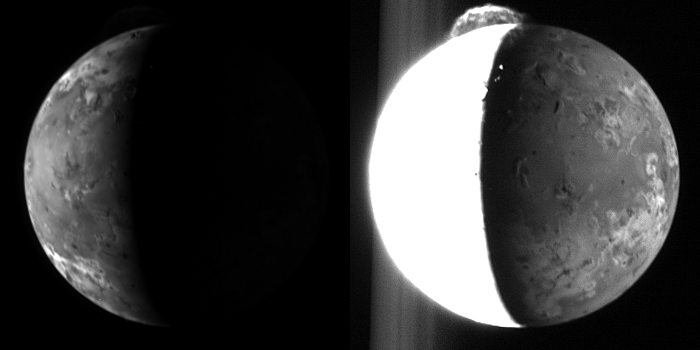
The New Horizons team has released this color image from the Multispectral Visible Imaging Camera (MVIC) as part of their commemoration of the one-year anniversary of the spacecraft's encounter with Jupiter.

The lefthand frame reveals the red ring around Tvashtar Paterae, the result of sulfurous fallout from the volcano's large plume. The right frame is the same image, but stretched to better show the Tvashtar and Prometheus plumes (near the equator along the limb). These plumes appear blue due to small, smoke-sized particles in the plume. The right frame also shows the some of the terrain illuminated by Jupiter as well as a hint of the incandescent lava in the Tvashtar fire fountain.

The color presented here is only approximately true color. Two filters were used to create this image: a blue filter with a central wavelength of 475 nm and a methane filter with a central wavelength of 889 nm in the near-infrared. So you are seeing colors a little redder and less yellowish than what you would see with the naked eye.

For comparison, there is a nice Galileo frame from November 1997 that has a similar geometry.

As another comparison, I've put together a couple of the LORRI frames taken at nearly the same time as this MVIC image: one exposed to show the area illuminated by the Sun (and the lava fountain at Tvashtar) and another exposed to show the Tvashtar plume and the area illuminated by Jupiter.

Link: Seeing Red [pluto.jhuapl.edu]

Saturday, March 1, 2008

No Io New Frontiers Mission this time around

Spaceref.com has a press release from NASA's Science Mission Directorate on the upcoming New Frontiers AO. The article conveys a couple of points. First, it announces the eligibility requirements for New Frontiers mission PIs and the availability of pre-screening to see if an individual meets those requirements. Basically you have to have either a 4-year stint in a "mission leadership role" (think Steve Squyres) or two, 2-year stints in a "mission or instrument leadership role." I use the exact quote here because I have no idea what "leadership role" means in this context, whether you have to have been a PI or whether co-Is are eligible, or mission scientist (think Bob Pappalardo during the Cassini Extended Mission). The other news in the press release is the news that the New Frontiers 3 Announcement of Opportunity is expected by June. Maybe it will even be June of this year. I'm not holding my breath, but Alan Stern seems to have been running a tight ship thus far.

I guess the Io-related tidbit here is the news that RTGs will not be allowed on the next New Frontiers mission. So whatever new frontiers we are aiming for, it had better be closer to the Sun than Jupiter or be a short mission. This news effectively eliminates an Io Observer mission from the list of potential candidates. As others have reported, it seems likely that this AO will again restrict the submissions to a list of mission profiles, likely a South Polar-Aiken Basin lunar lander, a Venus atmospheric probe/lander, a comet sample return mission, and probably a Saturn atmospheric probe.

A little bummed by the news, but the fact that an Io mission was probably not in the cards this time around wasn't unexpected by me. Hopefully next time, though if the Jupiter System Orbiter is selected as the next flagship mission, a dedicated Io mission would likely drop in priority.

Link: NASA Offers Pre-screening of Principal Investigator Revised Requirements for New Frontiers Opportunity [www.spaceref.com]

E6 Reprocessed Images

This evening, I finished reprocessing most of the images from the Galileo's E6 orbit from mid-February 1997. These include the following sequences: E6ISSRFMON01, E6ISPLUME_01, E6ISTOPMAP01, and E6ISSRFMON02.

E6ISSRFMON01 covers the leading hemisphere of Io using the SSI camera's Violet, Green, and IR-756 filter. I used the IR-756 filter due to the lack of a Red filter, so some of the reds appear a little more vividly than they would otherwise appear, like in the red deposits south of Zal Patera.

E6ISPLUME_01 (left) covers the anti-Jovian hemisphere using the SSI camera's Violet, Green, and Red filters. Very nice image of this hemisphere.

E6ISTOPMAP01 is a medium-resolution, clear filter of the area around Colchis Regio and Pele. Very nice view of Boosaule Montes. Too bad this was never publicly released at the time.

E6ISSRFMON02 cover the trailing hemisphere using the SSI camera's Violet, Green, and Red filters. This image was released by the Galileo project at the time as PIA01223.

Link: E6 Images [pirlwww.lpl.arizona.edu]

Friday, February 29, 2008

Jupiter from a Fissure on the Floor of Gish Bar Patera

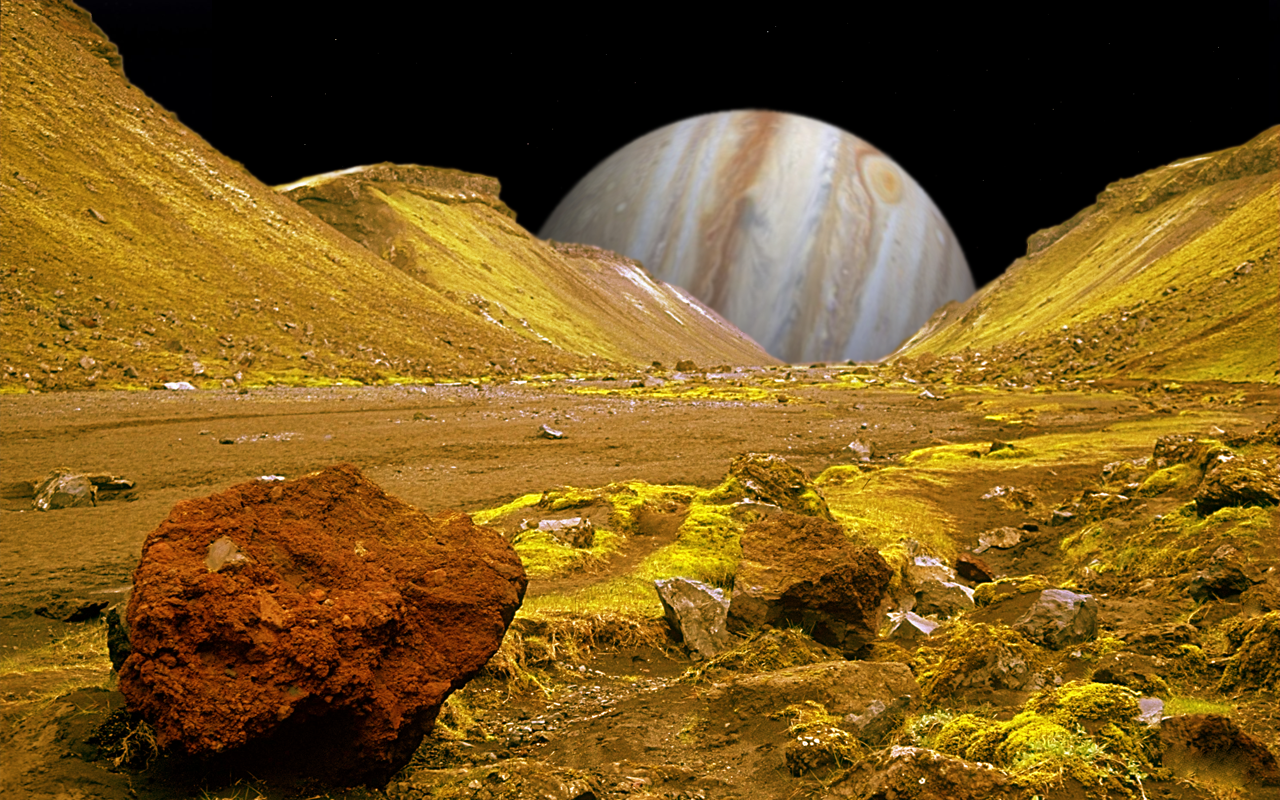
Most of you have probably already seen this very famous image acquired by the Io Science Laboratory but I still think it is one of the best spacecraft images every acquired. This image was taken on the floor of a fissure on the floor of Gish Bar Patera during the probes 3 hours active on the surface. The colors seen are largely the result of a various sulfur allotropes, ranging from the red coating on the lava bomb in the foreground, to orange, to the more stable yellow. Sulfur dioxide can be seen on a distant cliff face, likely emplaced after sapping from the subsurface. Exposed silicate materials can be seen in many of the rocks near the lander, such as an exposure of olivine in the large, foreground boulder.

Okay, okay, I made this last year in Photoshop to be a background for my laptop. It was created by combining an image taken by Andreas Tille in the Eldgjá Fissure in Southwestern Iceland (original image) and a simulated view from the surface of Io (from Gish Bar Patera) of the eastern horizons. I used Photoshop CS to adjust the colors to match those of Io, to blur out the more obvious blades of grass, and to remove some of the distant mountains (due to the obvious atmospheric scattering).

Hope you like.

Link: Jupiter from Gish Bar [pirlwww.lpl.arizona.edu]

Thursday, February 28, 2008

G2 and E4 reprocessed images

As I mentioned a few days, the next set of images I planned on working on were from the G1 and E4 orbits. I got these done today and posted them on my Galileo Images of Io website.

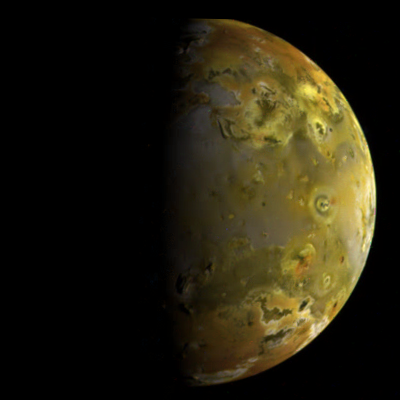
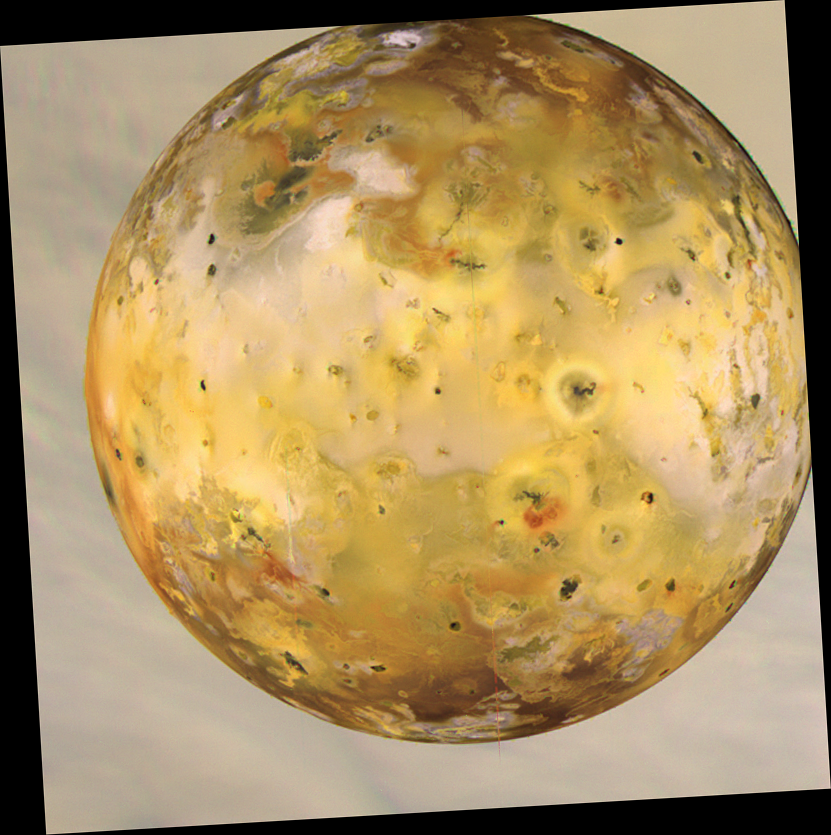
The G2 image, shown at left, was the first observation to cover the anti-Jovian hemisphere during the Galileo mission. the 3-color image was acquired on September 7, 1996. Comparisons between this frame and Voyager images revealed changes at Prometheus (including a new lava flow and a 75-km change in the position of the plume vent), Culann, and Zamama (a volcanic center not visible in Voyager images), as well as at other volcanic centers. During the G2 encounter period, numerous other violet filter images were returned, designed to study Io's volcanic plumes. I have not done anything with these images due to their high compression ratios. This image was released by the Galileo Project as PIA00494.

For E4, I redid the E4ISGLOCOL02 observation. There are a couple of others on that page that I have done new work on. E4ISGLOCOL02 covers much of the same terrain as the G2 iamge, as well as additional terrain to the east. The geometry of this observation is very similar to the high-resolution global color mosaic acquired during C21. At the time this observation was acquired, on December 18, 1996, this image provided the highest resolution imaging of Io's leading hemisphere and parts of the sub-Jovian hemisphere. The observation also revealed several changes between the September and December 1996 in this region, including new or changed plume deposits at Prometheus, Zamama, and at a volcano near 80 N, 100 W. This image was released by the Galileo Project as PIA00584.

Well, I guess E6 is next.

Link: Galileo Images of Io [pirlwww.lpl.arizona.edu]

LPSC 2008: Geologic Mapping of the Zal Region of Io

The Lunar and Planetary Sciences Conference is coming up in a couple weeks. I unfortunately will not be attending but the abstracts for the conference, which are almost mini-papers in length, have been online for a few weeks now. Nearly all the Io-related abstracts are for posters to be presented on the evening of Tuesday, March 11. In this post, and in blogs to be posted over the next week or so, I will cover one of the abstracts for this conference.

The first abstract I'm going to discuss is "Geologic Mapping of the Zal Region of Io" by Melissa Bunte, David Williams, and Ron Greeley. This abstract covers work done as a part of series of geologic mapping work performed by the Planetary Geology group at Arizona State University on the mosaics Galileo acquired of Io during its seven encounters. This time they cover the area around Zal Patera. This volcano on Io's northern Leading hemisphere is bounded to the west and south by the two-part Zal Montes.

Like most places the group has mapped, they found 5 basic terrain types: plains, mountains, patera floor materials, flow materials, and diffuse materials. Their mapping allowed the authors to determine the age relationships between the different flow units within Zal Patera based on the brightness of the flows. Basically, as a flow ages, it cools (obviously) and as it cools, more volatiles can condense on it. Color-wise, the progression at this latitude is (generally now) from black, to green (when you got your sulfur mixing with your iron), to yellow (thanks to S8), and then to red-brown when radiation starts to work on the sulfur and break it down (anyone know how long that roughly takes, by the way?). The group also mapped some very extensive, old flows that they attribute to Rustam Patera, the proposed name for an active volcano on the western margin of South Zal Montes.

Following the work they have done previously in the Amirani and Camaxtli regions on Io, they will like publish this work sometime in the next year or so. Certainly will be a paper to look for. I would be interested in how they handle the connection between Rustam Patera and the lava channel that runs north from it up through to what they identify as a fissure along the western margin of Zal Patera. Another interesting feature in this region (or actually just off the western edge of their mapped segment) is a small, explosive eruption from the summer of 1997 that produced a small dark pyroclastic deposit that partly overlaps onto the western margin of the North Zal Montes plateau, which is identified as a flow (?) in the map included in the abstract, and a bright ring around that pyroclastic deposit. Strangely enough, no obvious effusive materials from that eruption.

The ASU group also has another poster at the conference where they present the work they have done so far on producing a global geologic map. I will discuss that abstract in a later post.

Link: Geologic Mapping of the Zal Region of Io [www.lpi.usra.edu][pdf file]

Tuesday, February 26, 2008

Here Be Dragons...

Stuart Atkinson sent along a poem he wrote following the New Horizons encounter with Io last year. It is a great poem and he has allowed me to post it here. Stuart has a blog of his own called The 'Verse where he posted numerous poems he's written related to various space events that have occurred over the last year, such as the MESSENGER encounter of Mercury or the dust storm that affected the Mars rovers Spirit and Opportunity last summer, and is a site definitely worth checking out.

HERE BE DRAGONS...

Through your telescopes I am

merely a star, a spark of light that slides

and glides ‘round proud Jupiter;

one night here, the next night there,

sometimes with company, often alone

on Jove’s left or right. One of four

fluttering fireflies flitting silently through

the blush of the Red Spot’s glow.


But dare to approach me, to brave Jupiter’s

cell-scything rays and you’ll crave

the safety of Earth once more, for I am a world

where chemistry screams at the sky

and tears at your eyes, with claws

of colour so sharp and so raw

you’ll turn your face away and seek

the comfort of Callisto’s cratered smile.


For where my colder, older brother

and sister moons glow shivering shades of blue

and grey, my tortured face is painted hues

of fiery red; instead of frigid plains

of painfully pastel tones, my bones lie under

seeping fields of sores and blistering boils.

A pox-infected moon am I, a leprous satellite

that brings my smooth-skinned family shame.

Yet, if they knew my secret, the mysteries

I keep hidden from their disapproving

view, they would feel envy, for the tangerine-

and clementine-hued splashes on my

face are not mere volcanoes, as your

Earthly scientists believe, but are great blooms

and plumes of fyre, breathed out by beasts

which bathe beneath my Jupiter-racked crust.


Maui, Marduk, Loki – dragons all, and with

Volund and Pele prowl and crawl thru my sulphurous

churning seas; wings outstretched, tails sweeping

to and fro below my scabby-encrusted skin,

swimming, spinning, gorging on my

bitter bile before breaking through to spew

their flaming breath out into space in great

gushes of furious light. What a sight!


And what luck you had, sending one of your

nuts and bolts butterflies gliding past me

just as mighty Tvashtar roared, vomiting his

dragonfyre towards the stars, howling with

Masubi and Prometheus in a choir of dragons

singing to the Great One’s swirling storms;

what fortune to soar through this cloud of worlds

on your way to the Belt, and Beyond…

© Stuart Atkinson 2007

Europa: Featured Article of the Day

Just as I am going to bed (finally, yes, I know, it is 2am in the morning), what do I find to my horror when I do a quick check of Wikipedia: Europa is the Featured Article of the Day. To be honest, it isn't a bad article. It does spend a too much time on astrobiology and comparatively little time on Europa's surface features. That, in my mind, demonstrates all that is wrong with Europan science. Last time I checked, no life has been found on Europa. It spends plenty of time talking about Black Smokers and extremophile life, which is all well and good, but until we find life on Europa, that has nothing to do with that moon. The article also spends quite a bit of time on canceled missions to Europa, but preciously little article space to missions that have explored Europa or ones that have a good chance of exploring it.

Anyways, so that article is on Wikipedia if you want to check that out.

Link: Main Page - Wikipedia, the free encyclopedia [en.wikipedia.org]

Monday, February 25, 2008

Lava lakes on Io: New perspectives from modeling

Tracy Gregg and Rosaly Lopes have a new paper in the March issue of Icarus titled, "Lava lakes on Io: New perspectives from modeling." The paper provides a possible model for the volcanism observed at Loki Patera (shown at left from images taken by Galileo's SSI and NIMS instruments). Previous models by Davies et al. and Rathbun et al. suggested that the episodic activity was the result of lava flows spreading out from a fissure and an overturning lava lake, respectively. The lava lake hypothesis has gained particular currency among the Iophile community over the last few years, particularly its ability to explain the distribution of thermal sources as seen by NIMS.

Gregg and Lopes, in their paper, point out a few problems with both models. In the first, wherein lava flows spread out from a fissure, the lack of overflowing lava despite repeated eruption episodes over the last 20 years is a concern. In the second, the difference in scale between terrestrial lava lakes (most are on the order of 100 meters across) and Loki (approximately 200 km across) is an issue. The authors point out several other issues, including the scale of magma reservoir needed and the thermally patchy nature of the patera floor.

The authors instead propose the following model for Loki Patera: 1) Magma is fed into a thin (10s-100s meters thick) chamber from a tidally heated source deep beneath Loki; 2) When this chamber is filled, magma travels up a conduit a few km long (assuming relatively low surface porosity) and into a fissure along the southwestern margin of the patera; 3) The lava then flows out from the fissure into pre-existing lava tubes or covered-over lava channels, travelling out from the fissure across the rest of the patera; 4) The lava ends up being intruded into the country rock of the patera floor (rather than flowing along the surface as lava flows) or fills lava ponds along the patera margin; 5) The eruption episode ends when the magma chamber is emptied and the lava in the fissure trench drains back down. The authors suggest that the eruption style at Loki is roughly analogous to eruptions along the East Pacific Rise.

This model is consistent with observations obtained of Loki. The thermal wave seen by ground-based observers and NIMS would be produced by heat conducted up from the lava tubes to the patera floor. The hotspot along the southeastern margin of the patera represents the location of the fissure. The other hotspots along the patera margin and along the margin of the "island" on the floor of Loki likely represent lava ponds where lava has collected at a topographic obstacle. The corresponding darkening wave at visible wavelengths seen along the patera floor by Voyager 1 and 2, rather than being the result of lava flowing across the surface or new crust in an overturning lava lake, is the result of volatiles being driven off a surface that is heated from below by lava flowing through lava tubes.

This is certainly a very interesting model for Loki as it explains the lower temperature measured by NIMS and PPR compared to eruptions at other volcanoes on Io and the lack of lava overflowing the patera margin. I think the lava lake model works best for smaller volcanoes like Pele and the southeastern portion of Gish Bar Patera, where the difference in size between terrestrial and Ionian lava lakes wouldn't be so great. It would be interesting to see how well this model might work for other inter-patera flows, like the main floor of Gish Bar or Emakong Patera.

Link: Lava lakes on Io: New perspectives from modeling [dx.doi.org]

G1, E26 Reprocessed Images

I've added reprocessed images from G1 and E26 to my Galileo Images website. The G1 images from late June 1996 are global views that represent that highest resolution views of Io's surface since the Voyager encounters of 1979 and allowed scientists to examine changes to Io surface in the intervening 17 years. These include changes at Pele, Acala Fluctus, Euboea Fluctus, Fjorgynn Fluctus, and Ra Patera. Two of the sequences from G1 were designed to look for plumes at Loki and Aten; instead plumes at Ra Patera and Masubi were observed.

The E26 observation from January 2000 is the highest resolution color observation from Galileo covering the trailing hemisphere of Io. This includes Loki, Daedalus, and the northern half of Pillan. This isn't a widely-known observation. As far as I know, the whole image was not released publicly by the project, though a composite showing color changes was available (I think).

I have been working on reprocessing Galileo Io images over the past year off and on. The images I have been posting over the last month have gone through the following processing steps:
  • The raw images are downloaded from the Galileo Planetary Image Atlas Website
  • These images are then converted from the original PDS format to the ISIS format. ISIS is a spacecraft image processing software suite produced by the Astrogeology department at the United States Geological Survey branch in Flagstaff, Arizona. The ISIS software package will definitely be the subject of future posts in the form of image processing tutorials.
    • This step includes the pds2isis, gllfixlabel, and levinit procedures. These convert the original raw files to ISIS, correct the original labels to work with ISIS software, and apply geometry backplanes to the images, respectively.
    • For now, the geometry applied by the levinit program assumes the default SPICE kernel files are correct (which may or may not be the case), but in general, since I've only reprojected one of these observations so far, any discrepancies haven't mattered.
  • The ISIS procedure ssical is used to calibrate each image and to convert the pixel values from the 8-bit DN values to 16-bit I/F values. This allows me to ensure that each color filter image is scaled the same when I convert them to TIF and merged to create proper color images.
  • The edges of each image are trimmed to remove edge effects.
  • Several instances of the ISIS procedure boxfilter are run to clean up noise. Due to the enhanced charged particle environment at Jupiter (and Io in particular), bright pixels can show up at random locations. This steps helps to remove those pixels and fill them with an average of the surrounding pixels. The standard deviation used in boxfilter is adjusted (usually between 1.3 and 1.9) depending on the Signal-to-Noise ratio of the image. In general, close-up images of Io or images from later in the mission are noisier than distant images or images from earlier in the mission.
  • The cleaned-up, calibrated images are converted to TIF using the ISIS procedure isis2tif. The images are scaled so that the pixel value 255 is equal to the brightest pixel in all three images used in a color composite.
  • The images are then merged into a color composite or a mosaic in Adobe Photoshop CS. They are then rotated so that north is up.
Sometime this week, I hope to have some time to work on the images from G2 and E4, though with a Titan flyby over the weekend, I'm not sure I will have the spare time.

Link: Galileo Images of Io [pirlwww.lpl.arizona.edu]

New Blog

Well, after 7 years of absence, it is time to restart my Io website. This is actually the site's third incarnation. The first I started almost 10 years ago. The second I started up on Fortunecity in 1999. You actually still visit that website at http://volcanopele.fortunecity.com/. Unfortuately, Fortunecity's file storage capacity decreased to the point where for some reason, I got locked out of the account, but the website remained online. Then college happened. In 2004, I started working on the Cassini mission, currently in orbit around Saturn nowhere near Jupiter and Io.

Early last year, my attention returned to Io thanks to New Horizons. I became interested in what had happened on Io since Galileo last looked at it in October 2001 before crashing into Jupiter in September 2003. After posting some analysis of the New Horizons LORRI images on the Unmannedspaceflight.com website, I was privileged to be a co-author on the Science magazine paper on the New Horizons results at Io. Also the year before, I co-wrote a review chapter for Rosaly Lopes and John Spencer's book Io After Galileo on that probe's mission at Io.

So over the last year, in my spare time, I've been drawn back to Io: reprocessing Galileo and Voyager images, working with the New Horizons images, and editing the Wikipedia article on Io. Now, a blog.

Wait, a blog about Jupiter's Moon Io? But there isn't a spacecraft within 100 million km of it!

True, but that doesn't mean that there is no news, new images, or potential discussion points about everyone's favorite moon. I plan on reporting on papers and abstracts that are released and explaining some of these new results. I will post some of my reprocessed images that I've been working on. If any readers are amateur astrophotographers (or professional, I'm not discriminatory), and you have some nice Jupiter-Io shots to share, pass them along. Got some new volcano news you like to share, I would love to hear it.

Obviously, since news is not being generated daily about Io, there will some off-topic posts, like movies I am enjoying at the moment or the latest Europa news to annoy me (hey, wanna be creative and make some nice anti-Europan propaganda posters, pass them along). Obviously, as a new blog, we'll see how this goes.

I hope you all enjoy!