There are some new web trends that I grab onto with both hands. There are others, like Twitter, that I avoid for the longest time before breaking down. Well, I have finally accepted the inevitable and joined Twitter. You can follow me at my twitter page. What in the world will I post on Twitter? Funny stories I see online. Brief mentions on what I am working on now. The occasional reaction to any Io news that comes out before I have the time to write up a longer blog post here. The occasional non-sense. I am not sure yet. I will need to find some desktop app that will allow me to post quick Twitter posts without needing to remember to get the twitter page open...
So, if you use Twitter, you can now follow me... But please, not too closely.
Link: Jason Perry (volcanopele) on Twitter [twitter.com]
Wednesday, April 22, 2009


OPAG Spring Meeting Presentations
Well, Hey Hey all! You've probably been wondering where in the world I have been. Well, I have been around, but unfortunately there hasn't been much news lately, and I've been spending my free time playing Europa Universalis III rather than processing Io images. Sorry, but it is true. I think it was time well spent. I just conquered Constantinople. I feel rather proud of myself. So I haven't abandoned you all. I will try to post more often. I'm sure there are scraps of news I've missed.
Anyways, the presentations from the OPAG Spring Meeting are finally online. Yes, Hell has frozen over. Or maybe that was Europa. Wait, that's redundant, scratch that... I kid, I kid. NASA's Outer Planets Assessment Group (OPAG) held their spring meeting in Bethesda, Maryland last month and we have been waiting for the presentations to get posted online. Not just me, but Van over at Future Planetary Exploration has been waiting.
Two presentations caught my eye. The first is by my advisor, Alfred McEwen, and covers the Io Volcano Observer. This presentation covers much of the same terrain that we saw in the presentation given in December at the Io Workshop, but it also goes into further details over a possible tour plan and the science goals. The example tour presented includes some info about how the IVO team might plan the mission. The sample tour includes no flybys with altitudes less than 291 km in altitude, but the previous slides does point out that the do plan to try closer encounters, down to 100 km, later in the nominal mission and extended mission. Closer encounters are particularly important in order to observe small scale features on the surface (like skylights) and to use the mass spectrometer within an active plume. The sample mission assumes a different launch from the nominal January 2015 one, so again, take the sample tour with a grain of salt. Still, it would seem that the tour designers want to keep the sunlit region on Io during the flybys fairly similar, but not so similar that only half the surface would ever be visible during these encounters.
The IVO presentation also concentrates on the science objectives for the mission. These mission objectives largely cover those proposed for the Io Observer mission type available for the New Frontiers-3 announcement of opportunity (but all but impossible because NF-3 can't use radioisotope power sources). These science goals include (level 1 goals in bold):
Curt Niebur gave a presentation on the results of the Outer Planets Flagship Mission selection process. Niebur goes into detail the rationale behind the Selection Panel's decision to give higher priority to the Europa/Jupiter System mission for the next decade flagship mission. Basically, as has already been reported, the EJSM concept was seen as been more technically mature, the result of several prior mission studies over the last decade for a Europa follow-on mission to Galileo. Niebur notes several issues with the Titan concept, but the technical review basically noted that technical issues and design drivers many of the mission elements, such as the SEP stage development, the thermal subsystem, the integration of the in situ elements, and aerobreaking where not realistically reflected in the budget estimate.
Link: OPAG Spring Meeting Presentations [www.lpi.usra.edu]
Anyways, the presentations from the OPAG Spring Meeting are finally online. Yes, Hell has frozen over. Or maybe that was Europa. Wait, that's redundant, scratch that... I kid, I kid. NASA's Outer Planets Assessment Group (OPAG) held their spring meeting in Bethesda, Maryland last month and we have been waiting for the presentations to get posted online. Not just me, but Van over at Future Planetary Exploration has been waiting.
Two presentations caught my eye. The first is by my advisor, Alfred McEwen, and covers the Io Volcano Observer. This presentation covers much of the same terrain that we saw in the presentation given in December at the Io Workshop, but it also goes into further details over a possible tour plan and the science goals. The example tour presented includes some info about how the IVO team might plan the mission. The sample tour includes no flybys with altitudes less than 291 km in altitude, but the previous slides does point out that the do plan to try closer encounters, down to 100 km, later in the nominal mission and extended mission. Closer encounters are particularly important in order to observe small scale features on the surface (like skylights) and to use the mass spectrometer within an active plume. The sample mission assumes a different launch from the nominal January 2015 one, so again, take the sample tour with a grain of salt. Still, it would seem that the tour designers want to keep the sunlit region on Io during the flybys fairly similar, but not so similar that only half the surface would ever be visible during these encounters.
The IVO presentation also concentrates on the science objectives for the mission. These mission objectives largely cover those proposed for the Io Observer mission type available for the New Frontiers-3 announcement of opportunity (but all but impossible because NF-3 can't use radioisotope power sources). These science goals include (level 1 goals in bold):
- Understanding the eruption mechanisms for Io's lavas and plumes and how these compare to similar processes on Earth and other terrestrial planets
- Determining Io's interior structure, particularly the melt fraction of the mantle
- Determining the properties and mechanisms of Io's tidal heating and implications for the orbital evolution of Io and Europa
- Investigating the processes that form Io's mountains and other tectonic structures in the satellite's high heat flow environment
- Understanding Io's atmosphere and ionosphere and their connection to Io's volcanism
- Determining whether Io has a magnetic field
- Understanding Io's surface chemistry, including volatiles and silicates
- Improving our understanding of Jupiter system science
Curt Niebur gave a presentation on the results of the Outer Planets Flagship Mission selection process. Niebur goes into detail the rationale behind the Selection Panel's decision to give higher priority to the Europa/Jupiter System mission for the next decade flagship mission. Basically, as has already been reported, the EJSM concept was seen as been more technically mature, the result of several prior mission studies over the last decade for a Europa follow-on mission to Galileo. Niebur notes several issues with the Titan concept, but the technical review basically noted that technical issues and design drivers many of the mission elements, such as the SEP stage development, the thermal subsystem, the integration of the in situ elements, and aerobreaking where not realistically reflected in the budget estimate.
Link: OPAG Spring Meeting Presentations [www.lpi.usra.edu]
Tuesday, March 24, 2009
LPSC Io Poster Session Tonight
The Io poster session at the Lunar and Planetary Sciences Conference is tonight! Unfortunately, I'm not there, I'm here in Tucson. I am sure most you are not there either, but if you are, you have no excuse after visiting a blog about Io for not visiting the lonely Io posters, more than likely shoved in some deep dark corner, where most people would fear to tread. LPSC this year is at a new venue so I am not sure how the layout is, but all the years I was at LPSC, Io and the other Galileans were off along the far wall of the gymnasium the poster session was held in.
For those who need a refresher on what is being presented this year, I posted summaries of the abstracts last month:
For those who need a refresher on what is being presented this year, I posted summaries of the abstracts last month:
- Volcanism on Io: Insights from Global Geologic Mapping by Dave Williams et al. The blog post covering this abstract is located here.
- Geologic Mapping of the Hi'iaka and Shamshu Regions of Io by Bunte et al. The blog post covering this abstract is located here.
- Classification of Io's Paterae: Active vs Inactive by Barth, Radebaugh, and Christiansen. The blog post covering this abstract is located here.
- Ionian Volcanoes Reveal Their Temperatures by Allen and Radebaugh. The blog post covering this abstract is located here.
- Optimal Wavelengths for Studying Thermal Emission from Active Volcanoes on Io by Keszthelyi, Davies, and McEwen. The blog post covering this abstract is located here.
- Ground-Based Observations of Io in Support of the New Horizons Flyby by Rathbun and Spencer. The blog post covering this abstract is located here.
- Argus: A New Frontiers mission to observe Io by Borer et al. The blog post covering this abstract is located here.
- DSMC Modeling of 3D Vent Geometries for Ionian Plumes by McDoniel et al. The blog post covering this abstract is located here.
- Io Volcano Observer (IVO) by McEwen et al. The blog post covering this abstract is located here.
Sunday, March 22, 2009
Cosmos on Hulu and Io from Australia
The 1980 television series, Cosmos, is now available on Hulu in its entirety. The series, hosted by Carl Sagan, was a landmark series for its time, introducing many Americans and people around the world to the wonders of astronomy and planetary science. The videos are only available to people in the US, though I am sure there are proxy servers for non-US people to get around that, but you may have an easier time getting series off of iTunes. To be honest though, Cosmos never influenced me as greatly as it has many other people. In fact, I never even saw an episode of it until I watched the Jupiter/Saturn episode, Travelers' Tales yesterday. What I found most interesting was the part where Sagan is sitting down with Larry Soderblom, discussing dark spots on Europa and whether certain features were impact craters or potential geyser sites. Nice to see Sagan break character a bit ;-)
The shows are updated at the end with some info on results from the 1980s, though some of the graphics have definitely been updated as recently as the late 1990s (the Galileo images of Europa kinda give that away). Still definitely worth checking out at least as a reminder of how far this field has come in the last 30 years.
In completely unrelated news, astronomers in the Philippines and Australia continue to turn their telescopes to Jupiter now that the planet is moving further and further from the Sun from Earth's perspective. Anthony Wesley captured a great view on March 21 of Jupiter with Io transiting across the giant planet. Io is the faint orange spot to the left of the dark spot near the center of Jupiter's disk. Io's shadow is the dark spot further to the left.
Tip of the hat to Phil Plait.
Link: Cosmos on Hulu [www.hulu.com]
The shows are updated at the end with some info on results from the 1980s, though some of the graphics have definitely been updated as recently as the late 1990s (the Galileo images of Europa kinda give that away). Still definitely worth checking out at least as a reminder of how far this field has come in the last 30 years.
In completely unrelated news, astronomers in the Philippines and Australia continue to turn their telescopes to Jupiter now that the planet is moving further and further from the Sun from Earth's perspective. Anthony Wesley captured a great view on March 21 of Jupiter with Io transiting across the giant planet. Io is the faint orange spot to the left of the dark spot near the center of Jupiter's disk. Io's shadow is the dark spot further to the left.
Tip of the hat to Phil Plait.
Link: Cosmos on Hulu [www.hulu.com]
Saturday, March 21, 2009
The Galilean Satellites from STEREO
 One of the two STEREO spacecraft, the one trailing Earth, captured this view of a coronal mass ejection from the Sun as well as Jupiter and its four Galilean satellites. Io is the one closest to Jupiter on its left. The planet and its four largest moons crossed the coronagraph's field of view over a period of 30 hours on March 15-16, 2009. In addition to this still image, the team also released a movie of images acquired by STEREO-A's coronagraph. This instrument is designed to look at the Sun's outer atmosphere, looking for changes in the charged particles in the corona, such as from coronal mass ejections like the one that occurred during this observation.
While the caption states that, "No one has been able to observe Jupiter and its moons for some time," that has been changing over the last few days. Anthony Wesley captured a great view of the giant planet yesterday, observing the hemisphere that includes the Great Red Spot. Like Red Spot Jr. (Oval BA), the Great Red Spot seems to be quite pale in color compared to other reddish cloud bands. Compare with images acquired the day before of Oval BA.
Link: STEREO - Jupiter and Galilean moons observed [stereo.gsfc.nasa.gov]
Thursday, March 19, 2009
Mission Madness
Okay, I've been telling myself that I wouldn't post about this, then I found the trash talking thread, and finally I got my blood up. The NASA EDGE podcast team have been hosting a spaceflight version of March Madness called Mission Madness. Similar to the college basketball March Madness, you can fill out a bracket consisting initially of 64 human and robotic missions with 32 match-ups. You can select which mission you think is better in those 32, first-round matchups. Every few days, the next round begins with match-ups being filled by the winners of previous round, until you reach the final four missions in early April. The voting has begun for the first round of matchups, so don't forget to vote.
There has been quite a bit of ranting about missions that were excluded from the bracket in the thread I linked to above. The only two missions I would have liked to see included but weren't would be Galileo and STS-61 (the first Hubble servicing mission). There is also a relative lack of Earth science missions. This could have been resolved, IMHO, by replacing the unflown missions like Ares-1, ORION, and JWST with some of these "missing missions".
Not to influence you too much, but my final four is Apollo 11, Vikings I & II, MER, and Voyager 1 & 2, with Apollo 11 beating Voyager 1 & 2 in the championship.
So far in the first round of voting, the votes are following the bracket I filled out with a few exceptions I want to make known (so you can vote for my picks, thus making me look like a genius). First off, SPB (a balloon mission) is currently leading over the Mars Rovers? WTF?!? I call shenanigans! A few closer matchups that aren't going my way at the moment: LCROSS is leading over MRO, NB-52 is leading over L.P. 1, Bell X-1 is leading over THEMIS, and SR-71 is leading over Friendship 7.
For the record, my college basketball final four is Kansas, Memphis, Pittsburgh, and Gonzaga, with Memphis beating Pittsburgh in the championship game. Of course, as I write this, my winner, Memphis, is currently losing in their first round game to Cal State-Northridge... I used to be good at picking these. I was in the top 20 in the Facebook bracket tournament going into last year's championship game, but I ended up picking the loser of that game. And to people in North Carolina, I'm sorry I picked Gonzaga over you guys. I actually met and talked with Roy Williams, UNC's coach, back when he was the head coach at KU. He was a frequent visitor to my high school when he was recruiting one of the players on my school's team.
There has been quite a bit of ranting about missions that were excluded from the bracket in the thread I linked to above. The only two missions I would have liked to see included but weren't would be Galileo and STS-61 (the first Hubble servicing mission). There is also a relative lack of Earth science missions. This could have been resolved, IMHO, by replacing the unflown missions like Ares-1, ORION, and JWST with some of these "missing missions".
Not to influence you too much, but my final four is Apollo 11, Vikings I & II, MER, and Voyager 1 & 2, with Apollo 11 beating Voyager 1 & 2 in the championship.
So far in the first round of voting, the votes are following the bracket I filled out with a few exceptions I want to make known (so you can vote for my picks, thus making me look like a genius). First off, SPB (a balloon mission) is currently leading over the Mars Rovers? WTF?!? I call shenanigans! A few closer matchups that aren't going my way at the moment: LCROSS is leading over MRO, NB-52 is leading over L.P. 1, Bell X-1 is leading over THEMIS, and SR-71 is leading over Friendship 7.
For the record, my college basketball final four is Kansas, Memphis, Pittsburgh, and Gonzaga, with Memphis beating Pittsburgh in the championship game. Of course, as I write this, my winner, Memphis, is currently losing in their first round game to Cal State-Northridge... I used to be good at picking these. I was in the top 20 in the Facebook bracket tournament going into last year's championship game, but I ended up picking the loser of that game. And to people in North Carolina, I'm sorry I picked Gonzaga over you guys. I actually met and talked with Roy Williams, UNC's coach, back when he was the head coach at KU. He was a frequent visitor to my high school when he was recruiting one of the players on my school's team.
Hunga Tonga-Hunga Ha’apai eruption in Tonga
 While Hunga Tonga-Hunga Ha’apai would be a great name for a volcano on Io, I am actually referring to the undersea volcano in the South Pacific island nation of Tonga. This seamount erupted yesterday producing a large steam and pyroclastic cloud reaching at least 15,000 feet into the air. The BBC has a video captured on a boat a few miles from the eruption site. The video clearly makes out the brighter steam and darker pyroclastic clouds. The large size of the eruption column is leading to disruption of Air New Zealand flights.
You can follow news about this eruption over at the Volcanism Blog, a great site to learn more about volcanic activity on Earth.
 The closest analog to this eruption on Io would be an explosive eruption west of Zal Patera during the summer of 1997. Almost no lava was deposited during the eruption (within the limits of resolution and the annoying noise hits of our best images of the area), but there is evidence for an SO2 dust plume (analogous with the bright steam cloud seen at this Tongan eruption) and pyroclastics that produced a dark deposit that radiates out from the central vent (analogous to the dark cloud seen in the video linked above). Akin to sulfur dioxide plumes on Io, the steam cloud is produced as heat from the eruption boils off the water above the source vent. On Io, this "boiling off" normally occurs when lava flows over SO2 frost on the surface. The pyroclastic eruption at "At'am" would act remarkably like the pyroclastic flow here (though it would look less like a cloud, I would presume). There would be an initial ballistic phase as the largest clasts get sorted out. After a few kilometers, the pyroclastic column, consisting mostly of ash with low volatile contents, would collapse and move rapidly laterally along the surface. As can be seen at "At'am", the rapid speed of the pyroclastic surge allows it to climb up shallow slopes even on the 2 kilometer tall plateau, North Zal Montes.
Pyroclastic flows on Io were modeled by Smythe et al. back in 2001.
Tuesday, March 17, 2009
Cool New Images of Jupiter and Saturn
 With Saturn high in the sky nowadays and Jupiter finally starting to rise out of the muck in the morning sky here on Earth, some great astrophotography is being taken of these two planets. The big news of day was the release of a series of images acquired last month by the Hubble Space Telescope of a quadruple moon transit at Saturn. In the image at right, Enceladus, Dione, Titan, and Mimas (from left to right) can be seen cross the disk of Saturn. What is great about this shot is that it makes it clear just how large Titan is compared to these other moons of Saturn and just how much Saturn dwarfs Titan. Other images taken in this series show the shadow of Titan on the cloudtops of Saturn. Finally, the Hubble team released a video of these images put together. Very sweet stuff.
Saturn isn't the only large planet being looked at. Jupiter, as reported yesterday, is still pretty low in the sky in the morning, but that isn't stopping Christopher Go and Tomio Akutsu, both in the Philippines, from imaging it. From images taken on March 16, there are hints that the reddish coloration of Oval BA, nicknamed the Red Spot Jr., maybe fading, perhaps reverting back to its whitish appearance it had before 2006. Both observations seem to suggest that Jupiter seems less stormy at the moment. Mike Salway and Anthony Wesley also captured a few nice views of Jupiter on March 17.
In other news, the presentations from last week's OPAG meeting are still not online. Brian, the fruit bat who decided to take a nap on the space shuttle Discovery's external tank, didn't make it. Let us have a moment of silence for the little guy. Though wait, if he is in the big orange grove in the sky, what is he doing still tweeting? Finally, the San Diego Union-Tribune has an article on Europa and Titan and their chances for life.
YouTube Videos of Galileo Flybys of Io
A couple of weeks ago, I uploaded a video showing an animation of Voyager 1's encounter with Io. I have gone ahead and uploaded animations showing the seven flybys Galileo made of Io between 1995 and 2002. These were created using Celestia, a 3D space simulation program that supports user-created add-ons. This is great because it is easy to modify the program to suit your needs, whether you want to create science fiction/fantasy worlds in a galaxy far, far away or model spaceflight events closer to home. I've modified my installed version so that it uses NAIF Spice kernels to produce accurate position information for all the planets and satellites in the solar system and many space probes, such as Galileo, Cassini, both Voyagers, Mars Reconnaissance Orbiter, MESSENGER, Dawn, and Pioneer 10 and 11. I have also modified it to include a high-resolution basemaps for Io and many other planets and moons. Here are the links to those videos on Youtube, plus an embedded version of the I33 video below.
In a few other quick notes, the presentations from last week's OPAG meeting still haven't been posted online, in case you are waiting for me to discuss them. As soon as they are, I will let you know here.
Astrophotography of Jupiter and its moons certainly have died down in recent months due to January's conjunction, when Jupiter was on the other side of the Sun from Earth, making it difficult to observe because Jupiter's been so close to the Sun. However, over the last few weeks, Jupiter has been reaching higher and higher in the sky, making it more visible in the morning sky. Tomio Akutsu in the Philippines captured a great view of Jupiter on March 7, also showing that Io is in fact, still in existence (in case there were any skeptics out there ;-)
- I0 - December 7, 1995
- I24 - October 11, 1999
- I25 - November 26, 1999
- I27 - February 22, 2000
- I31 - August 6, 2001
- I32 - October 16, 2001
- I33 - January 16, 2002
In a few other quick notes, the presentations from last week's OPAG meeting still haven't been posted online, in case you are waiting for me to discuss them. As soon as they are, I will let you know here.
Astrophotography of Jupiter and its moons certainly have died down in recent months due to January's conjunction, when Jupiter was on the other side of the Sun from Earth, making it difficult to observe because Jupiter's been so close to the Sun. However, over the last few weeks, Jupiter has been reaching higher and higher in the sky, making it more visible in the morning sky. Tomio Akutsu in the Philippines captured a great view of Jupiter on March 7, also showing that Io is in fact, still in existence (in case there were any skeptics out there ;-)
Sunday, March 15, 2009
Cannibalistic Jupiter
 Recently I wrote a quick note on some research conducted by Robin Canup and William Ward that suggested that Jupiter "ate" many of the early generations of satellites that formed around it. After some digging, I found the paper these press articles were based on. The two researchers from Southwest Research Institute in Boulder, Colorado wrote a chapter in the upcoming Europa book to be published by the University of Arizona press titled, "The Origin of Europa and the Galilean Satellites." A pre-print is available at arXiv.org.
For the last few years, Canup and Ward have modeled the formation of Jupiter and the Galilean satellites. They believe that Jupiter and other gas giants like Saturn for more like stars than terrestrial worlds like Earth. Jupiter formed in a mini-nebula within the fledgling solar nebular 4.5 billion years. This mini-nebula began to spin and slowly collapsed, forming an inner core that would become Jupiter and a disk of gas and dust around its equator. Moons accreted from this disk of material, much like the terrestrial planets accreted in the inner solar system.
However, the two had a problem with their model. To form an appropriately sized Jupiter, they required an initial disk of material that contained around 10% of Jupiter's mass. This was reasonable, except the Galilean satellites contain around 2% of Jupiter's mass. Where did the other 8% go? They resolve this by modeling the formation of earlier generations of moons, which formed to a maximum size of Ganymede before it stopped accreting dust. However, these moons would slowly be dragged down toward newborn Jupiter by gas drag within the Jovian nebula. Eventually, these moons would be dragged all the way into Jupiter. The amount of material in the disk could have supported the formation of 20 large satellites, Europa to Ganymede-sized, mostly consisting of rock since the early disk would be too hot to allow for the condensation of water. Eventually, the disk would cool down, allowing water to condense. At the same time, gas inflow from the solar nebula had also stopped. This helps clear out much of the gas in the disk, putting a stop to the inward migration of the satellites at that time. The satellites that survived this cannibalistic stage are the moons we know today as the Galilean moons.
They also note a few other implications of their gas accretion model. For example, their late formation of the Galilean satellites, about 5 million years after the formation of calcium-aluminum-rich inclusions, is consistent with water-rich Ganymede and Callisto, water-glazed Europa, and nearly water-free Io. Their long formation times, 100,000 to 1 million years as the result of slower material inflow from the solar nebula, would also support the accretion of water-rich material on the outer moons and most of the accreted material would have come in the form of small impactors, in the range of 1 km across. Finally, the migration of Jupiter satellites, particularly Ganymede, during their formation could have led to the development of the Laplace resonance that has led to tidal heating on Io and Europa.
It should be noted that this process may have also occurred at Saturn, though only one large moon seems to have survived, with many smaller moons left behind as well. So yes, Goya's painting, "Saturn Devouring his Son" is appropriate here.
Link: Origin of Europa and the Galilean Satellites [arxiv.org]
Saturday, March 14, 2009
Carnival of Space #94 @ Out of the Cradle
Ken Murphy over the blog Out of the Cradle is hosting this week's Carnival of Space, the 94th Edition. This week, learn more about HiRISE images of Mars' moon Deimos, the recently launched Kepler mission, and plans in the 1960s for planetary exploration in the 1970s. Well worth checking out!
Link: The 94th Carnival of Space - Out of the Cradle [www.outofthecradle.net]
Link: The 94th Carnival of Space - Out of the Cradle [www.outofthecradle.net]
Friday, March 13, 2009
Naked Science: Journey to Jupiter Follow-up
 So yesterday, I reminded all of you to check out the National Geographic Channel show Naked Science, which had a new episode last night titled, "Journey to Jupiter". The show covered results from the Galileo mission at Jupiter and how unanswered questions from that mission have led to a host of new missions planned for the giant planet.
Overall, I thought the show was quite decent, if a bit uneven in its coverage. I thought the first half of the show covering the planet itself was excellent. The show presented several mysteries regarding Jupiter, its origins, and how it fits in with the formation and evolution of the solar system. These include the Galileo probe results which have led to the theory that Jupiter has migrated inward from the outer solar system, Shoemaker-Levy 9 observations that provided evidence for the amount of water in Jupiter's atmosphere (which the Galileo probe failed to obtain because it flew through an abnormal dry hotspot), and cloud tracking results which show how large storms evolve and persist on Jupiter. The episode also showed how lingering questions from the areas of interest have led to the development of Juno, a mission scheduled for launch in 2011. Again, the show's producers did a great job with Jupiter, in my opinion. However, since I am less familiar with gas planet research in general, I may not be in the best position to judge that parts effectiveness.
The second half of the episode was dedicated to Jupiter's four largest moons: Io, Europa, Ganymede, and Callisto. During this part, I felt the show faultered a bit. No, I am not criticising it for only dedicating 4 or 5 minutes, at best, to Io, and 15 minutes to Europa. I accept the fact that Europa may generate more interest from shows such as this, and I am not going to criticise them for the editorial choice on how much to time to give each moon. However, I felt that the style of coverage, presenting a few new results from Galileo and looking at remaining mysteries, didn't carry over as well from the Jupiter half of the show to the satellite part, particularly the Io section. What do we learn instead from the Io section: Io has active volcanism (a surprise!) and that it is powered by tidal flexing of the moon's interior. Okay, but what about the results from Galileo? Surely, there were new results from Galileo or other aspects of Io that could be touched on briefly. Sulfur vs. silcates? High-temperature volcanism? Maybe the radiation effects on Galileo? Nothing. Io has active volcanism and it is powered by tidal flexing. Ganymede and Callisto faired a bit better, with a brief discussion of the results regarding their interiors and Ganymede's magnetic field.
The last 15 minutes of the show were dedicated to Europa. Fine, okay, I think I can live if Europa gets her moment in the Sun. I think the biggest issue with the section may not be the producers' fault, the show was clearly completed well before the flagship downselection, but the show did spend some time discussing what a Europa orbiter would accomplish. I am a bit envious that Bob P. got to play around with huge blocks of ice (while two guys in the background tried to pretend there wasn't a film crew in their lab, from experience, 10 bucks they are pretending to work so they get to be in the shot). In my turn at being interviewed for on of these types of programs, all I got to do was point at a map or point at a computer screen (or be one of those people in the background pretending to work). Anyways, the Europa section does do a decent job in presenting the geological finding of Galileo, then it delves into astrobiology. Say it with me children, "Water DOES NOT EQUAL life." Now, keep saying that until you get it. I swear, it is like nails to a chalkboard whenever someone implies that. True, they did touch on the fact that Europa might have accessible raw materials that would be needed for native life. So I give them kudos for that (they even mentioned CO2, good on them). Now with that being said, the end of the show does present us with a potential future mission to Europa, a sub-surface submarine, by looking at a prototype being used on Earth. It presents the issues with such a mission, such as the need for autonomy and the heat source required for the sub to tunnel its way down through Europa's ice shell. Still, it would have been better, I think, for the show to stick with missions that are in the reasonable near-future.
This new episode of Naked Science covering Jupiter and its moons clearly focused on the planet itself and Europa. Jovian science was well-presented from this outsiders perspective, but more care could have been done to present some of the on-going mysteries about the satellites, particularly Io, where I felt too much time was spent explaining just the basics of tidal heating.
Thursday, March 12, 2009
Journey to Jupiter
Don't forget that tonight's new episode of Naked Science on the National Geographic Channel will cover the Galileo mission to Jupiter. The show starts at 8pm EDT (or 7pm MST, at least on HD channel). The webpage has a 3 minute long trailer for the show, so you can check that out now.
As far as other news goes, there is a press release about how Jupiter may have eaten its young and that the Galilean satellites we see today are the survivors of this early, cannibalistic period. Also, Emily Lakdawalla has a post on her blog discussing New Horizons images of the Neptune and Triton taken late last year.
Link: Naked Science -Journey to Jupiter [channel.nationalgeographic.com]
As far as other news goes, there is a press release about how Jupiter may have eaten its young and that the Galilean satellites we see today are the survivors of this early, cannibalistic period. Also, Emily Lakdawalla has a post on her blog discussing New Horizons images of the Neptune and Triton taken late last year.
Link: Naked Science -Journey to Jupiter [channel.nationalgeographic.com]
Tuesday, March 10, 2009
A Final Look Back at Voyager 1 at Io
 Over the last few days, we've been taking a look back at the Voyager 1 encounter with Jupiter and its volcanic moon, Io, that took place 30 years ago on March 5, 1979. For those of you who are just joining us, here are some quick links to those posts:
- 30th Anniversary of the Voyager 1 Flyby of Io - We take a look at the encounter itself as well as an animation created in Celestia showing the encounter
- More on the 30th Anniversary of the Voyager 1 Encounter - Based on an excerpt from "Voyage to Jupiter", a NASA-publication about the two Voyager encounters of the Jovian system
- Voyager 1 Southern Hemisphere Mosaic and Taking another look at Voyager 1 images of Io - We re-examined some of the images acquired by Voyager 1 during its flyby as I reassembled some of the mosaics the spacecraft acquired, including one covering much of the southern, pro-jovian hemisphere of Io. By looking at some of the wide-angle camera images, it looks like we can fill in some of the low-resolution gap in the global map of Io, particularly over Masubi and the terrain just east of Shamshu Patera.
- 30th Anniversary of the Discovery of Volcanism on Io - Finally, we looked back at the discovery of Active Volcanism on Io, of volcanic plumes on Io.
Before Voyager's close-up look in 1979, not much was known about Io. We knew from spectroscopic studies of Io and its environment that Io had sulfur on its surface and that is was surrounded by a cloud of sodium. From the earlier Pioneer 10 and 11 encounters, we also knew that Io was centered in one of Jupiter's radiation belt. This led to the hypothesis that the sodium cloud surrounding Io was the result of sputtering of an evaporite deposit, rich in sulfur and halite (also known as table salt), on Io's surface. In terms of its interior and geology, Io was expected to have an ancient surface similar to Earth's own moon considering that both worlds have a similar size and mass.
This model obviously changed as a result of the Voyager 1 flyby. Instead of an ancient surface, Voyager found a geologically active world with volcanism and mountains produced through tectonic motion. The images and spectra returned by the spacecraft provide brilliant confirmation for the model by Stan Peale, Patrick Cassen, and R. T. Reynolds that Io's interior was heated by the varying tidal pull of Jupiter on Io. This variation in the tidal pull is the result of the forced eccentricity in Io's orbit induced by the moon's orbital resonance with two other Galilean satellites of Jupiter, Europa and Ganymede. Over the next few years following the Voyager flybys, two competing models of Io's interior and geology developed. Simplifying things a bit, the two models basically attempted to explain what the composition of Io's lavas were.
 In one model, all the volcanism on Io could be explained with sulfur. In this model, Io was overlain with a thick layer of sulfur and sulfur dioxide. The top layer of this sulfur would be solid, but it liquefied the further down you went, until you had a nearly global sulfur ocean underlying a solid sulfur crust. Imagine Europa with its water ice shell and water ocean underneath, but with sulfur instead of water. The multi-colored flows Voyager observed were explained as being the result of sulfur and its various allotropes flowing out across the surface; the dark volcanic pits were filled with boiling, pitch black sulfur. Underlying this sulfur shell was the silicate lithosphere. This lithosphere had to be active itself, as the mountains on Io had to consist primarily of silicates in order to sustain the heights seen by Voyager. In these cases, the mountains consist of parts of the silicate crust poking up above the sulfur shell. Silicate volcanism was thought possible beneath this shell, as silicate magma reaches up to the level of the sulfur-silicate interface before forming a sill and heating the sulfur above it. This model of primarily sulfur volcanism was supported not only by Io's multi-colored surface, but also by the temperatures seen at Io's volcanoes by the IRIS instrument on Voyager.
 In the other model of Io's interior and volcanism, Io's crust consisted primarily of silicate rock with only a thin veneer of sulfur and sulfur dioxide. In this case, Io's lavas consisted of silicate rock, like volcanism on Earth (with some exceptions), with a sulfur enrichment. At the time of the Voyager flybys, this model was supported by the topographic structures visible on Io, which were not thought to be supportable by a crust that consisted primarily of sulfur. However, the thermal data to back it up didn't really come until 1986 when an eruption on Io's leading hemisphere was observed from Earth, and the blackbody radiation temperatures of the eruption were too high to be explained by sulfur. Other eruptions, including an eruption at Surt in June 1979, also had temperatures too high to be explained by sulfur. The lower temperatures seen by Voyager could be explained by the fact the IRIS instrument's wavelength band-passes were in the mid-infrared, wavelengths too long to sense the high-temperatures consistent with silicate volcanism. The discoveries made by Galileo in the 1990s and early 2000s seemed to put the nail in the coffin for the sulfur volcanism model as high-temperature volcanism (> 1000 K) was observed at many active volcanoes on Io and absorption bands consistent with orthopyroxene were found in some of Io's pyroclastic deposits.
 The current consensus view of Io's volcanism, interior, and geology is in many ways seems like a merging of these two models. This consensus view was published in 2004 by Keszthelyi et al.. In this model, Io's crust consists primarily of silicate rock. As depth decreases, or as your approach the surface from Io's interior, the amount of sulfur in the lithosphere increases. This sulfur and sulfur dioxide is constantly being brought back up the surface, or recycled, by silicate volcanism. However, as silicates rise through the lithosphere from deeper magma reservoirs, they stall out as they become neutrally buoyant and form sills. These sills heat up the sulfur near it, which then melt, forming a depression on the surface and leading to sulfur volcanism (and some silicate volcanism as well). Over time, this depression deepens, allowing more silicates to reach the surface until the sill is unroofed and the bottom of the depression, or patera, becomes a silicate lava lake. I posted a more detailed explanation of this process last week.
The Voyager encounter with Io in March 1979 greatly increased our knowledge of Io as well as the rest of Jupiter system. It changed how we view the worlds of the outer solar system, making us scientists always expect the unexpected when we look at these worlds, even with an orbital mission like Cassini, where we have found active cryovolcanism on Enceladus and a dynamic climate system on Titan capable of producing large lakes at that moon's pole and great sand dune seas and canyonland terrain in the equatorial region.
It has been a pleasure looking back at the Voyager encounter with all of you. I hope you all enjoyed the mosaics I have put together over the last few days :) And thanks to Emily Lakdawalla for the shout-out on her blog.
Monday, March 9, 2009
Taking another look at Voyager 1 images of Io
 Today I got finished processing three additional mosaics from Voyager 1 images. The first two use narrow-angle camera images acquired shortly before the encounter, and the other uses wide-angle camera images during the spacecraft's closest approach to Io on March 5, 1979.
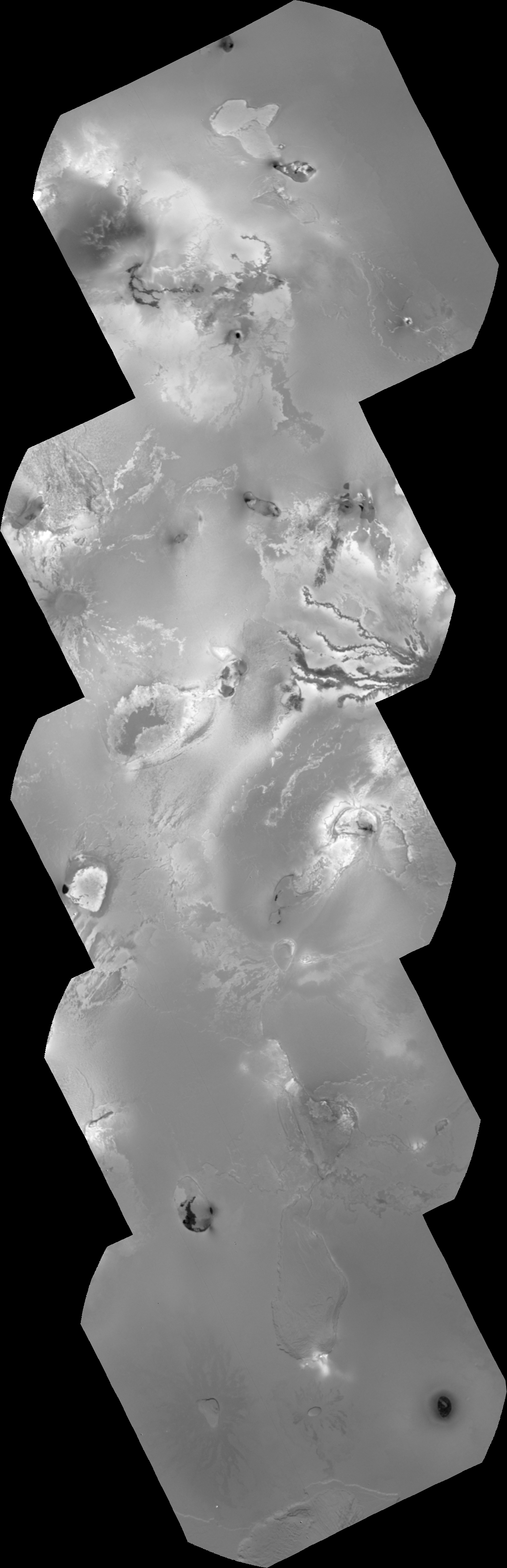
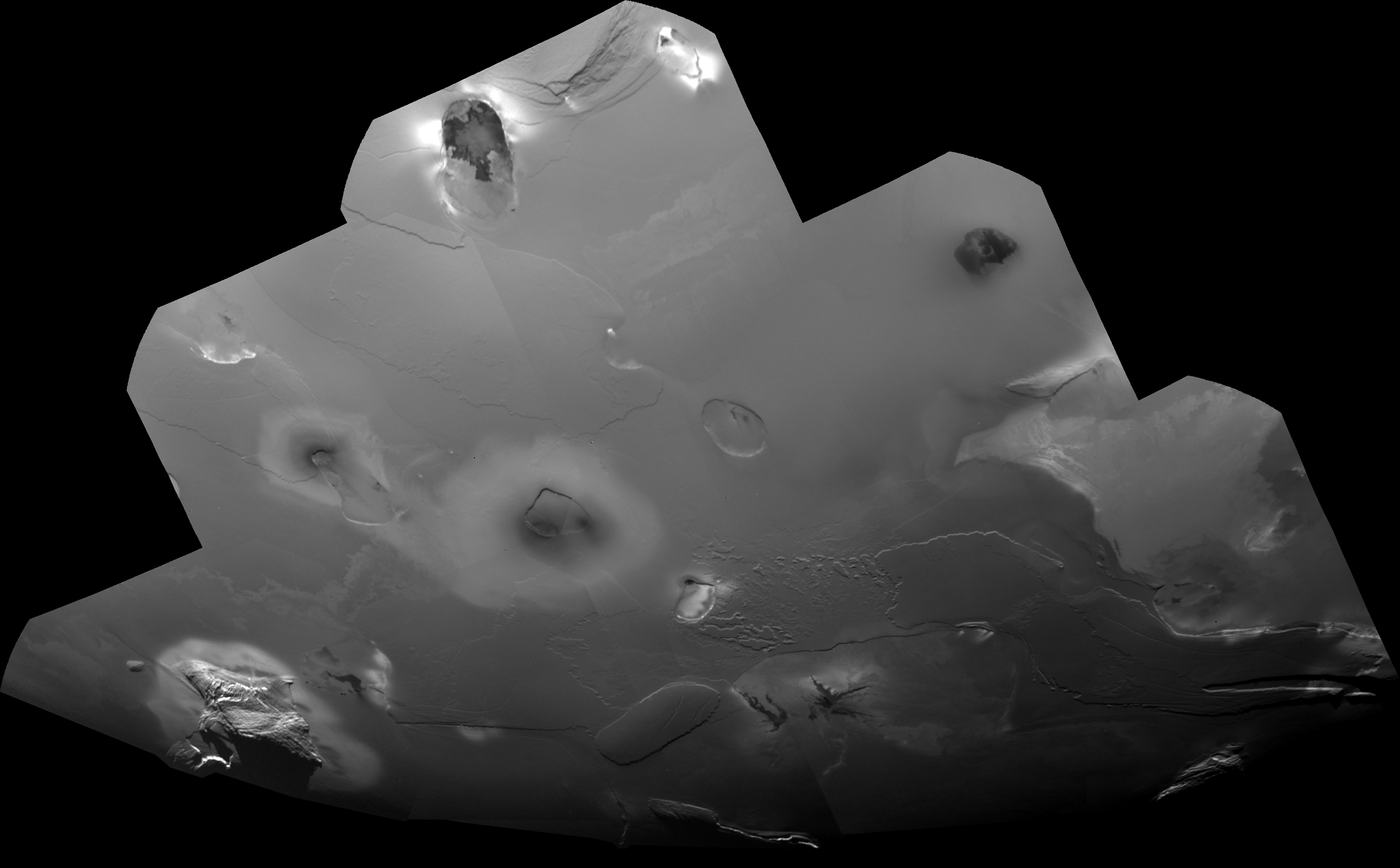
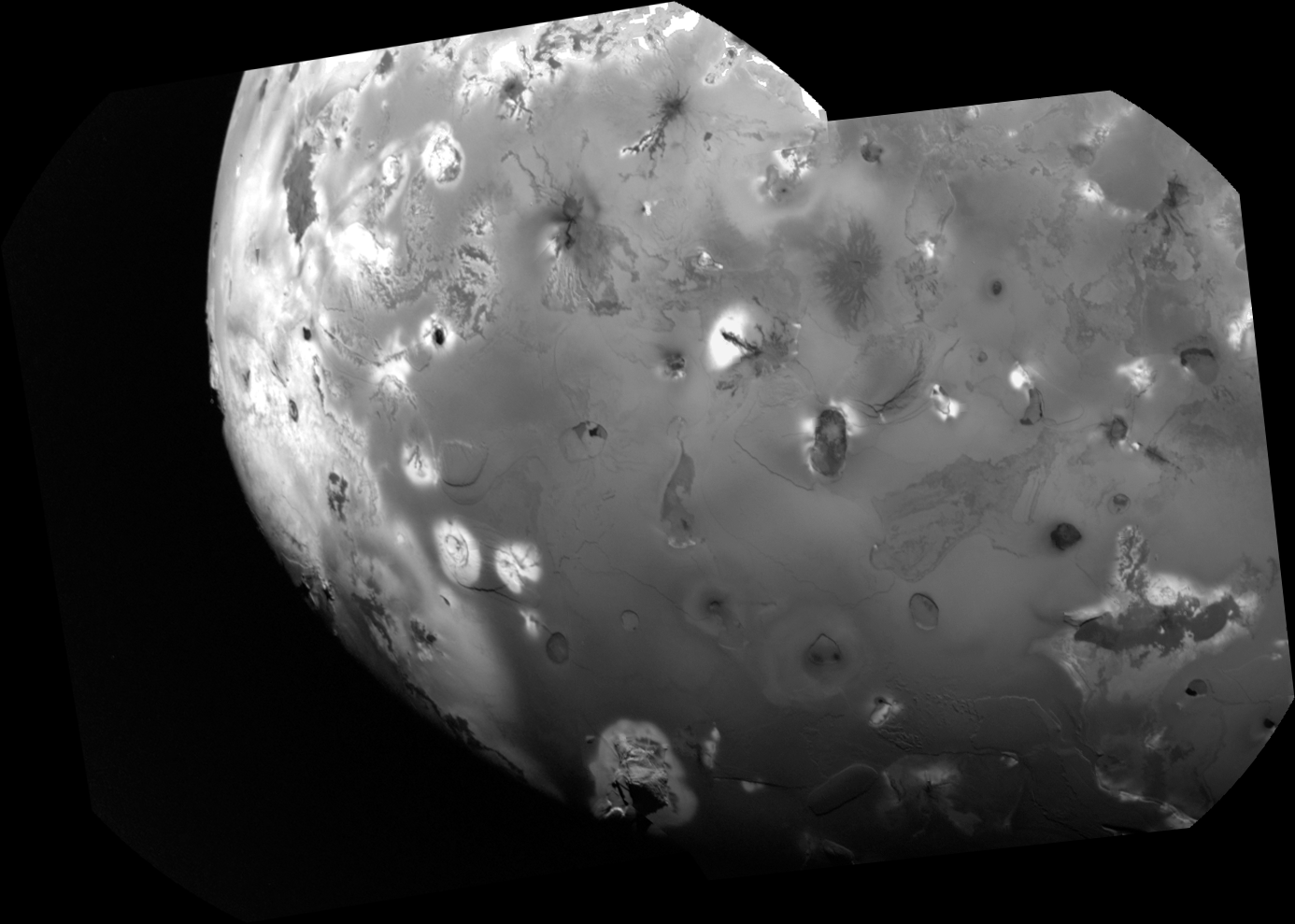
The first mosaic uses images acquired as support imaging for the Photopolarimeter Subsystem on Voyager. The PPS acquired a north-south scan across the center of the disk to measure information about Io's surface texture and bond albedo. Click here to see the ISS-NA mosaic at full-resolution. This mosaic runs from Acala Fluctus, across the flows that radiate out from Ra Patera, Kava Patera, and ends on the northern flanks of Euboea Montes. This mosaic cross high-sun terrain, so albedo markings are emphasized over topographic shading, though some mountainous features, such as Iopolis Planum and Euboea Montes, both in the bottom frame, can be seen. This mosaic has a resolution of 610 meters per pixel.
 The second mosaic uses images that were part of a high-resolution mosaic design over the south polar region of Io. Click here to see this ISS-NA mosaic at full-resolution The terrain here is much closer to the terminator, so more topographic features are clearly visible. For example, several tall mountains are visible along the terminator, the line between day and night, including Haemus Montes at bottom left. Some of the low plateaus visible, such as Echo Mensa (the rounded rectangular mesa at center bottom) and the western part of Nemea Planum (to the northeast of Echo) appear eroded, potentially from sapping of Sulfur dioxide, though no evidence of recent sapping, like bright material along the base of the low cliffs at these features, is visible. Such evidence can be more clearly seen at the eastern end of Nemea and in a fracture to the west of Echo.
 The final mosaic consists of two, violet-filter wide-angle camera images acquired during Voyager 1's closest approach to Io. Click here to see this ISS-WA mosaic at full-resolution. These two images show similar terrain to the other mosaics I've posted here in the last few days, but what makes these images exciting to me is what you can see along the limb on the left side of the mosaic. This region shows feature that I had thought had only been seen at much lower resolution. These images have a pixel scale of 2 km/pixel, whereas the previous best I could find has a resolution of around 9.5 km/pixel. So obviously, this appears to be a significant improvement. Among the features visible is the Masubi flow field (at lower left, also see the cropped image at the top of this post), a semi-persistent volcanic plume source. This feature is notorious for having plumes that jump around along the length of the flow field as well as having plume with multiple source vents (such as during the Voyager 1 and New Horizons encounters). In this mosaic, you can see a plume deposit around the main vent, a V-shaped flow field (not quite sure where the source patera, but I have an idea). There appears to be a disconnect between the flow to the south and the main V-shaped field, not sure how real that is, or if the flow connecting the two was quite narrow, akin to the connection between the Amirani and Maui flows fields. These WACs seem to close the notorious gap between the Voyager and Galileo high-resolution coverage that existed between 40 and 60 West, at least south of the equator, which I am excited to see.
Tomorrow, I will close out my coverage of the 30th Anniversary of the Voyager 1 flyby by looking at the post-Voyager perspective on Io and how it compares to our view now.
Subscribe to:
Posts (Atom)


 Posts
Posts