The 139th edition of the Carnival of Space, a weekly series highlighting the best in the astronomy and space blogosphere, is now online at Mama Joules, a kid-friendly astronomy blog. You know the drill. Some great posts on orbital terminology, the premature reports of Spirit's demise, and early reports of the President's NASA budget for FY2011. Gotta love the white board drawings illustrating the concepts of "gravity" and "flyby".
Speaking of the President's NASA budget for FY2011 (10/2010-10/2011), it was released today and a number of my fellow bloggers have commented about it including Van Kane and Phil Plait. For information from the horse's mouth, check out this presentation from the NASA website, the NASA FY2011 factsheet from the Office of Management and Budget website, and the more detailed budget breakdown on the OMB site (though its breakdown is less helpful, IMHO). For me this budget is a mix of good and bad. Let me be clear there is a lot of good in this budget, though of course that assumes you trust the out-year budget estimates... I like the precursor mission concept. This could put some of the Mars, Moon, and near-Earth asteroid exploration from the Science Mission Directorate to the Exploration one, increasing the amount of money available for other targets. The budget increases for space technology and extends the lifetime and capabilities of the International Space Station, which I support. While the space station wasn't very popular when it was started, now that it is near complete, the ISS represents an important asset in space and we should use it for as long as we possibly can. The ISS should be in use until we are basically holding the thing together with duct tape, a la the Mir space station. The earlier plan to abandon the station in 2016 would have turned the ISS into an even larger waste of money.
Finally, the planetary science budget, which controls how much money all of your favorite missions in progress (Cassini, New Horizons, MER, MRO) and in construction (EJSM) get, increases by $140 million in FY2011 compared to this year's budget. Looking at the out-year projections, the budget could increase by a $164 million between FY2011 and FY2015, but again, out-year projections are generally just guesstimates of future budgets, and should be taken with a GIANT grain of salt. However, the NASA presentation does make it clear that they intend to use this money to restart Plutonium-238 production, essential for outer-planet missions, as well as continue operations for existing spacecraft like Cassini and funding for the Europa/Jupiter System Mission (EJSM).
Now, for the bad... The budget cancels the Constellation program which include new heavy-lift rockets like Ares and crew vehicles like Orion to replace the shuttle. This program was intended to support future manned missions to the Moon and Mars with a focus on long-term habitability as opposed to the Apollo-like short trips. This program will be replaced by a combination of funding for commercial ferries to the space station and technology development to get the technologies in place to go to the Moon. The good news is that this would shorten the time NASA would need to rely on Russia to get to the International Space Station following the Space Shuttle retirement from 5 years to 2-3 years with some cost savings. However, I am concerned that it will be more difficult to maintain the out-year budget increases for science if federalized manned spaceflight is cut, as NASA could lose some its protection from powerful senators from Texas and Florida. Then again, Constellation, with its payoff not coming for another five years, has always been a budgetary target, and it really comes as no surprise that Obama would cut it. After all, George W. Bush proposed it, and since he was evil, Constellation must be a bad idea... Wait, that makes no sense...
In conclusion, I like the budget increases we are seeing for the planetary science budget, particularly the restart of the plutonium-238 production (though that was also proposed last year by the President, but got shot down by Congress). However, I believe that the cancellation of Constellation and the move from a federal manned spaceflight program to a privatized one will make the projected out-year budget increases more politically vulnerable.
Link: Carnival of Space #137 [mamajoules.blogspot.com]
Link: NASA Fiscal Year 2011 Budget Estimates [www.nasa.gov]
Monday, February 1, 2010


Sunday, January 31, 2010
Io articles on Wikipedia
 This evening between rounds of Modern Warfare 2, I thought I would get some Wikipedia editing in. Over the last week or so, I've been working to improve some of the Io-related articles on the site. The primary article on Io is already a featured article on the website, as is Volcanism on Io, both of which I worked to bring it up to the state it is in along with some great editors in the Solar System Wikiproject in 2008.
This time around, I've been focusing on individual articles for some of the more important surface features on Io, those with plenty of sources for use as references. To support this effort, I improved the lists of Ionian surface features to include additional information such as mountain height and whether activity has been observed at each named volcano or lava flow. You can check out the lists for bright regions, volcanic features, and mountains to see those improvements.
This evening I created articles for Masubi and Tupan Patera. These should be fairly comprehensive with appropriate images for both, particularly Masubi. In the last year, I also created articles for Surt, Prometheus, Pele, and Amirani, with the latter two definitely in need of improvement. I certainly welcome others to join in on this effort. Keep in mind that for many internet users, Wikipedia articles come up first in Google searches for many topics, and they will be seen as the first and last source of information on some topics. I believe it is important that this information is as accurate, comprehensive, and well-sourced as possible. My list for which volcano articles are most important for updating or starting can be found on the Io article's talk page.
Saturday, January 30, 2010
LPSC 2010: Determining Volcano Eruption Styles from Infrared Spectra
 For the last two weeks, we've been looking at the Io-related abstracts for presentations at this year's Lunar and Planetary Science Conference. Today we will look at a presentation titled "The Thermal Signature of Volcanic Eruptions on Io and Earth - Implications for a Future Mission to Io" by Ashley Davies, Laszlo Keszthelyi, and Andrew Harris. This paper will be presented as a poster at the Igneous and Volcanic Processes session on Thursday, March 4.
In this poster, Davies et al. will present a method for determining the eruption style of a volcano based on the near-infrared spectrum of the volcano taken from space, either a satellite observing the Earth or spacecraft or ground-based observations of Io. This is done by examining the shape of near-infrared spectra taken of a volcano between two and five microns, the slope of this spectra between these two wavelengths, and how the shape and slope of the spectra change with time. This methodology allowed the research to differentiate between insulated flows and lava lakes on Earth. Extended to Io, the authors were able to predict based on spectra with a low-spatial resolution the eruption styles at a number of volcanoes such as Pele and Prometheus that was also confirmed, this time using higher-resolution observations later in the Galileo mission.
 In the case of active lava lakes like Pele, they found that the ratio between the power output at 2 microns and 5 microns to be near unity. As active lava lakes this makes sense as there is a fixed amount of terrain (remember, the lava lakes are bound by the patera margin) covered with cooling lava that is renewed with fresh lava on a regular basis. So the power output at the two wavelengths is about the same. For insulated flows, there are generally small areas where fluid lava is exposed at the surface both at the source vent and at the active flow lobe. The vast majority of the insulated flow is covered by cooling lava whose thermal emission is concentrated at longer wavelengths like 5 microns, compared to the hotter vent and flow front, whose thermal emission will be concentrated at shorter wavelengths, like 2 microns. So, for insulated flows like Prometheus and Amirani, the power output at 5 microns is greater than at 2 microns. The ratio between 2 microns and 5 microns decreases as eruption intensity decreases. Interestingly, many paterae have a similar signature, but it is not known if this due to these paterae, like Tupan, Malik, and Hi'iaka, being more quiescent lava lakes than Pele or due to insulated flows on the floor of these volcanoes.
Eruption style can also be determined by monitoring how the spectra of these features can change with time. The authors in the abstract highlight research into the Pillan eruption. In that case, the first near-IR observations of Pillan revealed a 2μm/5μm ratio near unity, suggesting a rigorous eruption with lava fountaining and open channel flows. As the eruption progressed, its total power decreased as did the 2μm/5μm, show the shutting down of the fountaining and an increased area of the cooling flow. A similar eruption progress was seen at an outburst in 1990, though in that case, along with other outburst eruptions like Surt in 2001, the 2μm/5μm ratio was actually greater than 1 initially, suggesting an initial phase of very vigorous lava fountaining with only a small area of emplaced lava at that point in the eruption.
Finally, the authors suggest ways to apply this methodology on a future mission to Io. They suggest including filters at two and five microns in a thermal mapper in order to directly apply their method. They also suggest two at longer wavelengths such as 8 and 12 microns to further constraining the amount of cooler lava flows that are older than those that would detected at 5 microns. They also suggest that observation often enough to detect changes in eruption style or thermal emission that would further constrain that style, like a vigorous outburst eruption that starts out with high thermal emission at short wavelengths, then cools down as the eruption shuts down or changes to an insulated flow style, like Thor. The authors do point out that this type of analysis can be done at low-spatial resolutions, so regular observations would not need to be conducted just during Io flybys.
Link: The Thermal Signature of Volcanic Eruptions on Io and Earth - Implications for a Future Mission to Io [www.lpi.usra.edu]
Friday, January 29, 2010
LPSC 2010: Heat Flow from Dark Paterae Floors
 Last Wednesday, the abstracts for this year's Lunar and Planetary Science Conference were posted online and since then I have been discussing a few of these abstracts here on this blog, including ones on the new global geologic map to the stability of patera margin slopes. Today we are going to take a quick look at an abstract by Glenn Veeder, Ashley Davies, Dennis Matson, Torrence Johnson, Dave Williams, and Jani Radebaugh titled, "Io: The Dark Paterae Component of Heat Flow". In this abstract, the authors discuss new thermal modeling work based Galileo NIMS, SSI, and PPR infrared data and the USGS global basemap. This modeling was done to determine the contribution to Io's heat flow made by dark material on the floor of volcanic depressions known as paterae.
Io's total heat flow, ~9.5×10¹³ W, has been measured from disk-integrated, ground-based IRTF data along with incomplete global data from Voyager IRIS and Galileo PPR. Galileo's SSI camera and NIMS near-infrared spectrometer acquired more complete global data (except over the polar regions), providing information on current or recently active volcanoes, but most of Io's heat flow is released at much longer infrared wavelengths from cooling lava flows, wavelengths IRTF, IRIS, and PPR were sensitive to. To inventory how Io's internal heat is released, the authors created a thermal model to estimate the amount of total energy released by volcanoes that are either outside of the terrain covered by IRIS or PPR, or were too small for those instruments to detect. In 2008 and 2009, this same group examined the contribution to Io's total heat flow from dark lava flows on the plains of Io (e.g. Amirani), both at LPSC in March 2008 and in a paper published in November 2009.
 For this research, the authors mapped the distribution of dark paterae floor materials across Io's surface and measured their areas. In total they found a total of 148,000 square kilometers, which is about 0.4% of Io's total surface area or a little less than the "dark patera floor" unit mapped by Williams et al. The authors found that the distribution of dark patera floor material has a similar bimodal distribution in longitude (with peaks near 130° W and 315° W) as paterae in general.
Of the total mapped area, 30,500 km2 are composed of a combination of Io's two largest dark floored paterae, Loki Patera (shown above) and Dazhbog Patera. The authors then took the areas of this dark patera floor material and using an effective temperature of that material, estimated their total power output. The total average power output of these two volcanoes was modeled to be 9.6×10¹² W and 4.0×10¹² W, respectively. In the case of Loki, this is 10% of Io's total heat flow. Both modeled power outputs are close to the measurements made by PPR. The other areas of dark paterae floor material account for six times that seen at Loki Patera, Io's most powerful volcano.
The abstract is part of research into how Io's internal heat is released, i.e. what heat sources make up Io's global heat flow. Assuming the same effective temperature for all these materials as Loki, dark paterae would account for 70% of Io's total heat flow (compared to 5% for dark flow fields on the Ionian plains like Masubi or Amirani). This makes dark paterae floor materials the most significant contributors to Io's heat flow.
Link: Io: The Dark Paterae Component of Heat Flow [www.lpi.usra.edu]
Thursday, January 28, 2010
Io Maps from Galileo orbits G7 and I32
 As I mentioned yesterday, one of the little side projects I have been working on has been to create color maps of Io for each Galileo orbit we have color data from (though I did create a clear filter map from C3). This would allow for easier comparisons between Galileo orbits of Io's surface changes (though note that Io has some funky phase angle brightness changes between different regions on the surface that can complicate matters).
This evening, I finished the maps for G7 (April 1997) and I32 (October 2001). The other maps can be found by browsing my Galileo Images of Io website. With these two maps, I have expanded the cutoff I use to trim the images in both incidence angle (an angular measure of distance from the sub-solar point) and emission angle (an angular measure of distance from the sub-spacecraft point). So these new maps show features a little closer to the terminator and limb, respectively, than before. I think the numbers I am using now for the lunar-lambert function seem to be a better fit than what I used before, making this possible (basically 0.2 above what I would have used before).
I think this is the last pair for a little while. Cassini is really starting to heat back up again with data coming down in a few hours (sleep for me tonight will be a cat-nap really...) from encounters with Aegaeon (yes, Joe, those six pixels are what I am looking for the most...), Prometheus, and Dione. Later today we have a Titan flyby where ISS will be prime at closest approach for one of two times during the extended mission. So yeah... :-) I will try to get another post out about one of the LPSC abstracts later today if I have some time.
Link: Galileo Images of Io - G7 [pirlwww.lpl.arizona.edu]
Link: Galileo Images of Io - I32 [pirlwww.lpl.arizona.edu]
Tuesday, January 26, 2010
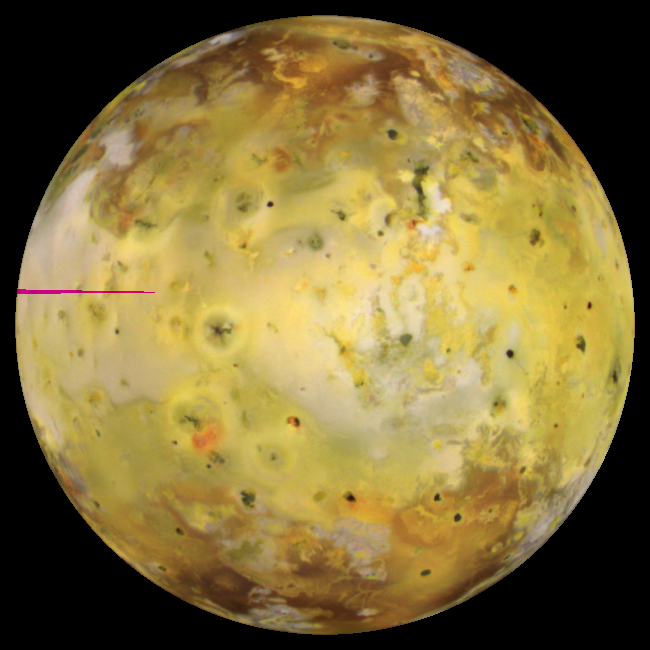
Io Maps from Galileo orbits E4 and E6
 Last year, I started a little project to create color maps of Io for each Galileo orbit there was color data. The intention was to make it was easier to illustrate surface changes by combining these maps into a single Photoshop file. Last January and February, I managed to get through G1, G2, C3, C9, G29, and I31.
Over the last two evenings, I've gone ahead and added two more orbits to the list: E4 and E6. These two orbits from the middle of Galileo's primary mission occurred in December 1996 and February 1997, respectively. The E6 map is particularly useful as it is one of the few orbits for which a nearly global map was acquired, though one of the observations, E6ISRA____01 had many of its color frames cut off.
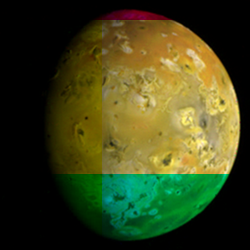
In addition to finishing these two maps, I also have two new reprocessed versions of a couple of observations: E4ISGLOCOL02 (shown above) and E6ISRA____01. While these both are processed to provide a view of Io in color that is not overly saturated, the E4 observation uses a near-infrared filter centered at 756 nm for red and a violet filter for blue, so the color isn't exactly what you would see with your naked eyes, but it is the closest you are going to get with this data set.
I hope these maps are at least interesting to some of you. Tomorrow evening, I will see about whipping up ones for G7 and I32.
Link: Galileo Images of Io - E4 [pirlwww.lpl.arizona.edu]
Link: Galileo Images of Io - E6 [pirlwww.lpl.arizona.edu]
Monday, January 25, 2010
Carnival of Space #138 and other news
The 138th edition of the Carnival of Space, a weekly series highlighting the best in the astronomy and space blogosphere, is now online at Nancy Atkinson's new blog. You know the drill. Some great posts the Mars rover Opportunity's latest travels, Martian dunes as imaged by HiRISE, and the Southern Cross from various exoplanets.
I also wanted to take this quick post opportunity to point a few other news items. There was a paper in Nature Geosciences titled, "Origin of the Ganymede–Callisto dichotomy by impacts during the late heavy bombardment," by Amy Barr and Robin Canup. I haven't downloaded this paper, but a great summary can be found at ScienceBlog. Essentially, they found that Ganymede's closer distance to Jupiter and thus being deeper in Jupiter's gravity well, led to more and larger cometary impacts than on Callisto early on in the history of the Solar System. These impacts helped to cause more complete differentiation on Ganymede by bring rock closer to the core and water closer to the surface. Fewer large impacts on Callisto meant that it was less differentiated. Today, Callisto has a more ancient surface with few signs of internal activity, while Ganymede has a convecting iron core producing an internal magnetic field and a surface covered in lanes of grooved terrain separating more ancient terrain.
Finally, there are a couple of new Io-related papers in press in the journal Icarus. The first is "A Comprehensive Numerical Simulation of Io’s Sublimation-Driven Atmosphere" by Andrew Walker et al. This paper details a new Monte Carlo simulation of the atmosphere of Io. The other is "Monte Carlo Modeling of Io’s [OI] 6300 Å and [SII] 6716 Å Auroral Emission in Eclipse" by Chris Moore et al. This paper will also look at modeling of Io's atmosphere. In this case, the authors are attempting to recreate observations of Io's aurorae, seen in eclipse in May 1997. Both these papers have associated LPSC abstracts so I will combine the discussion of them into one post in the next week.
Link: Carnival of Space #137 [noisyastronomer.com]
Link: SwRI researchers offer explanation for the differences between Ganymede and Callisto [www.scienceblog.com]
I also wanted to take this quick post opportunity to point a few other news items. There was a paper in Nature Geosciences titled, "Origin of the Ganymede–Callisto dichotomy by impacts during the late heavy bombardment," by Amy Barr and Robin Canup. I haven't downloaded this paper, but a great summary can be found at ScienceBlog. Essentially, they found that Ganymede's closer distance to Jupiter and thus being deeper in Jupiter's gravity well, led to more and larger cometary impacts than on Callisto early on in the history of the Solar System. These impacts helped to cause more complete differentiation on Ganymede by bring rock closer to the core and water closer to the surface. Fewer large impacts on Callisto meant that it was less differentiated. Today, Callisto has a more ancient surface with few signs of internal activity, while Ganymede has a convecting iron core producing an internal magnetic field and a surface covered in lanes of grooved terrain separating more ancient terrain.
Finally, there are a couple of new Io-related papers in press in the journal Icarus. The first is "A Comprehensive Numerical Simulation of Io’s Sublimation-Driven Atmosphere" by Andrew Walker et al. This paper details a new Monte Carlo simulation of the atmosphere of Io. The other is "Monte Carlo Modeling of Io’s [OI] 6300 Å and [SII] 6716 Å Auroral Emission in Eclipse" by Chris Moore et al. This paper will also look at modeling of Io's atmosphere. In this case, the authors are attempting to recreate observations of Io's aurorae, seen in eclipse in May 1997. Both these papers have associated LPSC abstracts so I will combine the discussion of them into one post in the next week.
Link: Carnival of Space #137 [noisyastronomer.com]
Link: SwRI researchers offer explanation for the differences between Ganymede and Callisto [www.scienceblog.com]
Sunday, January 24, 2010
LPSC 2010: Analysis of the new Io Global Geologic Map
 The next abstract we will take a look at is "Volcanism on Io: Results from Global Geologic Mapping" by Dave Williams, Laszlo Keszthelyi, Dave Crown, Paul Geissler, Paul Schenk, Jessica Yff, W.L. Jaeger. The authors completed a global geologic map of Io over the last few years in ArcGIS™ based on a basemap containing Voyager and Galileo created by the USGS. Their map has gone through peer-review, but has not been published online as far as I know (I'd love to be proved wrong though). Geomorphologic maps such as this global one can be used to determine the distribution of different terrain types across a planetary surface. Progress on this project was reported earlier at the last few LPSCs, including 2008 and 2009, as well as other other conferences like EPSC. This year's paper will be presented as a poster at the "Satellites and their Planets" session on Thursday, March 4.
 This year, the authors of the global geologic map will present statistical analyses of the units in the map, which include: plains, lava flows, paterae, mountains, and diffuse deposits. This involves looking at where certain units and sub-units are most concentrated and how different sub-units are correlated. As an example, they found that bright flow fields outnumber dark flow fields 3 to 2. These are considered the youngest flows on Io, composed of sulfur compounds and silicate basalt respectively. They note a concentration of bright flows at 45-75° N, 60-120° W, covered in the area shown at right. Williams et al. argue that this region might be indicative of extensive sulfur volcanism here in the past. An alternative explanation, particular given what happened at Thor (bottom center in the image at right, far right in the Thor link), would be that these flows are older silicate flows that have been coated with sulfur in falling from nearby plumes. While these flows are old enough to be completely coated and turn a bright shade of yellow, they are not old enough to have been converted to red-brown sulfur (S4) through radiation damage. So these flows stand out against the background plains, while at the equator, they might not have been as noticeable. Thus the process of a lava flow aging and becoming indistinguishable from the background might take longer at the poles than at the equator.
Comparing the distribution of Io thermal hotspots (indicative of volcanic activity) to terrain type, the authors found that 20.3% of hotspots are associated with dark flow fields, 9.3% with undivided flows (older mapped flows, like the ones at lower left in the color image above), 45.3% with dark patera floor material, 1.7% with bright flows, and 18.6% with other patera floor units. This matches with intuition that recent active volcanism on Io is dominated by silicates. One difficulty that would be interesting to see how they address are surface changes on Io over the course of the Voyager and Galileo missions, and between them. For example, hotspots associated with undivided or bright flows may well come from fresh dark flows that formed after the images used in the basemap were taken, as would be the case for Thor. Activity from Pillan in 1997 would also not be represented in the map since they don't appear in the basemap.
 In additional analysis, the authors found that lineated mountains tend to be taller than other mountain that show signs of mass wasting. This is as expected as mountains are thought to be uplifted crustal blocks that almost immediately begin to waste away. When looking at diffuse deposits, they found that these materials are dominated by condensed gas deposits from volcanic plumes as opposed to pyroclastics, the latter normally associated with transient outburst-class eruptions, like Pillan or Thor, though some pyroclastic deposits seem to be more permanent around some volcanoes like Pele and Babbar. Finally, they note that white plains, composed of sulfur dioxide ice fields, are mostly concentrated along the equator on the anti-Jupiter hemisphere in regions such as Colchis Regio, Bosphorus Regio, and Bulicame Regio. They suggest that this region might be a colder region of Io's surface, possibly due to differences in magma sources, delivery mechanisms, and crustal thickness, but I wonder if runaway thermal segregation, the kind seen on Iapetus, might be a possibility.
In this abstract, Williams et al. once again take a look at the global geologic map the group has created over the last few years, attempting to use the map to determine correlations between different surface units and other Io data, such as mountain height and volcanic hotspots. Hopefully, sometime in the next year, the map will be officially published, like the Ganymede map was last year.
It's Not Easy Being Green: The Chaac Patera Story
 Thursday morning, I posted a newly reprocessed version of a two-frame mosaic of a portion of Chaac Patera. At the time it was a bit too late in the evening to do are more extensive writeup on the geology of the scene and that of the other three images in the observation, 27ISCHAAC_01, so I thought today I would explore this interesting data set with all of you. I should point out that this discussion is a mix of summaries of published analysis of this observation and my own thoughts from look at these images during the last couple of days. In this post, we will take a look at the different types of geologic landforms shown in this observation, paying particular attention to three questions: Is the upper few kilometers of Io's lithosphere layered (and what are these layers composed of), how did Chaac Patera form, and why is Chaac Patera green?
Chaac Patera and the images of it
Chaac Patera is a volcanic depression 475 kilometers north of Prometheus on Io's anti-Jupiter hemisphere. A lower resolution image of Chaac Patera from I27 (combined with color from C21) is shown above along with its context on Io. By chance, it is also the volcano in this year's blog header up at the top of this page. The volcano is 80 by 40 kilometers in size and is inset into a larger depression on the eastern side of a low plateau. There is another depression in the plateau to the southeast of Chaac named Balder Patera. This floor of Balder is covered in bright material that NIMS found to be nearly pure sulfur dioxide ice. The patera is notable for its distinctive green floor, with darker green shades on the northern end, lighter shades in the middle and southern parts of the patera. The edge of the patera is marked by much darker or brighter material in places. The Galileo NIMS spectrometer found a thermal hotspot at the southern tip of Chaac.

What Chaac's walls tells us about how it formed
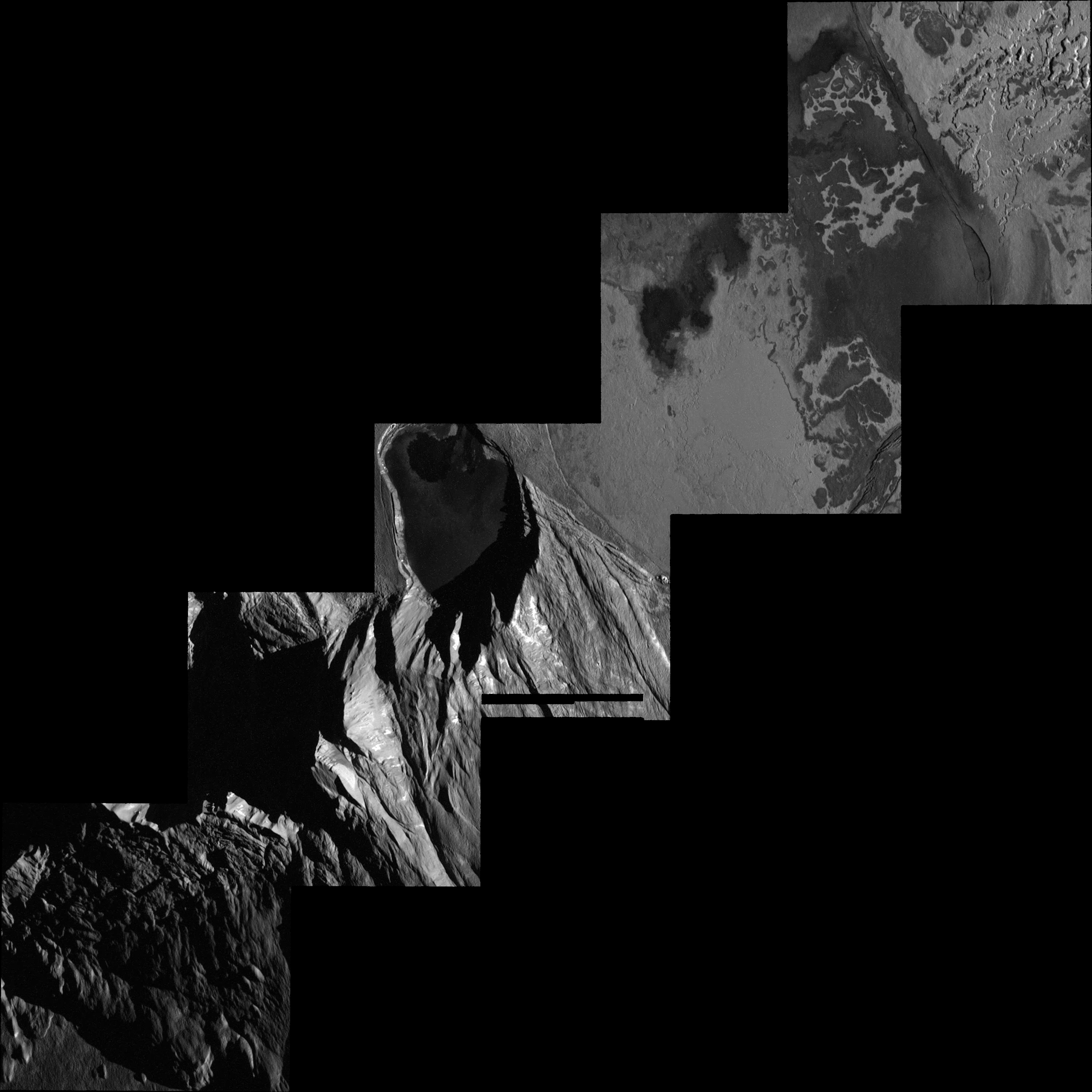
 Before we examine these five images in more detail, let's ask the four questions I said at the beginning again, just to refresh our memory: Is the upper few kilometers of Io's lithosphere layered? What is the upper few kilometers of Io's lithosphere composed of? How did Chaac Patera form? Why is Chaac Patera green? As I will attempt to show in this analysis, these questions are directly related. Let's first tackle the structure of the upper part of Io's lithosphere first because I think this one is the easiest to answer. Let's take a look at three areas where this question can be answered. In frame c0539932065r (the far left frame), the talus apron at the base of the Chaac Patera margin has two albedos, a lower bright unit and an upper dark unit. This would indicate that there are at least two compositional units within the wall that has resulted in mass wasting of the slope. Looking further south along the shadowed slope itself, we can see a few cases of 50-meter thick bright layers along an otherwise darker slope. The final observation of layers within the wall of the patera come from the opposite margin along the bottom of the frame c0539932165r on the far right end of the montage above. The top of this margin has a very different texture than the eastern margin. Instead of brighter hills on top of a dark background, we see a mostly brighter surface crossed by E-W trending scarps dipping to the south. The terrain just above and below each scarp is darker than the rest of the plateau. Finally, there some of the bright material is eroded between some of the scarps, producing what look like dark channels running between the scarps. Finally, the bright material along the edge of the scarp seems to have been removed, leaving behind the darker material.
These three areas appear to indicate that the upper 2-3 kilometers of Io's lithosphere, at least in the area around Chaac, is layered, with inter-bedded bright and dark material. So what is the composition of these layers? The bright layer is presumably sulfur dioxide ice. This is supported by the albedo of these areas in regional scale images, which is comparable to Balder Patera, which has been determined by NIMS to be an area of SO2 ice. This is also supported by the differential erosion between the bright and dark layers on the western margin. The bright materials seems to be more easily eroded, probably thermally, than the dark material, which fits with SO2 likely lower melting point than the dark material. So what is the dark material? The two most likely compositions are basalt (cooled lava flows) and cold sulfur. From the fractures in c0539932165r we can tell that the dark material deforms brittlely. Both materials could do so. This dark material is too small to see in the lower resolution 27ISCAMAXT01 observation or in C21 color data (1.3 km/pixel), so it may be impossible to identify the composition of the dark material uniquely.
The fact that we see both materials, or at least the SO2 ice, thermally eroded in at least one area of the patera margin, does support the current prevalent model for patera formation, that paterae represent areas where sills (shallow magma bodies that form parallel to preexisting strata or the surface) have been exhumed by the removal of the material above it. This model was presented in a paper by Keszthelyi et al. in 2004. In another paper by this group in 2001, they suggested that the dark material flowed out of the scarps as fissure-fed flows, which might explain the channels leading downhill from some of the scarps. Darker plateaus just beyond the bright margin on the floor of the patera might areas that haven't been exhumed completely yet, while the bright area at the bottom of c0539932165r may still be undergoing that exhumation process. The same could also be said of the shelf along the bottom of the eastern part of the patera wall (in c0539932065r and c0539932078r).
Volcanism
 Finally, I want to look at volcanism on the floor of Chaac Patera as well as answer the question, Why is Chaac Patera green? The floor of Chaac Patera is covered with inflated, darker silicate flows with brighter material filling in the valleys. This is particularly seen in c0539932139r and to some extent in the images on either side of it. Keszthelyi et al. 2001 suggested that this is the result of a bright, low-viscosity liquid (presumably SO2) seeping into the low regions between flow lobes. The sources for flows on the floor seem to be along the margin of the patera. In the last frame, c0539932165r, there is a dark depression that runs parallel for much of the southwestern margin of the patera. Keszthelyi et al. 2001 interprets this feature as a drainage pit. Many of the flow-like features on the floor of Chaac Patera appear similar to those found in terrestrial shield summit calderas, such as at Kilauea.
 Along the northeastern edge margin, we see thinner volcanic flows, but we also see clearer evidence for sulfur volcanism. Near the center of the image at left, there is a cooled silicate flow that erupted from a small vent along the base of the patera marginal shelf. To the left and right of this vent, on top of the shelf, are bright deposits. I would argue that these two bright patches are deposits from fumeroles along the shelf margin. Fumeroles (or more specifically in this case, a solfatara) are vents that emit gases exsolved from a magma or lava body, in this case sulfur dioxide. These gases left a deposit of bright material on the shelf, which is above the plane of the patera floor proper by a few dozen meters. The fumerolic activity at this vent may have ceased quite a while ago, as there is no bright deposit from this vent on top of the lava flow, suggesting it is younger. To the right of this vent, we see a pair of bright flows on top of the cooled lava floor of the patera, below the margin shelf. These flows are likely have a sulfur dioxide composition. It is unclear from this observation if these are primary SO2 flows, or if they are secondary flows activated by the heat of the nearby silicate magma chamber. I think the close proximity of the solfatara and these flows, and the fact that silicate lava seem to be using the same vents, would suggest the latter. There is another possible example of a sulfur flow to the lower left, below the talus apron, but the morphology of this material is less clear.
The close proximity of both silicate and sulfur flows and deposits, often using the same vents, the fact that Chaac still seems to be forming with SO2 melting/sublimating from its walls, would suggest that the theory that the green color is the result of sulfur contaminated by iron from still warm magma would be correct. However, rather than sulfur falling on the lava from plumes necessarily, it may have come from still melting sulfur as the sill finishes up being exhumed.
Conclusions
To sum up this discussion of Chaac, I want to run down some of our conclusions about this volcano from the high-resolution data Galileo acquired almost 10 years ago. First, the observation support the presence of at least sulfur dioxide and some dark component forming thick layers within the upper few kilometers of Io's lithosphere. Without color information, it is impossible to say what the dark component is composed of without some modeling of the processes observed. It could either be silicate basalt rock or cold sulfur. These observations seem to support the model that Chaac (and perhaps most if not all Ionian paterae) form from the exhumation of a magma sill, with heat from the sill melting or sublimating sulfur and sulfur dioxide above it (perhaps supporting the possibility that the dark material is sulfur). Finally, there is nothing to argue against the current theory that the green color of Chaac's floor is caused by sulfur becoming contaminated by iron from the cooled basalt lavas, though I would argue that the source of the sulfur is the material that is still being exhumed above the sill, not so much from sulfur depositing on top of the lava flow.
I hope this rambling exploration of this Ionian volcano was at least enlightening, or at the least comprehensible. Hopefully, this will get Chaac out of my system so I can get back to what's more important for me right now, playing Forza Motorsports 3...
Friday, January 22, 2010
LPSC 2010: The Stability of Io's Paterae Walls
 The abstracts for this year's Lunar and Planetary Science Conference are now online. LPSC is one of the largest planetary science conferences of the year, along with DPS in the fall and AGU in May and December. This year's Io presentations will be a diverse bunch with mission concepts, geologic mapping, and plume modeling, and statistical analyses of Ionian landforms.
The first LPSC abstract I want to discuss here is titled "Paterae on Io: Insights from Slope Stability Analysis" by Laszlo Keszthelyi, Windy Jaeger, and Chris Okubo. Keszthelyi will present this paper as a poster on Thursday, March 4 at the Satellites and Their Planets session. In this presentation, the authors uses the slopes of Io's volcano-tectonic depressions, also known as paterae, to probe the properties of the upper 2-3 kilometers of Io's lithosphere. A nice example imaged by Galileo is Tupan Patera, shown at left. Keszthelyi et al. use slope stability analysis to constrain the potential composition of the upper part of the lithosphere by using observed slopes on Ionian paterae, which is related to the strength of that material.
While Io's lithosphere is dominated by cooled lava flows that have stacked one on top of another, the upper few kilometers are thought to be a mix of sulfur and sulfur dioxide ices intermixed and layered with layers of basalt. These ices are volatilized by shallow magma chambers and magma conduits and mixed with ascending magma below those first few kilometers. Generally though, the upper 2-3 kilometers, according to Jaeger and Davies 2006, would be dominated by sulfur and sulfur dioxide ices. This process leads to a density gradient in Io's lithosphere, with the least dense material near the surface with density increasing with depth (just how much it increases depends on the resurfacing rate).
 Keszthelyi et al. tested three possible compositions: basaltic rock, solid sulfur, and unwelded ash (as would be expected from a pyroclastic deposit). The slope they tested in the program Slide was the 2.8-kilometer margin of Chaac Patera shown at right. The right part of the cliff in this image has a slope of 70° based on measurements of the shadow at the cliff base. Their slope stability analysis tested whether the above compositions can support this kind of steep slope. They determined that the slope could not be supported by unconsolidated material, like unwelded ash, as these would collapse to the angle of repose (like the talus apron you see at the cliff base on the bottom left part of this image).
Such a steep cliff would be okay for cold sulfur or basalt. The authors note that without more detailed slope profiles (see, we need the laser altimeter and radar instrument on JEO), they can not distinguish between the two compositions. In general, based on the abstract's Figure 2, slopes composed of cold sulfur would have more concave profiles (steeper at the top than at the bottom) than those composed of basalt.
One additional point that Keszthelyi et al. makes is that these slopes (regardless of composition) could not withstand Ioquakes greater than a moment magnitude of 4. For comparison, last week's earthquake in Haiti had a moment magnitude of 7. This goes against intuition a bit when you see the height of Io's mountains and how quickly these structures are built, not to mention Io's intense volcanic activity, which could cause tremors as well. The authors note that this contradiction would be resolved if the stress on Io's faults is relieved by daily tidal flexing, rather than in massive earthquakes, as they are on Earth. They also point out that Windy Jaeger's work on tectonics in Io's lithosphere in 2003 suggested that the "globally-averaged stress level in the crust is close to the sliding friction of the faults." Put together, stress on Io's faults, rather than building up slowly over time until released on a sudden jolt, are relieved on a regular basis in much smaller events, small enough that they are not a major factor in the degradation of Ionian paterae wall slopes.
 I want to return for a second to that image of the margin of Chaac Patera. I have re-posted it here, this time with annotations. I am definitely going to do another post on this thing, maybe later today, because it really is just freaking awesome to finally understand what is going on here (hint, I am now a firm believer of sulfur volcanism on Io...). Anyways, let's stick to analysis specific to our discussion here, the stability of the Chaac Patera margin. Now, the 70°-slope section can be seen on the right side, with very little loose material at the bottom of the slope. In fact the patera floor at the bottom of that slope looks like asphalt pavement (not saying it is, just that it looks that smooth at this scale, ~7 meters per pixel). On the bottom left and the far upper right ends, we see a change in slope, the result of talus — loose debris at the base of the cliff at about the angle of repose (we'll leave the two-tone talus discussion for tomorrow). So what makes these sections different from the more stable middle? It is a little more difficult to tell in the upper right corner because of the data dropouts and the edge of the frame, but to the lower left we see section of the wall that have broken away from the upper plateau and slumped down hill. The likely cause of this slumping seems to be local faults that run parallel to the margin of the patera, best seen at the top of the image. These suggest that Chaac Patera is continuing to expand due to continued collapsing along the patera margin. We see examples of this kind of faulting at other Ionian Patera, such as Gish Bar Patera and Radegast Patera. Regardless, while it would seem that some patera wall slopes eventually succumb to slope failure (note the terracing along some sections of the margin of Radegast Patera), many observed paterae slopes show no sign of mass wasting like talus aprons or terracing and thus require strong material like cold sulfur ice and/or basalt to hold up these steep slopes.
Keszthelyi et al. will present an interesting paper on the geology of Ionian volcanoes in March at LPSC. Definitely check it out if you are going to that conference.
Thursday, January 21, 2010
Science: Io's Induced Magnetic Field and Mushy Magma Ocean
 Back in October, I pointed out the then-recently released abstracts for December's Fall Meeting of the American Geophysical Union related to Io. Out of all the planned talks, the one I was most excited about was one by Krishan Khurana et al. titled, "Evidence of a Global Magma Ocean in Io Revealed by Electromagnetic Induction." Unfortunately, I was not at the AGU meeting so I couldn't report on this talk here on the blog at the time. However, Richard Kerr of Science Magazine was, and in Friday's issue of the journal, he delivers several reports on presentations given at the meeting, including Khurana's talk.
The question of a magnetic field on Io had been a vexing one for Galileo scientists on the magnetometer team. On December 7, 1995, Galileo performed its only Io flyby of its primary mission as the spacecraft approached its Jupiter Orbital Insertion maneuver. While remote-sensing instruments like the camera were turned off for the pass, the gravity data and fields-and-particles instruments provide a wealth of data. This data showed that Io had an iron- or iron-sulfide core that was 36-52% of Io's radius in size. While magnetometer data from the encounter was originally thought to be consistent with an intrinsic magnetic field at Io, however the low resolution of the data acquired precluded scientists from distinguishing between an intrinsic field, an induced magnetic field (precluded by Kivelson et al. 1996 due to the lack of free iron in Io's mantle), or interaction between Jupiter's magnetosphere and Io's extended ionosphere. The two polar flybys during the Galileo Millennium Mission (I31 and I32) were used to distinguish between these alternatives. This data showed that there was no intrinsic magnetic field at Io, perhaps resulting from an iron core that has no convection currents to generate an internal dynamo (at least a dipole anyway, higher-order fields were NOT ruled out).
Fast forward to last month's conference. According to Richard Kerr, Khurana looked back at Galileo magnetometer data and used a magneto-hydrodynamic model of the interaction between Jupiter's magnetosphere and the material surrounding Io in order to remove that interaction's signature in the magnetometer data. When they did this for the data from one Galileo's encounters with Io, what appeared to be the signature of an induced magnetic field remained. When they took a look at data from another Io flyby, they found that the poles of the magnetic field had flipped, as would be expected if there was an induced magnetic field at Io.
 So what could create an induced magnetic field at Io? Induced magnetic fields are created when a time-variable magnetic field sweeps through an electrically-conductive material, like the briny water oceans of Europa, Ganymede, and Callisto. Jupiter's magnetic field is tilted with respect to Io's orbital plane, so at times Io is above or below the normal plane of Jupiter's magnetic field. The time-variable magnetic field produces electrical currents within the conductive material, which produce a magnetic field through induction. The direction of this current changes twice each Jovian day (remember, the magnetosphere is co-rotational with Jupiter, even at the distance of Io), causing the poles of the induced field to switch twice each Jovian day.
For the icy Galilean satellites, the conductive material is salty water, but what about Io? Khurana in his talk said that the data was consistent with a silicate magma ocean 50 kilometers beneath the surface. In order for an induced magnetic field to be produced, this ocean must be global or nearly so, though David Stevenson points out in a quote in the article that the depth and level of partial melting of this ocean don't seem to be uniquely determinable in the current data set. To do so would require a new mission to Io. Keep in mind that Khurana is also the head of the magnetometer group in the Io Volcano Observer proposal. A magma ocean (at least a mushy one with a large crystal fraction) was suggested by Laszlo Keszthelyi, Alfred McEwen, and G. J. Taylor in 1999 based on the very high temperatures thought to exist at some of Io's volcanoes, such as Pillan and Kanehekili, based on Galileo SSI eclipse results. Their models suggested 25-65% partial melting in Io's upper mantle in order to support the eruption temperatures observed (think of slushy magma). However, a re-evaluation of this same SSI camera data in Keszthelyi et al. 2007 reduced the estimates of the eruption temperature of Io's lavas, reducing the amount of partial melting required to 20-30% liquid in a mechanically weak asthenosphere, consistent with tidal heating models. Kerr's article does not mention whether this new magnetometer analysis is consistent with that lesser amount of partial melting or if more would be required.
Certainly a very exciting result, and I look forward to the paper to see what Khurana et al. has to say about what limits their analysis places on the amount of partial melting would be required to produce this magnetic field. This result also shows that a magnetometer on a future Io mission is a requirement, not just for understanding the near-Io environment of Jupiter's magnetosphere, but also to understand Io's interior structure and to provide another data point for the amount of partial melting is needed in Io's asthenosphere beyond tidal heating models and eruption temperatures.
Link: Magnetics Point to Magma 'Ocean' at Io [dx.doi.org]
EDIT: Just a minor correction of an error pointed out by Jon Eckberg. That shouldn't be inductance... changed that to induction
The Margin of Chaac Patera as seen by Galileo
 Tonight I was attempting to create a graphic for a post I'm going to write tomorrow evening on one of the LPSC abstracts about Io, but I don't think the above could wait. The two frame mosaic above was released as a strip of images in an image release in May 2000 by the Galileo imaging team, but I never could really SEE the steep slope until now. All it took was rotating the images 90 degrees...
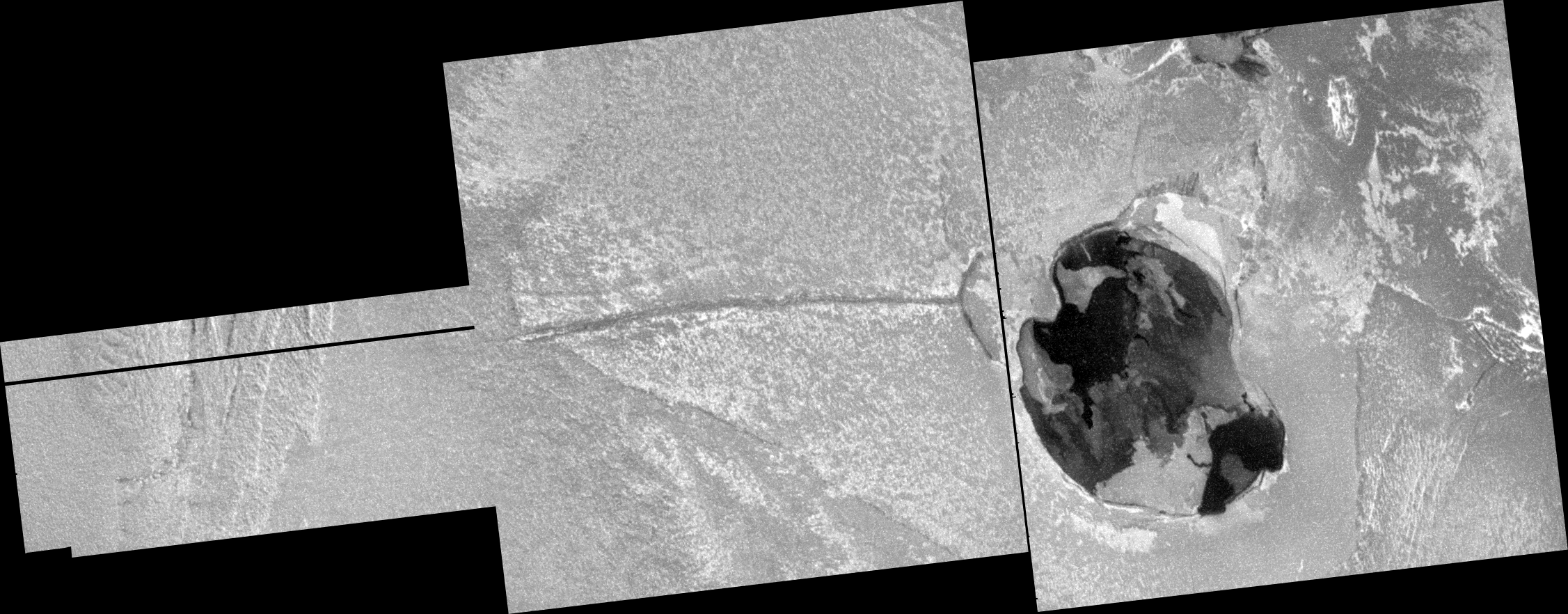
The mosaic at left shows a portion of the northeastern margin of Chaac Patera, a volcanic depression on the anti-Jupiter hemisphere of Io. Click the image for a full-resolution version. The terrain to the upper left is the hummocky plains that make up the upper level of the depression Chaac sits in. The terrain to the lower right is the floor of Chaac Patera, consisting of overlapping, thin silicate flows. The margin itself is quite steep, with slopes approach 70 degrees on the right hand side. On the left hand side, mass wasting has produced a two-tone talus apron at the base of the slope. This mass wasting seems to be the result of more extensive slope failure (see the broken off section of massive lava on the far left edge of the image).
It is getting rather late for me, almost 3:30am so I will continue the discussion of this mosaic tomorrow.
These images were taken during the Galileo spacecraft's February 2000 flyby of Io. The pixel scale is 7 meters per pixel.
Wednesday, January 20, 2010
LPSC 2010 Abstracts Now Online
Abstracts for the 2010 Lunar and Planetary Sciences Conference (also known as LPSC) are now online. The final announcement for attendees has also been published.
This year's conference is at The Woodlands Waterway Marriott Hotel north of Houston, Texas. This year's conference has also been moved to one week earlier than usual, the week before spring break for many universities. The conference is scheduled for March 1–5, 2010.
Several Io-related abstracts have been submitted for the conference. Unlike previous years, talks and posters this year are generally organized by process, as opposed to specific Io or Galilean satellites sessions. Also, there is definitely an increase in the percentage of Moon or Mars related sessions as opposed to meteorites or outer solar system topics. As a consequence of the former, these talks and posters will be in different sessions.
By now I am sure you know the drill. Over the next few days, I will post discussions of each abstract here on the blog. The links below take you to the abstracts themselves. I will add links to my discussion of them as they are posted in the bullet list below.
Oh one other abstract I will be talking about here that isn't Io-related, but still cool and is Jupiter-related: A New Ring or Ring Arc of Jupiter? by A. F. Cheng. Apparently, Phoebe isn't the only outer irregular moon with an associated dust ring. Seriously, at this point, can we just say that small moons in the outer solar system, unless strongly gravitational effected by a much larger moon (so scratch Telesto or Helene at Saturn, yeah I know, I will come to eat those words come March 4), have dust rings associated with them. Weaklings, can't even hold up to micrometeorite impacts...
Link: 41st Lunar and Planetary Science Conference (2010) [www.lpi.usra.edu]
This year's conference is at The Woodlands Waterway Marriott Hotel north of Houston, Texas. This year's conference has also been moved to one week earlier than usual, the week before spring break for many universities. The conference is scheduled for March 1–5, 2010.
Several Io-related abstracts have been submitted for the conference. Unlike previous years, talks and posters this year are generally organized by process, as opposed to specific Io or Galilean satellites sessions. Also, there is definitely an increase in the percentage of Moon or Mars related sessions as opposed to meteorites or outer solar system topics. As a consequence of the former, these talks and posters will be in different sessions.
By now I am sure you know the drill. Over the next few days, I will post discussions of each abstract here on the blog. The links below take you to the abstracts themselves. I will add links to my discussion of them as they are posted in the bullet list below.
- Volcanism on Io: Results from Global Geologic Mapping by Dave Williams et al. This poster will present updates regarding the global geologic mapping project and research based on this new map. A blog post about this abstract has been posted.
- Io: The Dark Paterae Component of Heat Flow by G. J. Veeder et al. Last year, this same group published a paper on the contribution to Io's total heat flow from dark lava flows. This poster appears to be a continuation of that work, not focused on dark paterae. A blog post about this abstract has been posted.
- DSMC Modeling of the Plume Pele on Io by W. J. McDoniel et al. Last year, this group presented results from modeling non-circular plume vents on Io, and their application to Prometheus. This year's poster extends this modeling to the specific case of the Pele plume, with very encouraging results. A blog post about this abstract has been posted.
- The Geothermal Gradient of Io: Consequences for Lithosphere Structure and Volcanic Eruptive activity by G. Leone et al. A blog post about this abstract has been posted.
- Science Rationale for an Io Volcano Observer (IVO) Mission by A. S. McEwen et al. A blog post about this abstract has been posted.
- Io's UV-V Eclipse Emission: Implications for Pele-type plumes by C.H. Moore et al. A blog post about this abstract has been posted.
- Modeling the Sublimation-Driven Atmosphere of Io with DSMC by A. C. Walker et al. This talk will cover the model that was examined and compared to real data in Gratiy et al. and discussed here last week. A blog post about this abstract has been posted.
- Distribution and Comparison of Io's Paterae: Areas, Effective Diameters, and Active Volcanism by B. Barth et al. A blog post about this abstract has been posted.
- Paterae on Io: Insights from Slope Stability Analysis by L. Keszthelyi et al. I guess you can scratch "Ioquakes" off a list of natural hazards for future Ionian colonists. A blog post about this abstract has been posted.
- The Thermal Signature of Volcanic Eruptions on Io and Earth - Implications for a Future Mission to Io by A. Davies et al. A blog post about this abstract has been posted.
Oh one other abstract I will be talking about here that isn't Io-related, but still cool and is Jupiter-related: A New Ring or Ring Arc of Jupiter? by A. F. Cheng. Apparently, Phoebe isn't the only outer irregular moon with an associated dust ring. Seriously, at this point, can we just say that small moons in the outer solar system, unless strongly gravitational effected by a much larger moon (so scratch Telesto or Helene at Saturn, yeah I know, I will come to eat those words come March 4), have dust rings associated with them. Weaklings, can't even hold up to micrometeorite impacts...
Link: 41st Lunar and Planetary Science Conference (2010) [www.lpi.usra.edu]
Tuesday, January 19, 2010
Carnival of Space #137 @ One Astronomer's Noise
The 137th edition of the Carnival of Space, a weekly series highlighting the best in the astronomy and space blogosphere, is now online at One Astronomer's Noise. You know the drill. Some great posts include looking at the Southern Cross from a new perspective, T Scorpii, and some great astrophotography.
Link: Carnival of Space #137 [noisyastronomer.com]
Link: Carnival of Space #137 [noisyastronomer.com]
Friday, January 15, 2010
Video of Lava Pond Draining Event/Haiti
 A few weeks ago the USGS's Hawaiian Volcano Observatory released an incredible video of lava draining out of a lava pond at Kilauea's Halema`uma`u vent (an embedded Flash version can be found on the Big Island Video News website). At the beginning of the video, lava mostly fills the pond (a depression filled with mostly molten lava that is NOT connected directly to the underground source of the lava, unlike a lava lake), but as the lava drains out to the right, more of the shelf surrounding the pond becomes visible until lava starts cascading over that shelf. Known lava ponds on Io include Pillan Patera during the 1997 eruption, when lava from a fissure eruption 75 kilometers to the north of Pillan flowed over the edge of the patera, and covered its floor.
While we ooo and ahh at the powerful forces of nature, like this beautiful lava pond, these same geologic forces on Earth, volcanism and tectonism, can cause tremendous suffering for the planet's inhabitants. This can be clearly seen this week in the island nation of Haiti, where a simple break along a major strike-slip fault on the boundary between the Caribbean and North American Plates has caused a massive loss of life and tremendous suffering for the survivors in the area around Haiti's capital of Port-au-Prince. I encourage my readers to donate some of their resources to the charity of their choice that they feel can make a difference down in the earthquake zone. One important thing to remember that in the days and weeks to come, the survivors of this quake will be facing a second disaster, one of disease and infection as a result of a complete loss of what sanitation and infrastructure they did have and the injuries they suffered from falling debris during the quake and its aftershocks. My favorite charity, Doctors without Borders will be working on the ground there in Haiti to try to mitigate that potential second disaster. Consider a donation to that wonderful organization, or the International Red Cross/Red Crescent, or check out the CNN.com website for a list of worthwhile and trustworthy charities.
Thanks!
Subscribe to:
Posts (Atom)


 Posts
Posts