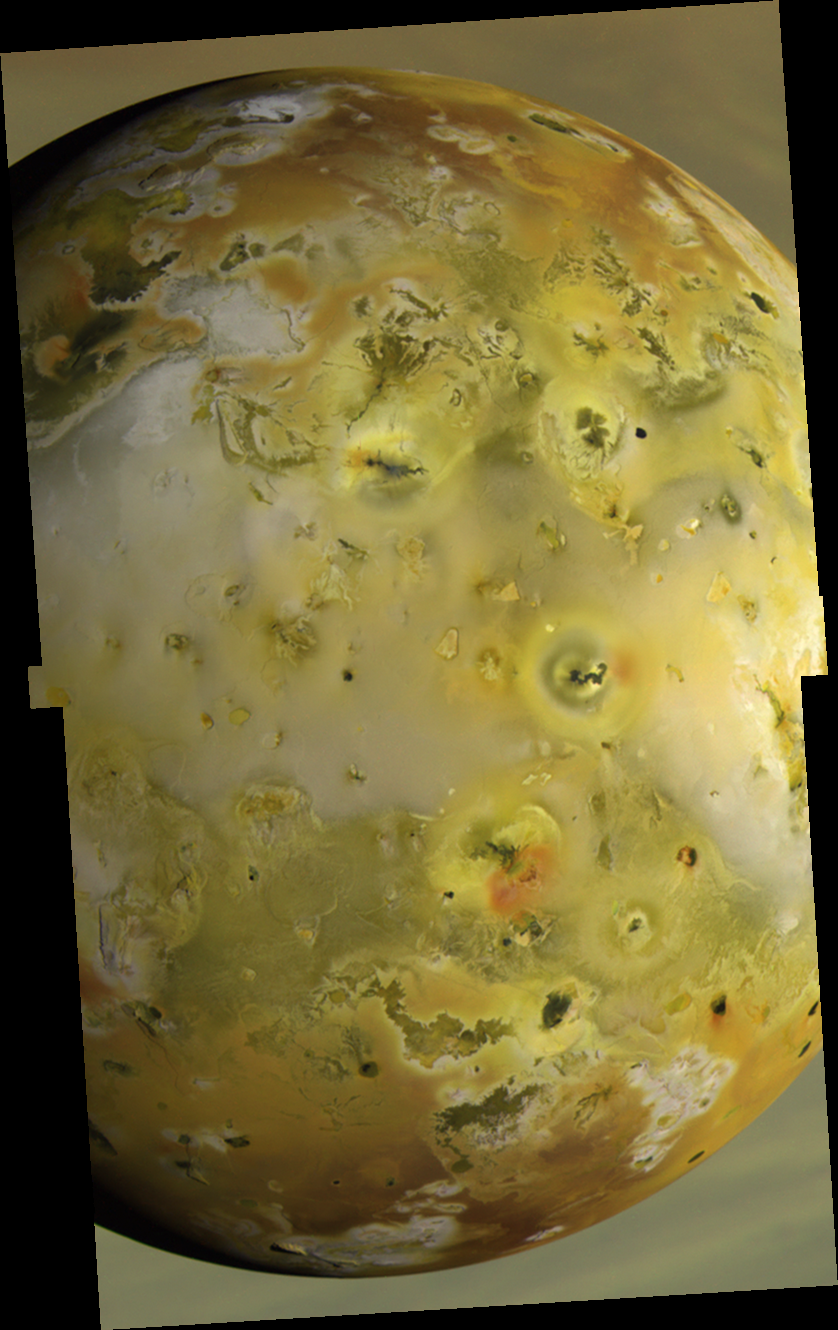
Thursday, January 7, 2010

Io@400 Part 4: 400 years ago today, Cosmica Sidera

This week we are looking back at the discovery of Io and the other Galilean satellites by Galileo Galilei 400 years ago today.  Yesterday, we took a look at Simon Marius's observations of the Jovian system and his claim that he observed the Galilean satellites as early as late November 1609.  Today, in part four of our series of posts in commemoration of the discovery of Io, we examine Galileo Galilei's discovery of the Galilean satellites on January 7, 1610, 400 years ago today, and his subsequent observations of the system during the first two months of 1610.
Behold therefore, four stars reserved for your famous name, and those not belong to the common and less conspicuous multitude of fixed stars which, with different motions among themselves, together hold their paths and orbs with marvelous speed around the planet Jupiter, the most glorious of all the planets, as if they were his own children, while all the while with one accord they complete all together mighty revolutions every twelve years around the center of the universe, that is, round the Sun.
- From Galileo's Sidereus Nuncius (trans. by Edward S. Carlos)
Three Little Stars

In early January 1610, Galileo had just finished up an incredible series of observations of the Moon, the Milky Way, and several stellar nebulae.  In the case of the Moon, his 20-power telescope revealed the Moon's cratered and mountainous surface, showing that it was not smooth and perfect as stated in the Aristotelian world view, but was in fact, quite rough.  Galileo discovered a multitude of stars, far more than could be seen with the naked eye, within the "clouds" of the Milky Way, on the belt of the constellation Orion, and within nebulae and star clusters such as the Orion Nebula, Beehive Cluster, and the Pleiades.  During the first week of January 1610, Galileo drafted a letter to Galileo's Florentine friend, Enea Piccolomini describing these observations along with details on how best to operate the telescope for astronomical viewing, for example, suggesting the use of a stand for the telescope to prevent inadvertent hand motions from ruining observations.  Galileo set aside the letter for a few days, picking it back up on the evening of January 7, 1610.

That evening, an hour after sunset, Galileo aimed his 20x telescope, with a newly masked objective lens, toward the planet Jupiter, at the time near opposition and in the midst of its retrograde loop in the night sky.  In this case he observed three stars forming a line with Jupiter, parallel to the ecliptic.  Two of these stars were to the lower left (east) of Jupiter and another star was to the upper right (west) of the planet.  He noted this in the conclusion of his letter to Piccolomini:
... and only this evening I have seen Jupiter accompanied by three fixed stars, totally invisible by their smallness, and the configuration was in this form [graphic shown matches the configuration displayed in the screenshot from Celestia at left] nor did they occypy more than one degree of longitude.  The planets are seen very rotund, like little full moons, and of a roundness bounded and without rays.  But the fixed stars do not appear so...
On January 7, 1610, Galileo discovered what we call today the Galilean moons, believing them at the time to be fixed stars behind Jupiter.  When I first read this passage, I assumed he was referring to the moons as "The planets" in that last section, hence my anniversary message earlier today.  However, re-reading that and understanding the timing of when that was written, the very night he made his first observation of these satellites, he was actually referring to planets like Venus, Jupiter, or Mars as "little full moons", and that these "fixed stars" do not appear like that.  This again drives home the point that on January 7, the day of discovery, Galileo hadn't figured out what he found, but it was enough for him to keep making observations over the following days.

A quick note: Galileo refers to having seen three little stars, not four.  In fact, he did see all four Galilean satellites.  Ganymede was the lone star to the west of Jupiter and Callisto the star furthest east.  The eastern star closest to Jupiter was actually two moons, Io and Europa, too close together for Galileo's low-powered telescope to separate.

Over the following days, Galileo continued to observe Jupiter.  On January 8, he found three moons again, this time all to Jupiter's west with about equal spacing (from Galileo's Sidereus Nuncius, with moon labels added by me):

This observation startled Galileo, "Yet my surprise began to be excited, how Jupiter could one day be found to the east of all the aforementioned fixed stars when the day before it had been west of two of them."  Jupiter was moving retrograde, as expected being at near opposition, and if anything, Jupiter should be to the west of all three stars.  Galileo even noted that he hadn't even considered the fact that all three were now closer together.  I should point out that a fourth Galilean satellite, Callisto, could have been seen to the far east of Jupiter, but was apparently outside Galileo's field of view and thus wasn't recorded.

After he was clouded out on January 9, he continued his observations on January 10, finding two stars (Callisto and a close conjunction of Ganymede and Europa) to the east of Jupiter.  Io was caught up in the glare of Jupiter in Galileo's telescope for him to observe it that night, as he suspected.  At this point, as he noted in his Sidereus Nuncius, Galileo realized that the orientations of the stars with respect to Jupiter changed, not due to the motion of Jupiter, which would have to be chaotic, first moving west, then east, then west again on successive nights, but due to the motions of these stars themselves.  On January 11, he noted two stars to the east of Jupiter (Ganymede and Callisto; Io and Europa were transiting Jupiter at the time and were thus lost in the planet's glare).  Galileo even noted the difference in brightness between Ganymede and Callisto.  With this observation, according to his Sidereus Nuncius, Galileo came to the conclusion that these were not stars at all, but little planets in orbit around Jupiter, just as the planets revolved around the Sun.  He also deduced that there were not three bodies moving about Jupiter, but four, even despite the fact that he hadn't solidly observed all four at once to this point.  Some historians, such as Stillman Drake, propose that these conclusions, that Jupiter was orbited by four little planets, were actually reach several days later, and that he simply put his those notes in the wrong place in his notebook, which were then further transcribed in his book two months later.

Cosmica Sidera

Galileo continued to jot down his observations on the draft of a letter he had written to Venetian Doge Leonardo Donato back in August 1609 (promising not to show his innovations to another foreign power...oh, like Tuscany...).  On January 12, Galileo observes Jupiter for a more extended, first observing the planet and two of its moons on each of the planet, Ganymede to the east and Europa to the west, then seeing Io emerge from Jupiter's glare to the planet's east.  Callisto remained hidden from view in the glare.  By this point, certainly Galileo could make the conclusion that the "stars" moved perceptively during a single observing run.  The following day, January 13, Galileo observed and recorded all four Galilean satellites for the first time, with Europa to the east of Jupiter and Ganymede, Io, and Callisto, respectively, to the west.  So it is on January 13 that Galileo could obviously conclude that there were four stars, instead of three.

I notice on Wikipedia that this is listed as the discovery date for Ganymede, while January 7 is listed for the other three. While January 13 was the date that Galileo first observed all four satellites at the same time, by that date, he had observed all four, though just not all at the same time.  You could reasonably argue that for any of the moons, that three were discovered on January 7 and the fourth on January 13, but the fact remains that on January 7, all four were visible to Galileo and noted by him (though two were too close to be separated).

Galileo's first detection of motion between the moons, evidence that the moons orbited Jupiter, came on January 15 when Galileo observed all four moons to the west of Jupiter.  Over the course of four hours that night, Galileo observed Io moving east and slowly become lost in the glare of Jupiter.  Ganymede and Europa, the middle of the two moons seen, were observed to come closer together as the night progressed.  From this and his earlier observations, Galileo was able to conclude that these four stars actually orbited the planet Jupiter, just as the planets orbit the Sun.

For Tomorrow

Galileo would continue to observe Jupiter and the moons he would christen the Cosmic Stars, after his former pupil and future employer, Cosimo II de' Medici, the Grand Duke of Tuscany, for the next month and a half, until March 2, 1610.  At that point, he published his findings, the rough terrain of the Moon, the countless stars of the Milky Way, and the new Jovian planets, in Venice as Sidereus Nuncius, or The Starry Messenger.  Tomorrow, January 8, we will discuss this ground-breaking book and its reception by the public, Church, and fellow scientists.

Link: Galileo's First Jupiter Observations (comparing Galileo's records with simulated views) [home.comcast.net]
Link: The Galileo Project | Satellites of Jupiter [galileo.rice.edu]
Link: JPL Galileo Discovery Page [www2.jpl.nasa.gov]

The Quadricentennial around the Intertubes

Of course I am not the only blogger to make note of today's anniversary.  Here are a collection of links from other commentators for this special day:
I am sure there are others I am missing.  Feel free to send those links along I will update this post with the links.  As mentioned in a few of the links above, now is a great time to view Jupiter in the southwestern sky just after sunset, before Jupiter reaches conjunction.  Jupiter appears as a -2 magnitude star to the unaided eye about 20 degrees or so above the horizon.  With a telescope or with a decent pair of binoculars, you should be able to see a pair of moons on each side of Jupiter, tonight, unless you are socked in by a snow storm ;-)

EDIT 01/07/2010 2:33 pm: Added Bing.com commemoration and JPL Blog post.  Tip o' the hat to Jani Radebaugh and Daniel Fischer.

Happy Io Discovery Day, everyone!

    Happy Io Discovery Day!

    ...and only this evening I have seen Jupiter accompanied by three fixed stars, totally invisible by their smallness...  The planets are seen very rotund, like little full moons, and of a roundness bounded and without rays. - Galileo Galileo, January 7, 1610

    Wednesday, January 6, 2010

    Io@400 Part 3: Simon Marius and the Mundi Iovialis

    This week we are looking back at the discovery of Io and the other Galilean satellites by Galileo Galilei 400 years ago tomorrow.  Yesterday, we took a look at Galileo's first scientific observations with his new telescope in the fall of 1609 which included the viewing of mountains and craters on the Moon and stars fainter than what would normally be seen with the naked eye.  We also looked at Thomas Harriot's observations of the Moon in the summer of 1609, providing an example of the kind of tip of the iceberg the telescope's invention was in 1609.  Today, in part three of our series of posts in commemoration of the discovery of Io, we examine the research of another contemporary of Galileo's, Simon Marius, who claimed to have discovered the Galilean satellites before Galileo in December 1609.
    Then for the first time I looked at Jupiter, who was in opposition to the Sun, and made out some tiny stars, sometimes following, sometimes preceding Jupiter in a straight line with him.  First, I thought that they were of the number of those fixed stars ... However, as Jupiter was then retrograding, and still I saw these stars accompanying him throughout December, I was at first much astonished; but by degrees arrived at the following view, namely, that these stars moved round Jupiter, just as the five solar planets revolve round the Sun.
    - Simon Marius in the Mundus Jovialis (1614)
    Meanwhile, in Germany...

    In late 1608, as news of the Dutch discovery of the telescope spread across Europe, one of the inventors traveled to Frankfort in an attempt to market it.  The news of an instrument that made "the most distant objects be seen as though quite near" caught the attention of John Philip Fuchs, Lord Privy Councilor to the Margraves of Brandenburg-Ansbach.  He attempted to buy the telescope from the Dutch glass maker.  While he was allowed a demonstration of it, he found the price unacceptable.  Upon his return to Ansbach, Fuchs met with the court astronomer, Simon Marius (latinized from Simon Mayr), and they attempted to fashion their own telescope, but their were unable to get a working model since they didn't know how to polish glass and the lens makers in nearby Nuremberg didn't have the right tools.  By the summer of 1609, enough copies of the telescope were being made in the Netherlands that the prices had come down substantially since Fuchs first attempt to buy one the previous autumn.  With a newly purchased telescope, Simon Marius set to work making astronomical observations with it from both the home of the Lord Privy Councilor and at Marius's home at the Ansbach Observatory.

    As described in his 1614 book, Mundus Iovialis anno M.DC.IX Detectus Ope Perspicilli Belgici (translated from the Latin title as "The World of Jupiter discovered in the year 1609 by means of a Dutch spy-glass"), Marius began to observe Jupiter in late November 1609 as the planet approach opposition, when Jupiter was opposite the Sun in the sky and thus allowing for more time for observations at night with Jupiter high in the sky.  It was during this observations that he noted at least three stars adjacent of Jupiter.  When the stars continued to move with Jupiter even when it was moving retrograde during opposition in December 1609, he realized that the "stars" were actually moving around Jupiter, just as the planets moved around the Sun.  When Marius came to this stunning realization, he began to record his observation on December 29, 1609, observing three of the moons to the west of Jupiter.  One thing to keep in mind about this observation was that Simon Marius, being a Lutheran, was using the Julian calender, just as the rest of the Protestant world used at the time.  December 29, 1609 in the Julian calendar is equivalent to January 8, 1610 in the Gregorian calendar, used by Galileo Galilei and those in other Catholic countries.  In fact, Simon Marius's description of the positions of the Galilean satellites in his first recorded observation match those of Galileo for January 8.

    According to Marius in Mundus Iovialis, he continued to observe the Jupiter system until January 12 (January 22 for Galileo), at which point he determined that he was observing four bodies revolving around Jupiter. Following a trip to Swabia in Southwestern Germany, Marius returned in February 1610, and after discussing his observations with Fuchs, he was given permission to use the telescope on a more permanent at Marius's observatory.  This allowed Marius to make more continuous, detailed observations of Jupiter's satellites.  From the observations Marius acquired over the next few years from his observatory, eventually using an improved telescope of his own creation, he was able to determine that the four moons each orbited Jupiter in roughly circular orbits with different orbital velocities, with faster velocities for the innermost moons and slower velocities for the outermost.  Marius was also able to work out the orbital periods for each of the four moons, coming quite close to modern values for their periods. For example, his orbital period for Io was 1 day, 18 hours, 28 minutes, and 30 seconds, differing from the modern value by 56.5 seconds.  He noted that each of these moons orbit parallel to the ecliptic and that on occasion, the moons would appear either north or south of the equator of Jupiter, the result of Jupiter axial tilt (though not a conclusion Marius reached).  Marius would also note that Jupiter eclipses the inner moons during each orbit, causing Io and Europa to fade from view.

    Galileo and the Mundus Iovialis

    Simon Marius's treatise on his observations of the Jupiter system (as well as sunspots), Mundus Iovialis, was published in 1614, which included the first table of predicted positions for the satellites.  In his book, Marius acknowledged Galileo as the discoverer of the new worlds of Jupiter, "The credit, therefore, of the first discovery of these stars in Italy is deservedly assigned to Galileo and remains his."  Clearly, one could make the argument that he is quibbling when he says that Galileo was the discoverer IN ITALY, while he was the German discover of the moons.  Marius's supporters in Germany would later try to make the further claim that Marius was the sole discoverer, beating Galileo.

    Galileo would respond to Marius's claims (or probably more correctly the claims of Marius's German (read: Lutheran) supporters) in his 1623 book, Il Saggiatore (or The Assayer).  First, Galileo and Marius had some history together.  Between 1602 and 1605, Simon Marius attended the University of Padua, becoming an important member in the German student society there, while Galileo was a professor there.  While a student, Marius also tutored a rich Milanese student named Baldessar Capra, where they would together observe a supernova in 1604.  After Marius returned to Ansbach in 1605, Capra remained at Padua, where he published a book in 1607 on the sector, which just so happened to be exactly the same as Galileo's mechanical compass.  After this blatant case of plagiarism, Capra was expelled from the University.  With Marius so connected to Capra as well as a result of his actions as the president of the German student's society, he was not well liked by Galileo.  So, in Il Saggiatore, published nine years after Marius's Mundus Iovialis, Galileo attacked Marius, claiming that Marius framed his student for a plagiarism he was responsible for, and saying:
    Now four years after my Sidereus Nuncius appeared, this same fellow [Simon Marius] (in the habit of trying to ornament himself with other people's works) unblushingly made himself the author of the things I had discovered and printed in that book. Publishing under the title of Mundus Iovialis, he had the gall to claim that he had observed the Medicean planets which revolve about Jupiter before I had.  But note his sly way of attempting to establish his priority. I had written of making my first observation on the seventh of January, 1610. Along comes Marius, and, appropriating my very observations, he prints on the title page of his book (as well as in the opening pages) that he had made his observations in the year 1609. But he neglects to warn the reader that he is a Protestant, and hence had not accepted the Gregorian calendar. Now the seventh day of January, 1610, for us Catholics, is the same as the twenty-eighth day of December, 1609, for those heretics. And so much for his pretended priority of observation.
    So Galileo clearly took offense, despite Marius's attempt in Part 1 of Mundus Iovialis to relieve that possible tension.

    Now who should have credit?  Personally, I feel Galileo was right to point out the difference in calendar systems being employed between the two scientists.  Certainly the first observation Marius recorded on December 29, 1609 in the Julian Calendar matched the second of Galileo's observations from January 8, 1610 in the Gregorian Calendar.  Whether Galileo is right about Marius out right plagiarizing his work (again?), I don't think we can say.  Marius clearly was observing the Jupiter satellites starting at least in 1610, with enough observations for him to come up fairly accurate orbital periods for the satellites.  Still, based on the fact that Galileo has a  recorded observation, that has been verified using mathematical theories of the orbits of these moons, from the day before Marius's first recorded observation, gives Galileo the sole credit for the discovery.  Marius's claims that he was observing the moons as early as late November 1609 can't be verified because he didn't record what he saw.

    Io, Europa, Ganymede, and Callisto

    Regardless of who saw what, when, or who stole from whom, from the Mundus Iovialis, we do get the modern names for Jupiter's four largest moons.  Marius offers several naming schemes for the moons, calling them collectively the Brandenburg Stars (as a knock on Galileo calling them the Medicean Stars).  He also tried a naming scheme where he uses the names of the planets, for example "The Mercury of Jupiter" or "The Jupiter of Jupiter".  Finally, he offers a scheme suggested to Marius by Johannes Kepler in October 1613 while they were in Regensberg:
    Jupiter is much blamed by the poets on account of his irregular loves.  Three maidens are specially mentioned as having been clandestinely courted by Jupiter with success.  Io, daughter of the River Inachus, Callisto of Lycaon, Europa of Agenor.  Then there was Ganymede, the handsome son of King Tros, whom Jupiter, having taken the form of an eagle, transported to heaven on his back, as poets fabulously tell, and notably Ovid.  I think therefore, that I shall not have done amiss if the First is called by me Io, the Second Europa, the Third, on account of its majesty of light, Ganymede, the Fourth Callisto.
    For Tomorrow

    Tomorrow, January 7, we will take a look at Galileo's observations of the Jupiter system, and how he came to view them as moons of Jupiter.

    Link: Mundus Iovialis - Part 1 [adsabs.harvard.edu]
    Link: Mundus Iovialis - Part 2 [adsabs.harvard.edu]
    Link: Mundus Iovialis - Part 3 [adsabs.harvard.edu]
    Link: Mundus Iovialis - Part 4 [adsabs.harvard.edu]
    Link: Simon Marius [galileo.rice.edu]

    New Videos Showing Topography in the Jupiter System

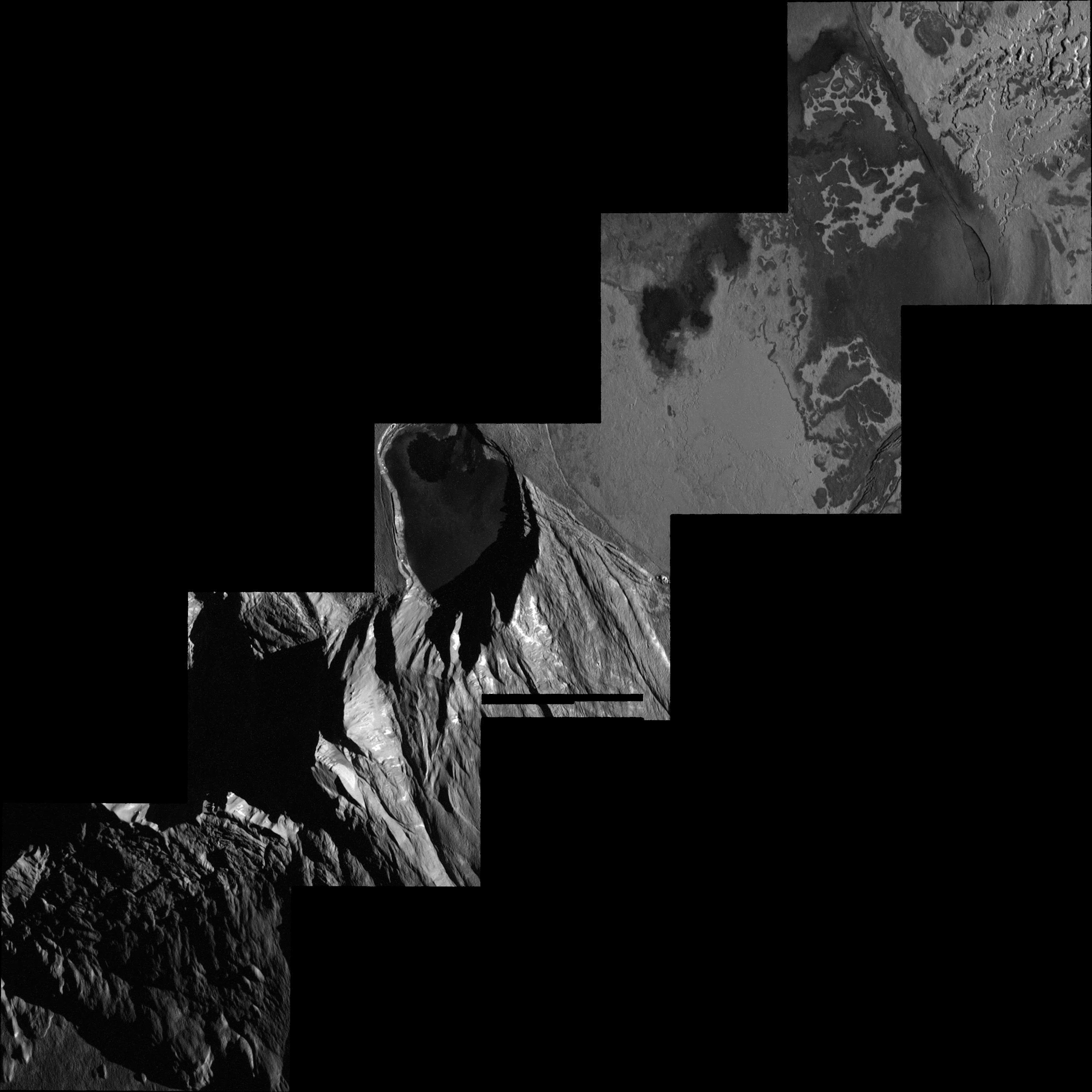
    Paul Schenk has posted some new, high-definition videos on Youtube showing the topography of various surface features across the four Galilean satellites.  These videos were created for a conference/celebration going on in Padua starting today, the IAU Symposium 269: Galileo's Medicean Moons - Their Impact on 400 Years of Discovery.  Schenk's videos can be found online at his Youtube channel, GalSat400.  These videos are based on photoclinometry and stereo imaging derived from Galileo images.  Photoclinometry uses changes in the topographic shading of a features to determine local slopes, and thus topography.  Stereo imaging uses pairs of images taken at different viewing angles to determine topography.  The latter example are often depicted as stereo pairs or anaglyphs.  For Io, these videos include flyovers of Tohil Mons based in part on a high-resolution mosaic of mountain from Galileo's flyby of Io during orbit I32, Hi'iaka Montes from I25 data, and the Pillan flow field from I24 data (not posted yet but I definitely look forward to Paul getting that online).  For your convenience, those videos are also below.  Paul has also post videos using high-resolution Galileo mosaics for the other Galileans.  Of these other videos, I kinda like the flyover of Manannan crater on Europa.  This relatively small impact crater looks crater-ish from a distance, but up close, when you look a the topography of the feature, you can see that the thin ice shell and ductile layers of that shell have mangled that crater out of all recognition.

    Definite check these videos out!


    Tohil Mons, Io (high-resolution)


    Liftoff from Hi'iaka Montes

    Link: Youtube - GalSat400's channel [www.youtube.com]
    Link: Galileo and Padova - 1610-2010 Celebration (New Videos) [stereomoons.blogspot.com]

    Tuesday, January 5, 2010

    Io@400 Part 2: Looking through the telescope in 1609

    This week we are looking back at the discovery of Io and the other Galilean satellites by Galileo Galilei 400 years ago this Thursday.  Yesterday, we briefly examined the state of astronomy at the start of the 17th Century and the conflict between different world systems in play.  We also examined how Galileo first developed his telescopes based on a Dutch invention.  Today, in part two of our series of posts in commemoration of this significant event in the history of astronomy and science, we look back at Galileo's first scientific investigations with the telescope in the autumn of 1609.  We also look at Thomas Harriot's similar investigations that year.
    These spots have never been observed by anyone before me; and from my observations of them, often repeated, I have been led to that opinion which I have expressed, namely, that I feel sure that the surface of the Moon is not perfectly smooth, free from inequalities and exactly spherical, as a large school of philosophers considers with the regard to the Moon and the other heavenly bodies, but that, on the contrary, it is full of inequalities, uneven, full of hollows and protuberances, just like the surface of the Earth itself, which is varied everywhere by lofty mountains and deep valleys.
    - From Galileo's Sidereus Nuncius (trans. by Edward S. Carlos)
    The Imperfect Moon

    With a copy of his new telescope gifted to the Venetian Republic, Galileo then traveled to Florence in October 1609 to provide the Grand Duke of Tuscany, Cosimo II de' Medici, a demonstration of his 8x power telescope (which he created after receiving new lenses in mid-September 1609).  Cosimo II was a former pupil of Galileo and had become Grand Duke earlier in the year following the death of his father, Ferdinando I.  The visit was intended to smooth over relations with the ruler of his hometown after after he had given a copy of his telescope to a rival of Tuscany in north Italy in hopes that he might get employment at the University of Pisa.  During this visit, Galileo showed Cosimo the view of the Moon through his telescope.  This demonstration also provided support for Galileo's 1606 theory that the bright regions of the Moon contained tall mountains and the dark regions low plains.

    Upon his return to Padua in late-October 1609, Galileo set to work creating a more-powerful telescope, this time with a 20x magnification, based on the lens blanks he had received a couple months earlier.  Galileo began his first detailed observations of the Moon, which he later published in Sidereus Nuncius, on December 1 (though other references suggest that he might have begun his first detailed observations in early October).  Again, he found shading on the Moon resulting from topography, hills and valleys that reminded Galileo of the hills and valleys of the Apennines of central Italy.  He correctly interpreted bright spots on the Moon's night-side as large mountains tall enough to reach into the sunlight, akin to sunlit mountains seen from the surrounding twilit plains.  He also correctly interpreted dark spots along the terminator, the dividing line between day and night, as valleys (in the case of the Moon, the floors of impact craters).  Over the next few weeks, Galileo continued to draw what he saw at the moon, noting sunlight slowly filling valley floors as well as the dark plains that seemed to be flat, devoid of topographic shading (though he noted that some were ringed by mountain chains).  These observations contradicted the current prevailing view of the Moon of perfect, smooth world.  The dark maria were attributed as simply being the result of differences in the density of the Moon.  Galileo's observations instead showed an imperfect world, more akin to the Earth with mountains he measured as four miles tall.  He even went so far as to suggest that the Lunar highlands were akin to terrestrial land areas and the maria were actually seas.

    In his March 1610 treatise, Sidereus Nuncius, Galileo acknowledged a potential argument against the Moon having substantial terrain.  While he observed evidence for significant topography within the Moon's highlands, its limb appeared to be smooth even at 20x magnification.  With mountains as great as four miles in height, the limb should be lumpy.  Galileo proposed two explanations.  First, he suggested that limb appeared smooth because the mountains were more distant than the ones near the center of the disk and would appear smaller and foreshortened, akin to mountains in the far distance on Earth.  His other suggestion, which he would later accept as incorrect but one I am more familiar with on another moon, was that an atmosphere on the Moon would make the appearance of the limb indistinct, blurring features and topography as emission angle increases.  So in this case, he argued that the limb appeared smooth because we are seeing the edge of the Moon's atmosphere, not the physical horizon. Finally, in the Sidereus Nuncius, Galileo notes Earthshine on the nightside of the Moon, most visible when it is near new moon phase, as well as albedo markings on the dark maria (rays from craters such as Copernicus and Tycho).

    During this period of late 1609, Galileo also observed background stars with his new "high" power telescope. He noted that his telescope did not magnify the appearance of stars, like the planets or the Moon.  Instead they seemed to brighten and become smaller.  His important discovery from these observations was the finding that telescopes seemed to bring out stars that were fainter than are visible with the naked eye.  For the Sidereus Nuncius, he highlighted three deep-sky features as demonstrations of this effect: the Orion constellation, the Pleiades star cluster, and the Milky Way.  In the first two cases, he noted that both areas of the sky had significantly more "invisible" stars than visible ones, charting 36 of these stars in addition to the six normally seen with the naked eye in the Pleiades cluster.  In the case of the Milky Way, he found that one what had previously been considered clouds were instead densely packed clusters of stars.  He found similar cases at other stellar "clouds", such as the Orion Nebula and the Beehive Cluster.

    In early January 1610, Galileo wrote a letter to a friend in Florence detailing his discoveries to date with telescope, and prepared its conclusion on January 7, 1610 when he made an even more amazing discovery.

    In England...

    As I mentioned yesterday, news of the invention of the telescope in the Netherlands spread quickly across Europe, with 3x-powered scopes being demonstrated in the courts of Europe throughout 1609.  Word also spread to an English scientist named Thomas Harriot and in early 1609 he purchased a copy while he was working at the Syon House, the residence of the Earl of Northumberland (well, not at the time... the Earl was in prison at the time following the Gunpowder Plot of November 5, 1605).  Harriot recorded the first astronomical observations using a telescope in the summer of 1609, including several illustrations of the Moon.  However, these were not well known at the time as he failed to publish his observations, unlike other astronomers at the time like Galileo, Kepler, and Simon Marius.  These observations included detailed maps of the Moon that would not be matched for several more decades.  Later, he did publish a book on algebra and determined Snell's Law of Refraction independently.

    For Tomorrow

    One other astronomer who was using a telescope in 1609 and 1610 was Simon Marius.  Tomorrow, January 6, we will take a look at his claim that he was the discoverer of the four largest moons of Jupiter in December 1609.

    Monday, January 4, 2010

    Io@400 Part 1: Copernicus, Galileo, and the Telescope

    This week we are looking back at the discovery of Io and the other Galilean satellites by Galileo Galilei 400 years ago this Thursday.  In part one of our series of posts in commemoration of this significant event in the history of astronomy and science, we look back at the invention of the telescope in the first decade of the 17th Century and how Galileo came to develop his own version and improve upon it.  We will also take a brief look at the state of astronomy prior to Galileo's discovery.
    About ten months ago a report reached my ears that a Dutchman had constructed a telescope, by the aid of which visible objects, although at a great distance form the eye of the observer, where seen as if near; and some proofs of its most wonderful performances were reported, which some gave credence to, but other contradicted.
    - From Galileo's Sidereus Nuncius (trans. by Edward S. Carlos)
    The Copernican Revolution

    Bartolomeu Velho's Map of the Heavenly Spheres surrounding a contemporary map of the Earth Since the time of Aristotle and Claudius Ptolemaeus, the western view of the structure of the universe was geocentric, with the Moon, the Sun, and the other planets revolving around a stationary Earth with fixed stars in the background (or Firmamento).  Comets were viewed as atmospheric phenomenon, seen as portents of change. This system was the dominant theory in Europe with the backing of church theology that preached a Earth-centric universe with hell below and a perfect, unchanging heaven above.  This world view was revived in the west in large part to the works of Saint Thomas Aquinas, summarized in his book, Summa Theologica.  In the geocentric model, the planets were free of imperfections, all orbiting the Earth in circular orbits. However, these circular orbits did not explain the motion of the planets during opposition nor their changing brightness.  So an increasing complex system of epicycles and epicycles upon epicycles were developed in an attempt to better explain planetary motion while keeping the Earth at the center of the universe.

    The late 16th and early 17th Centuries were important time periods in the history of astronomy and science. In 1543, Nicolaus Copernicus published his seminal work, De revolutionibus orbium coelestium, where he proposed a heliocentric universe, where the Earth moved around the Sun like the other planets in circular orbits.  However, to account for the apparent non-uniform motion of the planets (now known to be a result of the planets moving in elliptical orbits), Copernicus retained the epicycles of the Ptolemaic geocentric model. Additional models were developed during the 16th century, such as Thomas Digges's A Perfit Description of the Caelestiall Orbes (suggesting an "infinite" number of stars) and Tycho Brahe's modified geocentric model.  Brahe, while finding evidence such as supernovae and comets that revealed a changing sky, failed to detect stellar parallax, leading him to develop an alternative model, consisting of a geocentric universe with the Sun, stars, and Moon revolving around the Earth, but the other planets revolving around the Sun.

    By the start of the 17th Century, there was significant controversy regarding the validity of the Copernican model, which contradicted both Catholic and Protestant theologies at the time.  For astronomers of the age, such as Brahe's former assistant Johannes Kepler and Florentine mathematician Galileo Galilei, it was important to find further evidence that would confirm or refute the various theories that were discussed: the Ptolemaic geocentric model, the Copernican heliocentric model, or the Tychonic hybrid model.  Kepler, then the imperial court mathematician under Emperor Rudolf II, developed a model to explain the non-uniform motion of Mars in his 1609 work, Astronomia Nova.  He proposed that the planets moved in elliptical orbits, rather the perfect circles of earlier models, and that planets moved faster when they were closer to the Sun (perihelion) than when they are farther away (apohelion).  This model provided a more accurate and elegant model to explain planetary motions than previous models that replied on complex systems of epicycles.

    Enter the Spyglass

    On October 2, 1608, Dutch authorities at The Hague received a patent from Middleburg lens-maker Hans Lippershey for an instrument, "for seeing things far away as if they were nearby."  This device used a pair of glass lenses, a convex object lens and a concave one for use as an eyepiece.  This rudimentary telescope allowed for 3x magnification of distant objects. The patent was ultimately rejected as a result of similar designs by other Dutch lens makers like Sacharias Jansen and Jacob Metius.  However, Lippershey was given a grant by his government to produce three more of the telescopes.  News of the invention would spread from visitors to the Dutch court, like a Siamese emissary who was shown the scope while they were at The Hague.

    In 1609, word of the new invention reached astronomers like Thomas Harriot in England.  Galileo Galilei first heard about the telescope while in Venice in late July 1609.  There Venetian chief theologian Paolo Sarpi showed Galileo a letter from Jacques Badovere describing a copy of the instrument in Paris.  In early August 1609, Galileo received word of a a copy of the device with a foreign merchant in Padua, where Galileo worked as a mathematics professor, prompting him to rush home.  Unfortunately, by the time he arrived in Padua on August 3, the merchant had traveled on to Venice to sell his instrument.  Galileo worked out from Badovere and Sarpi's description of the telescope from the news he had received from the Netherlands the arrangement and shape of lens that would be required to magnify the appearance of distant objects.  His first design matched the magnification of Lippershey's instrument.

    Galileo at the time was suffering from some financial hardships and had hoped to get a salary increase for his work at the University of Padua on behalf of the Venetian government.  He placed some hope if he managed to improve on the design of the telescope, he could receive a raise.  By mid-August, Galileo developed a telescope design with an 8x magnification.  With his friend Sarpi holding off on purchasing the foreign merchant's telescope after being put in charge by the Venetian government to purchase it, he set up a demonstration of his improved telescope for Doge Leonardo Donato and members of the Venetian Segnoria and Senate from atop the campanile in the Piazza San Marco on August 25, 1609.  He was able to show the telescopes ability to show ships 50 miles away as clearly as if they were 5 miles away, demonstrating the telescope's use as a naval instrument, very important for a naval power like the Venetian Republic.  Giving the telescope as a gift to the Venetian state, his appointment to the University of Padua was renewed and his salary would be permanently doubled from 520 to 1000 florins per year after the end of his current term.  While the pay raise initially sounded like a great solution to his financial woes, the fact that this salary would run for life with no prospect of future increases, Galileo would later look for employment elsewhere, such as the University of Pisa (which we will touch on more on Friday in Part 5).

    For Tomorrow

    Tomorrow, January 5, we will continue this series by looking at Galileo's first scientific observations with his telescope in late 1609.  We will also look at Thomas Harriot's work with the telescope that year.

    Sunday, January 3, 2010

    Io@400: The 400th Anniversary of Galileo's Discovery of the Galilean Moons

    Thursday is the 400th anniversary of the discovery of Io and the other Galilean satellites by Galileo Galilei.  In celebration of this event, I will be posting a series of articles here over the next five days covering various topics related to the discovery of the Galilean moons.  On Monday and Tuesday, we will look at Galileo's first observations with a telescope building on the design of a Dutch patent by Hans Lippershey.  On Wednesday, we will look at Simon Marius and the claim of priority he presented in his 1614 book, Mundus Iovialis anno M.DC.IX Detectus Ope Perspicilli Belgici.  On Thursday, we will take a look back at January 7, 1610.  Finally, on Friday, we will take a look at Galileo's treatise on his discoveries with the telescope, Sidereus Nuncius, and the effects his discoveries had on his career.
    I will update this post with the links to these post as they go online over the next few days.  Keep in mind that I am in the Mountain Time Zone here in the US and I will post these articles in the evening here, so they will show up early the next day from what is indicated for European readers or in the early afternoon the next day for Australian readers.  Like I asked a few days ago, if you know of any star parties or other events occurring over this week in commemoration of this important anniversary in astronomy, send me an email and I'll post about them here.

    Happy Io Discovery Day!

      Carnival of Space #135 @ Steve's Astro Corner

      The 135th edition of the Carnival of Space and the first of 2010 is now online at Steve's Astro Corner.  The CoS provides links to the best in the space blogosphere from the last week.  Based on the posts highlighted, I take it that Jupiter hasn't turned into Lucifer?  Yet...  Still, this week, we are treated to articles on last week's "Blue Moon" partial lunar eclipse, the TiME Titan lander, and on new sunspots on the Sun (now coming out of a rather quiet solar minimum).

      With 2010 now underway, commemorations to the Arthur C. Clarke book and Peter Hyams movie are already well underway, from a monolith in the snows of Nibley, Utah to one on Europa Lane.  Remember no one WANTS to go to Europa, so why bother landing there ;-)

      Finally, as you can see above, I've been playing around with making a new top banner for the blog.  Expect another blog post later today related to that...

      Link: Steve's Astro corner: 2010 The Carnival of Space #135 [steves-astrocorner.blogspot.com]

      Saturday, January 2, 2010

      The Chemical Composition of Io

      From the comments on the 2009 Fall AGU meeting abstracts post back in October, I think it might be useful to have an overview post on what is known about Io's composition and the volatile chemistry that takes place at Io's volcanoes and in its atmosphere.  Much of the information I will present here is based on models of the kinds of chemical reactions that are thought to occur, but a few key measurements do underlie this discussion.  This first is Io's bulk density, derived from measurements of Io's size and Io's effect on passing spacecraft and its fellow Jovian satellites.  The latter measurement allows for an estimate of Io's mass.  Second, spectroscopic measurements of Io's surface and atmosphere provide details on the sulfurous volatiles that are common at Io's volcanoes and cover the bulk of Io's surface.  Finally, in situ and spectroscopic measurements of the composition of the Io Plasma Torus, a belt of charged particles co-orbital with Io, provide hints to the atomic breakdown of compounds that escape from Io and its atmosphere.

      Io's Interior Composition

      Io has the highest bulk density (3.53 g/cm3) of any object in the outer solar system.  This high density suggests that Io is composed primarily of silicates with a metallic iron or iron sulfide core.  Unlike nearly all the other moons in the outer solar system, very little water exists on the surface as Io formed inside the Jovian "snow line", where relatively little water condensed compared to those moons outside the snowline like Ganymede and Callisto.  What little water Io did retain was later lost as Io's became a more active body.  Thus, sulfurous compounds became the dominant volatiles on Io as the original metal sulfides in Io's interior became oxidized.

      Based on Io's density and moment of inertia measurements (which allow for estimates of the size of Io's core), Io's bulk composition is thought to match that of ordinary L- and LL-chondrites, based on modeling work by Kuskov and Kronrod 2001.  This suggest a low metallic iron content, with most of the iron and other metallic elements (like magnesium, aluminum, and titanium) tied up in oxides.  Model runs by Keszthelyi et al. 2007 assumed a refractory composition of 36% SiO2/30% FeO/25% MgO bulk composition with the majority of the iron tied up in the core.  The rest of the bulk refractory composition was taken up by additional oxides with potassium, calcium, sodium, and aluminum.

      Io's core consists primarily of iron with some unknown percentage of iron sulfide (up to 37% by weight for the iron/sulfur eutectic.  Because the amount of sulfur in the core is not known, the size of Io's core is only known as a range of sizes from 37% (assuming pure iron) to 52% (assuming an Fe-FeS eutectic mixture) of Io's radius.


      Silicate Lavas

      Based on temperature estimates from Galileo and ground-based observations of active volcanoes and near-infrared imaging by Galileo, Io's dark lava flows, diffuse pyroclastic deposits, and lava lakes are thought to be mafic to ultramafic in composition, high in magnesium and iron oxides and low in silica.  Minerals typically found in mafic basalt flows include plagioclase feldspar, olivine, and pyroxene.  The identification of Io's lava flows with basalt (rather than sulfur, as presumed following Voyager) is based in part on the high temperatures measured by the SSI camera on Galileo.  Initial temperature estimates in McEwen et al. 1998, based on the ratio of the observed brightness between the clear and 989 nm filters of Pillan during the summer 1997 eruption and other volcanic centers like Pele and Kanehekili, suggested ultramafic compositions for at least some of Io's lavas.  However the lower limit of 1600°C was found to be an overestimate, as new cooling models taking lava fountains into account and reprocessing of the Galileo data, suggested lava temperatures between 1250 and 1350°C, more in line with models of Io's mantle and tidal heating and with ordinary mafic compositions.  However, these estimates may underestimate the eruption temperature as the observed temperatures may be several hundred kelvin cooler after only a few seconds of cooling, so ultramafic compositions (less iron and more magnesium than regular mafic magmas) are not completely ruled out.  In addition, the eruption temperature may not be reflective of the liquidus temperature of the magma due to super-heating of the magma as it ascends to the surface.

      Another piece of evidence toward the composition of Io's lavas is the presence of an absorption band at 0.9 Î¼m associated with dark regions on Io found in SSI images taken with the 889 nm filter (identified in Geissler et al. 1999).  This absorption band has been associated with orthopyroxene, either the magnesium end member mineral enstatite (Mg2Si2O6) or the magnesium/iron mixture mineral (what used to be known as hypersthene).  Either mineral is consistent with a mafic or ultramafic composition for Io's primary lavas.  The model Io lithosphere used by Keszthelyi et al. 2007 (which would consist primarily of cooled lava flows) is similar in composition to terrestrial tholeiitic basalt, but with less silica (SiO2) and titanium oxide and more magnesium oxides.

      Volatiles

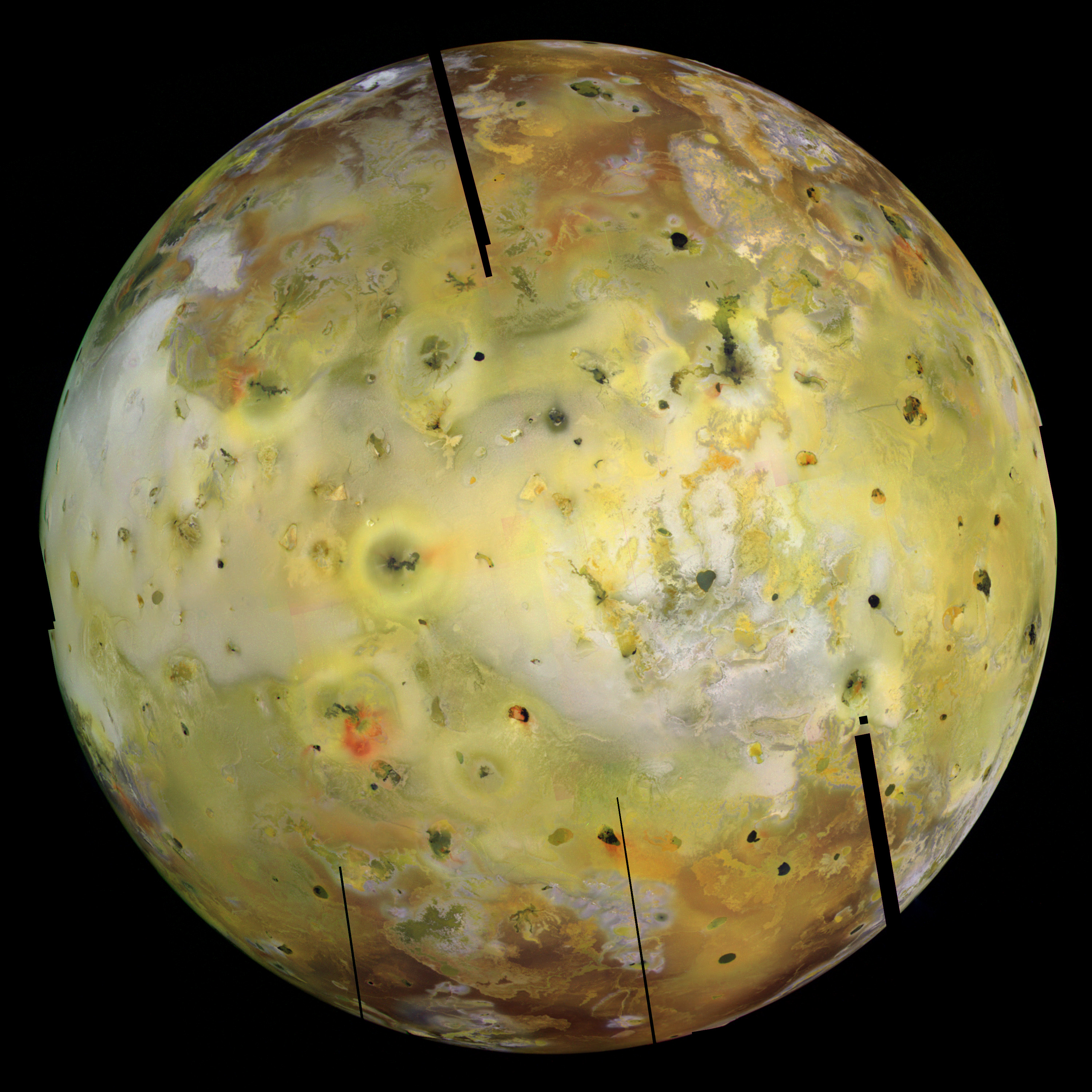
      The predominate volatiles, i.e. chemicals that can be sublimated or condensed at normal Io temperatures, are sulfur and sulfur dioxide (SO2).  In fact, SO2, the SO2 photolysis product sulfur monoxide, and the various allotropes of sulfur are the only volatiles that have been definitely identified on Io's surface and in its atmosphere and volcanic plumes.  These two are also largely responsible for Io's colorful appearance.  Course grained sulfur dioxide is responsible for the white-gray regions seen across Io's surface, including the large Colchis and Bosphorus regions seen in the color C21 mosaic.  Finer grained sulfur dioxide is more transparent at visible wavelengths, but can be identified using near-infrared absorption bands.  Band depth and width maps using near-infrared spectral data from Galileo has been used to create maps of SO2 abundance and grain size across Io in paper such as Doute et al. 2001. Sulfur dioxide is also the dominant chemical species in Io's plumes (from re-volatilized surface frost) and atmosphere and the deposition of which can produced bright regions surrounding volcanic plume vents.  Finally, sulfur dioxide maybe a primary lava in some areas, such as the bright floor of Balder Patera, during the early stages of patera formation as terrain above a sill starts to melt.

      Sulfur in various forms can be seen across Io's surface as red, red-brown, orange, and yellow region across its surface.  Diatomic sulfur (S2) is outgassed from Io's interior during volcanic eruptions, in some cases forming large plumes (along with condensing sulfur dioxide) such as those at Pele or Tvashtar.  S2 is quickly reorganized into reddish S4, by photolysis, when it is deposited on the surface, helping to create the large red rings seen around some active volcanoes on Io.  Over time, continued photolysis builds sulfur into the stable cyclic S8 form, which is yellowish in color.  This is why plume deposits from briefly active volcanoes eventually fade back to the earlier appearance from before the eruption (like at Grian Patera).  At Io's poles, where charged particles can more easily reach the surface, cyclic sulfur can be broken back down into S4 form, producing Io's dark, reddish-brown polar regions.

      Additional volatiles have been suggested for Io based on models of Io's volcanic gas chemistry, tentative identification of absorption bands in near-infrared spectra of Io's surface, and spectra of the neutral cloud that surrounds Io.  For example, additional sulfur oxides are likely in Io's atmosphere, such as sulfur monoxide (SO) and polysulfur oxide (SxO) based on models of Io's gas chemistry.  Additional thermochemical models of Io's volcanic gases suggest that sodium chloride would be a dominant salt in Io's plumes, and this is support by the identification of Na+ and Cl- in the Io Plasma Torus and NaCl in the dust streams that radiate out from Jupiter and have been associated with Io.  Potassium chloride is also likely.  Sulfuryl chloride (Cl2SO2) was tentatively identified at 3.92 Î¼m within the reddish plume deposit at Marduk by Schmitt and Rodriguez 2003.  Those authors also suggested that Cl2S might be the cause for the red color of the deposit, though how this fits with the ability for other reddish deposits to fade rather quickly is not certain.  Kargel et al. 1999 attributed Io's reddish material to impurities in Io's volcanogenic sulfur, such arsenic and selenium, which can drastically change the color of sulfur even at very low concentrations (~1%).  They also suggested that the green color of some paterae on Io, like Chaac Patera, may result from the interaction between sulfur and cooling, iron-rich lavas, forming pyrite. 

      Finally, water or at least hydroxyl may have been identified on Io by way of a 3.15 Î¼m absorption band and a broad one found at 3 Î¼m in the low spectral resolution NIMS data from the flybys. The 3.15 Î¼m band was initially found in ground-based data by Salama et al. 1990 and identified with either H2O or H2S.  However the lack of a corresponding 2.97 Î¼m feature suggests another culprit for this absorption band, perhaps HCl.  The 3 Î¼m band is observed in high-spatial, but low-spectral, resolution data at several mountain structures, such as Gish Bar Mons, Tvashtar Mensae, and Tohil Mons.  One possible explanation is that these features maybe the result of water ice or hydrous minerals deposited on Io by small cometary impacts in the last million years that have been brought back to the surface by the uplift of these mountains.  However the lack of other water ice absorption bands at 1.48 and 2.0 Î¼m led Granahan in 2004 to look for another compound that might create the observed band at 3 Î¼m.  He identified pyrite (FeS) or pyrrhotite as possible compounds responsible for the absorption bands. 

      Of course many of the chemical identifications on Io (save sulfur and sulfur dioxide) are either tentative or are based on chemical models of Io's volcanic gases or photolysis of gases in its atmosphere and plumes.  Additional spectroscopic studies with much higher spectral resolution than what was obtained by Galileo during its Io flybys will be needed to settle many of our questions about Io's surface composition.  Information on the eruption temperature of Io's lavas, in situ mass spectroscopy of its atmosphere and plumes, and gravity estimates of its interior structure will also be needed to refine our knowledge of Io's bulk composition.  The measurements will hopefully await us in the 2020s with IVO and JEO.

      Thursday, December 31, 2009

      Reprocessed images from Ted Stryk and jekbradbury

      With only a few hours left in 2009 (here in Tucson anyway, I know its already 2010 for you folks in the Eastern Hemisphere), I thought I would do a quick round-up from news and interesting links from the last few weeks that I haven't had a chance to get to.  Enjoy!

      On the reprocessed images front, Ted Stryk has taken a look at some global views of Io taken by Galileo, including some optical navigation frames from March 31, 1997 during a mutual event between Io and two of Jupiter's small inner moons, Metis and Adrastea, and GLOCOL01 from October 16, 2001.  Ted combined three frames from 1997 to show not only the windows (used to further compress the data sent back from Galileo) around Adrastea and Io (well the limb of Io anyway), but a plume on Io's limb.  The location of the plume, as Ted points out, suggests that it was associated with Pele, but the size of the plume and its brightness at this phase angle makes me think otherwise...  maybe the plume is Pillan instead, but this data was taken at least a month before the eruption began.  I'll have to check into that.  The other image Ted processed was the GLOCOL01 global color observation from orbit I32, taken shortly after a flyby of Io.  I previously presented my version of this image.  Ted was able to pull out the plume from the Thor eruption that summer and fall.  I am amazed he was able to pull that out of the violet filter data.  My own stretching of that same data, shown at left (the plume is on the bright limb on the lower left hand portion of the image), BARELY shows that plume at all, suggesting that Ted had to noise filter that image to an extreme degree... great job, Ted!

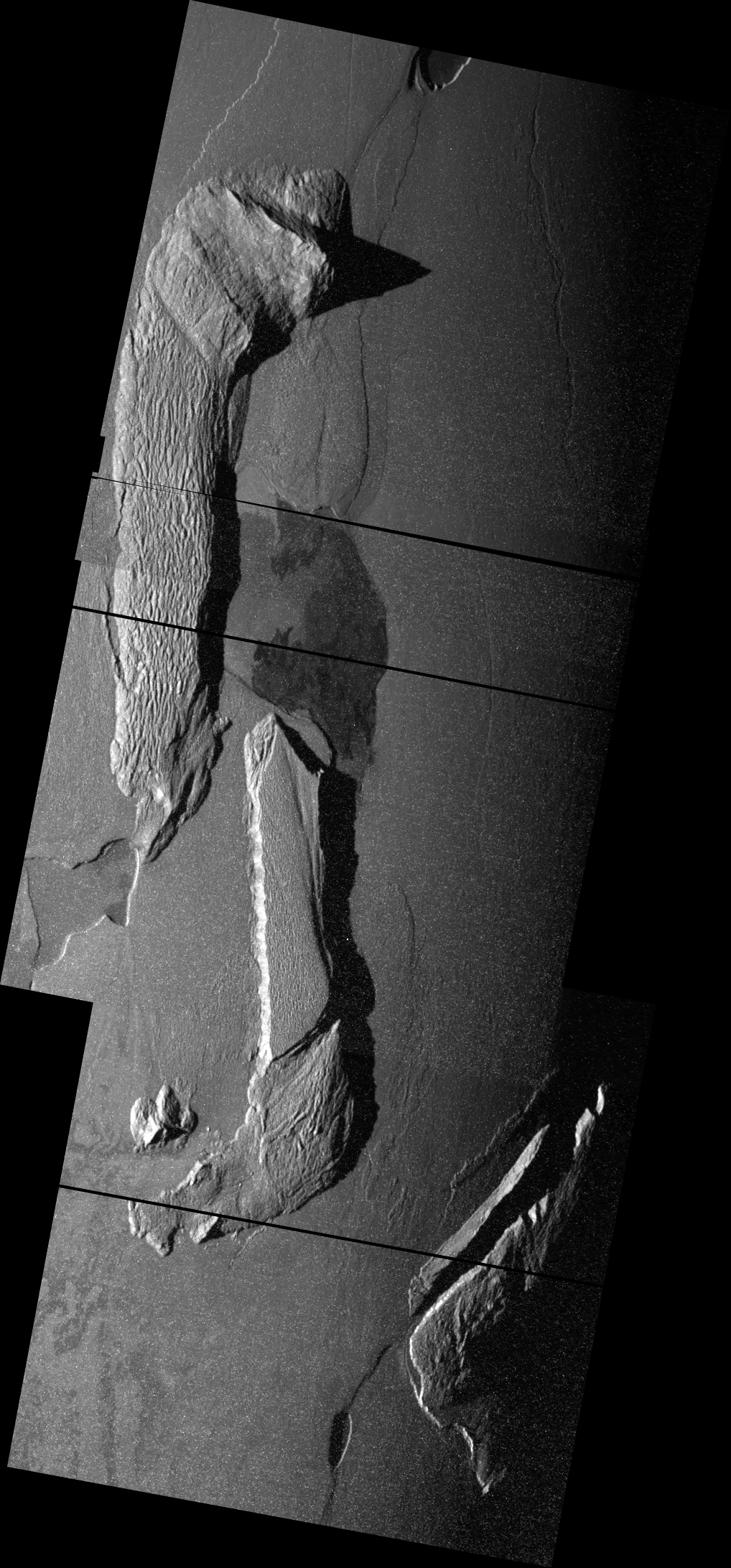
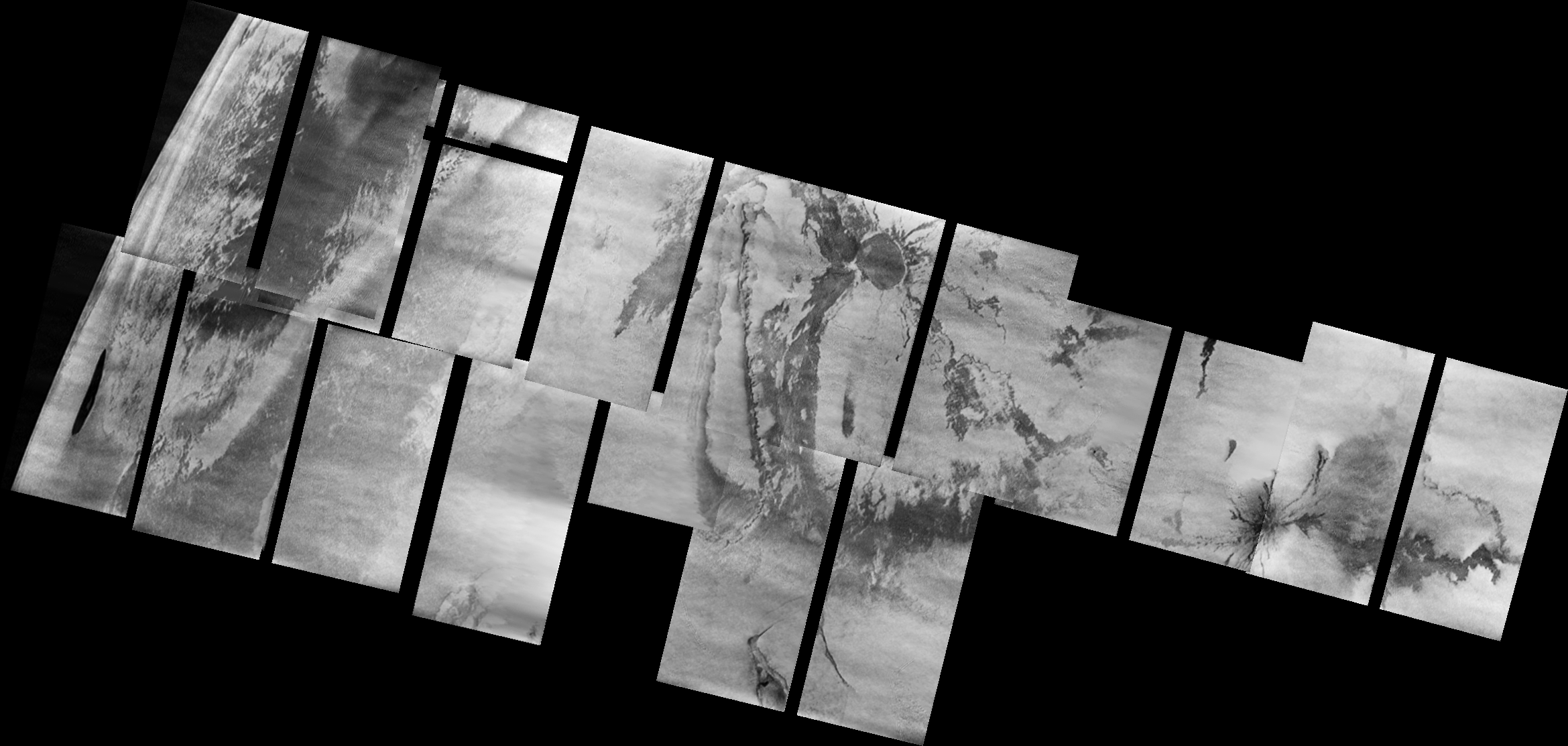
      As jekbradbury commented here last week, he was able to bring out some details from some garbled I24 images that had yet to be reconstructed.  These images are marred by dark, vertical bands resulting from a corruptions of the camera's image summation algorithm.  Details on the image he processed can be found at the unmannedspaceflight.com forum.  The resulting image shows the current (as of 1999) main flow of Volund on the right side of the image and older, greenish flows to right of that dark flow.  For comparison, see the image at right taken from a color mosaic acquired in March 1998.  I think he is correct in his assessment that it isn't very useful for scientific uses since the data is so garbled, the effective resolution isn't any better than data acquired earlier in the Galileo mission, like the image at right.  However, it is nice to see this "lost" data set finally get some attention paid to it.  Perhaps the full ZAMAMA02 mosaic can be put together, even if some frames are of lower quality.

      We are coming up on the 400th Anniversary of Galileo Galilei's discovery of the Galilean satellites.  If you know of any event commemorating this occasion, feel free to send them along to me and I will post them here on the blog.  I don't know of one here in town, I might have a small party at my home next weekend, but that is about it at this point.

      Tuesday, December 29, 2009

      New Frontiers Mission Candidates Selected

      Candidates for the third New Frontiers mission (the first two being New Horizons and Juno) have been selected by NASA's Science Mission Directorate.  As stated in the press release, these missions include:
      • The Surface and Atmosphere Geochemical Explorer, or SAGE, mission to Venus would release a probe to descend through the planet's atmosphere. During descent, instruments would conduct extensive measurements of the atmosphere's composition and obtain meteorological data. The probe then would land on the surface of Venus, where its abrading tool would expose both a weathered and a pristine surface area to measure its composition and mineralogy. Scientists hope to understand the origin of Venus and why it is so different from Earth. Larry Esposito of the University of Colorado in Boulder, is the principal investigator.
      • The Origins Spectral Interpretation Resource Identification Security Regolith Explorer spacecraft, called Osiris-Rex, would rendezvous and orbit a primitive asteroid. After extensive measurements, instruments would collect more than two ounces of material from the asteriod's surface for return to Earth. The returned samples would help scientists better understand and answer long-held questions about the formation of our solar system and the origin of complex molecules necessary for life. Michael Drake, of the University of Arizona in Tucson, is the principal investigator.
      • MoonRise: Lunar South Pole-Aitken Basin Sample Return Mission would place a lander in a broad basin near the moon's south pole and return approximately two pounds of lunar materials for study. This region of the lunar surface is believed to harbor rocks excavated from the moon's mantle. The samples would provide new insight into the early history of the Earth-moon system. Bradley Jolliff, of Washington University in St. Louis, is the principal investigator
      As a result of the restriction of using solar panels for this round of missions, each of these candidate missions will be sent to targets in the inner solar system or the asteroid belt.  While outer solar system missions with short primary missions are possible with a combination of solar panels and batteries (as has been suggested for potential Enceladus sampling missions or Saturn atmospheric probes), none were selected for this round's New Frontiers mission.  Io was a possible target for this round, but the solar panel restriction made an orbiter or a flyby spacecraft unlikely, and I don't think any were seriously proposed this time around.  The next New Frontiers mission after this one is currently expected to allow the use of radio-isotope power sources.

      Out of these three potential missions, I would really like to see the SAGE mission approved.  No spacecraft has landed on Venus since before I was born (I am excluding the VEGA balloons here since they were primarily atmospheric probes).  And the descent imaging could be some of the most dramatic images that we could expect for the next decade.

      Check out Van Kane's post on this subject for more information.

      Link: NASA Chooses Three Finalists for Future Space Science Mission to Venus, an Asteroid or the Moon [www.nasa.gov]

      EDIT: As Ted points out in the comments, the VEGA probes did land on the surface, but they didn't return images of the surface, so they still don't count.  I am still looking forward to the descent images from SAGE.

      Monday, December 14, 2009

      Paper: Geomorphologic Mapping of Hi'iaka and Shamshu Regions

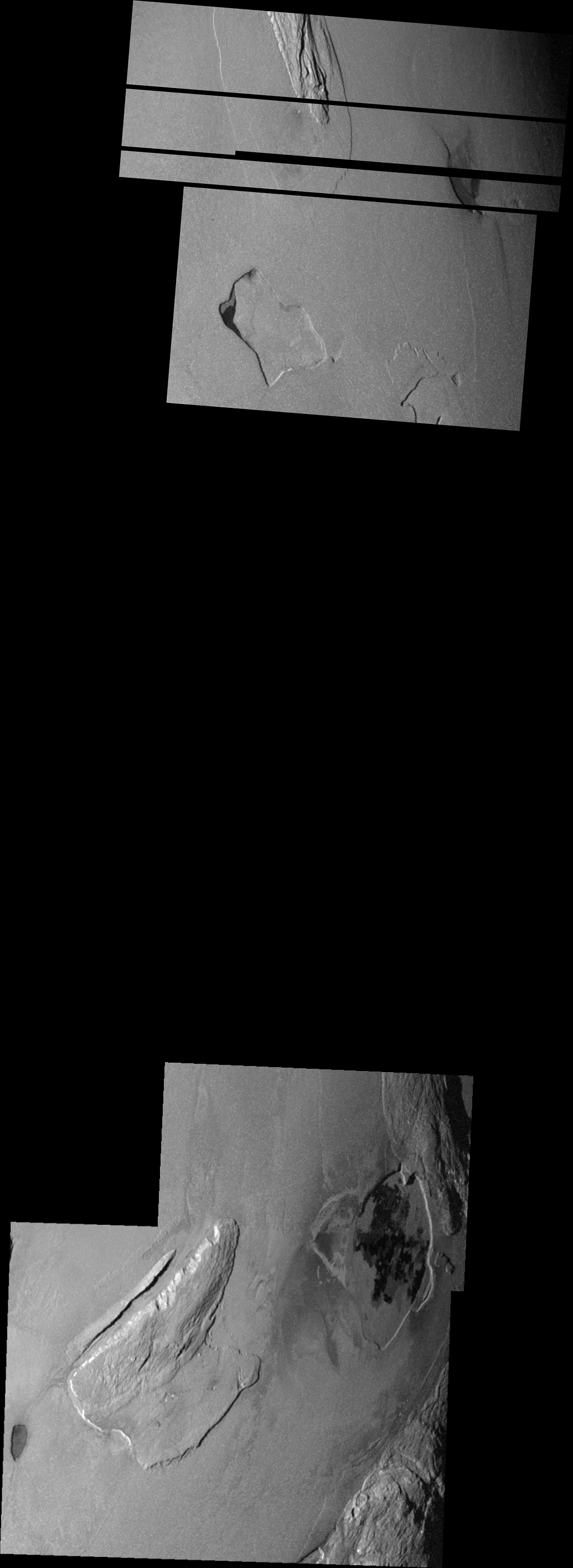
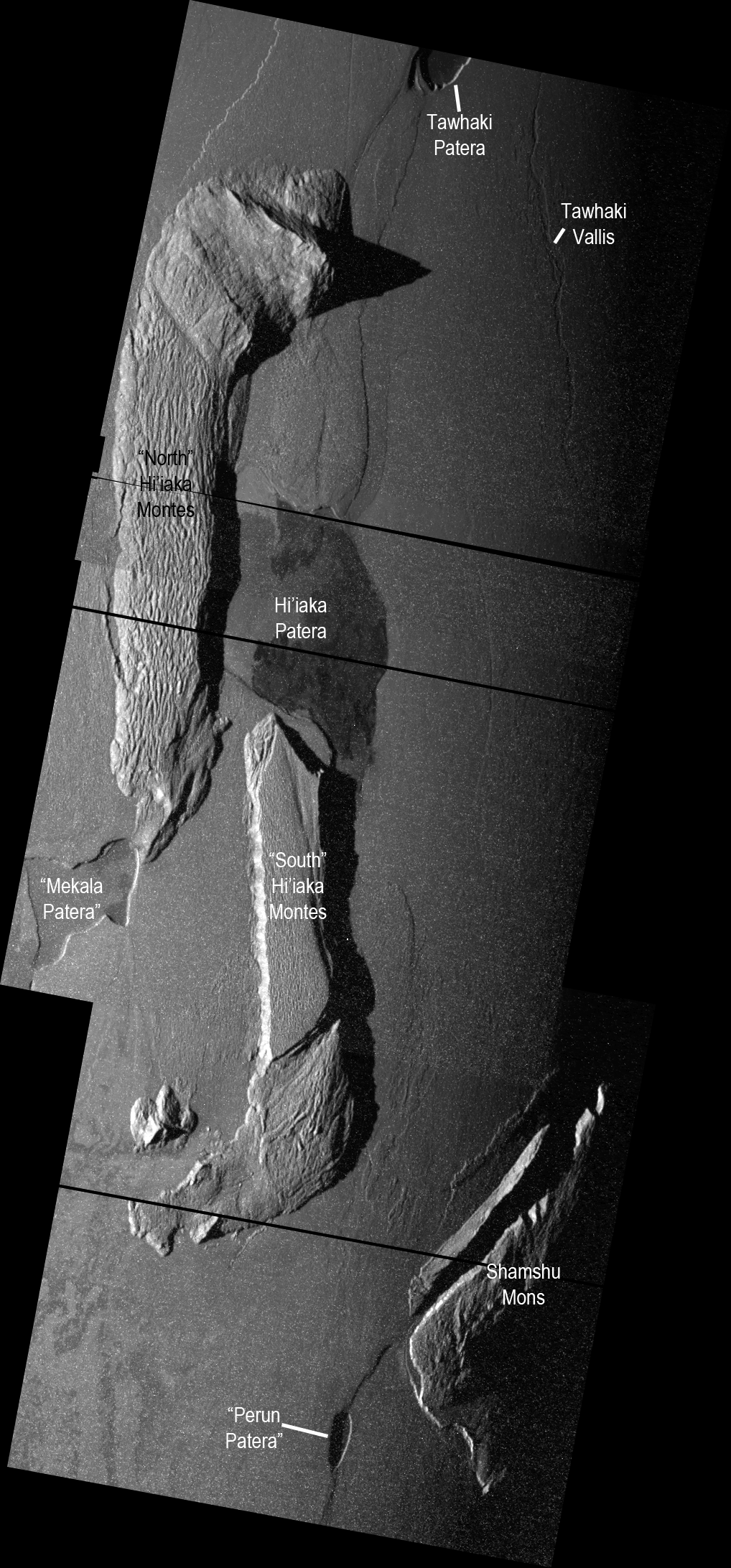
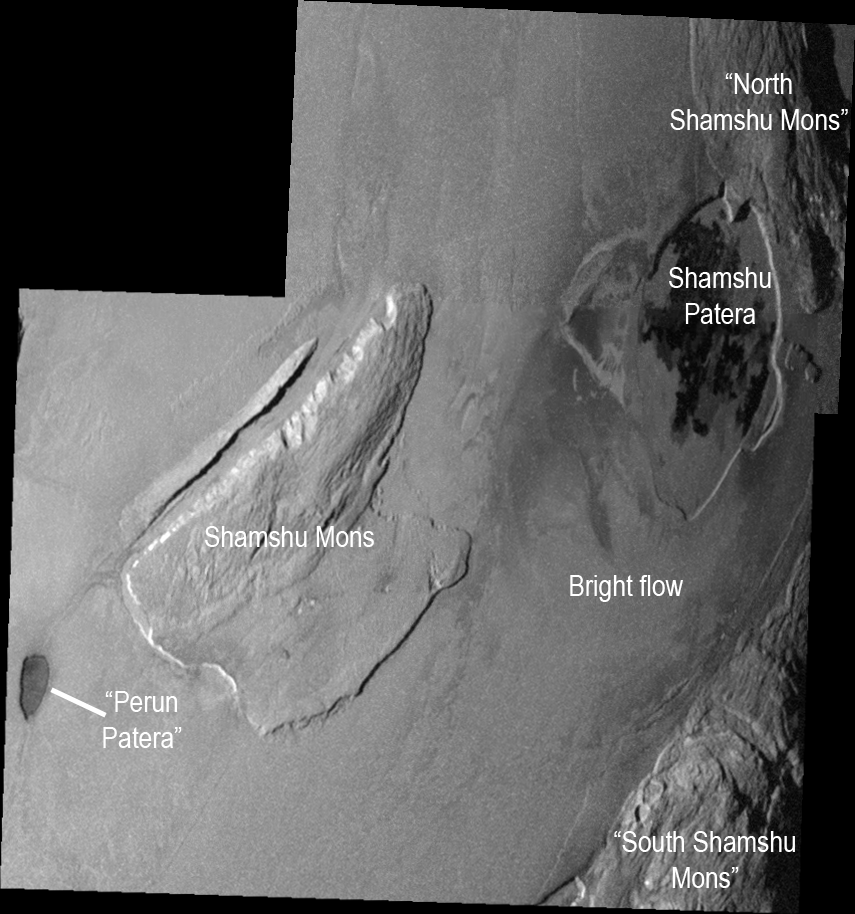
      On Friday, a new paper was published in press in the journal Icarus titled, "Geologic mapping of the Hi’iaka and Shamshu regions of Io".  In press articles are those that have been reviewed and approved for publication, but have not yet been published in the print journal.  This paper, by Melissa Bunte, David Williams, Ronald Greeley, and Windy Jaeger.  This paper discusses the results of a geologic mapping project based on the 25ISTERM__01 mosaic of the Hi'iaka region and the 27ISSHMSHU01 mosaic of Shamshu region [I've also uploaded labeled versions of these two mosaics, Hi'iaka and Shamshu, to help people with this discussion].  These two regions are dominated by a patera with a floor partially covered in dark lava flows surrounded by several large mountains.  This paper is part of a series of geomorphologic mapping projects using medium-resolution Galileo mosaics of Io for their basis.  We previously covered papers discussing maps of Prometheus and Zal.  Other regions mapped by the ASU group include: Chaac-Camaxtli, Culann-Tohil, Zamama-Thor, and Amirani-Skythia-Gish Bar.  In March, I covered this group's LPSC abstract covering the mapping of Hi'iaka and Shamshu, so bare with me if I repeat some things from that post..

      For this paper, the authors created two geomorphologic maps of the regions surrounding Hi'iaka and Shamshu Paterae, two volcanoes near Io's equator on the leading hemisphere.  These maps were based primarily on two SSI mosaics from Galileo's I25 and I27 encounters with Io in November 1999 and February 2000, respectively.  Color information and low phase brightness information was taken from the global color mosaic produced by the USGS.  Geomorphologic maps are a type of geologic maps where different surface units are identified and mapped so that relationships between these different units can be identified.

      In the case of the Hi'iaka and Shamshu regions, four basic units types were identified: plains material, mountain/plateau materials, patera floor materials, and lava flow materials.  These units were also identified in the mapping of other regions on Io, though diffuse material, recent surface coatings that are derived from volcanic or sapping processing and identified in other mapped regions, was not identified in the Hi'iaka and Shamshu regions.  It should be noted though that diffuse materials are often transient; red diffuse material was observed in a faint partial ring of material surrounding Hi'iaka during Galileo's first orbit of Jupiter, suggesting the presence of a plume at Hi'iaka shortly before June 1996.

      These four basic units were further sub-divided into different sub-units based on their albedo, color, surface texture, or structural contacts.  For example, mountain units are divided into lineated (ridged/grooved material, generally found at higher altitudes, bounded with plains by scarps), mottled (hummocky, often with lobed margins), undivided (intermediate in texture and altitude between the mottled and lineated types), and plateau (flat-lying terrain with smooth or hummocky textures) types.  Based on the spatial relationships between these units, the authors theorize that these types represent different stages of degradation on Io's mountains.  Lineated mountain units tend to be higher standing and have sharper unit contacts with the surrounding plains, suggesting that terrains of this unit have undergone the least amount of degradation.  The ridges and grooves, such as those seen above at north Hi'iaka Montes, are the result of down slope slumping of a mobile surface layer atop the mountain (see Jeff Moore's 2001 paper on slope degradation on Io).  Remember that mountains are thought to be tilted crustal blocks, the ridged and grooved top surface of the mountain is the result of the upper few kilometers of the mountains, which is a mix of basalt and sulfurous materials that was once part of the upper few kilometers of Io's flat plains.  Once that upper layer sloughs off, the unit transitions to the undivided or mottled types (though the mottled types are likely a mix of old mountain and the mass wasted materials surrounding the mountain).

      A similar age progression in sub-units was also noted in patera floor and lava flow materials based on color and albedo (for dark flow/patera floor materials, darker equals younger).  The paper only mentions briefly the debate whether some bright or yellowish lava flows are primary or secondary sulfur flows, or silicate flows with chemical altered surfaces.  The authors (and I agree) that these flows are likely old silicate flows.  This supported less in this region but at Thor, where an outburst eruption generated lava flows that overlapped those of an older, yellowish flow.  Exceptions to this could include a bright white flow to the south of Shamshu Patera and the orange floors of "Mekala Patera" and western Hi'iaka Patera, which could be due to mobilized sulfur dioxide and sulfur, respectively.

      As I mentioned in my post from March on the researchers' LPSC abstract on this subject, the authors examined the hypothesis that the three mountains that surround Hi'iaka Patera had at one point been part of a single structure that had split apart as a result of strike-slip and extensional faulting.  This fault would have also resulted in the creation of pull-apart basins that would become Hi'iaka Patera and orange-color patera to the lower left of north Hi'iaka Montes (named Mekala Patera in the paper).  The authors note that the freshest lava flows on the floor of Hi'iaka appear to emanate from the eastern and southern margins of the patera, a pattern consistent with this break-up scenario.  This model of regional-scale plate tectonics was also applied to the mountains in the Shamshu region (with Shamshu Patera being presented as a pull-apart basin) with less convincing results, but it does suggest a new line of investigation to see just how prevalent this style of plate tectonics is on Io with mountains forming, breaking apart, and shifting around across Io's surface.  How many other close groupings of mountains were the result of a single mountain being broken apart by strike-slip and extensional faulting?  I should note that several Ionain mountains have been observed with canyons running down the centers as a result of extensional faulting, like Ionian Mons (upper left), Mongibello Mons, and Danube Planum.

      This paper summarizes the results of geomorphologic mapping of the Hi'iaka and Shamshu regions on Io based on regional-scale imaging by Galileo, finding units consistent with those found in other regional mosaics of the satellite.  The geologic history of these regions based on their mapping supports earlier research into this area by authors like Turtle et al. 2001 and Jaeger et al. 2001 that Hi'iaka Patera formed as the result of Hi'iaka Montes breaking apart by strike-slip and extensional faulting.  Magma then ascending to the surface using these same faults that bounded the pull-apart basin.  At this point, the volcanic activity at both Hi'iaka and Shamshu appear to be dominated by compound lava flows, unlike the lava lakes seen at Pele and Loki.  The mountains were then further degraded by gravitational mass wasting, SO2 sapping from ice layers within the mountain, and thermal erosion from nearby volcanoes.  Thermal erosion by flowing lava is thought to be responsible for Tawhaki Vallis, a channel observed to the right side of the image at top, as proposed by Schenk and Williams 2004.  Each of mountains in the region exhibit signs of degradation, from the ridges and grooves atop north Hi'iaka Montes and north Shamshu Montes, indicative of a slumping mobile surface layer, to hummocky-textured and lobe-edged landslide deposits, indicative of gravitationally- or sapping-induced mass wasting.

      I think that leaves one more region to map, Tvashtar.

      Link: Geologic mapping of the Hi’iaka and Shamshu regions of Io [dx.doi.org]

      Friday, December 11, 2009

      A Few New Io/Jupiter System Papers

      Sorry for the hiatus there is posts over the last couple of months.  I've just been a bit busy with Cassini plus I wanted to take a bit of a break after posting so much in September and October.  I wanted to post a quick note letting you all know about three new Io/Jupiter System related papers currently in press in the journal Icarus.

      The first is titled, "Geologic mapping of the Hi'iaka and Shamshu regions of Io" by Melissa Bunte, David Williams, Ronald Greeley, and Windy Jaeger.  This paper is the latest in a series that covers the geologic histories of some of the regions observed at high- and medium-resolution by Galileo during its flybys in the late 1990s and early 2000s.  Back in March, I covered the authors' LPSC abstract on this research so you can read up on that while I slowly get through this paper and post a summary over the weekend (hopefully, there is a major Titan flyby today whose data comes back Sunday morning).

      The other Io paper is titled, "Multi-wavelength simulations of atmospheric radiation from Io with a 3-D spherical-shell backward Monte Carlo radiative transfer model" by Sergey Gratiy et al.  Yeah, that's going to take me a bit longer to get through.  Hopefully I can post something next week.

      The final paper that caught my eye in Icarus is titled, "Global geological mapping of Ganymede" by G. Wesley Patterson et al.  This paper discusses the completed Ganymede global geologic map and presents research on the observed geologic units on that satellite.  Again, I've only flipped through the article, and maybe later this month I can write up something about it.