Sunday, February 28, 2010

Lunar and Planetary Science Conference Starting Tomorrow

Over the last month and a half, we have been taking an early look at some of the Io research that will be presented at the Lunar and Planetary Science Conference, which starts tomorrow in Houston, Texas.  I will not be there in Houston for the conference, but I will be in spirit.  That's not really the same...

Anyways, if you are going to the conference and you start getting sick and tired of same ol' Mars and Moon talks and posters, and you start asking yourself, "Is there nothing here that's cool and different, and not covered in hematite concretions?", here is your Io itinerary:

Tuesday evening, March 2, 6:30–9:30 pm: Poster Session I

Mission Plans and Concepts
Wednesday Afternoon, March 3, 1:30 pm: Planetary Atmospheres
Thursday evening, March 4, 6:30–9:30 pm: Poster Session II

Planetary Atmospheres
Satellites and their Planets
Igneous and Volcanic Processes
Also if you or someone you know will be blogging or twittering from the conference, send me a note and I will post a group of links to them in a post tomorrow.

Link: 41st Lunar and Planetary Science Conference [www.lpi.usra.edu]

Friday, February 26, 2010

LPSC 2010: Simulating Io's Auroral Emission in Eclipse

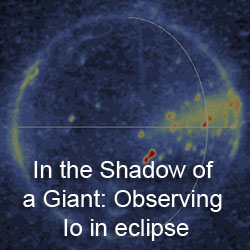
Yesterday, we talked about a model of Io's atmosphere using the Direct Simulation Monte Carlo (DSMC) method.  Today we look at another Monte Carlo (MC) model of Io's atmosphere, this time focusing on simulating the emission of Io's atmosphere during an eclipse.  Like the research discussed yesterday, both the abstract for next week's Lunar and Planetary Science Conference (LPSC) and a new paper in press in Icarus are available.  The LPSC abstract is titled, "Io's UV-V Eclipse Emission: Implications for Pele-type Plumes," by Chris Moore, David Goldstein, Philip Varghese, and Laurence Trafton.  This research will be presented as a talk next Wednesday afternoon, March 3 in the Planetary Atmospheres session.  The Icarus paper in press is titled, "Monte Carlo Modeling of Io’s [OI] 6300 Å and [SII] 6716 Å Auroral Emission in Eclipse," by Chris Moore, K. Miki, David Goldstein, K. Stapelfeldt, Philip Varghese, Laurence Trafton, and R.W. Evans.  Both cover the topic of simulating Io's auroral emission when the satellites goes into eclipse, but under different regimes: the LPSC abstract discusses emissions in the mid-ultraviolet as the result of SO2 and S2, while the Icarus paper talks about emissions in the red portion of the visible spectrum from oxygen (from decomposed SO2).

Last year, this same group published a paper on the dynamics of Io's atmosphere during an eclipse, which occurs each Ionian day when the satellite passes into the shadow of Jupiter.  Each eclipse lasts around 2 hours and 20 minutes.  During this time, no direct sunlight reaches Io surface, though Europa-shine and refracted sunlight from Jupiter's atmosphere can faintly illuminate the surface.  The authors found that Io's atmosphere doesn't completely collapse during an eclipse, as a diffusion layer of non-condensable atmospheric species like oxygen and sulfur monoxide forms near the surface, preventing sulfur dioxide above it from condensing out on to the surface.  With their model from last year's paper in hand, the authors further examined it, seeing how their model results would appear at different emission bands of the species they included in their model atmosphere (SO2, O, SO, S, and O2).  They also examined the emission from S2 gas present in volcanic plumes like Surt and Pele, and the effects of volcanic activity on the other emission bands.

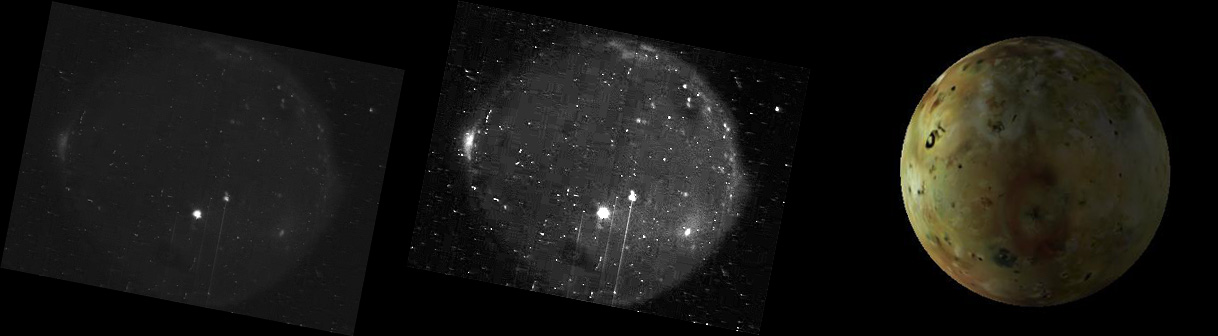
In their Icarus paper, Moore et al. focused on two emission bands, the prominent [OI] oxygen emission line at 630 nm and the much fainter [SII] band at 670 nm (both in the red portion of the visible spectrum).  Thus in the image above, the emission examined would be colored in red, so that covers much of the limb glow.  This limb glow shifts between the north and south polar region of Io, as seen by Galileo and Cassini.  Observations by Trauger et al. 1997 also revealed a high altitude bright spot in the [OI] line over the leading hemisphere, which is actually on the wake side of Io since the magnetosphere of Jupiter spins faster than Io revolves around Jupiter.  Moore's simulation of Io's atmosphere in eclipse was able to match the observed position of the bright wake spot, but not its intensity.  The model suggests that the position of the wake bright spot (which can be seen either above or below the equator) and the polar limb glows are related to the depletion of electrons from the Io-Jupiter flux tube, which effects the 630 nm emission by Io's position above or below the plasma torus, volcanic plumes (particularly large polar plumes), the density of the polar atmosphere, and Io's effect on Jovian magnetic field lines.  The authors also found that the [SII] emission is much weaker than the [OI] oxygen line, in part because of the lower S+ (remember, the ratio of oxygen to sulfur in Io's atmosphere is roughly 2 to 1).

The LPSC abstract examines emission bands by SO2 and S2 in the mid-ultraviolet to the visible (250-600 nm) as Io ingresses into an eclipse.  The authors found that the distribution of this emission across Io's sub-jovian hemisphere (the area covered by Trauger et al. 1997 Hubble observations) is strongly effected by volcanic plume activity.  These plumes act as shields for the atmosphere south of them from the electrons from the Jupiter-Io flux tube, reducing the energy of these electrons.  For example, if both the Surt and Acala plumes are active, the northern Surt plume shows up bright due to S2 emission above 300 nm, while Acala plume south of it appears fainter because molecules in its plume are not as excited by flux tube electrons.  The authors also examined the difference between the western and eastern halves of the sub-Jupiter side of Io at these wavelengths.  With the Surt and Pele plumes active, the emission from Io was much greater than if they were off.  The ratio between the eastern and western halves was greater than one when both are off because of emission from SO2, which as a greater density on the eastern half because before the eclipse, it had been in the afternoon (remember from the article yesterday that Io's sublimation atmosphere peaks in density where the frost temperature is greatest, around 2pm in the afternoon).  When both plumes are one, that ratio becomes less than one as the brightness of the S2 emission from the Surt plume dominates the brightness on the western side.  With significant differences such as these, the authors suggest that even barely disk-resolved spectra, particularly around 300 nm, can be useful for determining the activity of volcanic plumes on Io from Earth-based data.

These two papers explore Io's auroral emission at various wavelengths from the mid-ultraviolet to the visible using a simulation to explain the observations we have on hand.  They show that the auroral glow of Io's atmosphere is affected by volcanic plume activity, such that observations from Earth can be used to determine the presence or absence of different plumes, Io's position in the magnetosphere, and the density of Io's atmosphere.  These simulations also explore the various chemical species in Io's atmosphere and how even minor constituents like oxygen, formed from the disassociation of sulfur dioxide, can have a strong effect on its auroral, so vividly seen when Io is in eclipse.

Link: Io's UV-V Eclipse Emission: Implications for Pele-type Plumes [www.lpi.usra.edu]
Link: Monte Carlo Modeling of Io’s [OI] 6300 Å and [SII] 6716 Å Auroral Emission in Eclipse [dx.doi.org]

Thursday, February 25, 2010

LPSC 2010: Modeling Io's Atmosphere in Three Dimensions

Okay, it is about time I finished up my coverage of the abstracts covering Io science for next week's Lunar and Planetary Science Conference.  Today I am going to talk about "Modeling the Sublimation-Driven Atmosphere of Io with DSMC" by Andrew Walker, Sergey Gratiy, Deborah Levin, David Goldstein, Philip Varghese, Laurence Trafton, Chris Moore, and Benedicte Stewart.  A paper in press in Icarus was published last month by the group covering this topic, "A comprehensive numerical simulation of Io’s sublimation-driven atmosphere".  This post will act as a summary of both the LPSC abstract and the paper.  The LPSC paper will be presented as a talk next Wednesday afternoon, March 3 in the Planetary Atmospheres session.

In their model, Walker et al. used the Direct Simulation Monte Carlo (DSMC) method for simulated Io's rarefied atmosphere in three dimensions.  Previous modelers explored Io's atmosphere as a single dimension, looking at how column density and temperature changes over the course of a day in response to changes in surface temperature, or as a two dimensional model that looked at how these parameters changed across a single latitude, axi-symmetric with the sub-solar point.  With a three dimensional model, the authors were able to explore the effects on Io's atmosphere from volcanic plume activity at known volcanoes like Pele and Prometheus, plasma bombardment heating from above, planetary rotation, sub-solar temperature (115-120 K), the residence time of fine-grained sulfur dioxide frost on bare rock, and variations in frost temperature and areal coverage.  The DSMC method models individual sulfur dioxide molecules (usually representative of the total number of molecules), which is useful when the atmosphere has such low density that the mean free path of sulfur dioxide molecules exceed that the length over which many gas properties propagate.  Similar modeling was performed by Austin and Goldstein 2000, though this new model includes the inhomogeneous frost coverage mapped by Galileo NIMS. This also allows the authors to graph variations in the translational, vibrational, and rotational temperatures (related to the different emission bands of sulfur dioxide based on motions of the S-O bonds), density and column density (number of sulfur dioxide molecules per cubic centimeter or over a square centimeter of Io's surface, respectively), and flow rate (expressed in the article as mach number).

Since the authors primarily modeled the sublimation component of Io's atmosphere, the column density and many of the other properties of the lower atmosphere were related to the temperature and areal coverage of sulfur dioxide frost on the surface as this part of the atmosphere would be in vapor-pressure equilibrium with that frost.  Because of the difference between the position of the peak frost temperature and the sub-solar point, ~30° to the east or 2pm local time, the column density near the surface peaks to the east of the sub-solar point.  This lag in peak frost temperatures results from the thermal inertia of SO2 frost.  Changing the sub-solar peak temperature from 115 K to 120 K causes a five-fold increase in the peak atmospheric column density from 4.7×1016 cm–2 to 2.7×1017 cm–2.  This brackets the lower and upper bounds for the atmospheric column density measured by earlier observers of Io's atmosphere.  Compare this to the column density to the Earth's, which is ~3×1025 cm–2.

I should point out at this point that this group published a companion paper (Gratiy et al.) that actually showed up in the Icarus in press page first, and was discussed here last month.  This paper compared their model of Io's atmosphere to actual observations taken a ultraviolet, infrared, and millimeter wavelengths.  One note that Walker et al. does make is that the variation in column density with latitude doesn't seem to match the Hubble Lyman-α observations, which showed a sharp drop-off in atmospheric density poleward of ±45°.  They suggest that this could be because of differences in frost temperature from the assumed cos1/4(ψ) latitudinal variation.

In other results, the authors found that heating from the Io plasma torus inflates the upper atmosphere of Io and keeps the nightside atmosphere from completely freezing out.  Plasma from Jupiter's magnetosphere only penetrates down to an altitude of 1 km at the point of peak frost temperature, and the altitude decreases the further you get from that point, reach the surface at the poles and on the nightside.  This actually means that the low altitude translational temperature of the SO2 in the atmosphere is higher on the nightside (where plasma reaches all the way to the surface due the lower atmospheric density) and particularly along the terminator.  At the terminator, the higher density dayside atmosphere interacts with the low density nightside atmosphere, leading to supersonic gas flow just past the dusk terminator and near the poles.

Tomorrow we will take a look at another LPSC abstract and Icarus paper by this group on modeling Io's auroral emission.

Link: Modeling the Sublimation-Driven Atmosphere of Io with DSMC [www.lpi.usra.edu]
Link: A comprehensive numerical simulation of Io’s sublimation-driven atmosphere [dx.doi.org]

The Gish Bar Times Two-Year Anniversary

Today marks the second birthday for the Gish Bar Times.  You can check out the original Welcome message that I posted two year ago.  The last year has seen a number of commemorations of various anniversaries related to Io, including the flybys of Voyager 1 and 2 in 1979, the Galileo flyby in October 1999, and the discovery of Io by Galileo in 1610.  Focusing on these anniversaries in the last year has been a large driver of content here on the blog in addition to the usual discussions over new papers and meeting abstracts.

Now during last year's birthday message, I said that I would expand our content to include more discussion of the other Galilean satellites of Jupiter.  To some extent I did this, with posts on the delivery of oxygen to Europa's ocean, but for the most part, I've continued to stay focused on Io here on Gish Bar Times.  I think in the end, the focus will remain on Io, but if there is an interesting story regarding the other Jovian moons, I won't hesitate to post about it, but it won't be prominent in our coverage.  Last year, I was concerned about maintaining readership levels while maintaining a focus on one Jovian moon, but in the last year, we have gone from 51 unique visitors per day in 2009 to 107 so far this year.  In each of the six months, the number of unique visitors has exceeded those of any previous month except for February and March 2009 when the Outer Planet Flagship Mission was selected.

So what can you expect over the next year?  Well, recently I have gotten into writing more articles on various Io topics, such as surface features or the exploration of Io.  I think what you can expect is more connection between my write ups on Wikipedia and posts here, which I think will be of interest to readers here.  If I am wrong about that, let me know, but I think that could help both in the coverage of Io on Wikipedia and provide new and interesting content for the blog.  So in the next year, expect to see more overview articles on the various volcanoes of Io.  Of course, we will continue to cover the Outer Planet Flagship Mission, the Discovery mission AO, and new papers and mission abstracts.

In the next few days, you can expect some minor changes to the layout of the blog, to make it feel more like a website than just a simple blog.  The first step in this plan was done on Monday when we moved the site to its new URL: http://www.gishbartimes.org.  That move is now complete, and some of the tools I had that were temporarily gone are now back online.  This includes comment deletion, so spammers, your window of opportunity to run wild here has now closed.  I will add additional features, such as static pages and a table of contents below the title.

So with two years down, here's to another!

Wednesday, February 24, 2010

Galileo I32 Terminator Mosaic

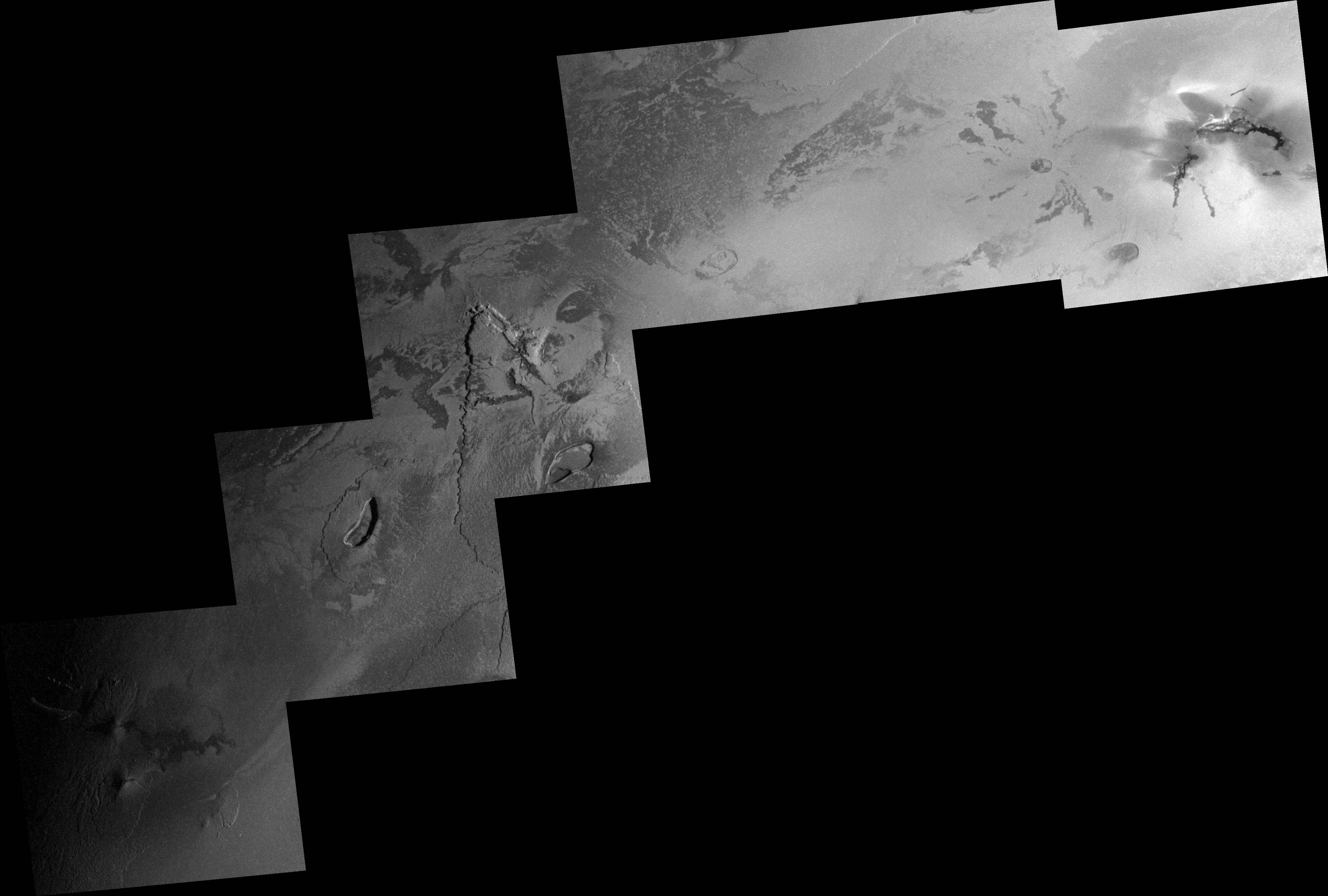
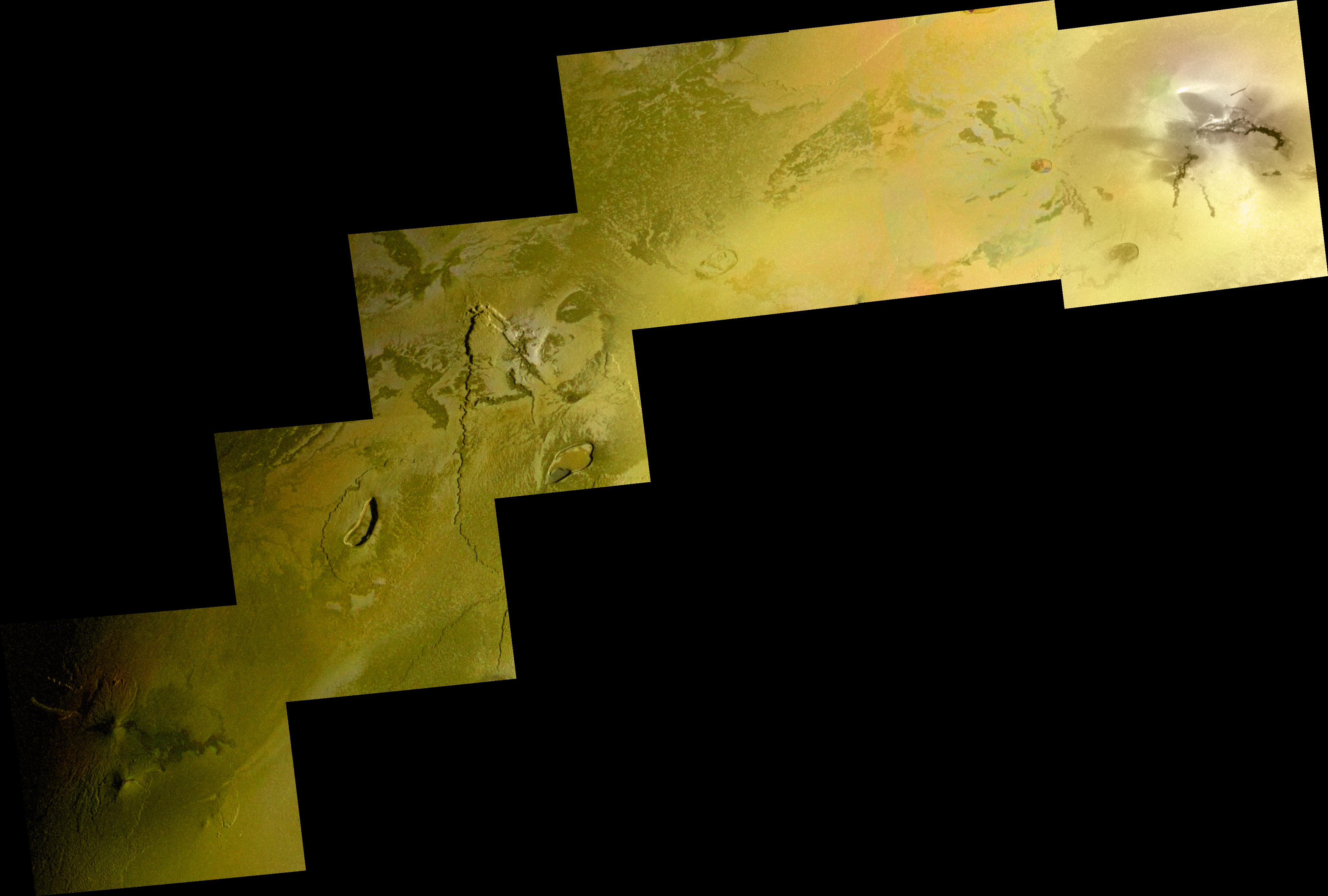
During Galileo's flyby of Io on October 16, 2001 (I32), the spacecraft's camera acquired two mosaics along its terminator that at the time ran along 175-180° West longitude.  One mosaic covered the southern hemisphere section, cutting across Michabo Patera, Tsui Goab, Culann, Tohil, and Mycenae Regio.  The Galileo imaging team released a version of that mosaic colorized with data from C21 a year later.

The other mosaic was to cover the northern hemisphere portion of the terrain near the terminator, useful for observing topographic features such as mountains.  However, during the previous Io encounter, Galileo discovered a new outburst eruption at Thor where no previous activity had been observed.  The imaging team decided to adjust the layout of this second terminator mosaic so that it would also cover Thor.  The result was the TERMIN02 mosaic that was returned following the October 2001 flyby.  What I wanted to present here is a colorization I have done of this clear-filter mosaic, combining it with color data from three orbits: E4, C21, and I31.  The full-resolution version of this color mosaic is also available.  The Thor eruption site is at top right and the Zamama plume site is at lower left.  At Zamama and at several other sites across the mosaic, we see shield volcanoes, volcanoes where lava has slowly built up a broad mountain with shallow slopes for the most part with the exception of basal scarps along their margin.  You can see similar morphology on a much larger scale at Olympus Mons on Mars.  You can also see areas where lava has craved broad channels into the sides of these shield volcanoes and onto the plains.

Enjoy!

Tuesday, February 23, 2010

Budgets, Carnivals, and Cryovolcanoes, Oh My!

Here are some short little news items that are hitting the interplanetary interwebs today:
  • Ian Musgrave's Astroblog is this week's host for the Carnival of Space, #142 of its name.  The Carnival of Space is a collection of links to the best space blog posts from the week that was.  In this edition, learn about the launch of the Solar Dynamics Observatory, the (then) ongoing STS-130 shuttle mission to install the Cupola at the International Space Station, and why the oxidation of iron creates a positive spectral slope in the visible (aka, "Why is rust red?").
  • Today, the Cassini Imaging and the Composite Infrared Spectrometer (CIRS) teams released a series of images from the November 21 encounter with Enceladus, a cryovolcanically active moon of Saturn.  This set of images includes some awesome mosaics, including one showing a series of water-rich jets erupting from fractures within the moon's south polar region and another combined with CIRS data to show thermal emission from one of these fractures, Baghdad Sulcus.  Also don't forget to check out two mosaics of Enceladus' leading hemisphere, an area not seen at high-resolution previously, and an 3D anaglyph (don't forget your red-blue 3D glasses) of a portion of Baghdad Sulcus.
  • Yesterday, NASA released further details on its proposed budget for the next fiscal year, FY2011, including the breakdown for Planetary Science.  Overall, the next year will see budget increases for the Planetary program with out-years showing shallower increases, that according to Van Kane, would barely cover inflation, possibly decreasing the budget's purchasing power. The Mars program and precursor missions (mostly Lunar) will see major increases, with more modest increases over the five projected years for the Outer Planets Program (Cassini, EJSM, and ROSES, a research grant program).  Until FY2013, the budget is inline with the project needs of the Europa/Jupiter System Mission for its Phase Pre-A and A when studies will be conducted to mitigate the radiation risk further, instruments selected using an Announcement of Opportunity, and the preliminary concept design finalized.  Starting with Phase B in FY2014, the budget does start to deviate from what is required for JEO, staying in the $150 million range when it should closer to $300 million (or $425 million if one includes reserves) in FY2014 and $400 million (or $600 million if one includes reserves) in FY2015.  While a bit discouraging, keep in mind that budget projections for years so far out are...very sketchy.  I don't trust them any farther than I can throw them; who knows who could be in the White House at that point.
Link: Carnival of Space #142 [astroblogger.blogspot.com]
Link: Enceladus Rev121: Forest of Jets [ciclops.org]
Link: FY11 NASA Budget Proposal Details [futureplanets.blogspot.com]

Monday, February 22, 2010

10th Anniversary of Galileo's I27 Encounter

I almost completely forgot about this, but today (for another 2 minutes here) is the tenth anniversary of the Galileo spacecraft's I27 flyby of Io.  This encounter occurred on February 22, 2000 and was the third of three flybys of Io that took place over a four-month period between October 1999 and February 2000.  The closest approach altitude was 198 kilometers.  It was the fourth Io flyby overall by Galileo (including the one right before orbit insertion) and took place during the spacecraft's 27th orbit of Jupiter.  Galileo went on to perform three more flybys of Io between August 2001 and January 2002.

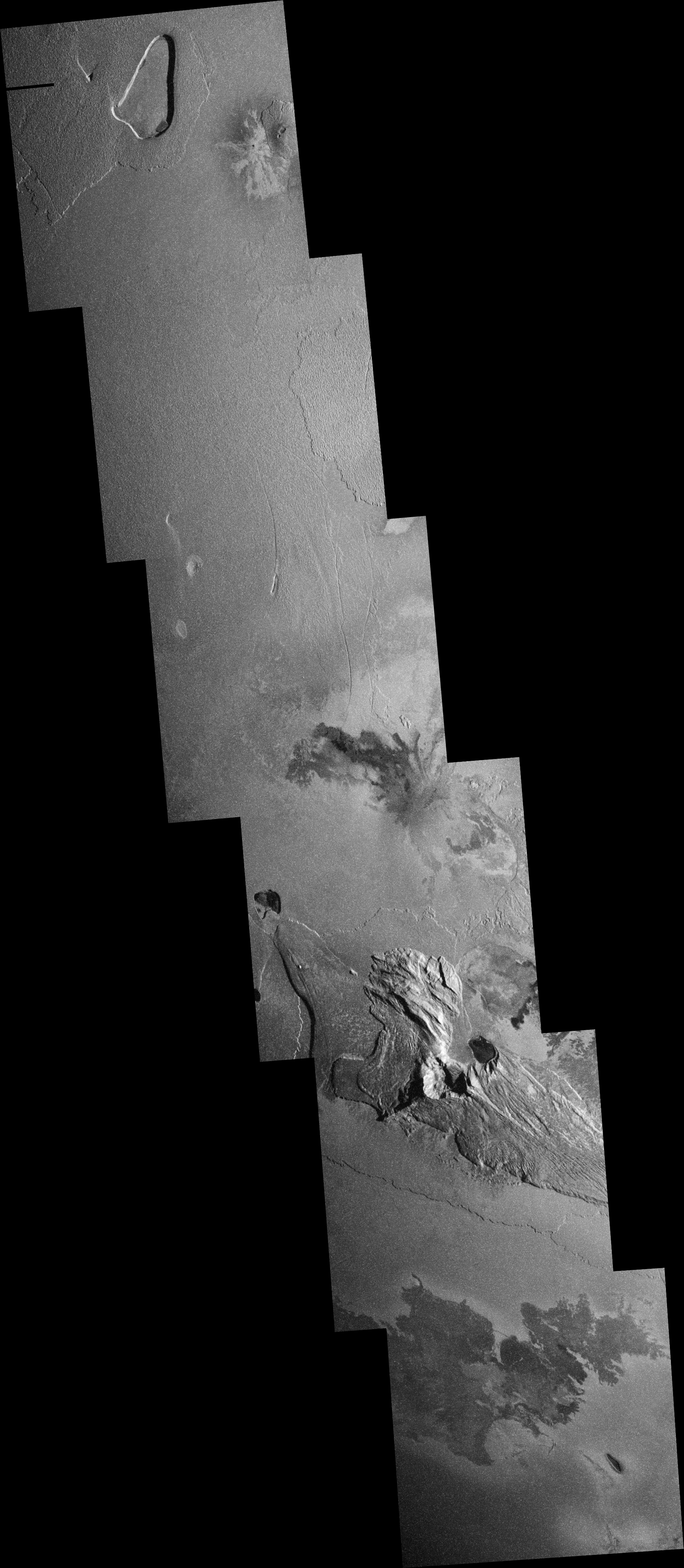
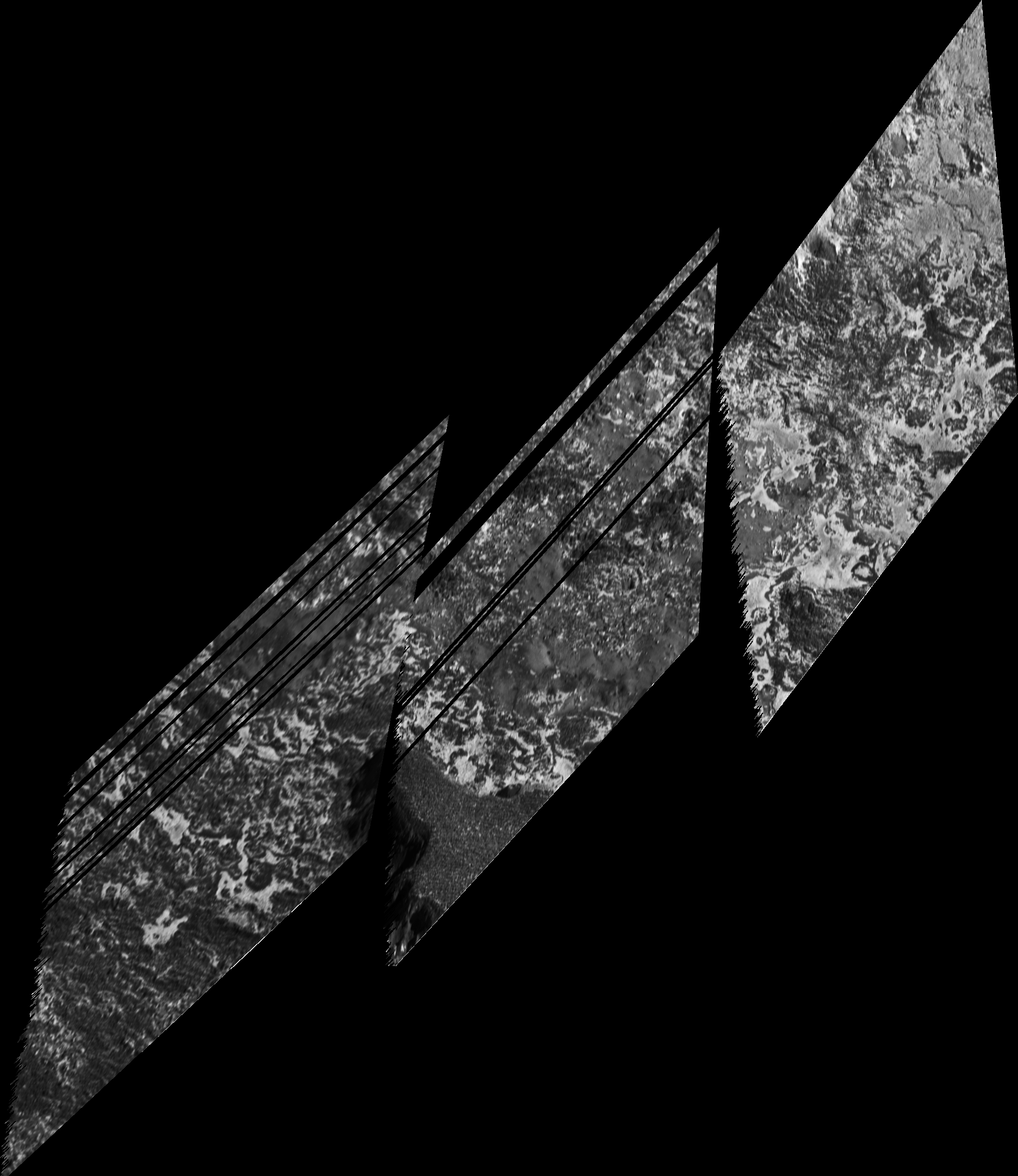
Compared to the first two flybys of this "Io campaign" section of the Galileo Europa Mission (the spacecraft's first extended mission), when spacecraft safe-mode events and instrument malfunctions limited the science return, the I27 flyby was relatively problem free.  All of the planned Io observations were acquired.  However, this did caused problems when it came to playing all that data back, as more images were planned than could be downlinked with the expectation that some data might be lost due to some spacecraft malfunction, like the other two encounters.  In which case, mission planner carefully selected which data to playback, in some cases skipping entire frames or only playing back a portion of others.  That was the case for the CHAAC_01 observation, a very high-resolution mosaic across Chaac Patera (a portion of which is shown above).  Another good example is the SOPOLE01 observation, a four-image, medium resolution mosaic that covered the southern mid-latitudes of the anti-Jupiter hemisphere, where only the first frame over Telegonus Mensae was played back in close to its entirety, while two others had 100 lines out of 800 played back.  These kinds of limits were seen in many of the SSI observations from this flyby, and that's even with three months between I27 and the next flyby, this time of Ganymede, G28.

For the other instruments on Galileo, I27 was a very exciting, with high resolution, Near-Infrared observations of Pele, revealing the location of the majority of the volcanoes thermal emission (which would be targeted by the camera in October 2001), coverage over the Chaac Patera and Camaxtli Patera region, which led to a confirmation of the connection between dark patera floor terrain and thermal emission as well as a patera covered in nearly pure sulfur dioxide ice (Balder Patera), and observations of the Prometheus and Amirani flow fields, showing the detailed thermal structure of these features.

For the camera, check out my I27 image page to see the images Galileo took during the flyby.  Among the highlights include the highest resolution images acquired of Io (covering layered terrain in Bulicame Regio, broken up by a dark promontory, a jagged fissure, boulders, and sapping channels), a 12-frame mosaic over the Chaac-Camaxtli region, and a high-resolution mosaic across the Prometheus flow field and the hummocky terrain that surrounds it. Mosaics of the Amirani and Prometheus lava flow fields showed changes since they were imaged in October 1999, providing the first direct measure of the lava coverage rate at these two prominent features.  So even though many images were only partially played back or not played back at all, an amazing array of gorgeous terrain is seen in the images that were returned.

With that, I want to leave you with a nice simulation from Celestia showing an animation of the I27 flyby (note the fly over of the Zamama plume):


Link: Galileo I27 Images [pirlwww.lpl.arizona.edu]

New URL for the The Gish Bar Times

With the second birthday for The Gish Bar Times coming up on Thursday, I want to go ahead and announce the blog's new URL: http://gishbartimes.org.  The old Blogspot URL will remain active, just redirecting you to the new site so you should never have any problems accessing the site or finding information on this site using Google.  Hopefully, people will find it easier to reach this blog by using this url.

Again, you don't need to do anything if you subscribe to the blog's RSS feed, subscribe via Google Reader, or have this site bookmarked, but certainly I would recommend changing to this new url if you like.  It looks like there are a few elements on the site that no longer work on the old gishbar.blogspot.com url, like some of the sidebar elements, like the ability to send a page to one of the social network sites like Digg or Facebook or Google Friend Connect.  I also had to recreate my blogroll.  For whatever reason, my ability to quick edit a post is gone with these custom urls.

Anyways, excuse the mess while we go through this transition to the new URL. Also allows a couple of days for the new URL to work its way through everyone's DNS listings.

Sunday, February 21, 2010

Animation of the Jupiter Europa Orbiter's Four Io Flybys

Yesterday, while finishing up work on the Exploration of Io article on Wikipedia and looking for a graphic for the Jupiter Europa Orbiter (JEO), I noticed that a SPICE trajectory file for JEO had been posted online. The Jupiter Europa Orbiter is NASA's portion of the Europa/Jupiter System Mission approved last year. I can use the SPICE kernel to display the position of the spacecraft at a given time in Celestia.  The trajectory file covers the Jupiter tour portion of the current mission baseline, though obviously a number of factors between now and the arrival of JEO at Jupiter will cause changes to this baseline, including changes in the launch date (assumed as February 2020 with an arrival at Jupiter in December 2025).  So, as of right now, these provide more of an example of the types of flybys JEO can perform at Io.

I've created a little video and uploaded it to Youtube with animations from Celestia simulating each of the four Io flybys in the current tour.  You can see some of the highlights from each encounter, though note that no science is planned for the first encounter (Io-0) as it takes place right before JEO's all-important, Jupiter Orbital Insertion burn.  For Io-1, on July 9, 2026, JEO passes almost directly over the Amirani plume, and depending on how high gases from the volcano reach, it could directly sample the composition of it.  JEO can also image the north polar region of Io from an oblique angle. However, Amirani's plume is ~75 km tall, while the altitude for Io-1 is 300 km.  For Io-2, on September 3, 2026, JEO should be able to image the Pele volcano and south polar region at high resolution. In the latter case, this is the section not covered by Voyager 1 at medium resolution.  The Zamama, Marduk, Prometheus, and Pele plumes will also be visible along the bright limb near C/A.  Finally, for Io-4, JEO will pass directly over Tohil Mons providing a chance to obtain laser altimetry over a mountain we have pretty good stereo coverage already, providing a useful comparison.

I wrote up a more detailed article on the potential science from each of these encounters last February.


I hope you all enjoy!  I should point out that this video was uploaded at 720p so you can view it in high-definition, and this definitely works better if you view it full screen.

Link: Animation of the Jupiter Europa Orbiter's Four Io Flybys [www.youtube.com]

Saturday, February 20, 2010

Exploration of Io article at Wikipedia

I just got finished writing up a major new article on Io over at Wikipedia covering the exploration of Io.  This article covers the discovery of Io by Galileo, the observations of Io from Earth leading up to the space age, and the spacecraft that have performed science at Io, covering the Pioneer, Voyager, and Galileo missions quite extensively, and touching a bit on the future of Io exploration.

I don't want to post the entire article here on the blog because of its length, but here is the lead section:
The Exploration of Io, one of Jupiter's four largest moons, began with its discovery in 1610 and continues today with Earth-based observations and visits by spacecraft to the Jupiter system. The Italian astronomer Galileo Galilei was the first to record an observation of Io on January 8, 1610, though Simon Marius may have also observed Io at around the same time. For the next two and a half centuries, Io remained an unresolved, 5th-magnitude point of light in astronomers' telescopes. During the 17th century, Io and the other Galilean satellites served a variety of purposes, such as helping mariners determine their longitude, validating Kepler's Third Law of planetary motion, and determining the time required for light to travel between Jupiter and Earth. Based on ephemerides produced by astronomer Giovanni Cassini and others, Pierre-Simon Laplace created a mathematical theory to explain the resonant orbits of Io, Europa, and Ganymede. This resonance was later found to have a profound effect on the geologies of the three moons. Improved telescope technology in the late 19th and 20th centuries allowed astronomers to resolve (that is, see) large-scale surface features on Io. New technologies also allowed astronomers to estimate Io's diameter, mass, and surface composition, as well as discover the moon's effect on Jupiter's magnetic field.

The advent of unmanned spaceflight in the 1950s and 1960s provided an opportunity to observe Io up-close. The flybys of the two Pioneer probes, Pioneer 10 and 11, in 1973 and 1974 provided the first accurate measurement of Io's mass and size. Measurements from the Pioneers also allowed for the discovery of an intense belt of radiation near Io as well as an Ionian ionosphere. In 1979, the two Voyager spacecraft flew through the Jupiter system. Voyager 1, during its encounter in March 1979, observed active volcanism on Io for the first time and mapped its surface, particularly the side that faces Jupiter, in great detail. The Voyagers also observed the Io plasma torus and Io's sulfur dioxide atmosphere for the first time. In order to study the Jovian study in better detail and over a longer period of time, NASA launched the Galileo spacecraft in 1989, which entered orbit in December 1995 following the first close flyby of Io by an unmanned spacecraft. Galileo orbited Jupiter until crashing into the giant planet in September 2003. In between, Galileo flew by Io six more times between late 1999 and early 2002, providing high-resolution images and spectra of Io surface, confirming the presence of high-temperature silicate volcanism on Io. Distant observations by Galileo during parts of the missions allowed planetary scientists to study surface changes on Io's surface as a result of the moon's active volcanism.

Following Galileo and a distant encounter by the Pluto-bound New Horizons spacecraft in 2007, NASA and the European Space Agency (ESA) generated plans to return to the Jupiter system and Io. In 2009, NASA approved a plan to send an orbiter to Jupiter's moon Europa called the Jupiter Europa Orbiter as part of a joint program with ESA called the Europa/Jupiter System Mission. The ESA component of the project, the Jupiter Ganymede Orbiter, is on their short list of large-scale missions to be launched in the next decade with final approval coming in 2011. While these missions will perform Io science as ancillary to their primary mission targets, the proposed NASA Discovery mission, the Io Volcano Observer, would explore Io as part of its primary mission, though this project still needs to go through a competition process to be approved. In the meantime, Io continues to be observed by Earth-based astronomers, utilizing new technologies such as adaptive optics and improved telescopes such as Keck, the European Southern Observatory, and the Hubble Space Telescope.
Again, the rest of the article can be read over at Wikipedia.  Among the things you might learn include Io's role in the drawing of the Mason-Dixon Line, post-Pioneer models of Io's surface composition, and the sampling of the Thor plume by Galileo.

Link: Exploration of Io [en.wikipedia.org]

Tuesday, February 16, 2010

Carnival of Space #141 @ Starry Critters

The 141st edition of the Carnival of Space, a weekly series highlighting the best in the astronomy and space blogosphere, is now online at Starry Critters, a blog dedicated to the latest images of our wonderful solar system.  You know the drill.  Some great posts on the latest shuttle launch, STS-130, Hubble observations of polar aurorae on Saturn, and a tribute to the now-stationary Mars rover, Spirit.

Link: Carnival of Space #141 [www.starrycritters.com]

Sunday, February 14, 2010

Happy Valentine's Day from Io

Completely ripping off the idea from Phil Plait, I submit for your approval two heart-shaped volcanic depressions on Io.  The volcano on the left is Inti Patera, observed by Voyager 1 on March 5, 1979.  The volcano on the right is unnamed and located at 8.5°N, 71.5°W.  This feature was observed by Galileo on February 22, 2000.

Both are somewhat cardioid-shaped.  Interestingly enough, both volcanoes have similar characteristics.  Both paterae have evidence of multiple floor levels, with the lowest portion (to the upper right on Inti, to the left on the other volcano) showing the most signs of activity.  Activity at both features tends to also be confined to the outer margins of the paterae, though the volcano on the right has a lower floor that is covered almost entirely by a dark lava flow or lava lake.  The majority of both volcanoes have an albedo similar to that of their surroundings, suggesting that lava has not flowed over their floors (except for the lower portions of the floor) in a very long time (>100 years, I'd say).  Finally, both show evidence for structural control, pre-existing faults that for part of the boundary for the volcano.  This is particularly evident in the volcano on the right, with has a number of straight margins.

Again, tip of the hat to Phil Plait.  And Happy Valentine's Day!

Link: Happy Valentine’s Day. Love, Rhea [blogs.discovermagazine.com]

Saturday, February 13, 2010

The Giant Book of Europa

Well, I ended up breaking down and picking up the new Europa book at the University of Arizona bookstore.  This 727-page tome by University of Arizona Press covers a number of Europa topics including its geology, the geophysics of its iceshell, its induced magnetic field, and of course, its potential to be an abode for life.  I haven't had much time to sort through it yet; I'm still trying to get through Titan from Cassini-Huygens that was sent to me last month.  However, I do like the abundant coverage of Europa geology, which holds much more interest to me than the speculation of whether Europa's sub-surface ocean contains life.  This book is edited by Bob Pappalardo, Bill McKinnon, and Krishan Khurana and each chapter has different authors that serve as a review paper for our current understanding of different topics.  Right now, I am flipping through the induced magnetic field chapter (by Krishan Khurana) since it certainly helps with understanding the recent Io results.

Yes, I know that buying a book all about Europa makes me a traitor... I know, I know...

Link: Europa (University of Arizona Space Science Series) (Hardcover) [www.amazon.com]

Thursday, February 11, 2010

Infernal Io

Over the last few days, rather than updating my blog or getting around to reading those two atmospheric model papers, I have spent my free time playing either Bioshock 2 or Dante's Inferno on the Xbox 360.  Now of the two, Dante's Inferno would seem to have the most connection to Io.  Bioshock 2 is set in a dystopian underwater city in the late 1960s would probably have more connection to Europa.  EA's Dante's Inferno is a very, very, very, very, very, VERY loose adaptation of the first third of the Italian epic poem, The Divine Comedy by Dante Alighieri, written between 1308 and 1321.  The game isn't for everyone, like anyone younger than 40, with all the dead, blade-wielding, unbaptized babies and dead prostitutes with projectile anatomies you have to fight.

The original poem by Dante has been used as the source for names for several features on Io.  The names of people and places from Inferno can be used for mountains, bright regions, layered plains, and shield volcanoes.  This change came about in 2000 as a result of the previous source of names for these features - people and places from the Greek myth of Io - had become exhausted.  With the abundant number of shades (souls condemned to limbo or hell proper) and places referenced in Dante's original story, it should take quite a while before this source is exhausted.  Dante's Inferno was chosen as a source for names for Io was Io's extreme volcanic activity that in many ways share similarities with Dante's description of hell, with fire (in the form of lava) and brimstone (another word for sulfur).


To date, three feature on Io have been named after people or places mentioned in Inferno: Capaneus Mensa, Bulicame Regio, and Mongibello Mons.  Capaneus Mensa is large, mitten-shaped domical plateau in southern Bosphorus Regio in an area with a high density of mountains, such as Seth Mons to its northwest.  Capaneus Mensa is at least 5.2 kilometers tall based on shadow measurements of its eastern margin, however, stereo data from Galileo suggest a height of around 9.2 kilometers, making it one of the taller mountains on Io.  Bulicame Regio is the northern extension of Colchis Regio, a bright, equatorial region on Io's anti-Jupiter hemisphere.  Bulicame, which lies to the Isum Patera volcanic region, has a higher albedo than the rest of Colchis Regio and its morphology suggests that it might be a bright lava flow, possibly composed of sulfur dioxide.  High-resolution images taken during I27 revealed dramatic, fine-scale albedo variations across parts of Bulicame, with some evidence for layering.  Mongibello Mons is a 7-kilometer tall double ridge on Io's leading hemisphere.  A medium-resolution frame was acquired over portions of Mongibello during Galileo's I27 encounter in February 2000.  The split morphology of Mongibello is suggestive of tectonic deformation of the feature after formation, resulting in one of half of the mountain breaking off from the other half.

The original The Divine Comedy chronicles the story of Dante, a poet from Florence who has become afraid that he has lost the path to salvation as a result of his own imperfections, largely a result of the author's own sense of loss after being exiled from Florence due to political infighting among the city's ruling Guelph party.  The spirit of a dead childhood friend, Beatrice, enlists the help of the Roman poet Virgil to guide Dante through the afterlife, Inferno (hell), Purgatorio (purgatory), and Paradiso (heaven) to help get Dante on the right path (diritta via).  In Inferno, Dante and Virgil visit each of the nine circles (plus Limbo) of hell, wherein each a different sin is punished in a sort of poetic justice, e.g. fortunetellers can only see the path behind them and murderers stand within a boiling river of blood at a depth corresponding to the extent of their sins.

The names for all three of the Ionian features described above come from Inferno XIV, the 14th "chapter" or canto of the Inferno part of The Divine Comedy. In this chapter, Dante is traversing the seventh circle of hell where those who committed grave acts of violence: against people and property (in that boiling river of blood); against self, be it through suicide or wanton waste of material possessions (where the suicides are punished by becoming heavily overgrown trees); and against God, nature, or established order.  It is this last section of the seventh circle, a burning desert where those who committed violence against God (blasphemy), violence against nature (homosexuality), and violence against order (usurpers) are punished, that Dante visits in Inferno XIV.  Dante had just come out of the overgrown forest of the suicides, and he and Virgil follow along the margin between the forest and the burning desert to keep Dante from burning himself.  While following this path, he comes across Capaneus, the soul of a mythological Greek warrior who participated in the "Seven Against Thebes" siege, lying on the burning sand (oh did I mention that fiery embers are falling from the sky too...).  Capaneus, his arrogance and pride being so great, proclaimed at the gates of Thebes that not even Zeus could stop him from taking the city.  For such blasphemy, Zeus struck him down with a thunderbolt created within Hephaestus' (or Vulcan to the Romans) forge in the crater of Mount Edna in Sicily.   In Dante's conversations with Capaneus, the volcano Mount Etna is referred to as Mongibello, meaning the "beautiful mountain" in Italian.  After passing the clearly unrepentant Capaneus, Dante and Virgil reach a stream of blood connecting the Phlegethon to the frozen Cocytus in the ninth circle deep below.  The two poets later travel along the dikes that keep the blood in its channel in order to traverse across the otherwise harsh, burning desert.  Dante compares this stream to the Bulicame, a hot sulfurous spring near Viterbo from which prostitutes in the town drew their water for their own homes since they were likely prohibited from using the public baths.

With plenty of names from Dante's Inferno available for use on Io's many mountains, we should see more names and places from the poem to be added to Io's infernal surface features.  I always thought the names of the Malebranche from the eighth circle would make a good fit for Io's mountains.  Come on, don't tell me you don't want to see a Barbariccia Mensa.

Link: The World of Dante [www.worldofdante.org]
Link: Princeton Dante Project [etcweb.princeton.edu]

Monday, February 8, 2010

Carnival of Space #140 @ Lights in the Dark

The 140th edition of the Carnival of Space, a weekly series highlighting the best in the astronomy and space blogosphere, is now online at Lights in the Dark, a blog dedicated to the latest images of our wonderful solar system.  You know the drill.  Some great posts on the latest age estimate for the universe, the mechanics of black holes, and early coverage of the latest shuttle launch, STS-130.  <Schwarzenegger voice> Go there.  Go there now!!!</Schwarzenegger voice>

I should also point out that at some point this week, I will post articles on the two remaining LPSC 2010 abstracts about Io that I haven't discussed yet.  They will take just a wee bit longer for a few reasons.  First, they cover modeling of Io's atmosphere, which as usual is difficult for me to summarize.  Second, both abstracts have related papers now in press in Icarus, so I can summarize the papers, not just the 2-page LPSC abstract.  Given the above, this will make the process even longer.  Finally, in about 5 minutes I am going to head out to Gamespot to pick up Bioshock 2 and Dante's Inferno, two games that will soak up a lot of my non-work time.  So bear with me a bit on this...

Link: Carnival of Space #140 [lightsinthedark.wordpress.com]